This is the fourth batch of pictures of the tapestry which is in the entrance lobby to the Chapter House in Salisbury Cathedral.
Article 16: Men and women have the right to marry and found a family. No on should be forced to marry. This panel by Carol Corke on behalf of the Isle of Wight group.
Article 17: Everyone has the right to own property. This panel is also by the Isle of Wight group, this time made by Sue Logan.
Article 18: Everyone has the right to freedom of thought, conscience and religion. And this panel is from our very own Salisbury group made by Fiona Donovan.
Article 19: Everyone has the right to freedom of opinion and expression. This includes sharing ideas with people from other countries. Another panel from the Mid Gloucester group, this time by June Styles.
Article 20: Everyone has the right to freedom of peaceful assembly and association. This panel was made not by an Amnesty group but by the Harbour Project in Swindon.
The Harbour Project welcomes and supports refugees and asylum seekers in Swindon. To those who’ve risked their lives, families and homes fleeing war and persecution, they provide friendship and hope for a future. They have been working tirelessly since the Kosovo crisis in 2000. Today, they are aiding people from across the world.
This is the third set of detailed pictures from the tapestry currently on display at Salisbury Cathedral at the entrance to the Chapter House where a copy of Magna Carta is displayed. It illustrates the articles of the Universal Declaration of Human Rights. A picture of the whole thing is on an earlier blog with a short video.
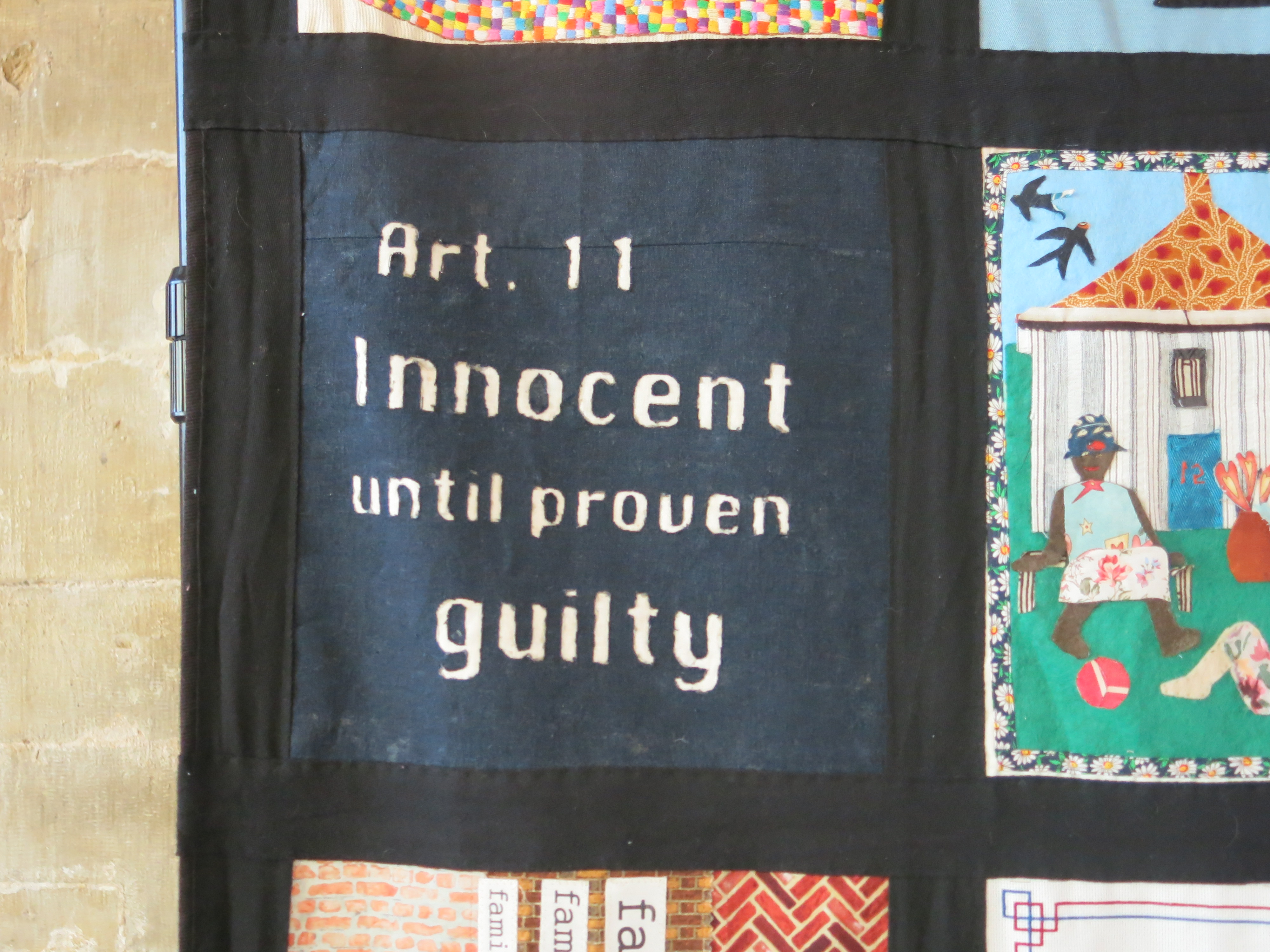
Article 11: Everyone charged with a penal offence has the right to be presumed innocent until proven guilty. This panel prepared by Rona Keene of the Bristol group.
Article 12: No one shall be subjected to arbitrary interference with their privacy, family, home or correspondence, nor attacks upon their honour and reputation. Another panel by Cari a member of the Frome group.
Article 13: Everyone has the right to freedom of movement. Prepared by the Farringdon group.
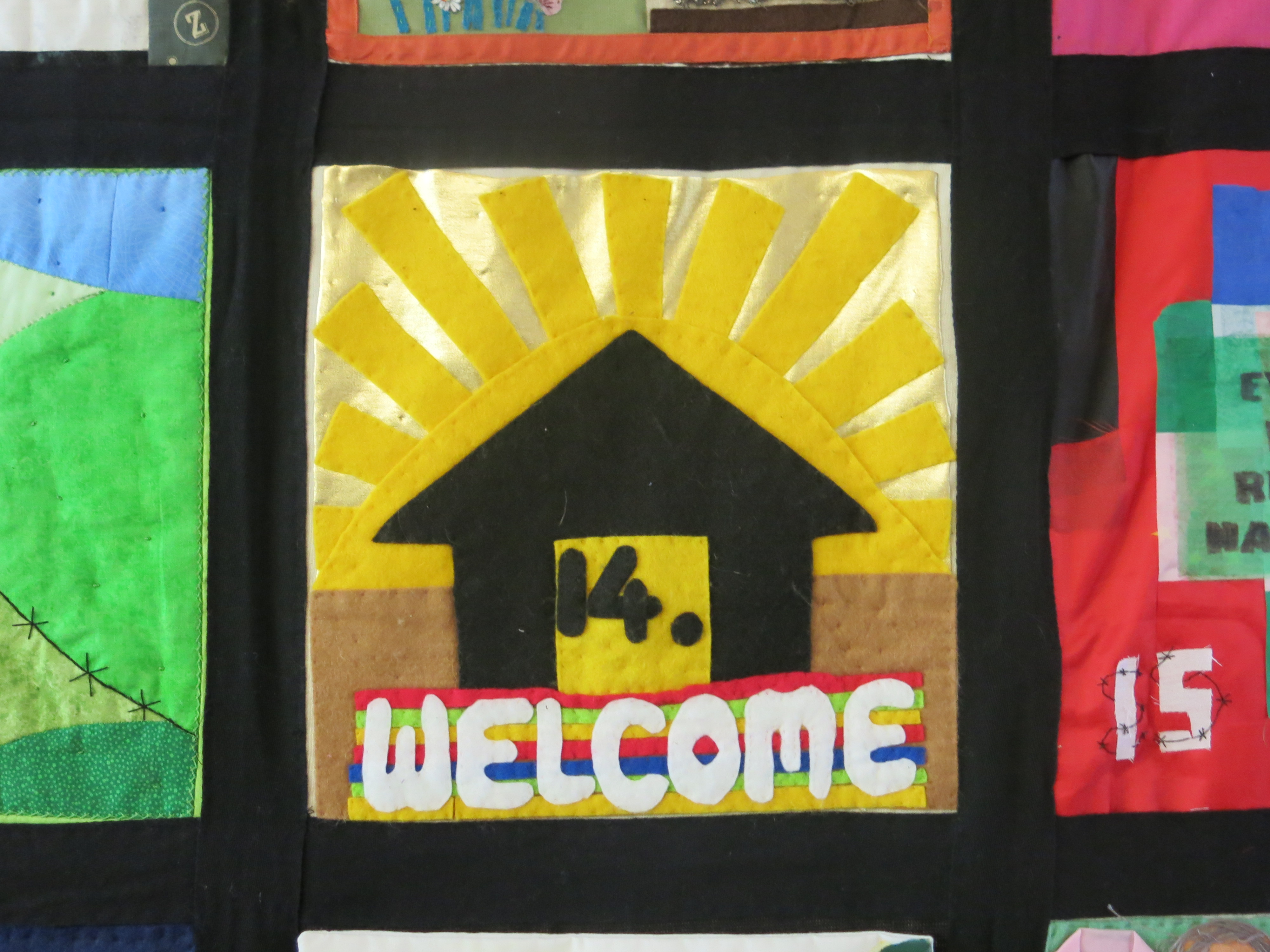
Article 14: Everyone has the right to seek and enjoy in other countries asylum from persecution. People lose this right if they do not respect what is written here. Another panel from the Southampton City group.
Article 15: Everyone has the right to a nationality. Another panel from the Bristol group this time prepared by Sarah Heath.
Any errors or if you want to add a name please let us know .
In a previous blog we showed the now complete tapestry which is on display, with kind permission of the Cathedral Authorities, outside the Chapter House where one of the extant copies of Magna Carta is displayed. The tapestry illustrates the 30 articles of the Universal Declaration of Human Rights ratified in December 1948 in Paris. In this, and subsequent blogs, we will be showing detailed pictures of the panels with appropriate attribution to their creators. We will be showing them in batches of five. Overall credit must go to Caroline Butler, the South Region Representative (AI), whose idea this was and who worked hard to bring this tapestry to its successful conclusion.
Most reading this will not be in the Salisbury area and thus may not be able to see it, but it has generated a lot of interest from visitors to the Magna Carta. We hope in due course that it will go on to be displayed elsewhere in the south region.
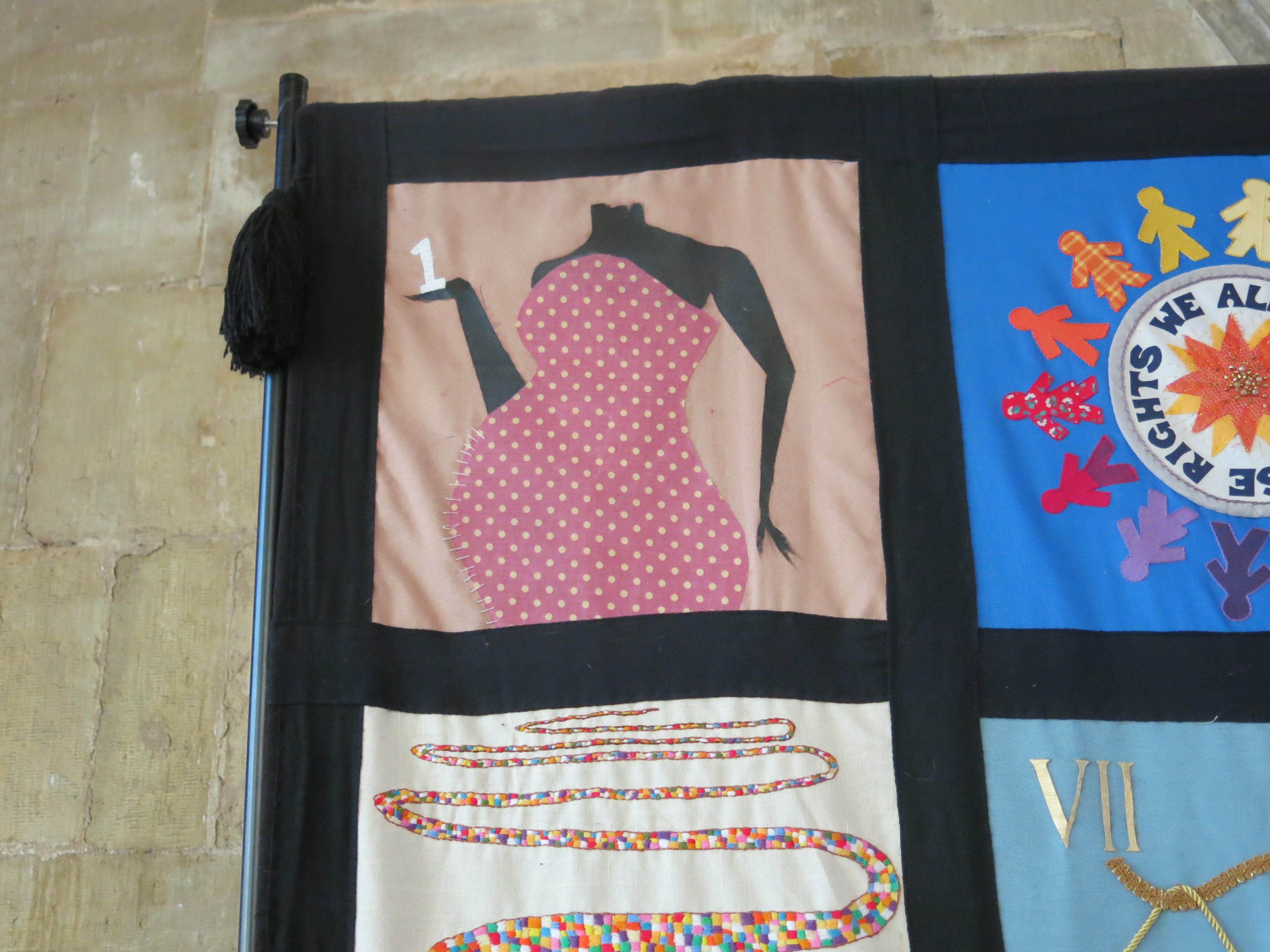
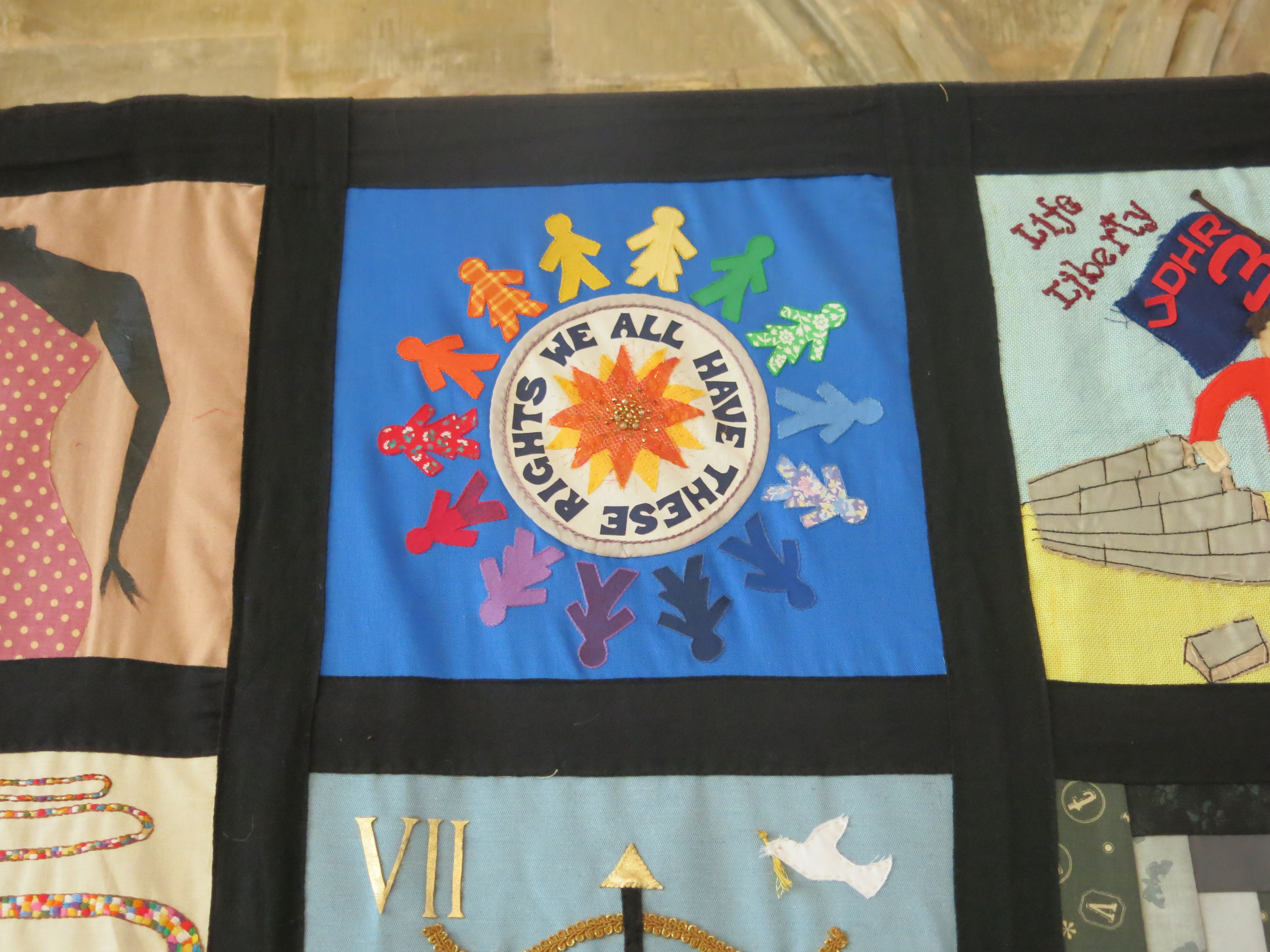
This is Article 1: All human beings are born free and equal in dignity and rights. Prepared by Liz James-Froud on behalf of the Bath Group.
Article 2: Everyone is entitled to all the rights and freedom regardless of race, colour, sex, language, religion, belief, race or origin. Prepared by Liza Lishman a member of the Swindon and Marlborough group.
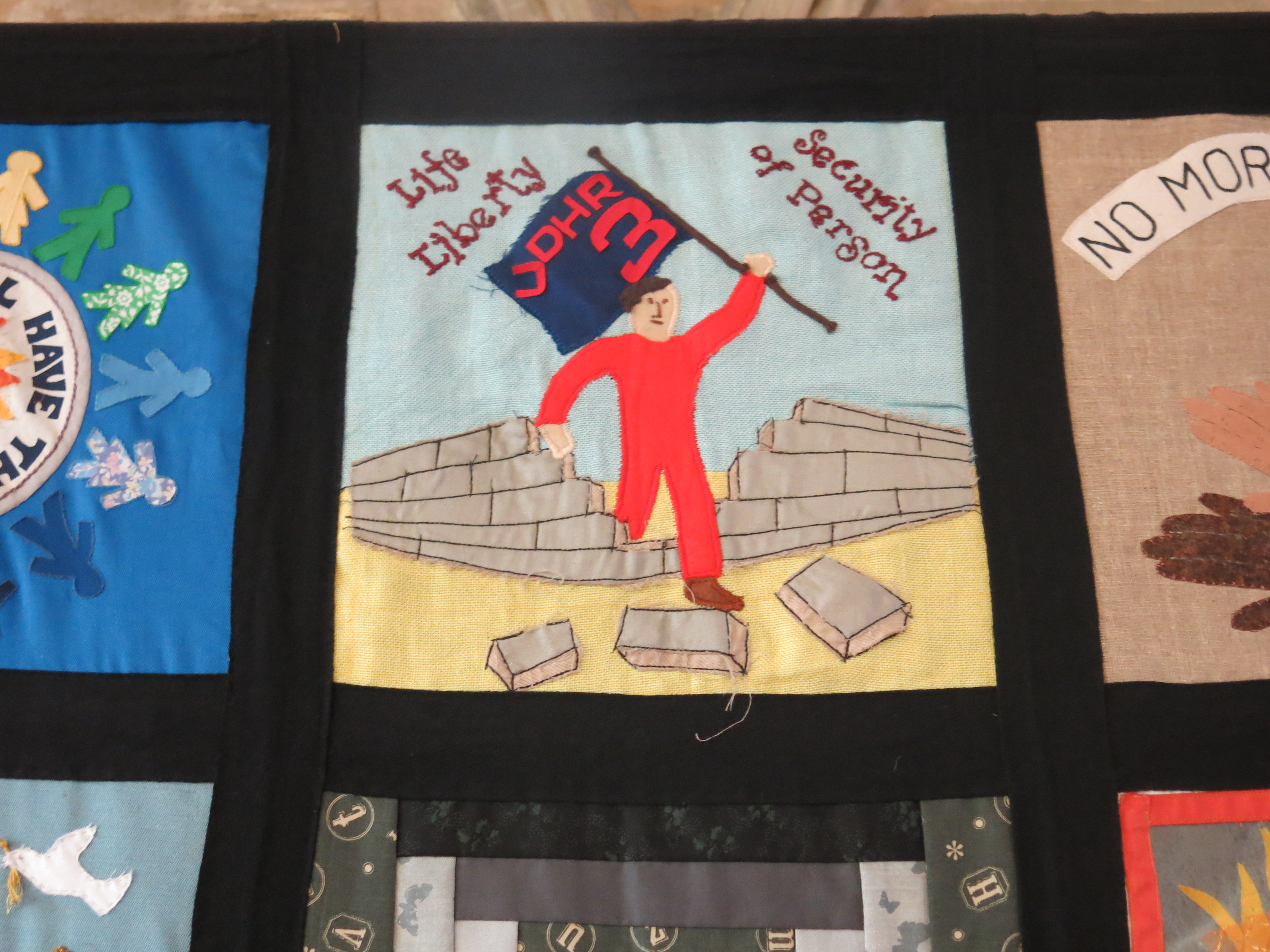
Article 3: Everybody has the right to life, liberty and security of person. This panel prepared by someone from the Bournemouth, Poole and Christchurch group.
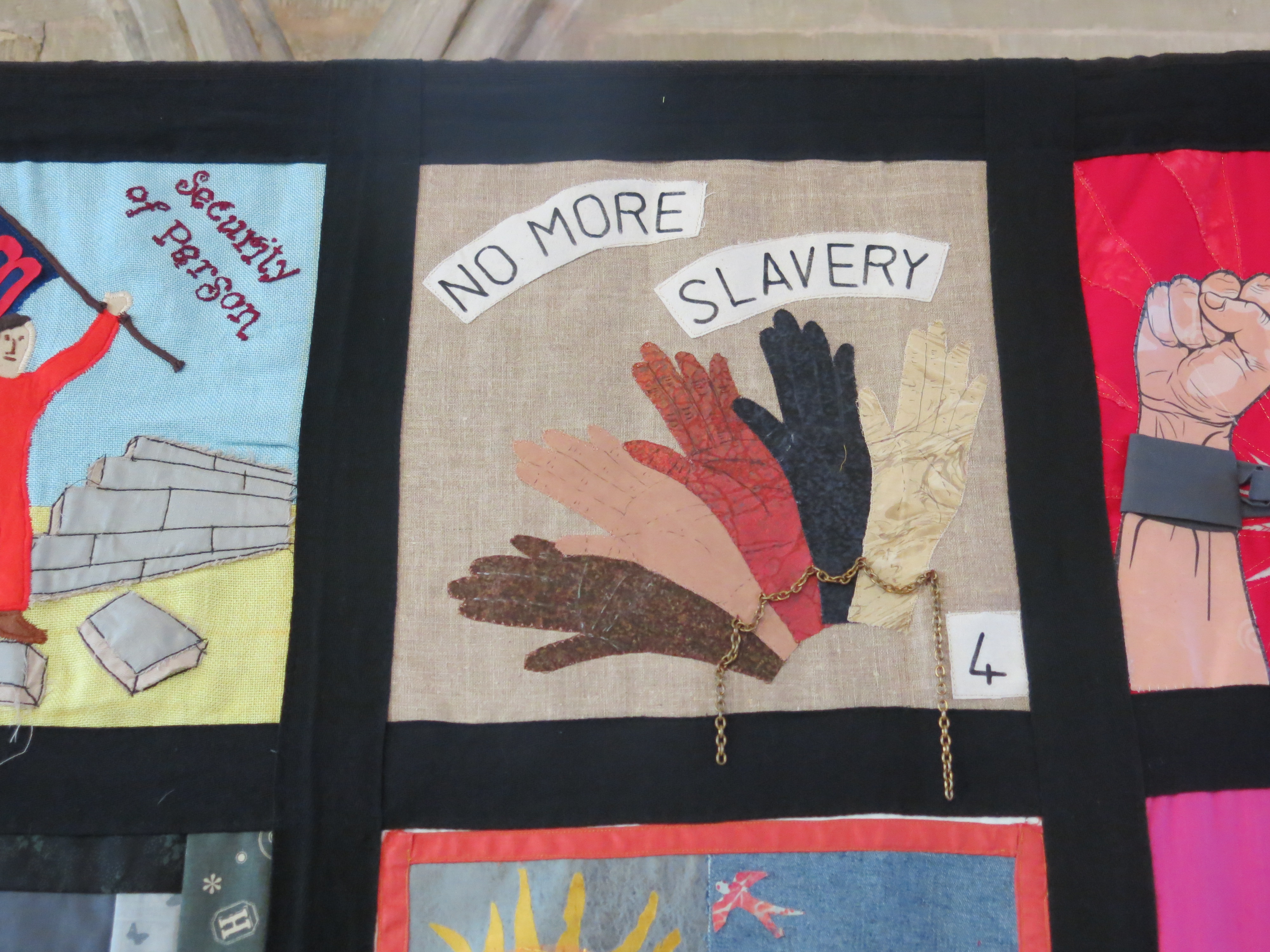
Article 4: No one shall be held in slavery or servitude. Dot Atkins of the Isle of Wight group.
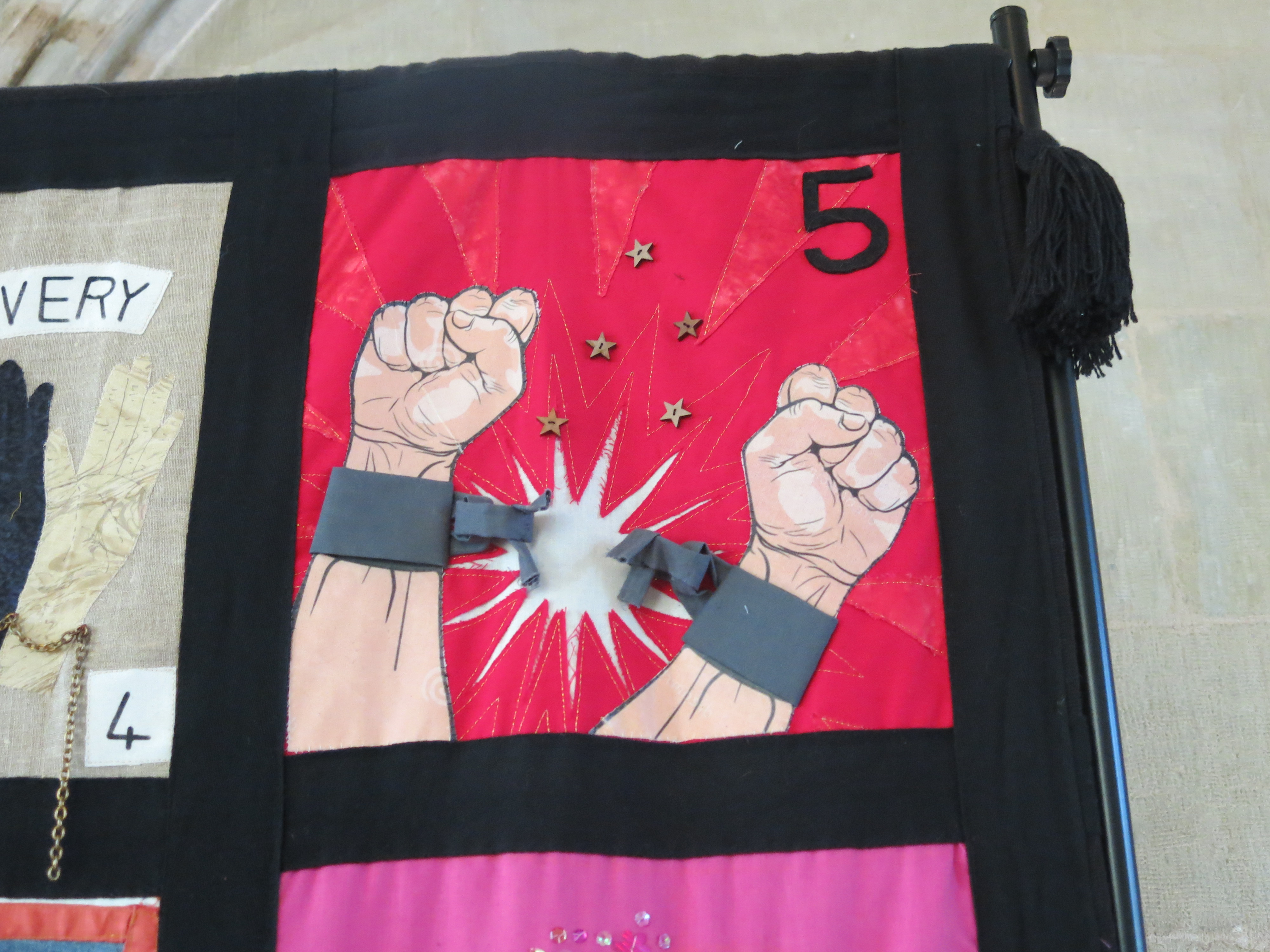
Article 5: No one should be subjected to torture or to cruel, inhuman or degrading treatment or punishment. This panel prepared by Rachel Berry of the Mid Gloucester group.
If there are any corrections or additions, please get in touch. The next set of panels will be posted up soon.
The tapestry assembled by members of the South Region of Amnesty International, is now on display at the entrance to the Chapter House in Salisbury Cathedral. Each panel represents one of the clauses of the UN Convention on human rights which led ultimately to the Human Rights Act in the UK. It is this act that the current Conservative government wants to abolish. The Chapter house is where one of the surviving copies of Magna Carta is displayed. We are extremely grateful to the Cathedral Authorities for giving us this space to display the tapestry. It will be on display for a few months and then will go on display elsewhere in the south region.
Last week we had the debate in Parliament about bombing the Islamic State IS or Da’esh as some call it. This was occasioned by the outrage in Paris and the massacre of ordinary people in that city. Parliament voted in favour of bombing and since then we have had recriminations in the Labour party between those who voted for and those against.
It is timely therefore that a report has been published by Amnesty International called Taking Stock: the Arming of the Islamic State. All politicians should read it. As we have noted several times on this blog, one cannot but help notice that when pictures are shown of IS fighters, they are well equipped and armed to the teeth. So where do all these arms come from? The report explains where and how in great detail.
The major source is Iraq supplemented by materiel taken from the Syrian army. The Iraq weapons were supplied by the coalition forces but because they were irresponsibly guarded, it was easy for them to be stolen or looted. As the report puts it, ‘there were decades of irresponsible arms transfers to Iraq principally by Russia, France and China.’
The supply and transfer of weapons was governed by a global treaty adopted by the UN in 2013. It places international human rights law, humanitarian law and criminal law standards alongside other international benchmarks for assessing the authorisation of exports and other transfers of conventional arms.
The report documents the astonishing amount of weaponry possessed by IS (the range and types are listed at the end). Although a total of 25 countries have been identified as suppliers – including some from the former Soviet Union – it is the Security Council members P5 who are the main culprits.
The Iraq invasion cast a long shadow over the region. Arms were poured in and in the chaos, thousands of weapons were lost to the militants. The Arms Trade Treaty was designed to put a stop to irresponsible activity and it will take a long time to take effect. We noted in an earlier blog that the UK and the US continues to supply Saudi Arabia which is bombing Yemen creating fertile ground for the next wave of insurrection.
It is much to be regretted that the House of Commons would not be packed or buzzing with excitement if the question of arms supplies was being debated. Yet unless and until arms supplies are curtailed to regions such as the middle east, organisations like IS will prosper in the chaos. Bombing the result seems a little pointless.
We attach an urgent action for a Young man who is facing execution in Iran. Iran is one of the world’s leaders in executions second only to China. Urgent actions are at the core of Amnesty’s work and involves writing to the country concerned and usually to its embassy here in the UK. There is some evidence that they have an effect, as in this case, where execution was at least delayed as a result of international pressure.
The attachment gives all the information and the back story so if you do have time to write that would be appreciated.
This is the title of a report produced by Amnesty International concerning the use of torture in China. It was only last month that China’s president received a red carpet treatment on his visit to Britain with smiles all round. The subject of human rights was taboo and was not to be mentioned during the course of his visit. The aim was to boost trade and to secure deals such as the nuclear power plant investment.
Human rights infringements are a major issue for China and there is always the hope that there will be a steady improvement over time. Indeed, it is a favourite argument by politicians that engagement – whether through trade, culture, sport or otherwise – is the best way to effect improvements in countries still practising torture or other cruel, inhuman or degrading punishments.
Only it doesn’t seem to be working in places like Saudi Arabia or China despite the huge effort put into engagement with their leaders. Amnesty has just published No End in Sight which shows that if anything, it is getting worse. Despite having signed up to UN Charter against torture, it is still widely practised in all its medieval brutality.
Tiger bench
The rot seems to start in police stations and the system of securing confessions acts as an incentive to extract one, by force if necessary. The methods are extremely unpleasant and the least graphic (though no lest brutal) is the ‘tiger bench’ illustrated left.
The report explains the weak nature of the justice system which means no meaningful enquiries are made and that lawyers are themselves coerced or threatened if they try too hard to stop it.
It is alarming that this major nation, which is a member of the Security Council and is thus in a position to influence a lot of what happens in the world, should be steadily getting worse not better as far as human rights are concerned. It is disappointing that the opportunity to express our concerns was apparently not taken during President Xi’s visit.
The revised Regulatory Powers bill has now been published and has been debated in parliament. It is better known as the ‘snoopers’ charter’ and tries to put the interception activities of the security services on a sound legal footing. The previous act, RIPA, was clearly inadequate and revelations by Edward Snowden revealed that it was being widely circumvented and ignored.
It has to noted that the public at large is mostly relaxed about the degree of intrusion into their electronic activity. The wholesale interception of emails, phone calls, Skype, Facebook and the like arouses no great passions. The general view can be summed up as ‘I’ve got nothing to hide so they’re welcome to look at my emails if they want to.’
The line put across by politicians is that these powers are needed to defeat the activities of terrorists; international criminals; people smugglers and the like is widely accepted and seen as a price worth paying if we are to remain safe and such people are to be put behind bars. The paradox however is that if you ask people the question ‘do you trust politicians?’ you are likely – indeed almost certain – to receive a very dusty or robust answer. They are seen – often unfairly – as untrustworthy, interested in their own careers, acting as lobby fodder or simply being out of touch. So allowing these individuals additional powers does seem to be something of a contradiction.
So what are the arguments about the Regulatory Powers Bill and why does it all matter? First is the issue of trust to which we have already alluded. Before Snowden, many of the same politicians were telling us that matters were under control and that warrants and searches were only used when strictly necessary. It was then revealed that comprehensive snooping was underway and that the ministers concerned – including those on the select committee – had little or no idea of the scope of the activity. GCHQ was hoovering up large quantities of information seemingly without any oversight.
David Davis MP, 3rd from left
… and they still don’t. Only a very few individuals get to see the core information since most of it is presented in terms of briefings. This goes back to the war when the JIC was set up to look at all the information and then put it together to inform the cabinet committee. Very few MPs have any serious experience of intelligence matters and the nature and sensitivity of the information they receive makes it difficult for them to find out. David Davies MP says we have a ‘comforting illusion’ about our intelligence services which leads to complacency.
There is a natural tendency for all organisations to talk up the issues they deal with. By highlighting risks it enables them to win resources in Whitehall battles and in battles with sister agencies. This needs to be remembered when blood-curdling threat assessments are issued.
There is a belief that more is better. By simply amassing more and more information using ever more powerful computers it is argued this will enable the intelligence services to protect us better. The only problem is that time after time it has been found to be wanting. The 45 minute claim is the most famous but there are others. Only this week we read of the death of Ahmed Chalabi who misled the USA in many different ways over Iraq. So despite the massive scale of the American intelligence system, the billions of dollars spent on the CIA and NSA, one man comprehensively fooled the State Dept. over a period of several years.
A fundamental issue at stake is one of power. It was not so long ago, following the collapse of East Germany, that the scale of their intelligence activities by the Stasi were revealed. Miles and miles of underground corridors existed with hundreds of thousands of files on almost every citizen in the state. Children informed on their parents; brother informed on brother; neighbour on neighbour. All typewriter fonts were recorded so that any typed samizdat could be traced. It was a nightmare world of paranoia and poisoned a generation. People in the West were horrified when this was revealed. That was clumsy by comparison to what the agencies can do today in the internet era. Yet we seem relaxed, not horrified.
The issue of power and who has it is central to the debate. Our society is based on division of powers in part going back to Magna Carta. For one group to have too much power is recognised as dangerous. We have the Lords (however imperfect) and the Commons. We have a separate judiciary. We have a reasonably independent media. These divisions prevent despotism or at least make it exceedingly hard to achieve. In addition there are elections every 5 years.
By allowing the intelligence agencies, to pry into every communication, to intercept communications between lawyer and client; to intercept emails of human rights groups such as Amnesty and to tap into the phones of journalists, is extremely dangerous and alters the balance of power significantly. All these things have happened.
It is also dangerous because of the frailty of the people in power. Lord David Owen in his books has investigated the mental capacity of various leaders in times of stress particularly war. In both TheHubris Syndrome (Politico) and in In Sickness and In Power (Methuen) he shows that senior politicians can be unstable and suffer from hubris. This led for example, Tony Blair and George W Bush to ignore or manipulate intelligence to fit their beliefs and with disastrous results.
The thirst for power can itself be dangerous. Obtaining it, holding on to it, fighting off those who want to take it from them, and wielding it, can be the all consuming passion for a politician. It is for these very reasons we should be extremely wary of granting them the advantage of even more intrusion.
It might reasonably be asked however, what about terrorist activity and especially a group like ISIS (or whatever we agree to call them)? They are undoubtedly a cruel and dangerous organisation. But they are not an existential threat to the UK. Even if they manage to pull off some outrage in this country, it cannot be argued that they will change our way of life. Giving up our liberties and our right to privacy is a heavy price to pay on the uncertain promise of greater security.
Our freedoms and liberties have been acquired over many centuries and we should be extremely wary at giving them up. Vague promises of judicial oversight – which are empty since they will only oversee the process not the actual decision – should not blind us to the fundamental risk this bill will pose if it gets enacted. Combined with the intention of scrapping the Human Rights Act, this is something to be worried about.
The Human Rights Act is under threat and we await the current government’s plans for its replacement which must be due very soon. Rights Info has produced a short video which is worth a look which you can access from their web site or from this link.

 Article 16: Men and women have the right to marry and found a family. No on should be forced to marry. This panel by Carol Corke on behalf of the Isle of Wight group.
 Article 17: Everyone has the right to own property. This panel is also by the Isle of Wight group, this time made by Sue Logan.
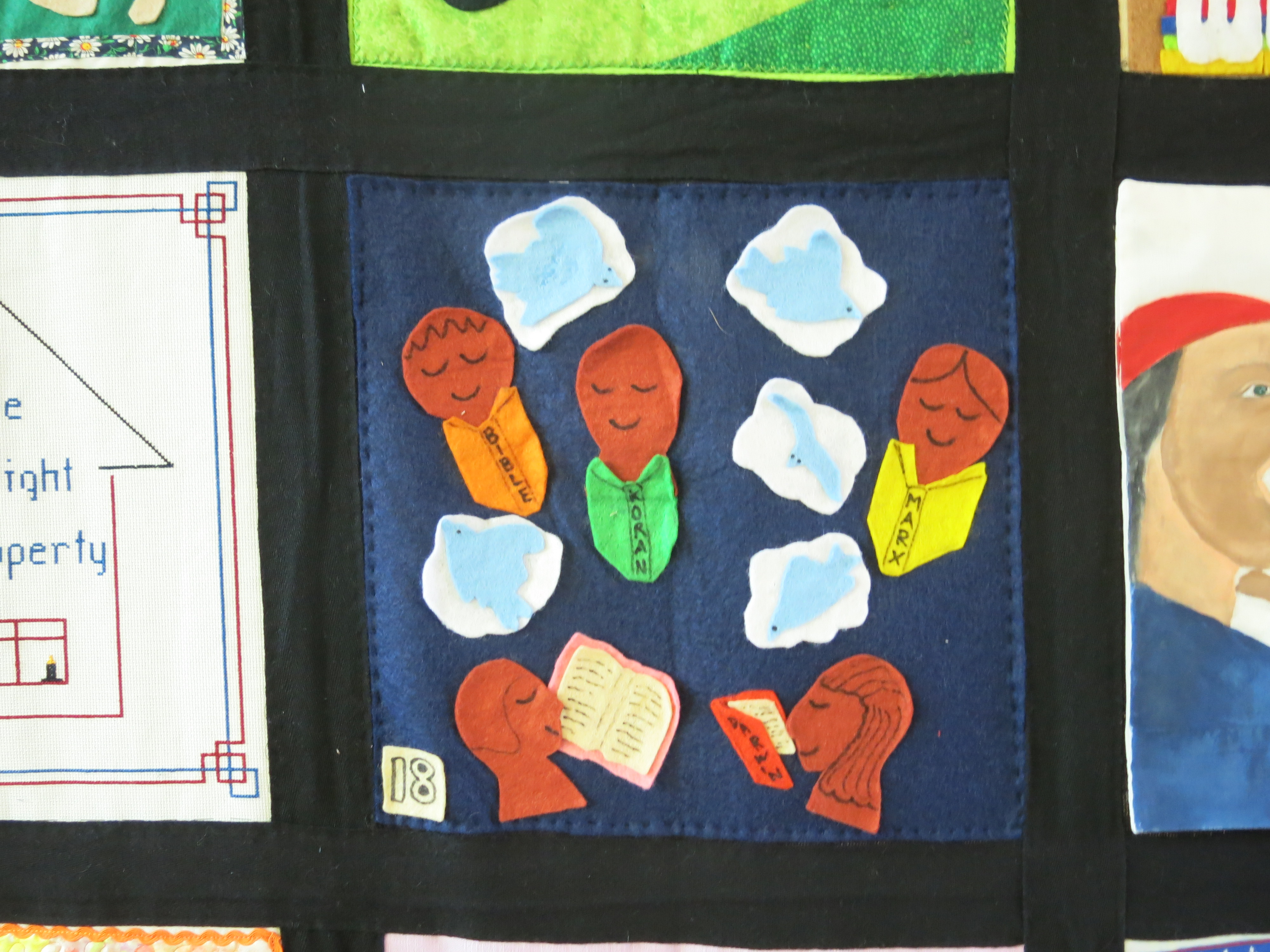 Article 18: Everyone has the right to freedom of thought, conscience and religion. And this panel is from our very own Salisbury group made by Fiona Donovan.
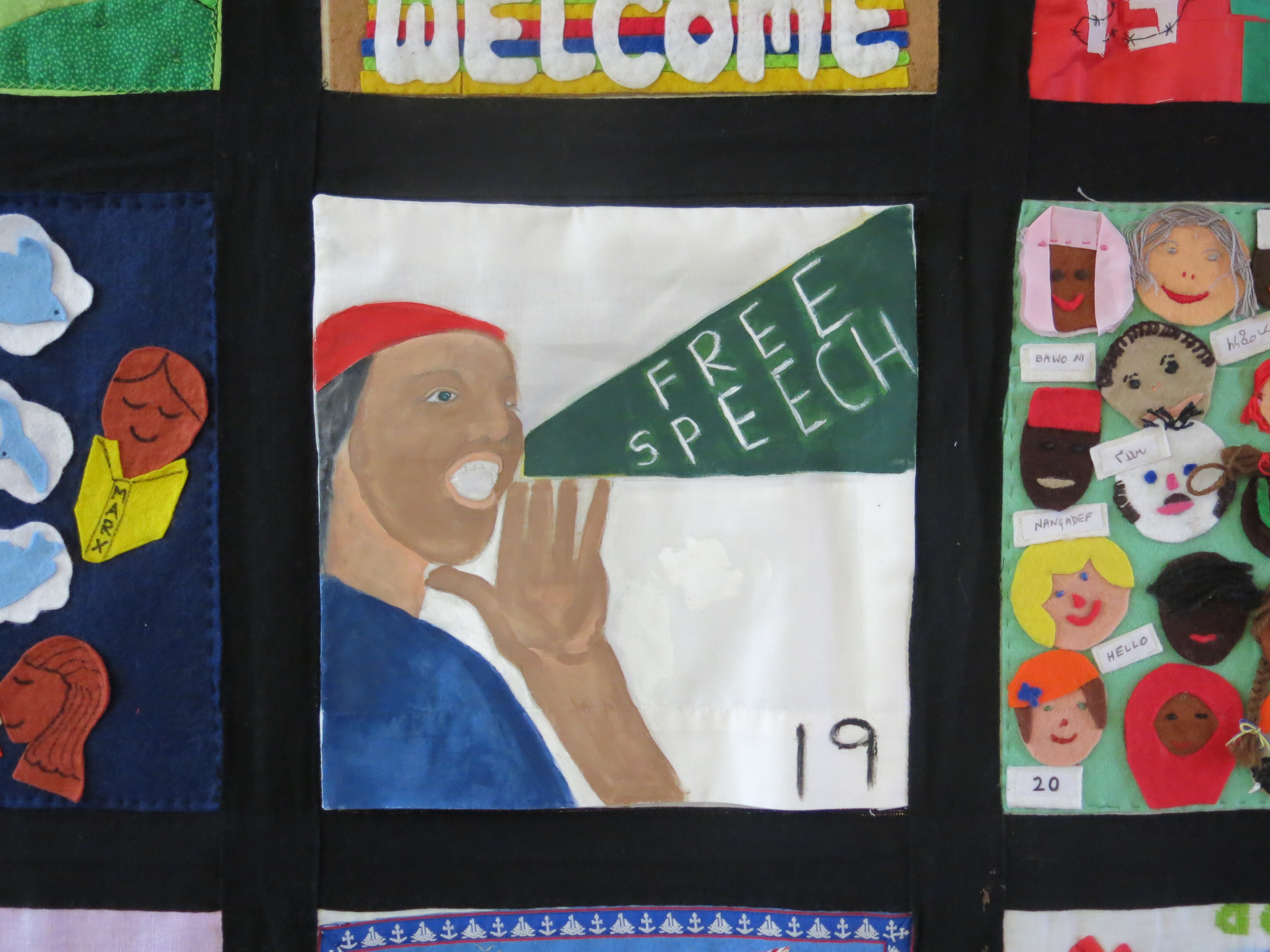 Article 19: Everyone has the right to freedom of opinion and expression. This includes sharing ideas with people from other countries. Another panel from the Mid Gloucester group, this time by June Styles.
 Article 20: Everyone has the right to freedom of peaceful assembly and association. This panel was made not by an Amnesty group but by the Harbour Project in Swindon.






 Amnesty in Salisbury & South Wiltshire