SCHOOL NOW CLOSED
The new South Wilts University Technical College in Salisbury is to be part-funded by arms companies and a number of people are concerned that young people will be corrupted by such firms. The Salisbury group has campaigned in the past on the issue of arms as Salisbury is surprisingly rich in arms companies. It is likely that because we are near to Salisbury Plain – where a number of regiments are based – and the garrison towns of Bulford and Tidworth, it is attractive to such firms to set up here. We are also near Porton Down and to Boscombe Down.
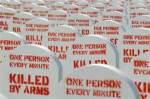 Some years ago, we discovered that a firm based in Salisbury was supplying the Indonesians with armoured land rovers being used in the oppression of the East Timorese. Chemring, which has a factory at a place called High Post near Salisbury, was also the subject of press interest recently for allegedly supplying CS gas to the Hong Kong police to help suppress demonstrations, and to Israel. Chemring supplied CS gas which was used in Egypt.
So the activities of arms companies are a matter of interest to us. It has to be said straight away that, unless you are a complete pacifist, there are aspects of the arms trade which are perfectly legitimate. We need to defend ourselves and therefore have a need to make armaments. We can also sell such arms to countries we trust or to whom we are allied. The difficulty is when arms are supplied to regimes who have little interest in human rights. This is why Amnesty among others has been promoting an arms trade treaty. Another problem is the shadowy world of dealers and brokers who go on to supply anyone willing to pay.
Anyone interested in the arms trade, then a book to read is The Shadow World: inside the global arms trade by Andrew Feinstein (Hamish Hamilton, 2011). This remorselessly describes the trade and the high degree of corruption involved in its activities. The industry is over £1tn in size and money flows via tax havens and brokers around the world.
Look at almost any news broadcast and it doesn’t matter who is fighting whom, what is noticeable is that they all seem to be remarkably well armed. The various belligerents drive around in military vehicles, and they seem to be guns and rocket launchers aplenty. These arms don’t appear out of nowhere, they are supplied by the shadowy world of the arms dealer and are financed via various tax havens, many of which are Crown dependencies.
Feinstein expresses it well in his introduction:
In our twenty-first-century world the lethal combination of technological advances, terrorism, global crime, state sponsored violence and socio-economic inequality has raised instability and insecurity to alarming levels. At the same time, the engine that has driven this escalation, the global arms trade, grows ever more sophisticated, complex and toxic in its effects.
It might therefore be thought essential that the world’s democratic nations should address this trade effectively and urgently. If it must exist, then surely it should be coherently regulated, legitimately financed, effectively policed and transparent in its workings, and meet people’s need for safety and security?
Instead the trade in weapons is a parallel world of money, corruption, deceit and death. It operates to its own rules, largely unscrutinized, bringing enormous benefits to the chosen few, and suffering and immiseration to millions. The trade corrodes our democracies, weakens already fragile states and often undermines the very national security it porports to strengthen. (p xxii, ibid)
Arms sales are promoted by the British government by the Defence Export Services Organisation (DESO). There has been a lot of publicity recently as various ministers – including the Prime Minister – visiting the Gulf states to sign arms deals. Some of these countries arrest or harass oppositions, use torture regularly, execute people in public, mistreat their women and have corrupt judicial systems. No matter it seems, there’s trade to be had. The Campaign Against the Arms Trade CAAT held a meeting in Salisbury recently to publicise the financing of this college by four arms firms. The firms involved include Chemring, QinetiQ, Esterline and Dstl. Serco is also involved which has a dubious record.
Some of the questions to ask of this college are: will their young people be free to discuss the activities of this trade? If it transpires that munitions supplied by one of these firms are used to suppress demonstrations or are used to kill unarmed people for example, will students be free to debate this? Will the effects and practices of the arms trade be a topic of discussion in Citizenship activities? Interesting questions … CAAT allege that the firms will use the college as a means to promote their image. It will be interesting to see how this UTC deals with the ethical and moral issues of the arms trade and adopts an appropriately impartial position when and if allegations of wrongdoing emerge.
The college is part of the Baker Dearing Educational Trust and none of its trustees has any local links.
Article in Salisbury Journal. CAAT item discussing the college is here.
UPDATE
The College has now closed (2019)
CAAT Newsletter item (p6)

 Olly Sprague is Amnesty’s Arms expert and for the first time ever, he was barred from the London Arms Fair this week. Maybe they didn’t like the ad campaign we made for them… Or maybe they had something to hide? At every one of the last five Fairs, we’ve uncovered illegal torture equipment and other illegal weapons being advertised, including leg irons, gang chains, electric-shock batons and cluster bombs.



 Amnesty in Salisbury & South Wiltshire