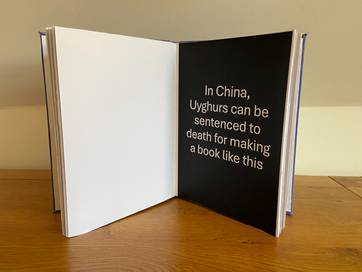
Reading books can get you killed


Reading a Uyghur book can lead to serious punishment

August 2026

This is not the Middle Ages. This is the 21st Century. But the desire of the Chinese to extinguish Uyghur culture can lead to draconian consequences. This short piece and the book, were created by the Amnesty Death Penalty project.

So often, we take our books for granted. But if you are Uyghur, reading, promoting or writing books in the Uyghur language – even children’s text books – can land you in serious trouble. In fact it can and has on a number of occasions, resulted in a death sentence. This is all part of the Chinese government’s attempts to suppress the Uyghur language, culture and identity. Too many governments around the world use the death penalty as a means of intimidating ordinary people into compliance.  Books, things that we take for granted in the West, can be very dangerous for Uyghurs which is why the Anti-Death Penalty Project has created a book (كىتاب) to show our solidarity. ‘Thank you so much Death Penalty Network for such a beautiful and thoughtful project!  

The Salisbury group publishes a report each month on the use of the penalty around the world. It does not include China as executions are a state secret. The country is believed to execute more of its citizens than the rest of the world put together.


Podcast Episode: Uyghur Solidarity And Advocacy


Short podcast of our last two posts on this campaign

Pip: August 2026, and a cultural genocide that’s largely dropped out of the news — which is exactly when a local Amnesty group decides to make some noise.

Mara: The Salisbury has been writing about Uyghur Solidarity Month, and that’s the territory we’re covering today — the scale of what’s happening in Xinjiang, and what people in Salisbury can actually do about it.

Pip: Let’s start with the oppression itself, and who’s trying to break through the silence.

Uyghur Solidarity Month: Oppression and the Fight for Awareness

Mara: The framing here is stark: this is described as “the largest campaign of cultural genocide in the modern era,” and Amnesty’s declaration of August as Uyghur Solidarity Month is a direct response to the crisis slipping from public view.

Pip: The post points to one outlet trying to hold that ground — Kashgar Times, founded in April 2025. Here’s how they describe their mission: “At Kashgar Times, our mission is to break through that silence. We aim to bridge the information gap. We provide a platform where Uyghur voices can be heard, and their stories told — free from propaganda.”

Mara: What that means in practice is that independent, on-the-ground reporting from Xinjiang is nearly impossible to obtain. China’s censorship has closed off the region to journalists and foreign observers entirely, so an outlet run by Uyghurs, for a global audience, is filling a gap that mainstream media simply cannot.

Pip: The scale is worth sitting with. Around a million individuals detained. Children separated from parents. Arbitrary detention, torture, forced labour, persecution on grounds of religion and ethnicity. And a proposed Chinese embassy in London — potentially the largest in Europe — raising fears about expanded surveillance of dissidents on British soil.

Mara: The second post, “Uyghur solidarity month,” pulls the crisis closer to home in a way that’s hard to dismiss. It includes a draft letter to local newspapers, drawing on findings from the UN High Commissioner for Human Rights and the 2021 Uyghur Tribunal, chaired by Sir Geoffrey Nice KC, which concluded the Chinese government had committed genocide.

Pip: And then there’s the wardrobe argument — which is either uncomfortable or very effective, depending on your tolerance for being implicated personally. A quarter of the world’s cotton comes from Xinjiang.

Mara: The post puts it directly: “You will have in your wardrobe, or be wearing, many items made of cotton. It is highly likely that some of them have been made with cotton from this region using virtual slave labour.” The ask is simple — write to your local paper.

Pip: Silence, as the post notes, makes it easier to ignore. And writing a letter is not nothing.


Mara: A genocide that’s fallen out of the news cycle, and a local group working to put it back — that’s the thread running through everything here.

Pip: More to come through the month, apparently. We’ll be watching.


Thought of subscribing?

Uyghur solidarity month


Bringing the plight of Uyghurs to a wider audience

August 2026

We noted in our last post on the Uyghurs that their plight had slipped out of the news in the last year or so. With war in Iran and the closure of the Straight of Hormuz, and continuing conflict in the Middle East including Gaza, giving attention to a far off land where contact with its people is almost impossible is not altogether surprising.

But we need to do our best to bring people’s attention to what is going on there. We should always remember desperate governments do desperate things. The UK is up against it politically and economically. This leads it to pursue arrangements with overseas powers with highly dubious human rights records such as Saudi and UAE, to promote arms sales with almost any country while claiming to have a ‘robust policy’ not to, supporting Israel overtly and covertly despite its destruction of Gaza and mounting violence in the West Bank. Economic needs trump concerns about human rights. Jobs in the UK count for more than rights half way across the world.

Write a letter

We are asking that people write to their local newspaper to highlight the dreadful way the Chinese are treating these people. The campaign organisers have provided a sample letter which unfortunately exceeds the word limit of local papers. We have amended the letter which could be the basis of your own contribution:

I want to draw the attention to people in Salisbury of the dire human rights situation facing the Uyghur people in Xinxiang province, China.

the UN High Commissioner for Human Rights concluded there were credible allegations that the Chinese government had carried out arbitrary detention, torture, forced labour, family separation, and severe restrictions on religious and cultural freedoms on a vast scale on the Uyghur people. They stated that these violations may constitute crimes against humanity. In 2021, the independent Uyghur Tribunal, chaired by Sir Geoffrey Nice KC in London, concluded that the Chinese government had committed genocide against the Uyghurs through measures intended to prevent births, and had also committed crimes against humanity.

Despite these findings, the suffering of the Uyghur people continues while the world looks away. More than a million Uyghurs are reported to have been detained, and countless families have been torn apart. Survivors have described detention camps, torture, rape, forced labour, coercive birth-control measures, and the removal of children from their families. Behind every statistic are innocent individuals whose lives have been destroyed for ever.

This month, Amnesty International’s Uyghur Solidarity Month is trying to raise awareness of the continuing crisis but also to celebrate the rich culture, language, and heritage now under such severe threat.

Whether one views this issue through the lens of international law, freedom of religion, cultural preservation, or basic human dignity, the plight of the Uyghur people deserves continued public attention and informed discussion. Uyghur Solidarity Month reminds us that protecting a people’s culture is inseparable from protecting their human rights.

Public awareness alone will not end this crisis, but silence only makes it easier to ignore. We all have a responsibility to ensure that the voices of the Uyghur people continue to be heard.

[NAME]

Provide name and address.

You might be tempted to think that what has this to do with me? It’s sad that a people are being persecuted in a far off land but there are so many other problems nearer to hand, why there? But you are involved. You will have in your wardrobe, or be wearing, many items made of cotton. It is highly likely that some of them have been made with cotton from this region using virtual slave labour – the Uyghurs. A quarter of cotton comes from there. You may have bought these garments from a well known and reputable store in the high street or online. Despite their fine words and protestations about the integrity of their supply chains, they still use this cotton. So you are wearing the evidence. You are involved.

Please write.


Thought of subscribing?

Blog at WordPress.com.

Up ↑