China: lawyer released


Prominent lawyer released from house arrest
Zhang Kai

We are pleased to announce that a lawyer who has been active in defending the attacks on churches, has been released although the reasons for his release are unknown.  It is good news however.  Many lawyers have been harassed or detained in China under the current crackdown.

Full details from the Amnesty factsheet:

Lawyer release


Death penalty report


Attached is the death penalty report compiled with thanks by group member, Lesley.No to the death penalty

Death penalty report


Follow us on Twitter and Facebook


Death penalty summary


The death penalty summary for the last month is published below with thanks to group member Lesley forNo to the death penalty compiling it.  It contains some good news with four more abolitionist countries and modest progress in USA.  Set against that is the dire situation in Saudi, Iran and Pakistan.  China is the worlds leader in executions but the figures are a state secret.

Many of the items in the summary are covered in greater detail elsewhere on this blog.

Death penalty summary

Death penalty: annual summary


Fuller version of the death penalty summary

No to the death penaltyCampaigning against the Death Penalty has continued to be a major focus for the Salisbury Group.  Regrettably, there has been no national campaign coordinated by Amnesty International in London.  We hope this might change in 2016 as we have taken part in a Survey currently being carried out by HQ confirming that we would like this important aspect of Amnesty’s work to be taken up again – particularly in the light of the recent changes in the priorities of the Foreign and Colonial Office (see later).

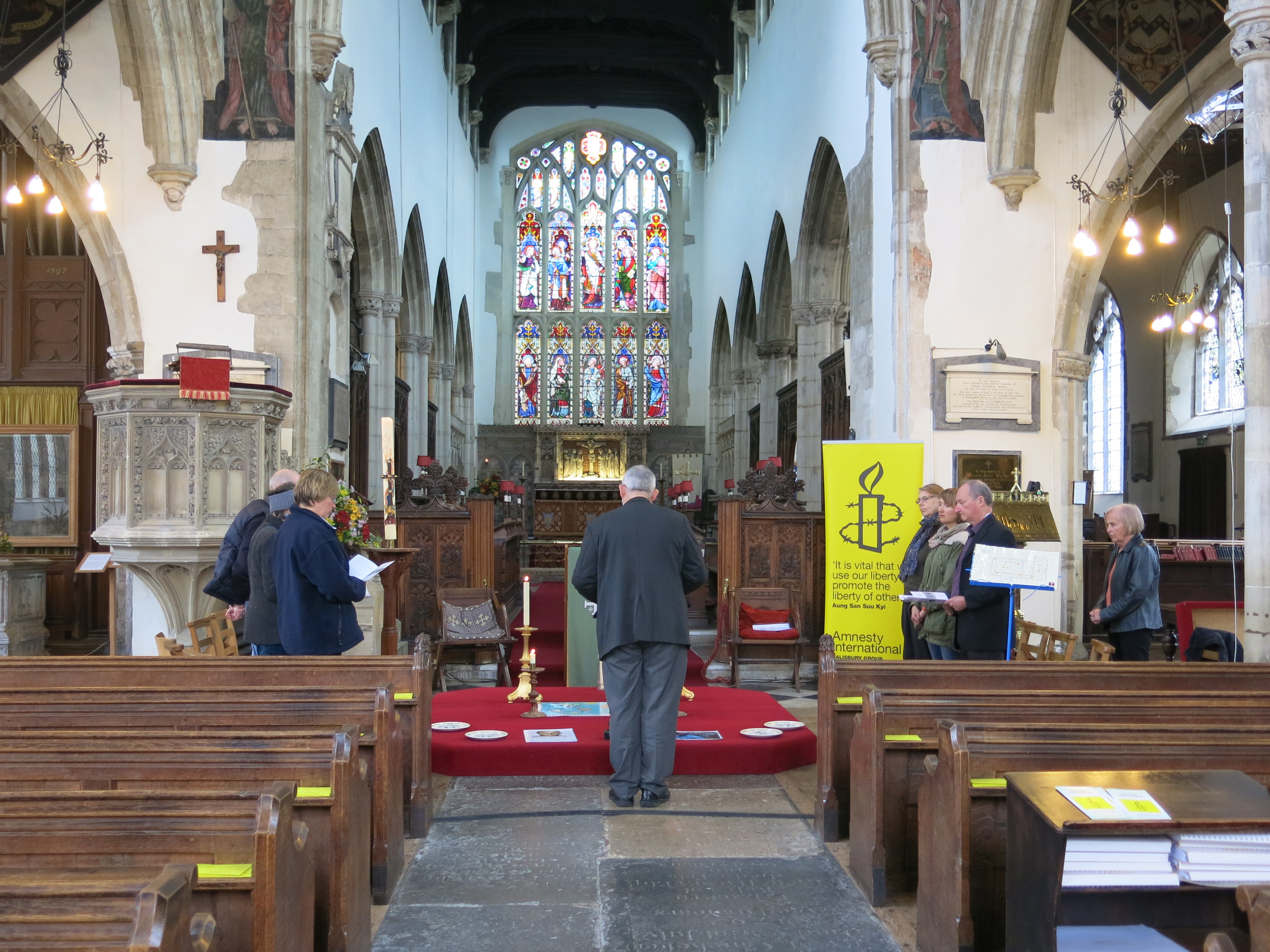
In the meantime, we have identified particular issues around the Death Penalty on which we have campaigned.  Throughout the year we have responded to all the Urgent Actions received in respect of individuals under threat of execution – 31 in total.  The majority of these have been for prisoners in Saudi Arabia, Iran and the USA.  We have worked on the cases of individuals sentenced to death within Amnesty’s Campaign against torture – most notably Moses Akatugba and Saman Naseem (see later), including them in letter writing, card signings and petitions, and have also continued to campaign on behalf of Reggie Clemons (see later).  In partnership with St Thomas’s Church, we held a Vigil as part of the World Day Against the Death Penalty.  This was our first such venture, and it has to be said that public support was disappointing, but the Group felt it had been very worthwhile.

2015 has been a challenging year:
  • We saw an unprecedented rise in executions in Saudi Arabia following the accession of King Mohammad bin Salman.   At least 151 had taken place by early November, and  executions are now at a 20 year high.  Disproportionate use is made against foreigners, particularly from poor countries, who do not understand arabic and are denied adequate translation in court.  Barbaric methods of execution are employed  – beheading, stoning and crucifixion.  Death sentences have been passed for a range of offences, including ‘apostasy’
  • There has been a rise in the number of executions in Iran – at least 694 in the first half of the year
  • There are considerable concerns at the numbers of countries now using the death penalty to deal with real or perceived threats to State security under the guise of terrorism – Pakistan, Tunisia, Chad and Egypt as well as Saudi Arabia and Iran.  Initial fears that the legislation would be used to include a wide range of ‘crimes’ other than terrorism were more than justified.  A report by Reprieve states that those executed in Pakistan have included individuals sentenced to death as children and victims of police torture
  • Concerns have been raised at the numbers being sentenced to death and executed for alleged crimes committed when children.  Countries with the worst records  for this are Saudi Arabia, Iran and Pakistan. This issue has been taken up by the Salisbury Group – as mentioned above, it was the focus of  our Death Penalty Vigil for this year’s World Day Against the Death Penalty.  We highlighted the case of Saman Naseem, a Kurd arrested at 17, tortured and sentenced to death for being a member of a banned organisation.  Reports earlier in the year of his execution proved to be unfounded, and he has now been granted a re-trial
  • There has also been the issue of the growth in sentences and executions for drug-related offences, particularly in Indonesia
  • China continues to refuse to publish details of the numbers of executions, but is believed to carry out more than the rest of the world combined.  There have, however, been some encouraging signs.  In January, a youth wrongly convicted of rape and executed 18 years ago received recognition of his innocence and a posthumous pardon. In May a number of Judges contributing to a Symposium on “Mistaken Cases” called for reforms which would go some way to meeting standards for a fair trial. Also in May, the sentence for a woman convicted of the killing of her abusive brother was commuted from death to life in prison
  • The year for the USA in respect of the death penalty has been mixed.   Its use continues to decline across America – the number of death sentences handed down dropped by a third in 2015 , with only six states – Texas, Missouri, Georgia, Florida, Oklahoma and Virginia – carrying out executions.  Public attitudes to the death penalty are also changing, partly because of concerns at costs incurred from keeping prisoners on death row for many years and the lengthy appeal process, but also because of an increasing recognition of the risk of unsafe convictions.  Almost 3,000 cases were identified involving unreliable or false testimony given by FBI Agents using a now discredited technique of hair analysis.  Following 28 years on death row, Anthony Ray Hilton was released from death row in Alabama when his innocence was confirmed through the use of ballistic tests
  • In 2015 Nebraska abolished the death penalty, and in Connecticut the death penalty abolished for new offenders in 2012, was abolished for the 11 inmates currently remaining on death row.  There remain, however, pockets within the States where the use of the death penalty is disproportionate to the numbers within the population.  Professor Frank Zimring of the University of Berkeley, California, believes the attitude of the district attorney to the death penalty to be a key factor
  • Here in the UK it is now 50 years since the abolition of the death penalty, and it is encouraging to note that for the first time support within the country for its use fell below 50%.  The Group have, however, been concerned at changes in our Government’s approach internationally to issues around human rights, and specifically to the use of the death penalty.  In June we wrote to Salisbury MP John Glen to ask why the British Government could not follow the lead of the French President, Francois Hollande, in speaking out publicly while in Saudi Arabia against the use of the death penalty.   His reply cited the value of behind the scenes diplomacy, seeing this as being more productive than speaking out publicly
  • In August we learned that the Foreign and Commonwealth Office had dropped explicit references to abolishing the death penalty from its global human rights work.  Despite the 2014 Human Rights and Democracy Report in which the Government claimed their work in this area was part of ‘sustained and long term efforts to to see an end to the death penalty world-wide’, all references to the death penalty were set to vanish from its stated priorities.  In reporting on this, The Times of India made a pointed reference to the British Government’s condemnation of the hanging last year of the convicted terrorist, Ajimal Kasab.   Mr Glen replied that the decision of the FCO to overhaul its approach to human rights had been made on the basis of feedback from diplomats who reported difficulties in relating our long list of human rights priorities with the issues they faced in real life.  He stated that the death penalty could come under all three of the broad categories listed in the new guidelines, and this approach would enable diplomats to ‘tailor them appropriately to local circumstances’.  As a group we are particularly concerned at what we see as a ‘fudged’ approach, and a serious threat to our country’s ability to be seen as promoters of human rights.

Economic prosperity was further up my list of priorities than human rights

Sir Simon McDonald, Head of the Foreign and Colonial Office in evidence to the Foreign Affairs Select Committee

This year has, however seen a number of successes in our campaigning: 
  • We have continued to campaign actively on behalf of Moses Akatugba, the young Nigerian accused of the theft of three mobiles and sentenced to death as a juvenile.  After ten years on death row, in June Moses was granted a pardon and released.  Over 34,000 had signed the petition, with more than 200 by people in Salisbury at last year’s stall for World Day Against the Death Penalty.  Amnesty have received a letter of thanks from Moses, describing his feelings on learning of an experiencing his release, and describing Amnesty activists as his ‘heroes’.  We were able to celebrate this success at our Vigil
  • Following our long term campaign for Reggie Clemons in Missouri, in December we received the news we had been waiting for.   After a long wait for a decision from the Court following the report of
    Reggie Clemons (picture Amnesty USA)
    Reggie Clemons (picture Amnesty USA)

    the Special Judge, Reggie’s conviction and sentence for first degree murder were ‘vacated’.  The Court had upheld his right to a fair trial, which was all that he had sought from the beginning.  We now await news of a date for his re-trial.

The Salisbury Group’s Campaigning Plans for 2016 
  • We will continue to write in response to individual Urgent Actions in respect of the death penalty
  • We will be continuing to campaign on behalf of Saman Naseem to ensure that he receives a fair trial
  • We will continue to campaign specifically on behalf of individuals sentenced for alleged crimes committed as juveniles.
  • We will await news of the date of Reggie Clemons’s new trial, and campaign to ensure this is fair and in accordance with internationally agreed standards.
  • We will await the outcome of the current AI Death Penalty Campaigning Survey, and will participate in any national campaign arising out of this.


Lobbying – the hidden scandal


Lobbying and business influence in government at a high level.  MPs receive millions for lobbying

We have frequently drawn attention to the issue of corporate influence on our political process and in particular, the role of oil and arms companies.  We have recently seen three leaders from China, Egypt and India, visit the UK and be given the red carpet treatment.  Each has – to put it mildly – a poor human rights record.

In the case of China it includes the use of torture, shutting down the freedom of speech and more executions than the rest of the world put together.  Egypt has been involved in mass arrests and torture and President Modi of India has a dubious record in terms of the treatment of Muslims.

It seems as though the ‘prosperity agenda’ is eclipsing all else and the only thing that matters seemingly, is the pursuit of business and contracts.  No one is arguing for boycotts but that the issue of human rights be brought up in discussion with these leaders.

A factor in this is the role of lobbyists and a recent analysis by Transparency International is worrying and should receive wider coverage.

Analysing the new UK Register of Lobbyists and data from Parliamentary registers of interests, their new research has found:

  • Less than 4% of lobbyists are covered by the Government’s new lobbying register – almost all lobbyists are completely unaccountable.
  • 8/10 of the most frequent lobbyists are from FTSE 100 companies – lobbying is dominated by the corporate world.
  • £3.4 million paid to 73 MP’s last year for external advisory roles – a significant risk of conflicts of interest.
  • Payments for Parliamentary advice is still allowed in the House of Commons, but prohibited in the House of Lords, Scotland and Wales – a major loophole in the rules (TI’s emphasis)

The findings come after detailed analysis of research across Westminster, Scotland, Wales and Northern Ireland.  The report can be read on their web site or can be accessed here[There is also a permanent link to their site at the bottom of our page under ‘Links‘]

With such a high level of corporate lobbying and with the substantial level of fees MPs are earning, it is perhaps not surprising that business interests get such a high profile and human rights issues so low.

It appears from the report that the situation has got worse under the new government.  There were some publications of meetings with lobbyists concerning the previous year but that now seems to have stopped.  Most of the lobbying it seems is around domestic matters for example, firms trying to get a slice of the health service.

Business is important and of course companies should be free to lobby.  But it should be transparent and registered.  More importantly, business interests should not trump all else.  The government is not after all some kind of selling operation for FTSE 100 companies.

UPDATE: 16 NOVEMBER

It’s not about human rights but as if to illustrate the point, it’s just been reported the ex Health Minister, Lord Lansley, is to take up posts with firms hoping to profit from the NHS. 

Andrew Lansley and the revolving door

China torture report


No end in sight

November 2015

This is the title of a report produced by Amnesty International concerning the use of torture in China.  It was only last month that China’s president received a red carpet treatment on his visit to Britain with smiles all round.  The subject of human rights was taboo and was not to be mentioned during the course of his visit.  The aim was to boost trade and to secure deals such as the nuclear power plant investment.

Human rights infringements are a major issue for China and there is always the hope that there will be a steady improvement over time.  Indeed, it is a favourite argument by politicians that engagement – whether through trade, culture, sport or otherwise – is the best way to effect improvements in countries still practising torture or other cruel, inhuman or degrading punishments.

Only it doesn’t seem to be working in places like Saudi Arabia or China despite the huge effort put into engagement with their leaders.  Amnesty has just published No End in Sight which shows that if anything, it is getting worse.  Despite having signed up to UN Charter against torture, it is still widely practised in all its medieval brutality.

Tiger bench
Tiger bench

The rot seems to start in police stations and the system of securing confessions acts as an incentive to extract one, by force if necessary.  The methods are extremely unpleasant and the least graphic (though no lest brutal) is the ‘tiger bench’ illustrated left.

The report explains the weak nature of the justice system which means no meaningful enquiries are made and that lawyers are themselves coerced or threatened if they try too hard to stop it.

It is alarming that this major nation, which is a member of the Security Council and is thus in a position to influence a lot of what happens in the world, should be steadily getting worse not better as far as human rights are concerned.  It is disappointing that the opportunity to express our concerns was apparently not taken during President Xi’s visit.


Sources

The Independent;

The Guardian;

Amnesty report

The Chinese President’s visit


President’s visit prompts human rights concerns

This week saw the visit to this country of President Xi Jinping with a president ji xinpinghuge amount of ceremony and including a meeting with the Queen.  His visit was surrounded with considerable controversy concerning the human rights record in China.

Our government stood accused of suppressing concerns about human rights because they want us to do more business with China and because the Chinese do not like questions being asked about their activities.  They view this as interfering with the internal affairs of their country.

Human rights in China are truly dire and may even have got worse since President Xi came to power.  The essential deal in China is that the communists stay in power and in return, they deliver growth and prosperity to their people who have little say over how the country is run.  To maintain this system, there is little in the way of free speech, the internet is closely controlled, minorities – including religious minorities – are hounded and arrested, torture is common and more Chinese are executed than the rest of the world put together.

Chen Guangcheng – who was a prisoner of conscience with Amnesty and on whose behalf, the local group campaigned – fled China following his house arrest and now lives in America.  He is personally well acquainted with the human rights situation in that country.  In an article in the Independent he says:

There is no doubt human rights have worsened in his home country in the decade since President Hu Jintao’s state visit and believes that the UK must publicly criticise the regime if it wants to improve human rights in China.

I don’t think all this trade and business should be carried out as the UK sacrifices human rights in exchange for these deals.

Amnesty has noted that during a nationwide crackdown, 248 lawyers and activists were detained in the summer of whom 29 are still in custody.  Then there is the continuing story of Tibet where freedom for Tibetans is a long-lost dream.

Our media is constantly predicting the time when the Chinese economy will overtake the USA to become the largest in the world.  Projections are frequent but have recently taken a knock with the acute fall in the Chinese stock markets and devaluation of their currency.  But the essential question is: can the Chinese Communist Party’s trick of providing continuous growth whilst maintaining a monopoly on power be maintained for ever? This question is important because it points to the fact that the Chinese needs the West as much as we need them.  We provide them with a market for their goods.  They need our technologies and our expertise.  They will increasingly need our consumer goods.  They want to be able to trade the remnimbi in London.  They want greater access to the European market.

This is why the craven approach by our government to the Chinese is so misguided.  The Chinese Ambassador has claimed that mentioning human rights would be ‘offensive’ to China.  But all the people who suffer in China from house arrests; deprivation of liberties; forced sterilisations; executions of loved ones after brief trials; loss of religious freedom and no freedom to look at the internet, might also feel ‘offended’ that the man at the top of the country responsible for all this repression and cruelty, is being fawned over and given the red carpet treatment in London without any of our leaders uttering a word about these goings on.  The only thing that seems to matter is the business and investment.

It seems clear that the Chinese were seriously worried about the protests which might have marred his visit here.  A large and apparently orchestrated series of demonstrations organised by the embassy largely drowned out the few protests which manage to break through.

And what of our local MP Mr John Glen?  In the Salisbury Journal (October 22) we read:

[…] The UK takes its human rights obligations very seriously. I do not believe for one moment that having a mutually beneficial commercial relationship prevents us from speaking frankly about issues of concern.

In fact, close relationships around economic, political and security interests have a track record of enhancing our ability to positively influence governments helping to promote democratic reform and raise human rights standards

As we noted in an earlier blog in connection with Saudi Arabia, we have enjoyed ‘close relationships’ with them for some decades but there is no let up in the tidal wave of torture, beheadings, floggings and amputations being carried on there.  It is simply wishful thinking to claim close economic relationships enhances our ability to help promote democratic reform.

The whole point of the controversy around President’s Xi visit is that human rights concerns are not being mentioned.  To say also that commercial relationships should ‘not prevent us from speaking frankly about issues of concern’ – one can only reply quite so!  They fact that there was no frank speaking seems to have escaped Mr Glen’s notice.

And is Mr Glen suggesting that signing these various contracts will ‘promote democratic reform and raise human rights standards [in China]?’  In which case he must be almost the only person to believe this.  The communist party has no intention of relinquishing power and signing a few deals in London will not alter that fact one iota.  Indeed, looking at the The Global Times, the communist party newspaper in China, reveals no mention of human rights or freedoms in their report of President Xi’s visit.  Anyone who saw the BBC’s Panorama programme on 19 October would be left in no doubt that the prospects for freedom and democracy in China under this president are exceedingly remote.

Trade and investment are of course important but not at the expense of all else.  There is something unsettling about our willingness to grovel to the Chinese for the sake of money.  Perhaps at long last we are learning the true meaning of ‘to kowtow’.

Sources

The Independent; Salisbury Journal; The Global Times; The Guardian; Human Rights Watch

Vigil against the death penalty


Vigil
Vigil

On Saturday members of the Salisbury group held a one hour vigil in St Thomas’s church to highlight the use of the death penalty around the world.  The vigil was timely as the world’s leading executioner is China whose president is on a state visit to the UK now.  Second is Iran and then Saudi Arabia.

Numbers were very disappointing partly because we were unable to achieve any publicity.

Death penalty report for September


UPDATE: 8 October.  Richard Glossip has been given an indefinite stay of execution


We attach the monthly death penalty report for September thanks to group member Lesley for compiling it.  China remains the world leader in the use of the death penalty.

September report

CORRECTION: Philip Hammond is the Foreign Secretary

What is the Foreign Office’s policy on human rights?


Contradiction at the heart of government’s human rights policy

October 2015

There seems to be a fundamental contradiction at the heart of the government’s policy as it relates to matters such as human rights and the death penalty.  Readers of this blog will be aware that we wrote to our local MP, John Glen, on 8 June to point out that France was speaking out publicly concerning the rise in the number of executions taking place in Saudi Arabia and that Sweden had reportedly stopped selling arms there.  We noted that in the first 5 months of this year, the number of executions has equalled that for the whole of 2014.

We received a response from a FCO minister Tobias Ellwood who assured us that Saudi Arabia ‘remains a country of concern on human rights, because of its use of the death penalty as well as restricted access to justice, women’s rights, and restrictions on freedom of expression, freedom of assembly and freedom of religion or belief.’

Within days of receiving this letter from Mr Ellwood with a covering letter from John Glen, it was reported that the Foreign Office had both dropped any explicit reference to death penalty and had also dropped the very phrase used by Mr Ellwood namely: ‘a country of concern’ and replaced it with the more anodyne ‘human rights priority countries’.

We wrote pointing this out to Mr Glen on 5 August and, not receiving a reply, wrote again a month later on 14 September.

Then, on 20 September came the astonishing news that a Saudi representative was to become a member of the UN’s human rights council (The Independent).  Human rights organisations were aghast that a country such as Saudi with its record of torture, floggings, executions and so on and so on, should be elected to such a body.  No sooner had we digested this piece of news when The Australian newspaper revealed on 30 September that this election had not happened by chance but that diplomatic cables released by WikiLeaks showed that the UK government had allegedly initiated the secret negotiations to enable the Saudis to get elected.  The cable apparently read:

The delegation is honoured to send to the ministry the enclosed memorandum, which the delegation has received from the permanent mission of the United Kingdom asking it for the support and backing of the candidacy or their country to the membership of the human rights council (HRC) for the period 2014 – 2016, in the elections that will take place in 2013 in the city of New York.

The ministry might find it an opportunity to exchange support with the United Kingdom, where the Kingdom of Saudi Arabia would support the candidacy of the United Kingdom to the membership of the council for the period 2014 – 2015 in exchange for the support of the United Kingdom to the Kingdom of Saudi Arabia.

In simple terms: we will support you if you support us.  Why the UK should need the support of such a country is a puzzle in its own right but for the UK to be supporting the Saudi government for a human rights council is beyond belief.

UN Watch commented:

[we] find it troubling that the UK refused to deny the London – Riyadh vote trade as contemplated in the Saudi cable, nor even to reassure the public that their voting complies with the core reform of the UNHRC’s founding resolution, which provides that candidates be chosen based on their human rights record, and that members be those who uphold the highest standards of human rights.

On 18 September, Mr Glen replies to our second letter.  He claims the change in wording came about on the basis of feedback from diplomats who ‘reportedly had difficulty relating our long list of human rights priorities with the issues they faced in real life – from the chaos of failing states to the corridors of Geneva.’  Adopting more thematic categories makes it easier to apply pressure it is argued depending on the circumstances of the country concerned.

Rather than being ‘vague and obfuscating’ (as has been claimed) the ‘categories are sufficiently broad that diplomats can tailor them appropriately to local circumstances.’  He argues that the change of wording is ‘essentially about semantics’.   FCO ministers have been very clear, even since the change of wording, that their stance on the abolition of the death penalty remains the same, he says.   He quotes Rt Hon David Lidington, Minister for Europe:

The Government calls on all states to adopt an immediate moratorium on [the] use of the death penalty in accordance with the relevant UN General Assembly resolution, and views this as part of the process towards complete abolition.  The Foreign and Commonwealth Office will continue to use its diplomatic and programmatic tools to work towards the goal of global abortion.

Finally, he says ‘I can assure you that the change of wording is not an indication of a change in policy: the UK government will continue to work towards a complete abolition of the death penalty, using all the tools at its disposal.’

So where is the truth?

On the one hand, solemn assurances are given that government ministers are committed to the cause of global human rights, whatever the wording of their policies, which are purely a matter or semantics it is claimed.  On the other hand, a ‘trade’ was undertaken between London and Riyadh to get the latter elected onto a UN human rights body.  Assurances that ‘all the tools at its disposal’ are being used in pursuit of global abolition must be set against George Osborne’s visit to China this month where the nationalist State-run Chinese newspaper The Global Times, lauded the 44-year-old Chancellor for his ‘pragmatism’ in concentrating on business matters and not drawing attention to human rights like some other visiting western leaders.  China leads the world in executions the numbers being a state secret.  It is a serial offender on the human rights front.

On the basis of this evidence it would appear that the claimed commitment to human rights is for domestic consumption only and that the reality, when it comes to actual dealings with foreign governments, is that they seldom feature.

Sources:

Human Rights Watch; The Australian; The Global Times (China); The Observer; The Guardian; The Daily Telegraph; International Business News

Blog at WordPress.com.

Up ↑