We attach the monthly death penalty report for October thanks to group member Lesley for compiling it.

Follow us on Twitter and Facebook – salisburyai
Amnesty in Salisbury & South Wiltshire
Promoting human rights from Salisbury UK

We attach the monthly death penalty report for October thanks to group member Lesley for compiling it.
Follow us on Twitter and Facebook – salisburyai

The death penalty report is now available thanks to group member Lesley for the work in putting it together. The report covers several countries but it must always be remembered that China leads the world in executing its citizens.
 Follow us on Facebook and Twitter @saliburyai
August 2016
Harassment and trials of over 230 human rights lawyers and activists are underway in China. This is part of a crackdown started by the Chinese government in July of 2015. The trials are extremely dubious with suspects turning up and uttering robotic statements in court reminiscent of the Soviet trials decades ago. People are arrested, denied access to lawyers and detained in unknown locations. This by a country which is on the Security Council of the UN.
The charges include nebulous statements such as ‘harmed national security and social stability’. The courts are sealed off and foreign journalists are not allowed entry being blocked by large numbers of police.
The US embassy in Beijing has said:
[the] US remains concerned by the Chinese governments continuing efforts to harass, intimidate and prosecute defense lawyers and human rights activists for their work.
The prevailing narrative concerning China is that of a country growing stronger. True the relentless predictions of when it would overtake the USA have disappeared of late but nevertheless, stories about its military buildup and foreign investments still fill the pages. But this activity of cracking down on dissenters, the strange abductions of Hong Kong booksellers, a strictly controlled press and the Chinese internet wall do not speak of strength but of a leadership which is fearful. The one party system has delivered so far but with more and more Chinese travelling the world and finding ways to circumvent the internet wall, there must come a time when sufficient people realise the fictions told to them are just that.
Last year the Chinese premier was given a shameless welcome in the UK as part of the government’s policy of cosying up to China in the hope of receiving their investment. It is interesting that Theresa May has paused the Hinkley Point power station investment – with substantial Chinese money – and one of the concerns is security. With Stuxnet in mind (where software was introduced into Iranian centrifuges to get them to burn out) the worry must be that the Chinese government will introduce a deliberate flaw in the design to activate if need be.
The Chinese government has managed to achieve world wide condemnation for these trials and they are to be deplored. Let us hope that a more robust attitude is adopted to the Chinese government in future and the craven approach by George Osborne and David Cameron is no more.
Sources: Amnesty UK; Los Angeles Times; Washington Post; The Guardian
Follow us on Twitter
The group’s death penalty report for June – July 2016 is now available thanks to group member Lesley for compiling it. USA features strongly where there are a number of struggles going on. The Maldives appear and we have written to our local MP Mr John Glen, who has a special interest in the country, to intercede.
China remains the country which executes the most followed by Iran and Saudi Arabia. Details of executions in China are a state secret.
This is the text of a letter sent to the Salisbury Journal but which was not published:
The Salisbury Group of Amnesty International is campaigning to end the use of the death penalty around the world. Of particular concern to the local group is its use in countries like Iran to execute juveniles.As the report recently published by Amnesty shows, around the world at least 1,634 people were executed last year, a 54% increase on the previous year. This excludes China where the numbers are a state secret.Frequently, after a high-profile murder or terrorist action in this country, someone will call for the death penalty to be re-introduced. When emotions run high it’s almost understandable, but it would be a mistake. The Amnesty report shows how in nearly every country where they still apply capital punishment, trials are grossly unfair, defendants are mistreated in prison, and legal representation is shockingly poor. In the USA, defence lawyers have fallen asleep during trials. In Iran, hearings may last only ten minutes. In China, where torture is rife, thousands are executed. This is not a club we want to join.Further details can be seen on the Group’s web site http://www.salisburyai.com/ and we would welcome anyone who would like to join us in our campaign to end the practice of the execution of juveniles in Iran.
We attach the monthly death penalty report, this time for 2 months, prepared by group member Lesley. China doesn’t figure in the report as its executions are a state secret but is believed to be the world’s leader in the numbers executed.

Interim International Update (from 14.4.16 – 28.4.16)
Date format: day/month/year
UK –
o 14.4.16 – Mya Foa, Death Penalty Director of Reprieve stated, ‘
It is easy for Ministers to condemn the death penalty from Foreign Office briefing rooms. But if the words are to mean anything, the UK must be willing to engage in targeted ways on specific cases, including making its concerns public where appropriate. The countries driving a global surge in executions are amongst the country’s closest allies. This gives us a voice and we should use it in service of our values.
She highlights Pakistan, Saudi Arabia, and also Iran, where the recent resumption of diplomatic relations demonstrates how we can make a difference. She quotes the instance of how David Cameron’s intervention in 2013 in the cases of three young men who had faced torture and abuse, and were given death sentences, had contributed to their pardon and release.
o 24.4.16 – Catherine Dunmore, a young lawyer from Swindon, who supported Amnesty while at secondary school, is about to spend 3 months in Florida, working as an unpaid volunteer for Amicus. This organisation provides legal representation for those on death row – For anyone who might wish to support her, please go to Crowdfunder appeal The Salisbury Group wishes Catherine well.
o 14.4.16 – Non Profit Quarterly have reported on the steady decline in executions since 2009 – from 52  to 28 in 2015. They attribute this in part to changing public opinion and increased media scrutiny, but also to the activism of death penalty opponents which has led to the limited availability of drugs essential in the use of the lethal injection.
The review shows that, while 31 states have the death penalty, only 4 are actively executing prisoners using lethal injection – Missouri, Texas, Alabama and Georgia. Florida are currently reviewing their procedures, while Louisiana, Virginia, Arizona and Arkansas have, or are about to, use the last of their supplies. Ohio have had to re- schedule their executions, and Nebraska are looking for a legal source of drugs.
The Danish Company Lundbeck were exposed as the suppliers of phenobarbital by Maya Foya of Reprieve, and the campaign against its supply and use was joined by Amnesty International. One of Lundbeck’s straplines on its UK site is: ‘Improving human life for almost a century.’ Although a number of states are considering alternative methods of execution, it is hoped that the delays and setbacks will provide sufficient time for the Supreme Court to consider the constitutionality of the death penalty.
o Texas –
United Nations – 19.4.16 – The first special session held in nearly 20 years to address drug policy resulted in tensions between countries as to whether criminalisation and punishment, or health and human rights, should be the main focus. AI reported that 30 countries have laws supporting the use of the death penalty for drug related offences, with at least 685 executions in 2015.
The outcome adopted by the member states included no criticism of the death penalty, stating only that countries should ensure punishments were ‘proportionate’ with the crimes.
UK/Indonesia –
o 19.4.16 – AI called on Mr Cameron to challenge the President, Mr Widodo, on his decision to re-implement the death penalty for drug related offences, and to raise the case of the British woman, Lindsay Sandiford.
o 28.4.16 – The Guardian reports that, a year after the execution of eight people convicted of drug trafficking, there are rumours of preparations for further executions, which could take place in the next few weeks. Prisoners on death row include two Britons – Lindsay Sandiford and Gareth Cashmore, and a young man – Yusman Telaumbana – believed to have been a minor at the time of the crime, and to have been tortured. (Note: Indonesia was booed at the United Nations session on drug policy).
Nigeria – 21.4.16 – It was reported in the Nigerian media that prosecutors in Kaduna were seeking the death penalty for members of the Islamic Movement of Nigeria (IMN) for the killing of a soldier in the course of two days of violence in December 2012 in the northern city of Zaria.
Iran – UA 65/16 – Alireza Pour Olfat was scheduled to be executed on 16.4.16 for a fatal stabbing committed at 16 in the course of a group fight. His execution was postponed to allow more time for seeking a pardon from the victim’s family. (Circulated to DPLWG 15.4.16).
Iran – New Zealand Amnesty petition – an online petition from Amnesty New Zealand calling on the Iranian Authorities to cease the execution of those who were children at the time of their sentences.(Circulated to DPLWG 27.4.16 and on the website)
Campaigning
China remains the country with the highest level of executions – believed to be in the thousands – but the statistics are a state secret.
Thanks to group member Lesley for compiling this report.
Follow us on Twitter and Facebook
STOP PRESS
Since this item was posted we have received notification that Californian Dept. of Corrections and Rehabilitation has extended its written public comment period to 15 May. Full details can be found on another post.
The death penalty report for March/April 2016 is now available thanks to group member Lesley for compiling it. It has been a grim period with rises in executions in Iran and Pakistan and several executions in USA following dubious trials. Iran is coming under increasing scrutiny worldwide for its practice of executing people who were juveniles at the time of their alleged offences.
China continues to lead the world with more executions than all other countries put together.


To read the full report click here (pdf)
The past year has seen a horrific increase in executions around the world – the most we’ve recorded in a single year since 1989, and an increase of an astonishing 54% from the year before.
A few countries are executing prisoners by the hundreds, sometimes for crimes that aren’t serious, sometimes after trials and treatment that isn’t just or fair, and always violating the individual’s right to life and right to be free from torture.
From Australians Myuran Sukumaran and Andrew Chan shot by firing squad for drugs charges in Indonesia to Shafqat Hussein, hanged in Pakistan for a crime he confessed to after torture, aged just 14, over 1,634 individuals were put to death by state authorities last year.
We recorded a huge increase in the death penalty, an increase of 54% compared with 2014. This is the largest number of state executions for a quarter of a century.
The number of countries that executed people rose – from 22 in 2014 to 25 in 2015. At least six countries resumed executions: Bangladesh, Chad, India, Indonesia, Oman and South Sudan.
Countries continued to flout other aspects of international law, putting to death people with mental or intellectual disabilities, as well as those charged with non-lethal crimes. Apart from drug-related offences, people were executed for crimes such as adultery, blasphemy, corruption, kidnapping and ‘questioning the leader’s policies’.
The death penalty is always a violation of human rights. We oppose it in every case.
A minority of countries are committing the majority of executions. 89% of executions in 2015 took place in just three countries: Iran, Pakistan and Saudi Arabia.
Iran continued to execute juvenile offenders like Shafqat – aged under 18 at the time of the alleged crime – in violation of international law. Authorities there sentencd juvenile offenders to death last year too.
Pakistan lifted its freeze on civilian executions in December 2014, and in the year that followed killed 326 people – the most we’ve ever recorded for that country in a single year.
An attack on a school in Peshawar prompted the government to start executing again, something it had not done since 2008. Initially, the freeze was lifted for those charged with terrorist-related offences, but in March 2015 the government resumed executions for all capital crimes, such as murder and blasphemy.
In a country where people are routinely denied the right to a fair trial, and evidence extracted through torture is used to seal convictions, hundreds of people are being sent to their deaths under the pretence of justice being served.
Last year saw a huge surge in executions for an already prolific executioner. These figures don’t even include Saudi Arabia’s mass execution of 47 people at the start of this year.
But these figures exclude China, where numbers remain a state secret, yet where we believe thousands of people are executed every year. We consider China to be the world’s top executioner, although the numbers are missing from this report.
We haven’t published figures for executions in China since 2008; we’re challenging the Chinese government to reveal their own figures and demonstrate that they really are limiting their use of the death penalty – something they have claimed to be doing since the country’s highest court began reviewing all death penalty cases back in 2007.
We also don’t publish figures for North Korea, a state shrouded in secrecy.
At least 1,998 people were sentenced to death in 2015 and at least 20,292 prisoners remained on death row at the end of the year.
Four countries abolished the death penalty for all crimes – the highest number to do so in the space of one year for almost a decade.
Madagascar, Fiji, Suriname and Congo all did away with the death penalty in the national laws once and for all.
Mongolia adopted a new Criminal Code outlawing the death penalty for all crimes in December which will enter fully into law in September 2016.
There is hope even in the USA, which continued to flout international law by executing people with mental disabilities. Pennsylvania abolished the death penalty for all crimes in 2015 , bringing the total number of US states that have abolished the death penalty to 18.
We still hope for a world without the death penalty, and today half the world has abolished it for good. Add to this countries which have abolished this punishment in practice, as opposed to law, and the total comes to two-thirds of the world.
We are pleased to announce that a lawyer who has been active in defending the attacks on churches, has been released although the reasons for his release are unknown. It is good news however. Many lawyers have been harassed or detained in China under the current crackdown.
Full details from the Amnesty factsheet:

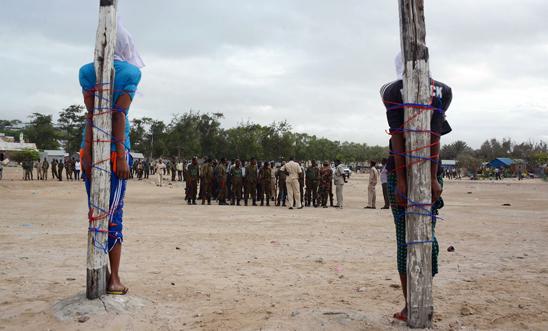 Two Somalis are tied to stakes as they await execution by firing squad on 15 July 2014 in Mogadishu © AFP/Getty Images
