September 2017
Latest death penalty report available
The latest report is now available thanks to group member Lesley for compiling it. Note that China remains the world’s largest execution but details are a state secret.
Amnesty in Salisbury & South Wiltshire
Promoting human rights from Salisbury UK
September 2017
The latest report is now available thanks to group member Lesley for compiling it. Note that China remains the world’s largest execution but details are a state secret.

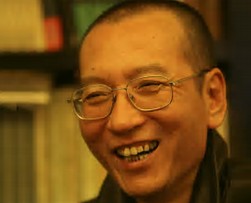
On Thursday, the Chinese dissident, Liu Xiaobo died of liver cancer. He had been in prison since 2008 mainly because he argued for greater democracy in China and was convicted of ‘inciting subversion’. He was awarded the Nobel Peace Prize in 2010 which infuriated the Chinese government and he was not permitted to go to Norway to receive it. He was only the second laureate to have been in prison at the time of the award. Once the cancer was diagnosed he was released to a hospital where he was still under heavy guard. According to Human Rights Watch, even as his illness worsened the Chinese government continued to isolate him and denied him freely choosing his medical treatment.
On Saturday he was hastily cremated and his ashes scattered at sea almost certainly to prevent a grave on land becoming a centre for protest. Activists were reported by the South China Morning Post to be ‘outraged at the humiliating arrangements’. His second wife, Liu Xia, is under house arrest.
Liu was a supporter of Charter 08 which argued for a fundamental change in the one party state, a whole series of reforms that would result in a separation of powers, a new constitution and legislative democracy. It was suppressed by the Chinese government.
A spokesman for Amnesty International said:
This is a sad day for human rights, but Liu Xiaobo leaves behind a powerful legacy to inspire others to continue the struggle for human rights in China and around the world
Boris Johnson, the Foreign Secretary, made the following lukewarm statement:
I am deeply saddened to hear that Liu Xiaobo has passed away. He was a Nobel Peace Prize Laureate and a lifelong campaigner for democracy, human rights and peace. His death is a huge loss and our hearts go out to his wife Liu Xia, his family, and his many friends and supporters.
Liu Xiaobo should have been allowed to choose his own medical treatment overseas, which the Chinese authorities repeatedly denied him. This was wrong and I now urge them to lift all restrictions on his widow, Liu Xia. 13 July 2017
This from a man not afraid to be outspoken at any given moment. Focusing on the restricted nature of his medical treatment is the least of the crimes the Chinese government has committed. ‘Has passed away’ gives the impression of a natural death not one hastened by harsh prison conditions, poor medical treatment and confining him right to the last. This is but the latest example of our government failing to stand up to breaches of human rights internationally. This is only set to get worse as the need to augment reduced European markets in the post Brexit world.
Under China’s president, Xi Jinping, there has been a major crackdown on any form of dissent. Restrictions on press freedom are well known and access to the internet is tightly restricted. Booksellers in Hong Kong stocking books detailing the corruption of the Politburo elite have been abducted. Details of this corruption among what are called the ‘Princelings’ has been revealed in the Panama Papers*. President Xi’s brother in law is implicated, along with other senior party people, in squirreling away billions in tax havens using the services of the Panamanian law firm Mossack Fonseca.
Any discussion of democracy is taboo in China as it is contrary to one of the Four Cardinal Principles one of which is to ‘uphold the people’s democratic dictatorship.’ One can see straight away that ideas of freedom of the press and ideas of running the country on more democratic lines are not going to get far with the government.
The future
China has pursued a policy of economic growth which so far has been successful and has led to the country being second only to the USA. It is expanding militarily most notably in creating false islands in the South China Sea. It is present all around the world where natural resources are to be found. The trick has been to maintain economic growth in return for maintaining its hold on political power. How long this growth can be maintained is open to question.
On the other hand, China wants to be more of key player in the world and is to be seen at G7 and G20 meetings as well as having a seat on the UN Security Council. As it grows in economic and military power, it seeks political recognition as well. This is difficult to achieve if at home it denies basic freedoms and human rights to its citizens; executes more than all the other countries in the world put together; locks up its dissidents; denies access to the internet and treats the people of Tibet appallingly. Using its power it is able to suppress criticism – cancelling contracts with Norway for example after Liu was awarded the Nobel prize – and tells other countries not to interfere in its internal affairs.
Fundamentally Chinese social policy is not progressing indeed, under Xi Jinping, it has regressed. So long as they can maintain their tight grip on power and the levers of power, the CPC will continue. But the lesson of history is that when a crack appears, as with a sheet of ice, it spreads rapidly and unpredictably.
*The Panama Papers, 2017, Bastian Obermayer and Frederik Obermaier, Oneworld, London (3rd edition). Details tax evasion by criminals, dictators and politicians – not just the Chinese – as revealed by a release of papers from Mossack Fonseca
Sources: Human Rights Watch; New York times; The Guardian; Amnesty International; South China Morning Post

The latest death penalty report for June/July is available thanks to group member Lesley for the hard work in compiling it.
If you would like to join the local group – because for example you have strong convictions against the use of the death  penalty – you would be most welcome. Or you can just write using one of the urgent actions in the report above.
China is the world’s leading executioner.
Follow us on Twitter and Facebook: salisburyai

June 2017
Liu Xiaobo who has liver cancer and was serving 11 years for ‘inciting subversion of state power’ which means any activity which seeks to undermine communist power. Liu was seeking reforms in China and improved democracy. He is now out of prison but essentially under arrest. Since his diagnosis, the Chinese did not want a Nobel Lauriat dying in prison, so released him to a hospital where he is expected to die. It is alleged the poor state of medical attention in prisons in China meant he did not get treatment earlier enough and this may have hastened his end.
China is accused of many failings to do with human rights. Activists and lawyers are targeted and frequently arrested. There has been a crackdown on lawyers. People with religious convictions are persecuted. The internet is heavily restricted and press freedom is also extremely limited. The country is a heavy user of the death penalty and executes more of its citizens than all the rest of the world put together. The precise number not known since it is a state secret.
The country is extremely sensitive to outside criticism and were furious when Liu was awarded the Peace Prize. Trade with Norway was curtailed which probably did not concern them too much since they are a wealthy country. The Beijing government summoned the Norwegian ambassador in protest. It called Mr Liu a “criminal”, saying the award violated Nobel principles and could damage relations with Norway. The Norwegian Nobel committee said Mr Liu was “the foremost symbol” of the struggle for human rights in China. It took six years before relations were normalised between the two countries according to the New York Times.
In some respects China is a powder keg. As long as prosperity increases then many people are happy to go about their lives and not bother too much about issues of freedom and human rights. They will not have access to sites or information which discuss or promote such issues (such as Amnesty International) and so the ruling communists need not worry too much about a restive population. Step by step they are securing hegemony over Hong Kong. Some ‘below the line’ comments in the press stories suggest that the Confucian tradition also plays a part and that, unlike Western nations, this tradition of loyalty to the state is more a feature of political life.
Another factor is that it is said by some observers that the Chinese rather resent being subjected to Western moral codes, in which they had no part in formulating, being applied to them. This does have some force except that they were a member of the Security Council when the Universal Declaration was signed in 1948. It does overlook the fact that the Declaration caused the Western nations some discomfort as well: the British and French with their treatment of the colonial peoples and the USA with its treatment of black people.
If China wishes to become a leading world nation then it is going to have to accept the norms the rest of the world tries to live by. The treatment of Liu Xiaobo (and many, many others) has been disgraceful.
And what of our Foreign and Colonial Office? It says:
Minister for Asia and the Pacific Mark Field said:
I am pleased that the 24th Round of the UK-China Human Rights Dialogue has taken place. Senior officials discussed the full range of our human rights concerns, including freedom of expression, freedom of religion or belief, access to justice and ethnic minorities’ rights. They also discussed areas where the UK and China could collaborate more closely, including modern slavery and women’s rights.
The UK strongly believes that respect for human rights is vital for growth and stability, and that these regular talks are an important part of our relationship with China. The dialogue has, once again, been held in a constructive and open manner. I am grateful for the valuable contribution made by civil society organisations before and during this exchange. [accessed 29 June]
Post Brexit the emphasis is going to be on trade and the UK government is unlikely to raise difficult issues with the Chines government or risk being treated like Norway.
Sources: Amnesty International, New York Times, BBC, Guardian.
Follow us on Twitter and Facebook, salisburyai. If you live in the Salisbury area and are interested in promoting human rights please get in touch. The best thing is to come along to one of our events and make yourself known.

 We are attaching the recent post issued by RightsInfo which gives 5 reasons to end the death penalty. There is a rising tide of executions around the world as the recent Amnesty report makes clear with China the country which leads the world (if ‘lead’ be the appropriate word) in executing the greatest number which it keeps a secret. Saudi Arabia and Iran are also major executioners often in barbaric circumstances.
Our local group produces a monthly report and these can be found on this site.
Briefly, the Rights Info report, entitled: 5 Reasons the UK is Trying to Stamp Out the Death Penalty Worldwide, says that the death penalty:
[we were unable to find a fifth in the report]
5 Reasons the UK is Trying to Stamp Out the Death Penalty Worldwide – RightsInfo copy (pdf)
This is the death penalty update report for mid March to mid April thanks to group member Lesley for compiling it. Some good news – even in China – where the statistics on the use of the penalty are a state secret, tempered by heavy use in Pakistan, Saudi Arabia, Vietnam and Iran.


Jihyun’s story is one that is difficult for British people to comprehend. She has endured privation both in China and in her home country of North Korea. She escaped from North Korea and spent six years in China effectively as a slave. She has been trafficked and forced into marriage. Eventually she was arrested and sent back to North Korea and was confined to a Labour Camp where she endured the severest of treatment. She escaped a second time via Mongolia and now lives in Manchester where she has been reunited with her son.
Part of her harrowing story was how she managed to regain contact with her young son on the phone while she was still in North Korea. He had been told she had deserted him and would not speak to her. It took several calls before meaningful contact could be resumed.
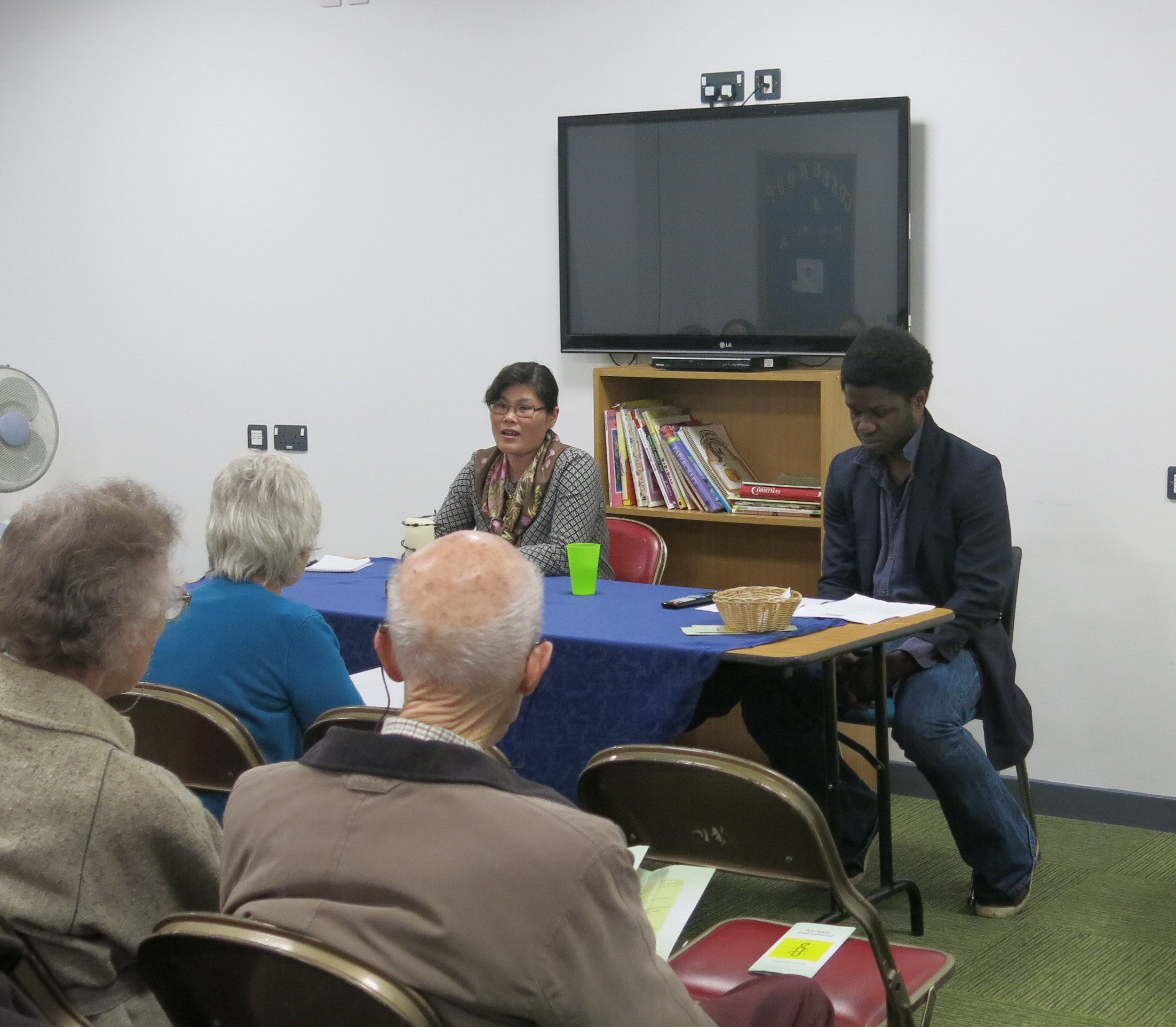
On Thursday 16 March, Jihyun came down to Salisbury and spoke to an audience at the Five Rivers Leisure Centre in the city. Over 50 attended and were immensely moved by her experiences. The evening started with a short film called The Other Interview (which can be viewed by following this link) followed by questions. The moderator was Amnesty regional representative Kenny Latunde-Dada who came down from Cambridge for the event. The audience asked many questions about both her experiences and life in North Korea.
There was some discussion about the role of China in both Jihyun’s story and more generally. North Korea is a sensitive issue for China and they are concerned about such an unstable country with its equally unstable leader on its doorstep. There are indications that they are tightening their policy of returning escapees to North Korea.
We were delighted to welcome Jihyun Park and were grateful for her making the trip down from Manchester to speak to us. We were also grateful to Kenny Latunde-Dada for coming down from Cambridge. Jihyun said she is writing her memoires and it should be published soon. Those interested may wish to read In Order to Live by another escapee Yeonmi Park published by Penguin (2015).
Follow us on Twitter and Facebook.
North Korea Video made by the Salisbury group
This Thursday 16th March Jihyun Park who managed to escape the closed country of North Korea will be giving a talk at the Five Rivers Leisure Centre, Hulse Road starting at 7:30 pm. Ji has led an incredible life having managed to escape the prison state of North Korea to China. In China she was trafficked and entered into a forced marriage. She worked more or less as a slave in China and was subsequently arrested and returned to North Korea where she was sent to a labour camp. She escaped again and now lives near Manchester.
North Korea is seldom out of the news these days with missile launches into the Sea of Japan and the murder of Kim Jong-un’s half brother in Malaysia. But the human rights situation in that country is dire and people live in situations of great adversity.
The event is free and there is a departing collection to help with our expenses.
See our video on North Korea
Attached is the death penalty report for mid February to mid March compiled by group member Lesley. A lot happening around the world and some worrying increases in execution activity. Note the report does not cover China – the world leader in executing its citizens but keeps the numbers a state secret.

The latest death penalty report covering the period 13 January to 9 February is attached and thanks to group member Lesley for compiling it. The report notes that many of the countries which feature in the report have close links with the UK as we have described in previous posts.


