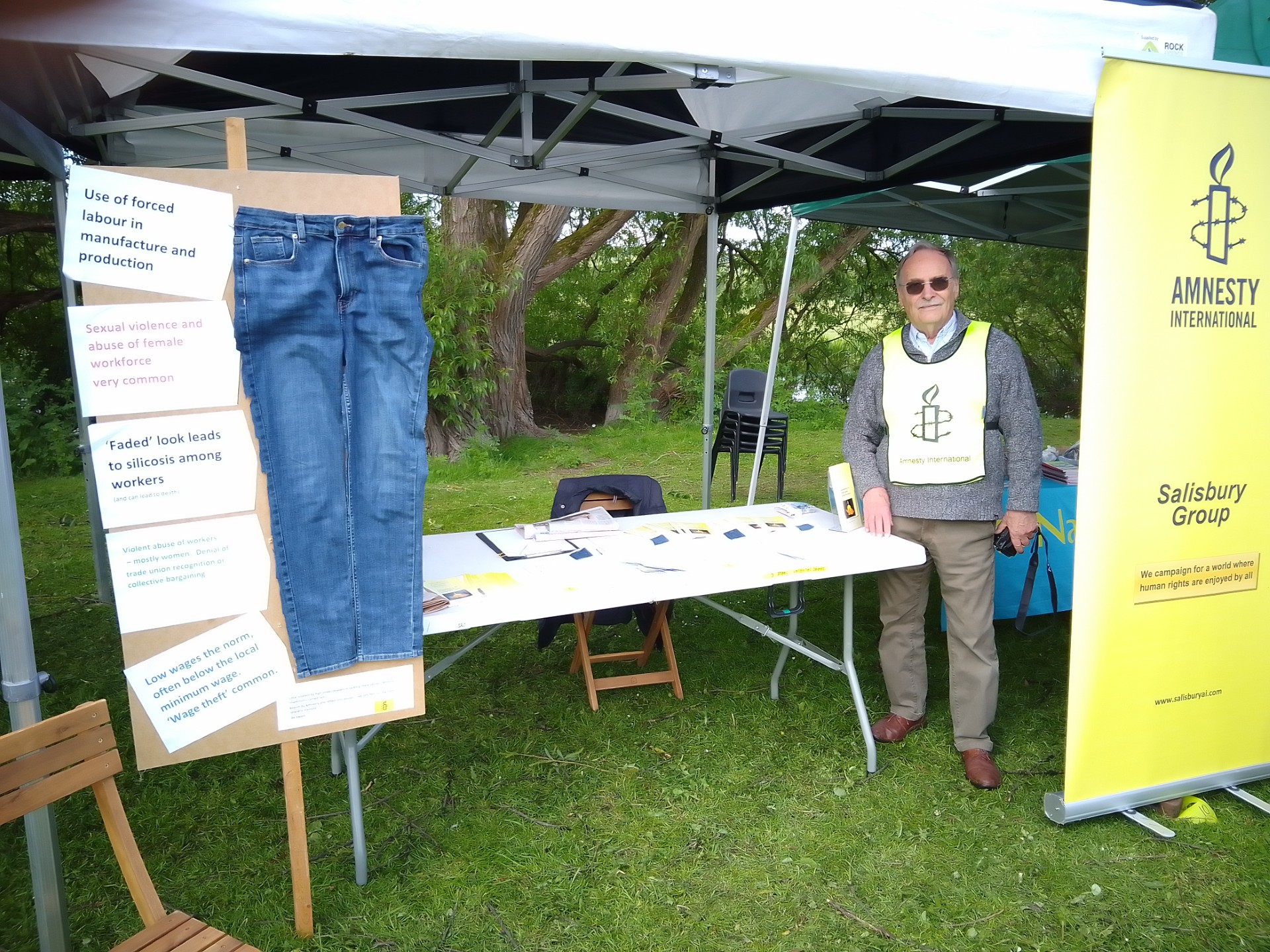
Clothing and the abuse of rights


We will be at the People in the Park event This Saturday to highlight this issue

At this event in Salisbury on Saturday 16th May, we shall be focusing on the human rights abuses involved in the manufacture of a pair of jeans. An everyday item of clothing, no less than 5 billion pairs are made every year mostly in factories in Far East countries. From the production of the cotton to the manufacture of the jeans themselves, millions of – mostly women – are subject to massive levels of abuse. Amnesty has produced a report called Stitched Up which provides background to this industry.

The numbers involved are quite staggering. There are something like 100 million garment workers worldwide the vast majority of whom suffer various kinds of abuse to enable us to buy cheap clothes (not just jeans).

The abuses

The abuses take place at every stage in the manufacture:

  • Around a quarter of the cotton comes from the Xinjiang region of China where the abuse of the Uyghurs is a massive issue. The treatment by the Chinese of these people is a story of itself and involves mass arbitrary detention and so-called ‘re-education’, unjust imprisonment, intrusive surveillance and forced labour. The treatment of the Uyghurs has been described as genocide.
  • To produce the faded look a dangerous process is used and the workers are in danger of contracting silicosis. Numbers die of this each year.
  • Low wages and levels below even minimum wage levels in their own country. This is linked to ‘wage theft‘. Workers are allegedly paid the minimum wage but do not if fact receive them. So inspectors carrying out cursory checks for the retailers see appropriate wages being paid.
  • Overwork. Overtime is compulsory if a big order arrives and workers may work very long shifts with no choice.
  • No collective bargaining and trade unions largely banned. It can involve working 99 hour weeks. Only 5 unions exist among Marks and Spencers 172 suppliers for example.
  • Abuses, physical and sexual, is widespread. With a mostly female workforce this is a serious problem.
The brands

The major brands on our high streets and on line are complicit in these abuses. It is important to stress the massive scale of the abuse involving millions of people. Virtually all the major brands are complicit in whole or in part, in these abuses largely due to inaction. If you read the Amnesty Stitched Up report linked above, you will see nearly all the familiar high street names mentioned. The supply chains are long so factories may be largely invisible to any inspection activity.

This post is to raise your awareness. It is almost certain that among the clothes you are wearing are garments produced which are the product of abuse, violence, forced labour about which the retailer you bought them from has likely done little to tackle. Cheap clothing comes at a cost. It is not costless because making clothes in the UK is extremely difficult if retailers are freely able to source from countries where regulations are ignored, wages are not always paid in full and there are no trade unions.

Previous year’s stall. Photo Salisbury Amnesty


Latest posts:

China successfully threatens university


China forces a British university to stop Uyghur research

November 2025

There is considerable evidence that around one million Uyghurs in China are subject to forced labour and people trafficking on a massive scale. It is thought that around one fifth of all textiles are now the product of coercive practices. Garment firms show little inclination to check sources beyond what is called the ‘first tier’ even though they could do so easily. Australian research shows that approximately 100 major consumer brands are sourcing their materials from this region. There are some 380 camps surrounded by razor wire and armed guards. The treatment of such large numbers of people in ways almost amounting to slavery is a matter of major concern. The complicity of many Western garment firms in these crimes is a disgrace.

One of the centres producing the research is based in Sheffield Hallam under prof. Laura Murphy. She has produced many reports and her work has been widely cited. The University congratulated her on this work and her research. Until that is the Chinese complained when everything changed. Her website was taken down and it decided not to publish her latest research. It amounted to a flagrant example of a breach of academic freedom. University staff based in China received threatening visits from security services.

The university said they stopped publication because they could not gain the indemnity insurance for her work mindful of possible lawsuits. Documents released under freedom of information laws showed that the University ‘had negotiated directly with a foreign intelligence service to trade [her] academic freedom for access to the Chinese student market‘. The point being that universities are so cash-strapped these days they have to recruit foreign students to balance their books. In other words, we (China) will not allow our students to come to your University unless you stop publishing material about the Uyghurs. China denies all claims but will not allow foreign observers into the region.

Clearly embarrassed the University has apologised and restored her work.

The story reveals how easy it is for China to intimidate those it dislikes or who comment negatively on their various activities. It also reveals how quickly and tamely a British University agreed to censor an academic’s work. Troubling is that this is an example of something which has come to light. Which other universities are quietly agreeing not to rock the boat and not even allow researches to get underway for fear of losing a contingent of Chinese students? The last two weeks have seen the government tie itself in knots over two alleged Chinese spies and whether or not to prosecute them. China’s increasing power is more and more troubling. Meanwhile, a million or so Uyghurs are virtual slaves.

Detailed work produced by Prof Murphy can be accessed here. It will be interesting to see if China’s heavy-handed efforts to threaten a British University will backfire.

Sources: BBC, China Star, Guardian, Sheffield Hallam University.

Photo: satellite picture of one of the Uyghur camps.

Blog at WordPress.com.

Up ↑