
DEATH PENALTY SUMMARY: mid to end of April 2016
Interim International Update (from 14.4.16 – 28.4.16)
Date format: day/month/year
UK –
o 14.4.16 – Mya Foa, Death Penalty Director of Reprieve stated, ‘
It is easy for Ministers to condemn the death penalty from Foreign Office briefing rooms. But if the words are to mean anything, the UK must be willing to engage in targeted ways on specific cases, including making its concerns public where appropriate. The countries driving a global surge in executions are amongst the country’s closest allies. This gives us a voice and we should use it in service of our values.
She highlights Pakistan, Saudi Arabia, and also Iran, where the recent resumption of diplomatic relations demonstrates how we can make a difference. She quotes the instance of how David Cameron’s intervention in 2013 in the cases of three young men who had faced torture and abuse, and were given death sentences, had contributed to their pardon and release.
o 24.4.16 – Catherine Dunmore, a young lawyer from Swindon, who supported Amnesty while at secondary school, is about to spend 3 months in Florida, working as an unpaid volunteer for Amicus. This organisation provides legal representation for those on death row – For anyone who might wish to support her, please go to Crowdfunder appeal The Salisbury Group wishes Catherine well.
- USA –
o 14.4.16 – Non Profit Quarterly have reported on the steady decline in executions since 2009 – from 52  to 28 in 2015. They attribute this in part to changing public opinion and increased media scrutiny, but also to the activism of death penalty opponents which has led to the limited availability of drugs essential in the use of the lethal injection.
The review shows that, while 31 states have the death penalty, only 4 are actively executing prisoners using lethal injection – Missouri, Texas, Alabama and Georgia. Florida are currently reviewing their procedures, while Louisiana, Virginia, Arizona and Arkansas have, or are about to, use the last of their supplies. Ohio have had to re- schedule their executions, and Nebraska are looking for a legal source of drugs.
The Danish Company Lundbeck were exposed as the suppliers of phenobarbital by Maya Foya of Reprieve, and the campaign against its supply and use was joined by Amnesty International. One of Lundbeck’s straplines on its UK site is: ‘Improving human life for almost a century.’ Although a number of states are considering alternative methods of execution, it is hoped that the delays and setbacks will provide sufficient time for the Supreme Court to consider the constitutionality of the death penalty.
o Texas –
- Pablo Vasquez, convicted of murder and on death row for 17 years, was executed on 6.4.16
- Robert Pruett’s execution, scheduled for 27th April, will now take place on 21.6.16
- Charles Flores is to be executed on 2.6.16
- Robert Roberson 21.6.16
- Perry Williams 14.7.16
- Ramino Gonzales 10.8.16
- Rolando Ruiz 31.8.16
- Robert Jennings 14.9.16
- Terry Edwards 19.10.16
United Nations – 19.4.16 – The first special session held in nearly 20 years to address drug policy resulted in tensions between countries as to whether criminalisation and punishment, or health and human rights, should be the main focus. AI reported that 30 countries have laws supporting the use of the death penalty for drug related offences, with at least 685 executions in 2015.
The outcome adopted by the member states included no criticism of the death penalty, stating only that countries should ensure punishments were ‘proportionate’ with the crimes.
UK/Indonesia –
o 19.4.16 – AI called on Mr Cameron to challenge the President, Mr Widodo, on his decision to re-implement the death penalty for drug related offences, and to raise the case of the British woman, Lindsay Sandiford.
o 28.4.16 – The Guardian reports that, a year after the execution of eight people convicted of drug trafficking, there are rumours of preparations for further executions, which could take place in the next few weeks. Prisoners on death row include two Britons – Lindsay Sandiford and Gareth Cashmore, and a young man – Yusman Telaumbana – believed to have been a minor at the time of the crime, and to have been tortured. (Note: Indonesia was booed at the United Nations session on drug policy).
Nigeria – 21.4.16 – It was reported in the Nigerian media that prosecutors in Kaduna were seeking the death penalty for members of the Islamic Movement of Nigeria (IMN) for the killing of a soldier in the course of two days of violence in December 2012 in the northern city of Zaria.
Urgent Actions
Iran – UA 65/16 – Alireza Pour Olfat was scheduled to be executed on 16.4.16 for a fatal stabbing committed at 16 in the course of a group fight. His execution was postponed to allow more time for seeking a pardon from the victim’s family. (Circulated to DPLWG 15.4.16).
Iran – New Zealand Amnesty petition – an online petition from Amnesty New Zealand calling on the Iranian Authorities to cease the execution of those who were children at the time of their sentences.(Circulated to DPLWG 27.4.16 and on the website)
Campaigning
- Reggie Clemons – we continue to await news
- The Group continues to focus on the sentencing to death of juveniles in Iran and to press AI UK for a coordinated action.
- This month’s Group Urgent Action – New Zealand petition (see above)
China remains the country with the highest level of executions – believed to be in the thousands – but the statistics are a state secret.
Thanks to group member Lesley for compiling this report.
Follow us on Twitter and Facebook




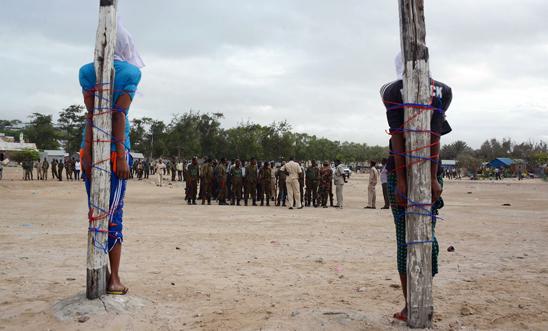 Two Somalis are tied to stakes as they await execution by firing squad on 15 July 2014 in Mogadishu © AFP/Getty Images

