We attach our latest report into the use of the death penalty around the world thanks to group member Lesley for compiling it.
Correction: the Death Penalty Vigil took place on 17 October and not November as stated in the report

Amnesty in Salisbury & South Wiltshire
Promoting human rights from Salisbury UK

We attach our latest report into the use of the death penalty around the world thanks to group member Lesley for compiling it.
Correction: the Death Penalty Vigil took place on 17 October and not November as stated in the report

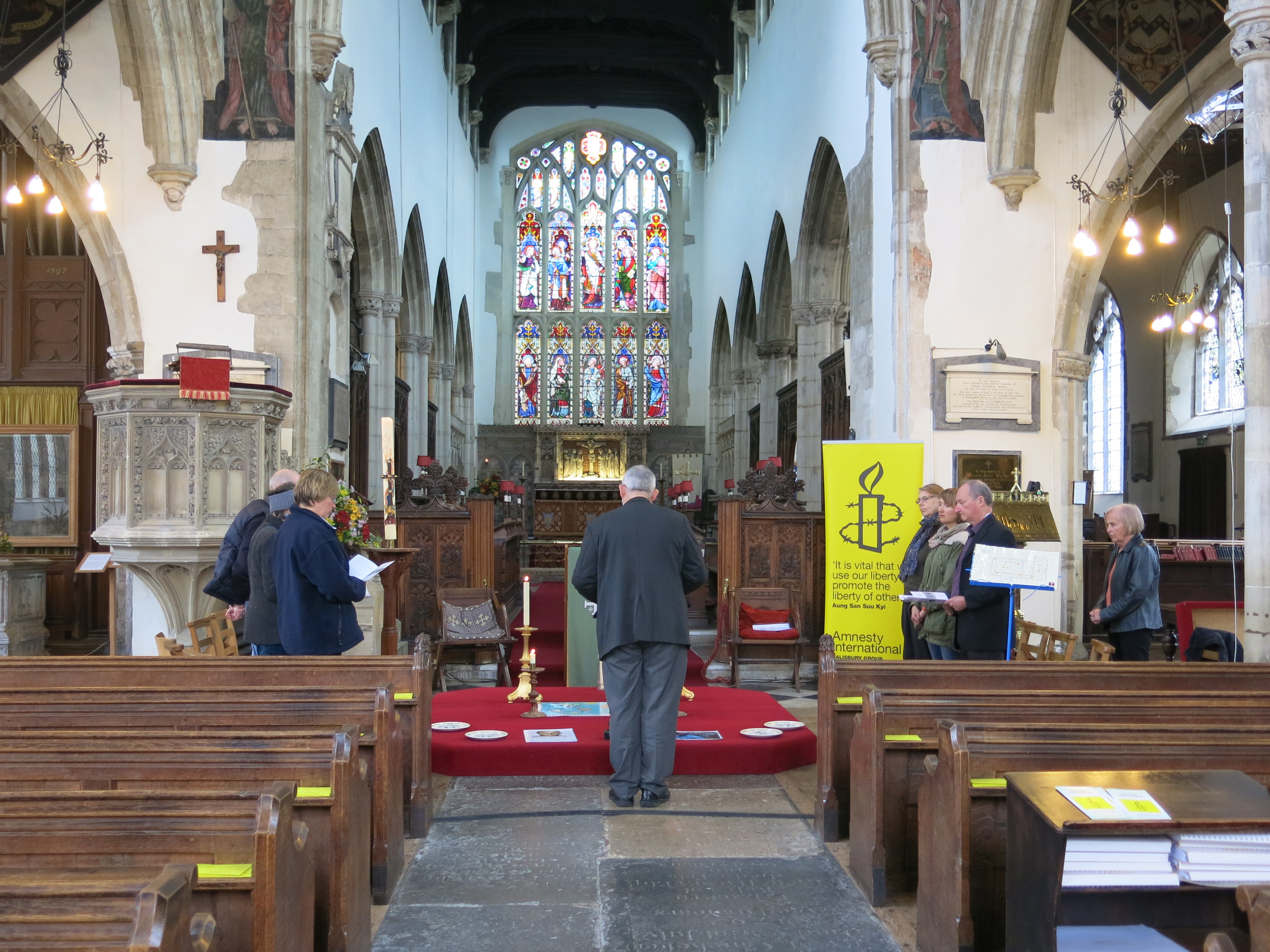
On Saturday members of the Salisbury group held a one hour vigil in St Thomas’s church to highlight the use of the death penalty around the world. The vigil was timely as the world’s leading executioner is China whose president is on a state visit to the UK now. Second is Iran and then Saudi Arabia.
Numbers were very disappointing partly because we were unable to achieve any publicity.
The minutes of the October meeting are now available. The group discussed the forthcoming Vigil at St Thomas’s; the tapestry and where that could be displayed; social media statistics; the death penalty; the forthcoming film at the Arts Centre and a report on the correspondence with John Glen concerning the government’s changes to its human rights policies.
UPDATE: 8 October. Richard Glossip has been given an indefinite stay of execution
We attach the monthly death penalty report for September thanks to group member Lesley for compiling it. China remains the world leader in the use of the death penalty.
October 2015
We have already commented on the revelation that the UK helped secure a seat for a Saudi onto the UN’s human rights council and in a further development, Philip Hammond the Foreign Secretary has declined to deny the story. Mr Trad, the man who will fill the role, has denounced UN attempts to get the death penalty ended internationally
This is further light on the claim that everything is being done to further human rights internationally. Mr Glen MP told us a few days ago:
I can assure you that the change of wording is not an indication of a change in policy: the UK government will continue to work towards a complete abolition of the death penalty, using all the tools at its disposal.
October 2015
There seems to be a fundamental contradiction at the heart of the government’s policy as it relates to matters such as human rights and the death penalty. Readers of this blog will be aware that we wrote to our local MP, John Glen, on 8 June to point out that France was speaking out publicly concerning the rise in the number of executions taking place in Saudi Arabia and that Sweden had reportedly stopped selling arms there. We noted that in the first 5 months of this year, the number of executions has equalled that for the whole of 2014.
We received a response from a FCO minister Tobias Ellwood who assured us that Saudi Arabia ‘remains a country of concern on human rights, because of its use of the death penalty as well as restricted access to justice, women’s rights, and restrictions on freedom of expression, freedom of assembly and freedom of religion or belief.’
Within days of receiving this letter from Mr Ellwood with a covering letter from John Glen, it was reported that the Foreign Office had both dropped any explicit reference to death penalty and had also dropped the very phrase used by Mr Ellwood namely: ‘a country of concern’ and replaced it with the more anodyne ‘human rights priority countries’.
We wrote pointing this out to Mr Glen on 5 August and, not receiving a reply, wrote again a month later on 14 September.
Then, on 20 September came the astonishing news that a Saudi representative was to become a member of the UN’s human rights council (The Independent). Human rights organisations were aghast that a country such as Saudi with its record of torture, floggings, executions and so on and so on, should be elected to such a body. No sooner had we digested this piece of news when The Australian newspaper revealed on 30 September that this election had not happened by chance but that diplomatic cables released by WikiLeaks showed that the UK government had allegedly initiated the secret negotiations to enable the Saudis to get elected. The cable apparently read:
The delegation is honoured to send to the ministry the enclosed memorandum, which the delegation has received from the permanent mission of the United Kingdom asking it for the support and backing of the candidacy or their country to the membership of the human rights council (HRC) for the period 2014 – 2016, in the elections that will take place in 2013 in the city of New York.
The ministry might find it an opportunity to exchange support with the United Kingdom, where the Kingdom of Saudi Arabia would support the candidacy of the United Kingdom to the membership of the council for the period 2014 – 2015 in exchange for the support of the United Kingdom to the Kingdom of Saudi Arabia.
In simple terms: we will support you if you support us. Why the UK should need the support of such a country is a puzzle in its own right but for the UK to be supporting the Saudi government for a human rights council is beyond belief.
UN Watch commented:
[we] find it troubling that the UK refused to deny the London – Riyadh vote trade as contemplated in the Saudi cable, nor even to reassure the public that their voting complies with the core reform of the UNHRC’s founding resolution, which provides that candidates be chosen based on their human rights record, and that members be those who uphold the highest standards of human rights.
On 18 September, Mr Glen replies to our second letter. He claims the change in wording came about on the basis of feedback from diplomats who ‘reportedly had difficulty relating our long list of human rights priorities with the issues they faced in real life – from the chaos of failing states to the corridors of Geneva.’ Adopting more thematic categories makes it easier to apply pressure it is argued depending on the circumstances of the country concerned.
Rather than being ‘vague and obfuscating’ (as has been claimed) the ‘categories are sufficiently broad that diplomats can tailor them appropriately to local circumstances.’ He argues that the change of wording is ‘essentially about semantics’. FCO ministers have been very clear, even since the change of wording, that their stance on the abolition of the death penalty remains the same, he says. He quotes Rt Hon David Lidington, Minister for Europe:
The Government calls on all states to adopt an immediate moratorium on [the] use of the death penalty in accordance with the relevant UN General Assembly resolution, and views this as part of the process towards complete abolition. The Foreign and Commonwealth Office will continue to use its diplomatic and programmatic tools to work towards the goal of global abortion.
Finally, he says ‘I can assure you that the change of wording is not an indication of a change in policy: the UK government will continue to work towards a complete abolition of the death penalty, using all the tools at its disposal.’
On the one hand, solemn assurances are given that government ministers are committed to the cause of global human rights, whatever the wording of their policies, which are purely a matter or semantics it is claimed. On the other hand, a ‘trade’ was undertaken between London and Riyadh to get the latter elected onto a UN human rights body. Assurances that ‘all the tools at its disposal’ are being used in pursuit of global abolition must be set against George Osborne’s visit to China this month where the nationalist State-run Chinese newspaper The Global Times, lauded the 44-year-old Chancellor for his ‘pragmatism’ in concentrating on business matters and not drawing attention to human rights like some other visiting western leaders. China leads the world in executions the numbers being a state secret. It is a serial offender on the human rights front.
On the basis of this evidence it would appear that the claimed commitment to human rights is for domestic consumption only and that the reality, when it comes to actual dealings with foreign governments, is that they seldom feature.
Sources:
Human Rights Watch; The Australian; The Global Times (China); The Observer; The Guardian; The Daily Telegraph; International Business News


UPDATE: 8 October. Richard Glossip has been given an indefinite stay of execution (Oklahoma)
We attach an urgent action on behalf of Richard Glossip with whom visitors to this site will be familiar with. He has won a temporary stay of execution. His legal team has presented new evidence to the appeal court. The evidence against him is weak as we have pointed out before and relies partly on a plea bargain by the man who committed the actual murder. Oklahoma is a hard line state as far as the death penalty is concerned.
We hope you can find time to write. See also this month’s death penalty report.

A man, Ali Mohammed al-Nimr, who was convicted when he was 17 is to face death by crucifixion after his appeal was turned down. The appeal was heard in secret and he was not present. He was accused of participating in illegal protests and of firearms offences. As is usual in Saudi, he was denied access to a lawyer and is likely to have been tortured and forced to sign a confession. See International Business Times for the full story.
Amnesty believes that Saudi has one of the highest rates of executions in the world and is exceeded only by China (details of which are a state secret) and Iran.
We are engaged in correspondence with our local MP John Glen about the government’s policy towards the kingdom and we were initially assured both by Mr Glen and a FCO minister Mr Tobias Ellwood, that the abolition of the death penalty was an important policy for the government. These matters were raised at the highest level with the Saudis we were told. Within days of these assurances, it was announced that the abolition of the death penalty was no longer an explicit policy of the government. We have written to Mr Glen on this and a reminder was sent this week. A reply is awaited …
See our death penalty report.

Richard Glossip’s execution has been deferred by two weeks only hours before he was due to killed. This was an urgent action by Amnesty International and members of our group have written to the Oklahoma authorities. You can read the full report in the New York Times here.
There is no physical evidence linking Glossip to the scene and a major part of the evidence is a plea bargain by Sneed who admitted to the murder but escaped execution by implicating Glossip.
Amnesty is opposed to the death penalty and this case reveals one of the reasons: flimsy evidence combined with a plea bargain means the likelihood of a wrongful conviction leading to a man’s death with no prospect of putting it right in future if fresh evidence appears.
The group is holding a vigil against the death penalty on 17 October in Salisbury starting at 12.45. Further details here and on Twitter soon.

 The minutes of the September meeting are now available thanks to Lesley. We discussed North Korea, the death penalty (see separate post on this), the forthcoming vigil on 17 October and agreeing to write to John Glen concerning his failure to reply to our letter of 5 August.

 Amnesty in Salisbury & South Wiltshire