Exeter Conference


March 2025

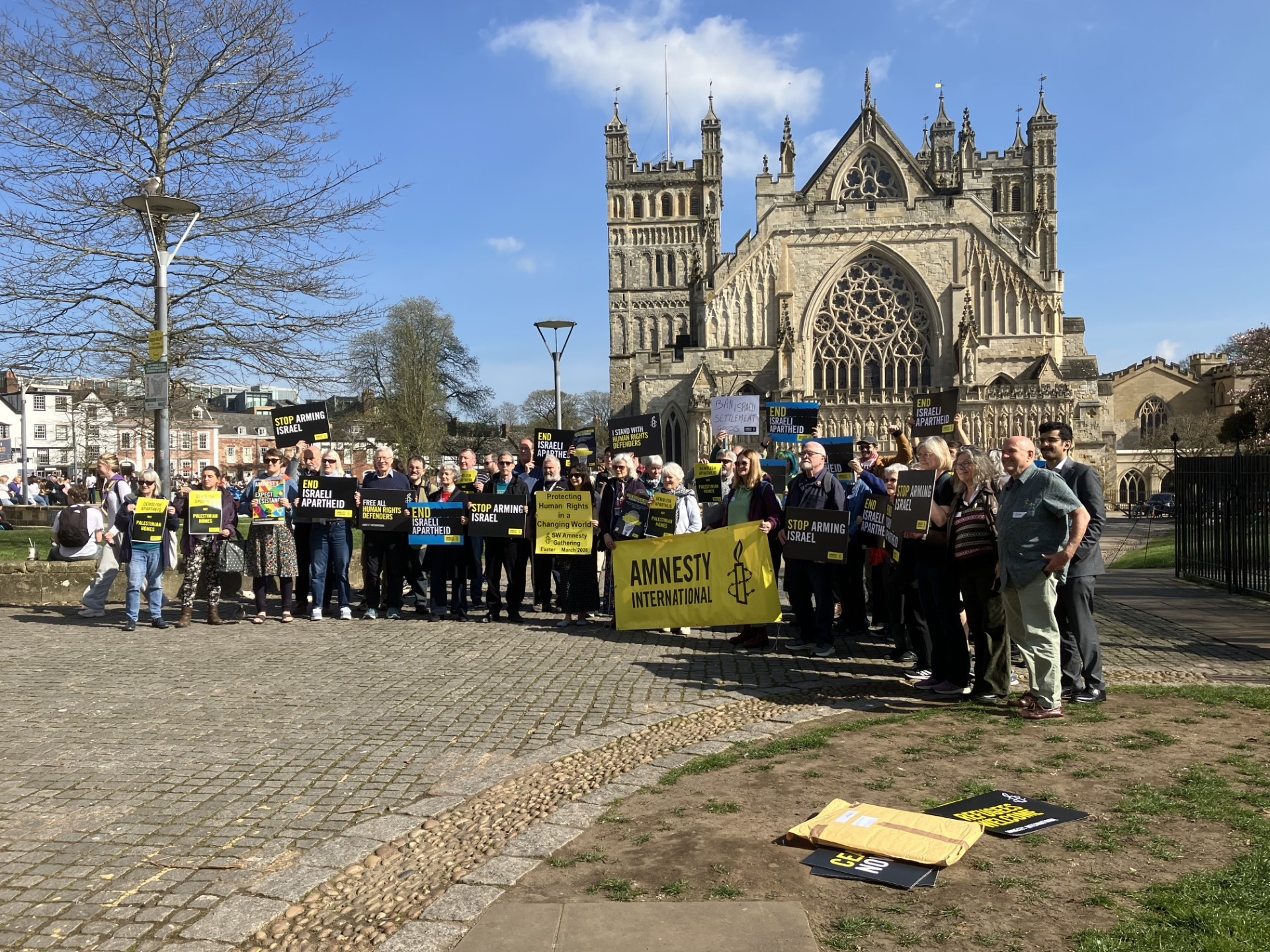
Members from groups in the South West gathered in Exeter last Saturday for an interesting day on human rights issues. All credit to the Exeter group who have organised this for several years now enabling us to meet other groups in the region. We held our usual photo opportunity in front of the fine Exeter Cathedral (almost as fine as Salisbury’s!), and this picture was to highlight the problems of being a woman in Afghanistan.

You can read a post on the issue of the UK’s support for cricket in Afghanistan particularly as women are not allowed to play it. There is a post on one of the speakers who discussed the current situation in Somalia.

Somalia – a forgotten conflict


Terrible abuses take place in Somalia with little attention paid by the media

March 2025

The news is filled with the terrible events in Gaza and the resumption of bombing there, the war in Ukraine which, following President Trump’s activities and support for Russia, shows no sign of an equitable or fair resolution, and a possible resumption of hostilities in Lebanon means other conflicts receive little attention. This is true of Somalia on the horn of Africa where corruption and lawlessness are rife.

At South West conference in Exeter of Amnesty groups organised by the City’s Amnesty group, we heard first hand from a Somalian human rights defender Abdalle Mumin (pictured). Entitled Human Rights in Somalia: the Struggle of Defenders in a Dangerous Environment, he gave a detailed description of the severe problems being experienced in that country but which remain largely unreported. His descriptions of being held in an underground cell was chilling.

He explained the power set up in the country which provides valuable background to understanding the politics of repression. There are three centres of power: 1. Al-Shebaab a terrorist organisation with close links to Al-Qaeda 2. the government and 3. the clans of which there seem to be three. All are male dominated and the role of women in the political process is much reduced he said.

Corruption is rife and there is no independent judiciary. Women who are not wanted for some reason or complain too much can be murdered with impunity as there are no investigations carried out. Femicide is frequently practised. There is considerable sexual and gender based violence. The corruption starts with the business of getting into government for which a bribe of around $1m dollars is required. This has to be paid back of course which is done by purloining food aid and selling it off, accepting bribes for favours, money laundering and rewarding friends and family.

Terrorism and corruption are like brother and sister

This corrupt state of affairs can be kept going because attempts to publish stories is difficult. Many journalists are murdered: 85 in the period 1991 – 2024. There is also straightforward intimidation of news outlets by all the parties with many being closed. There are heavy restriction on human rights groups. This has now become the standard playbook for authoritarian and dictatorial regimes.

Foreign interventions he described as ‘confused’. Much aid in recent times is tied to resource extraction and there is an emphasis on security over human rights. Different agencies have different agendas making offering concerted help difficult.

There has been a huge displacement of population with around 2.9m affected. 80% of children do not receive an education and girls none at all in the rural areas because of the influence of Al-Shabaab.

Altogether a grim tale and finding hope is difficult. The problem in Somalia and in much of sub-Saharan Africa is the battle for resources. Countries desperate for minerals, oil and rare earth metals are concerned only to extract what they can and they show little regard for human rights. Their activities fuel the corruption since mining is impossible without the say so and bribes of one or all the various powers in the country. Abdalle Mumin himself was some kind of inspiration however. Despite the difficulties and the risks he faces – which include death from people unconstrained by law or justice – he was both inspiring and uplifting not to say humbling. Amnesty members present in Exeter were grateful for his talk.

Exeter event


Film being hosted by the Exeter Amnesty group subject: China

On Saturday 18th January at 1pm, Exeter Amnesty group hosts the film, All Static and Noise, at Exeter Phoenix, followed by a Q&A session with Nabila Hanson, AIUK China Coordinator. The plight of Uyghurs in China does not receive the attention it deserves. Governments are keen to forge relationships with the country for commercial reasons. Little attention is paid for example to the scandal of cotton produced using forced or slave labour in the region which finds its way into clothes sold on our high streets.

In the film, All Static & Noise, by David Novack, survivors and their families risk everything to expose the truth of China’s Uyghur detention and ‘re-education’ camps. Jewher, a Uyghur teen from China, lands in the US after she is violently separated from her father at the Beijing airport. Abduweli, a linguist and poet imprisoned and tortured for teaching Uyghur language, leaves for Istanbul upon his release. Together, they join survivors of China’s “re-education camps” and their families, in Turkey, Kazakhstan, Europe and the United States to expose atrocities with the hope that global awareness brings change.

Saturday 18th January 2025 1pm Tickets £7 www.exeterphoenix.org.uk 01392 667080 https://exeterphoenix.org.uk/events/all-static-and-noise/

Image from the film site.

Exeter conference


Salisbury group members take part in the regional conference in Exeter

April 2024

Members of the Salisbury group went to Exeter last Saturday, 20 April, to take part in the regional conference organised by the Exeter group. We heard presentations on the somewhat forgotten problems in Kashmir where the Indian government is committing a wide range of human rights violations. These include disappearances, indefinite detention, using financial laws to persecute and, by such means, closed Amnesty’s office in the country. And – in similarity with India itself – giving preference to Hindus over other faiths. The speaker drew similarities to the situation in Gaza. She also pointed out that JCB is selling construction equipment which is being used to demolish Kashmiri homes.

There was also a very informative talk on the issue of racism including the ‘7 pitfalls’. This was given by Peter Radford.

It was altogether an interesting event and it was good to meet other Amnesty groups from the region and all praise to the Exeter group for organising it.

Photo: Exeter Amnesty

South West Conference, Exeter


March 2023

Members of the Salisbury group attended the conference in Exeter

It was good to get back to having a conference after a two year hiatus because of Covid. It was extremely well attended with over 60 people coming from all over the region including Penzance in the west and ourselves and people from Southampton in the east. To open, there was a video from Agnès Callamard, the Secretary General of Amnesty International.

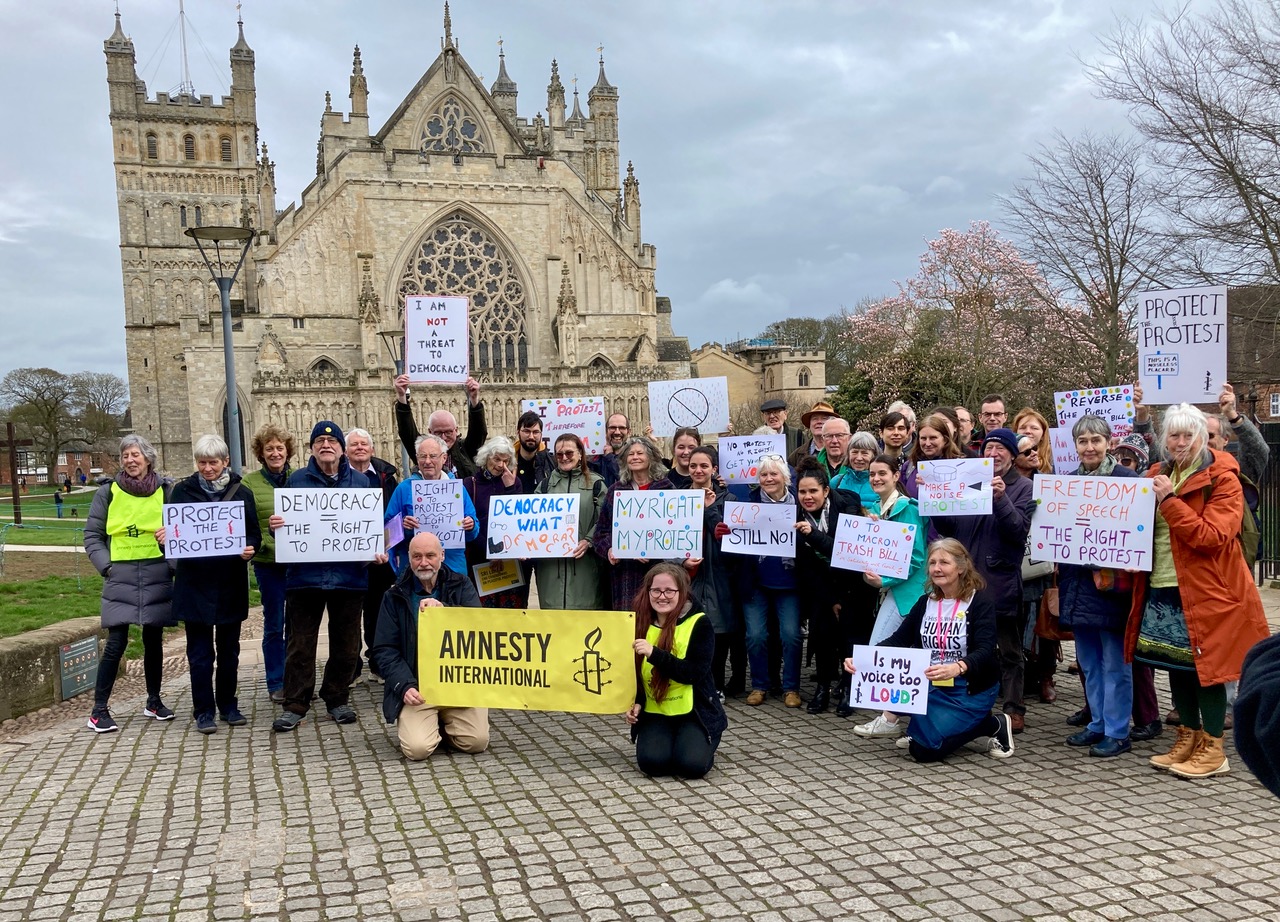
Among the speakers was Tom Davis who addressed the subject of protecting the protest. A series of bills have been introduced by the present government, some in advanced stages of enactment, which individually and collectively will have a serious effect on the rights of citizens to protest. There is no direct right to protest but it is inherent in the right of free speech and the right of assembly. It is sometimes forgotten that the protests of people in the past have brought much needed social change to our nation. Women would not have the vote without it; workplace laws would not have happened without it. The riots after the Peterloo massacre brought change and the Great Reform Act. Throughout our history there has been protest, sometimes violent, in an attempt to force change.

Recently, Extinction Rebellion have mounted a series of protests in their campaign to promote more attention to climate change and, in their view, insufficient and inadequate action by the government to tackle it. Many have objected to the inconvenience their actions have caused. Almost certainly, the succession of bills have had as a focus, giving police the means to frustrate these protests. For example, introducing the crime of ‘locking on’ to make it an offence to glue oneself to the pavement or link arms. Have we forgotten that the suffragettes chained themselves to railings?

Tom said the Public Order bill, currently weaving its way through parliament, was “deeply, deeply, concerning”. The police will be able to prevent people from attending protests in certain circumstances. The intention appears to be to so limit the ability to protest to those which no one notices. It is disappointing to note that Sir Keir Starmer is supporting some of the measures.

It seemed appropriate that another speaker was a journalist from Nicaragua. She is currently at the University of York, but were she to return to her country she will be arrested. Nicaragua is the only country in the Americas which has no newspaper she said. All have been shut down by the government. Daniel Ortega runs a brutal regime, any protest results in arrest and long sentences. The prisons are dangerously overcrowded and violent. The Pope recently described the state as a dictatorship resulting in Ortega cutting off diplomatic relations with the Vatican.

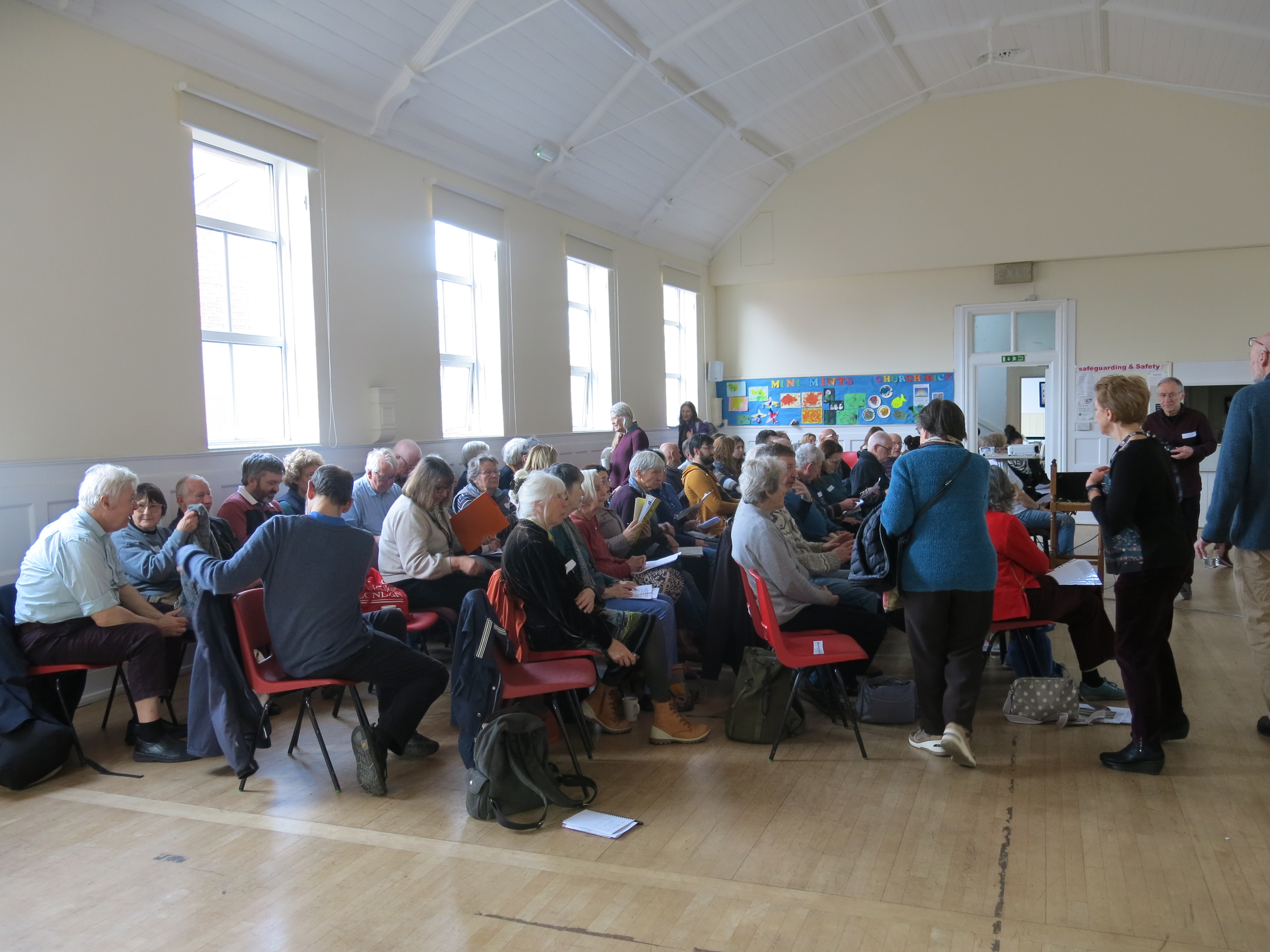
Photos show a quick demonstration in front of the Cathedral and people getting ready for the conference at the Mint in Exeter. Photos: Salisbury Amnesty

All praise to the Exeter group of Amnesty for hosting and organising this event.

South West Regional conference


The SW Regional conference was held in Exeter on Saturday 7 March 2020

Four members of the Salisbury group attended the regional conference in Exeter yesterday, a truly

Some members in front of Exeter Cathedral

uplifting event.  We had four excellent speakers and we had a photo opportunity in front of the cathedral.

With all the talk from the current government, echoed in large parts of the press, of getting rid of the Human Rights Act and their desire to pull away from the ECHR, it was good to be among people who believe in the importance of these rights.  They are not there to help terrorists go free and to help hardened criminals escape justice which is the common refrain now, but to protect all of us in our everyday lives.  This is especially so as we do not have a constitution.

But one of the high spots was a young woman, Geraldine Chacón (below right) from Venezuela who is a human rights defender who was arrested by around 10 armed men and spent 4 months in prison before being released.  She has not been tried however so can be arrested again if and when she goes back.  The rights we take for granted were denied her.  No warrant for her arrest; no access to a lawyer; constant interrogations; never brought before a judge; no access to her family, particularly her mother who came every day but was not allowed to see her; and no charges brought. She was labelled a terrorist and her release was used to present the government in a positive light ‘look, we’re releasing terrorists’.  Calling anyone a ‘terrorist’ is the standard claim by nearly all authoritarian regimes for people who campaign for democracy, the rule of law and respect for human rights.

The two speakers from south America

She became an Amnesty ‘prisoner of conscience’ POC case and thousands of letters were written.  She said they made a difference.  She was feeling vulnerable and abandoned she said and the letters made her realise ‘you are not alone’.  The letters ‘made me brave because I knew I had you with me’.  She only knew there were letters as news of them had to be smuggled in: she was allowed no correspondence directly.  It was a very uplifting talk.  In all this denigration of human rights by sections of our media and some of our politicians, it was good to know the basic business of Amnesty’s work, did and does make a difference.

One of the other speakers was Laíze Benevides Pinheiro from Brazil (left).  She spoke of her work in Brazil and the threat and risk from the most dangerous police in the world.  In 2019, they killed 1810 young men most of whom were black.  The murder of Mariella Franco has polarised opinion but she said a network had been created to help people who were the victims of violence.

There was another talk on climate and its link to human rights which may be the subject of a future post.  Kate Allen (Director of Amnesty) also spoke about the future direction of Amnesty and the worries about the attitudes towards human rights by some in the current government.  This is a worry expressed on this site in previous posts.

A really worthwhile day and congratulations to the Exeter Amnesty group for organising it so well.


There will be an Evensong this Thursday 12 March starting at 5:30 in the Cathedral.


Regional meeting


Amnesty International South-West Regional Conference in Exeter 11 May 2019

These are some notes of the recent regional conference made by Salisbury group member Fiona. They are not an official record.

The keynote speaker was Emel Kurma, a Human Rights defender from Turkey, currently hosted by the University of York’s Protective Fellowship Scheme. She outlined for us how a Citizens’ Assembly works. Inspired by the Helsinki Final Act, these are low-profile bodies (no smart headquarters or logos) that aim to stimulate social and political discussion towards a peaceful and inclusive society, valuing democratic and environmental principles. The best response to a state’s limitation of individual freedom is to strengthen civil society at all levels, allowing ethical thinking to penetrate even closed structures. For example a liberal academic offered an opportunity to go to a conference abroad might instead hand it to a member of a state institution in order to broaden that individual’s understanding of human rights as practised beyond their country’s borders.

Emel Kurma is a brave individual and her stoical acceptance of probable interrogation and possible imprisonment on her return to Turkey is both shocking and inspiring.

Israel Palestine 

Two other reports (also by women) focused on Palestine and Eastern Europe respectively.
Penny Wilcox has for several years worked with the intriguingly-titled Ecumenical Accompaniment Programme in Israel and the Occupied Territories.  Again in an unobtrusive fashion, they accompany vulnerable Palestinians at checkpoints (adults going to work, children to school, traders etc.) and, simply by acting as protective witnesses, aim to reduce the levels of conflict or anxiety so often experienced by this oppressed population.  This approach is also practised by various Israeli humanitarian groups who wish to offer support to trapped and threatened Palestinian communities.  Even simply to witness and record the bulldozing of ‘illegal” Palestinian structures (cow byres, olive trees) is an act of silent protest and solidarity.  One of the many ironies of this absurd and tragic occupation is that when sometimes belligerent Israeli settlers have gone into Palestinian villages to cause trouble, the Israeli army itself has been called in to defend the Palestinians residents.

The third report came from Central Europe co-ordinator Ulricke Schmidt, who traced worrying trends in the rise of racism and anti-Semitism in Hungary and, to a lesser degree, in Poland.

Hungary

In Hungary the usual targets are the Roma, but the influx of refugees has now made them the focus of anger.  This in spite of the warm reception originally given to those fleeing war, who were perceived as ‘passing through’ Hungary and in manageable numbers.  However attitudes have hardened and Ulriche quoted an acquaintance who got 6 months imprisonment for giving a lift to a refugee while NGOs risk being criminalised for helping them.  Additionally, resentment against global capitalism has contributed to a revival of anti-Semitism.  Huge posters crudely stereo-type George Soros as ‘an enemy of the people’ with his ‘army of leftist terrorists’.

Ulricke defines some of the underlying causes of xenophobia as relating to globalisation – seen as benefiting the few – and to a drift to the cities which has left a frustrated and impoverished rural population to grasp at the promises of the Right to restore Hungary’s romanticised past (sounds familiar, does it not?).

Poland 

Poland reflects some of these trends, but fortunately to a lesser degree. Some liberal teachers have been disciplined and protesters have had their personal data published.  But Poland has had a more recent history of resistance to authoritarian rule.  When an outright ban was placed on abortion thousands of women marched in protest to overturn it.  When a recent Independence Day march was joined by racist demonstrators, fourteen brave women entered the throng and unfurled a Stop Fascism banner.  They were beaten by some marchers, and subsequently charged and fined by the courts for ‘disrupting a lawful demonstration.’  But a recently published video has now prompted an Appeal Court investigation into the attack..

The European Union has triggered Article 7 against Hungary for imperilling European values and has also expressed concern that the judiciary in Poland is being politicised.  On a more positive note, 26 EU countries have recently seen powerful demonstrations against fascism, racism and anti-Semitism.

Death penalty

The Death Penalty workshop confirmed that our group is very well informed on relevant data thanks to the regular updates from group member Lesley. The new network now has two and a half thousand members.  An interesting recent survey estimated that it was actually more expensive to execute a prisoner than to simply keep them in prison.  The campaign is currently now focusing on Singapore and Iran, the latter for its practice of deferring punishment until a sentenced juvenile is old enough to receive the death penalty.  On a positive note – more and more countries are abolishing the death penalty – 106 in total by the end of 2018.

Many thanks to the regional representative Chris Ramsay for organising this meeting.

Blog at WordPress.com.

Up ↑