Monthly meeting


UPDATE

The last meeting was on Thursday, 8th January.  An agenda is attached.  The minutes of the December meeting are also attached.  Note that you can see all recent minutes by going to the ‘About Us’ tab on the front page.

We discussed:

  • the results of the carol singing which had been very successful
  • there was the December Death Penalty report
  • we discussed North Korea and the increasing interest in that country, and in particular the human rights situation there, was noted
  • the website numbers were given and that we now have 60 followers
  • there was an update on the Magna Carta events and there is to be a meeting soon with the Cathedral to start doing more detailed planning
  • the complete lack of interest by any of the sixth forms in the area to submit an essay was noted.  This was extremely disappointing in view of the efforts made with leaflets and contacting the schools ahead of time to promote it.
  • details on the Cathedral service are awaited

Minutes will be posted here as soon as they are available.

Agenda January 8th

December minutes

The case against human rights


December 2014

This was the title of a piece in the Journal section of the Guardian newspaper on 4 December by Eric Posner who is a professor at the University of Chicago Law School.  This is a thoughtful piece, not written by some demagogue, but by someone with a background in the subject and who has made significant contributions to the debate on the issue of human rights.  The points he makes are cogent and need addressing seriously.  The arguments he puts forward seem to come from his book The Twilight of International Human Rights Law (Oxford University Press, 2014).

His article starts with a review of the history of the subject, especially since 1948, with the adoption of the Universal Declaration of Human Rights by the UN which he correctly points out is not a treaty in the usual sense.  He might have added the European Convention of Human Rights came into being at about the same time and for broadly the same reasons.

The essential problem from the beginning he says was the different outlook by the key players when writing the UNDHR.  America had in mind their constitution which was largely based on ‘political’ rights which have developed under their constitution.  Even so, they did not want racial equality to be included: the effects we see today with the recent shooting in the USA of two black people by police and the lack of a legal follow through.  The then Soviet Union wanted more social rights and the need to provide jobs – hence a right to work.  The colonial powers – chiefly Britain and France – did not want the emancipation of their colonies to be included within it.  Hence the result was a partial framework not a coherent, legally binding treaty.

His argument is based on the following main points:

  • Human rights campaigning has failed to achieve its fundamental objectives.  Despite countries signing up to various agreements, torture is still widely practised, almost routinely, around the world; women’s rights are widely neglected especially in the middle east, and children are still working in mines and sweatshops
  • The notion of human rights is hopelessly ambiguous with over 400 listed, which can provide no guidance to governments on how to incorporate them.  For example, eliminating torture would require major changes to the police forces and reform of corrupt judiciaries.  It is still practised he argues, because the police have no other way in the light of crime and corrupt courts.  Governments would prefer to build schools and hospitals rather than spend on the police and reforming the court system
  • Things like free speech have little practical value where religious issues prevail.  Many western countries limit it, for example for defamation or obscenity
  • But his main argument centres around the ‘top down’ nature of human rights.  It is reminiscent of old colonial ways where primitive cultures had reforms foisted upon them by white occupiers who thought themselves superior.
  • Another factor is the post 9/11 use of torture by the United States.  This seriously undermined their moral standing and since they were the country most active in pursuing human rights, this was a serious blow to the cause.

This is only a flavour of his arguments but the essential point remains that six human rights treaties have been signed by over 150 countries around the world yet torture is still widespread, free speech is absent from many parts of the world (for example Russia where many journalists have been murdered), and democracy is a tenuous concept in countries like China – witness the recent events in Hong Kong where the communists only want their people to be on the ballot list.  Western countries are guilty of hubris and ‘forcing other countries to adopt western institutions, modes of governance, dispute resolutions systems and rights.’

It is indeed a gloomy picture.  His proposal is for human rights practitioners to follow the example of development economists who he says are changing from their top-down, coercive approaches and adopting more pragmatic ones better aligned to the countries own ways of doing things.  These arguments appear weak however since the west still imposes western style conditions on its funding and support for developing countries.  They are required to open up their markets and to privatise their industries, usually to their financial detriment.  Elsewhere from the Guardian article he has argued for open borders as far as migration is concerned – not something likely to make him popular for a European audience or even some US states.

So we must look at the failings he spells out and examine how true they are.

Firstly, the ambiguity he speaks of seems a weak reason why some rights are so cavalierly ignored.  One is tempted to ask ‘what is there not to understand?’ about such issues as torture or lack of due legal process.  These are not sophisticated or complex issues that countries are wrestling with.  Inflicting violence on individuals, in all its various forms, is abhorrent and since nearly all the countries of the world have signed up not to use it, it is odd to argue that there is some conceptual blockage to its continued use.

On the subject of torture, the suggestion that it is used by police forces because they are frustrated by the judicial process is also shaky.  Torture is never effective since people say anything to get it to stop.  It brutalises both the torturer and the tortured.  People are unlikely to wish to engage with police forces if they fear what might happen to them.

The ‘top down’ argument and that western governments seek to impose their morals on the west has merit.  On the other hand, this thinking has evolved from over a thousand years of strife, wars, revolutions and upheaval and, however imperfectly, has resulted in prosperity for these countries.  As a way of doing things they seem worth sharing with less well developed countries.  Doing it sensitively is of course desirable.

He discusses how China is admired today and the fact that they have opted for economic development in return for a lack of political freedom.  There is a kind of Faustian pact: we will provide the shopping malls if you allow us to carry on as a one-party state.  But for how long will this last?  Events in Hong Kong seem to demonstrate that for some Chinese, the ‘human right’ of being able to chose one’s leaders is quite strong.  It is that which worries the leaders in Beijing.  It is not that there is a lack of understanding of the human rights issues involved, it is a straightforward desire to hold on to power.  It is not a struggle to understand the concepts or the treaties.

Finally, professor Posner seems to overlook the influence of social media and travel.  Individuals are now able to exchange information in all sorts of forms at the press of a button.  Even in China, which works hard to shut out the web, information gets through and of course millions of Chinese travel the world.  So the diffusion of these ideas and aspirations are not just through treaties and international agreements.  There is pressure from the ground up for better standards.  People are aware of poor treatment and corruption and recognise it to be wrong, not necessarily because of a clause in a UN treaty but because they know it to be so.  This ‘bottom-up’ pressure is a significant force and the article does not give it sufficient credence.

On the one hand it is possible to be pessimistic about the lack of progress over the last six or seven decades, but there have been improvements.  Imperfect though it has proved to be, the Arab Spring for example, sent a shockwave through a range of undemocratic nations in north Africa and a key issue was human rights.  At base it is an issue about power and who has it.  However imperfectly, human rights express that power and give more of it to ordinary people.  It is that aspect which those who hold power do not like, not some puzzlement over the precise meaning of the UN Declaration or European Convention of Human Rights.

Citizenship day


Jonathan, Fiona and Andrew went to Bishop Wordsworth’s school  last month for the annual #Citizenship Day, an event for Year 12 students from the Bishops Wordsworth School and South Wilts Grammar.  More than 50 students opted to attend our sessions – about the same number as last year – choosing over other charities, pressure groups and political parties.

Citizenship
Citizenship

Three sessions were held and following an introduction by Andrew, Jonathan got them to work thinking about human rights in general and Fiona finished with a “what you can do” chat.  To judge from talking to other presenters, ours was probably one of the more interactive sessions, and the students seemed to respond well, overcoming a natural reticence.  Groups had interesting thoughts about what rights consisted of, and one group even came up with a definition, although knowledge of Magna Carta was surprisingly spotty.

We hope some will take up the essay challenge and a good number of forms were taken away.  Feedback has been positive, and we are hopeful of encouraging the students to take up Amnesty causes for themselves.

#Nigeria #stoptorture


Card signing
Card signing

We held a stall in the Library tunnel on Saturday 11 October in aid of the #stoptorture campaign and in particular, to highlight the case of

Moses Akatugba in #Nigeria.  He was arrested for allegedly stealing mobile phones, shot in the hand and tortured by the Nigerian Army.  He has been in prison now for eight years and is on death row awaiting execution.  Torture is routine in Nigeria and it is reported that police stations even have a ‘torture officer’.

We collected 189 signatures in three hours which is a good haul for a difficult subject which has received next to no publicity.  We shall be sending the cards in two batches to the Governor of Delta state in Nigeria where Moses is being held.  We have sent a report of the signing to the Nigerian Embassy in London (see under Update below).

If you would like to know more about this case then you can find it here: Nigeria fact sheet

We are grateful to all those who stopped to sign a card.  The great majority of passers-by did not to sign it has to be noted for

Moses Akatugba
Moses Akatugba

reasons that are never clear or revealed.  155 countries around the world have signed the UN protocol against the use of torture but according to Amnesty International figures, it is still practised in 141 of them. In other words, they sign treaties to end it but continue to use it.

Thanks to all the Salisbury Group’s team for taking part and their help in making this a success: Michael; Jonathan; Andrew; Lesley; Peter; Fiona; Eddie; Cynthia; Tony and Karen.

UPDATE 13 October  Nigerian Embassy letter

Some of the signed cards

#stoptorture


At a conference held by Amnesty in London, one of the speakers was Prof. Malcolm Evans of Bristol University.  He spoke on the subject of #torture and its use around the world with the particular perspective of the UN Convention Against Torture [full title: Subcommittee on the Prevention of Torture and other Cruel, Inhuman or Degrading Treatments or Punishment, SPT].

One of the problems with the issue of torture and its use is that many countries have signed up to abolish its use but nevertheless continue to practise it.  Another speaker pointed out that 155 countries have signed the protocol but as far as is known there are credible reports of its use in 141 countries around the world.  It’s easy when reading statistics sometimes for one’s eyes to glide over such figures.  But just ponder that figure -141 countries.

SPT gives the right of the UN to go to any country, which has signed the optional protocol, without prior warning.  It is the only UN body able to do this.  They are not there to investigate individual instances but to ‘get ahead’ of violations and to stop something from happening rather than holding individuals to account.

Their purpose is to get preventative safeguards established which include issues of legality, and knowing who is in detention.  They work alongside authorities and discussions are held, sometimes with people one would rather not have discussions with.

He made the point that it wasn’t just dictatorial regimes who engaged in this activity but that it was more a matter of how it has always been done.  There was a kind of routineness to it.  It was as much to do with corruption as anything else.  In trying to advance change, you have to work with what is practical to achieve and to establish relationships to achieve momentum.

He also raised the intriguing point that it was all very well writing to presidents and the like asking them to stop this practice, but since most of them had signed up not to do it anyway, how effective is that as a campaign method?

Human Rights Act


There will be much more on the plan by the Conservatives to abolish the #HRA if they get re-elected.  But for now, just a single thought.  The whole exercise is predicated on sovereignty.  Allegedly, Strasbourg is preventing our parliament and its MPs from doing what they are elected to do, thus denying it sovereignty.  But the proposal is to abolish the act.  So they can either abolish the act, that is they have sovereignty, or they cannot because the don’t.  It seems they are going to abolish it so they do.  So why do they need to abolish it?  Answers on a postcard please.

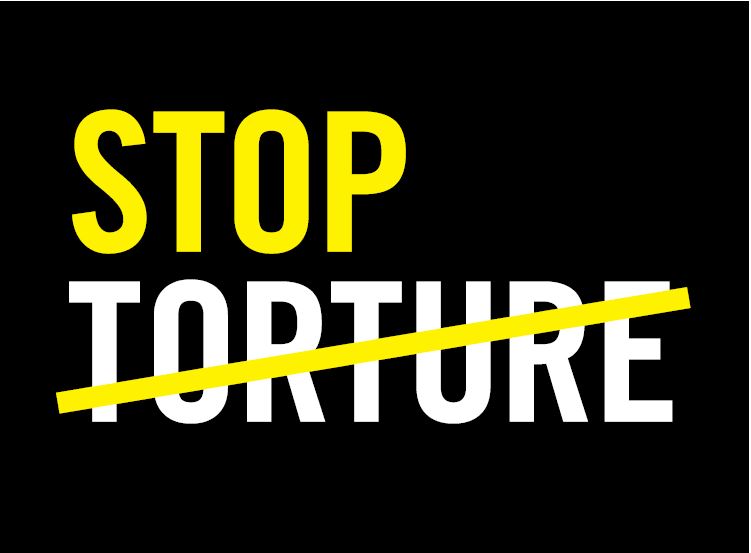
Stop Torture campaign


The local group will be manning a stand on 15 November to highlight the #stoptorture campaign which was launched by Amnesty in May this year.  The practice is alive and well throughout the world and Amnesty has recently ramped up its campaigning to stamp out the practice with the Stop Torture campaign.

'Waiting for the guards'
‘Waiting for the guards’

Ahead of its launch, Salil Shetty, Amnesty International’s Secretary General said governments around the world are “two-faced on torture” – prohibiting it in law, but facilitating it in practice”.

He added: “Torture is not just alive and well – it is flourishing in many parts of the world.  As more governments seek to justify torture in the name of national security, the steady progress made in this field over the last thirty years is being eroded.”

Stop torture will be a key part of the Amnesty display as part of the Magna Carta events at the Cathedral next year.

European Convention on Human Rights


Dominic Grieve was sacked by David Cameron in the last reshuffle and it was widely interpreted as a clearing of the decks by the prime minister of supporters of the Human Rights Act #HRA.  Grieve has now spoken on the issue and below is a link to the interview in the Guardian newspaper.

In an earlier piece, Dominic Grieve expressed his dismay that David Cameron had narrowed the range of views held by his senior team. The attorney general sacked by David Cameron over his dogged support for the European convention on human rights (#ECHR) says he fears the prime minister will use this week’s party conference to dilute the UK’s commitment to the international treaty.

The Conservatives have misgivings about the act partly because of their distaste for things European.  There has been a concerted tabloid campaign against the act and the ECHR because allegedly it gives rights to criminals and terrorists.  The benefits of the act to ordinary people is rarely given a mention however. They also publish a great deal of misinformation which is seldom corrected.

Readers may like to look at an earlier post following a meeting the group had with the Salisbury MP, John Glen.  He has said he wants to see the HRA abolished but after some of the benefits of the act for ordinary people – including some of his constituents – were explained, he did agree to be more balanced in future.

Guardian article


Nigeria


Moses Akatugba
Moses Akatugba

On Saturday 11 October we shall be manning a stall in Salisbury market to highlight the human rights situation in #Nigeria.  In particular, the case of Moses Akatugba who was tortured by Nigerian police to secure a conviction.  He was 16 when arrested, shot in the hand, beaten, and hung in an interrogation room for hours.  Pliers were used to extract his finger and toe nails.  His alleged crime was to steal three mobile phones.  Unfortunately, this ill-treatment is now a commonplace in Nigeria and there are reported to be ‘torture officers’ in police stations.

Executions were resumed in June last year when four men were executed in Benin city.  The bodies were not returned to the families for burial nor is the location of the graves known.

Amnesty has serious concerns about the increasing use of torture and other cruel, inhuman and degrading treatment or punishment in Nigeria.  Recent research by Amnesty indicates that police and military personnel routinely use torture and other ill-treatment to extract confessions and to punish and exhaust detainees.

Nigeria fact sheet (pdf)

You can also read about corruption in Nigeria here: Human Rights Watch: Nigeria

We look forward to seeing you in the market place on 11th.

Burma


There was rejoicing when Aung San Suu Kyi was released from detention at her house in November 2010.  It seemed at last that the political situation in Burma would improve and human rights and political normality would be established.  The IDC report Development and Democracy in Burma’  showed that improvements have indeed taken place.  Around 1000 political prisoners have been released; censorship has been reduced and trades unions have been formed.

This has led to a removal of controls put in place during the time of the general’s junta and trade links are being 3925established.  There has been a visit by Hilary Clinton and other politicians to the country.  There is a sense that things have improved and we can now relax as far as human rights are concerned.

Unfortunately, this seems to be a little way from the truth and that there are still serious things going on in the country.  Every quarter, the Foreign and Colonial Office publishes reports on ‘countries of concern’ and one such was for Burma in December last year.  According to the Burma Campaign UK, the FCO is seriously underplaying the human rights in Burma in its effort to promote the country for trade and investment.  One can see the attraction: Burma has the potential to be one of the richest countries in SE Asia with huge natural resources including the world’s largest source of teak and substantial oil resources.  The Chinese are of course interested and will have no interest in the human rights issues, hence a desire to see UK businesses getting their foot in the door.

Specifically, Burma Campaign say that the FCO report;

  • Falsely claims that Thein Sein ordered the release of all prisoners and persons facing trial for political activity
  • Fails to mention the human rights abuses against the Rohingya which have dramatically increased with violent attacks forcing 140 000 Rohingya people to flee.  Villages have been destroyed and women and children hacked to death
  • does not mention the arrests of thousands of political activists.

Médecins san Frontières were forced to stop work in another troubled state Rahhine because of threats and violence.

A picture is created of the EU and the FCO keen to promote trade in preference to human rights and even decline to mention ‘Rohingya’ for fear of upsetting the government there.

This seems to follow the pattern of several countries in recent times.  First there is concern expressed, sanctions are talked about and even imposed.  Then something happens in the country and normality of a kind is established.  There is a desire to establish contact and get things back to normal.  Then the country is forgotten and disappears off the news pages and political agendas.

There is nothing wrong in establishing trade with countries like Burma and there is an argument that trade can do a lot to promote better understanding between nations.  But Burma had to change its ways because it became more and more concerned that almost the only country willing to trade with them with no questions asked was China.  It needed to get the support of the West for its technology and to reduce its dependence on one country.  So the West still has leverage.

Campaigns against minorities are still being carried on and as far as the ethnic communities are concerned, it’s still business as usual.  Let us not forget Burma.

For further information go to www.burmacampaign.org.uk

Blog at WordPress.com.

Up ↑