Sport and rights


Major cycle races affected by protesters. Last stage of Vuelta abandoned

September 2025

La Vuelta a Espana is the tour of Spain cycle race and a major event in the cycling season. It follows the Tour de France and the tour of Italy, the Giro d’Italia. These are keenly watched by millions of fans and the teams are sponsored by commercial enterprises and countries. The last stage of the Vuelta had to be abandoned last week because of street violence. Cycling is fairly unique since races take place on ordinary streets and members of the public can see the cyclists close to.

The problem is one of the teams is sponsored by Israel Premier Tech and its presence is causing major headaches. There are threats to next year’s Tour de France which starts in Barcelona (there is an increasing tendency for these tours to start outside the home country). Indeed, the Giro started in Israel in 2018.

There is hardly any need to explain the problems with the war in Gaza, set to intensify with the attacks on Gaza city, leading to the deaths of over 64,000 Palestinians. Although the sponsor is a commercial firm, the website makes clear the deep involvement of the Israeli government and Netanyahu himself. It is a national team.

The boss of IPT, Sylvan Adams, is hard line in his approach to Gaza and is quoted as saying ‘Israel should finish the job in Gaza’. He calls the protesters ‘terrorists’.
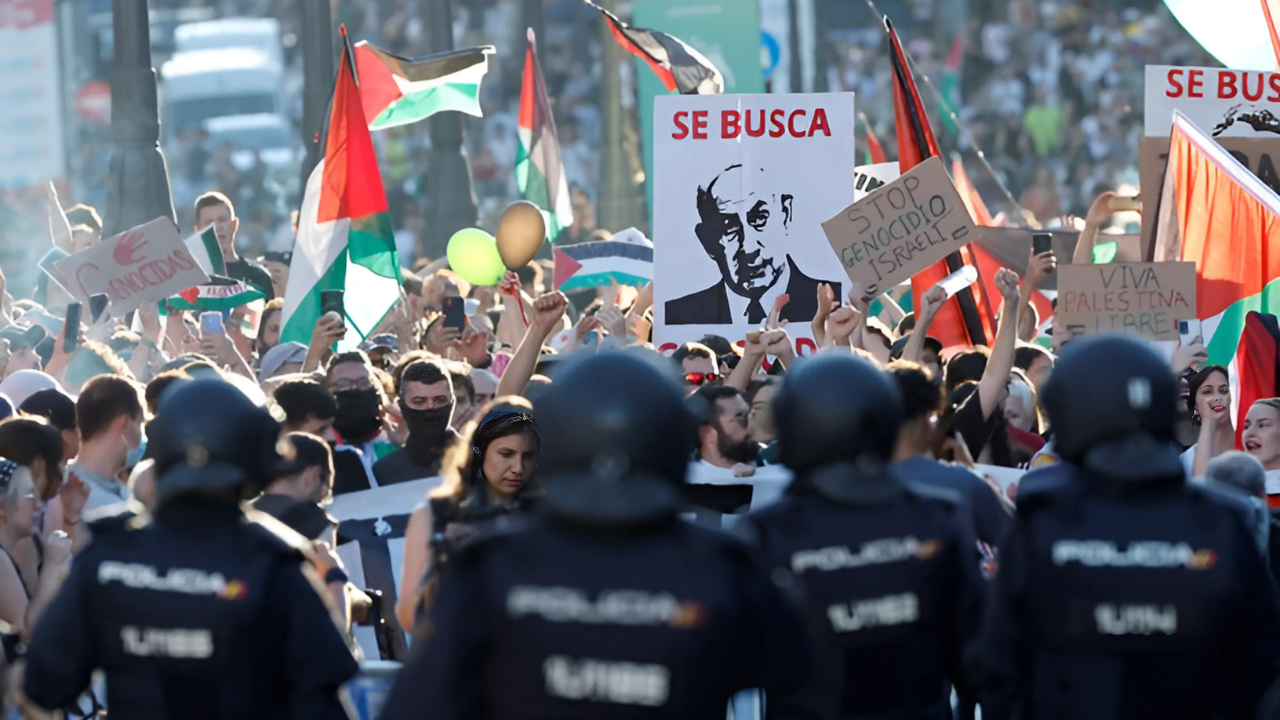
It is a major problem for race organisers since policing the roadside for three weeks is all but impossible. They are reluctant to ban or uninvite IPT because they are worried about being accused of being anti-Semitic. IPT is also extremely wealthy. Tour de France winner Chris Froome is on the team. The risk of disruption is high as we saw in Madrid. If the war in Gaza continues, protests are likely to grow and become more frequent.

It raises the question of sport and politics since countries like Israel are closely involved in teams as a means to promote themselves. Arab nations are spending billions engaged in the same thing. In the communist era, states like East Germany and Russia used sport to promote their ideology. The close involvement is a problem in times of war however. The involvement of IPT is only likely to intensify protests: there were two crashes in the Vuelta and two riders had to retire. The whole question of sport and politics is clearly an increasing issue especially as money is so important to success.

Latest posts:

Security


A significant step forward was made today against the excessive and arguably illegal interception of messages by the secret services and in particular, GCHQ. The hoovering of email, Skype, Facebook and other electronic messaging services was indiscriminate and is likely to have been illegal. Assurances that this surveillance is tightly controlled have been shown to be untrue.

wire tap imageThe ruling by the Investigatory Powers Tribunal (IPT) – a secretive legal body responsible for monitoring the shadowy world of the UK secret services – said that GCHQ’s access to (and use of) private communications swept up in bulk by the National Security Agency (NSA) breached human rights laws. This is the first time in its 15-year history that the IPT has ruled against an intelligence agency. The landmark verdict proves that mass surveillance sharing on such an industrial scale was unlawful, and a violation of our rights to privacy and to free expression.

Liberty, Privacy International and Amnesty, brought the case against the agencies, following the disclosures about mass surveillance made by whistleblower Edward Snowden in 2013. Thanks to Snowden’s revelations, the world is now aware of the extraordinary scale on which US and UK security services intercept and store our digital communications, including emails, messages on social networks and internet histories.

That includes not just the UK getting hold of what the US has picked up in its ‘Upstream’ and ‘PRISM’ programmes (which can cover Google, Facebook and other US-based internet platforms), but the UK’s very own ‘full-take’ Tempora system, which scoops up every single communication that passes through the UK. It’s very possible that highly sensitive communications between activists around the world have been monitored as part of these programmes. It also seems that journalists have been monitored as well as lawyers’ communications with their clients.

The IPT’s ruling acknowledged that the sharing of these communications between the US and UK governments violated human rights law until the end of last year. But even now the UK government will not publicly accept that these mass surveillance programs even exist.

The government has been playing a cat and mouse game over surveillance – talking about ‘national security’ while trying to cover up unlawful behaviour in its use of private data.

Secret rules about secret practices

Before this case was brought, there was simply no public information whatsoever about how and when the UK thought it could handle the data which the US had obtained. We had to force them to disclose what turned out to be a puny two-paragraph public summary of those rules during the case.  Due to that disclosure, the IPT ruled in December that the sharing of surveillance date between the UK and US is now lawful because there is supposedly enough ‘signposting’ in public about what is going on ‘below the waterline’.

So, that means up until that disclosure, the spying programme broke the law – but because they revealed a few vague details of how they gather and store that information – it’s now legal for them to continue doing so.

 Amnesty International strongly disagree with this decision.

Those forced disclosures made by the government are insufficient and fall far short of making its activities lawful.  We won’t stop here – we are planning to challenge the earlier ruling at the European Court of Human Rights.  But until then, while we’re pleased to see it acknowledged the programme has been unlawful up until very recently, the ruling means that the two spy agencies will retain unrestricted access to global communications with minimal safeguards in place.

We have argued before on this site that we accept that intelligence agencies have to intercept messages in their fight against terrorists and others bent on doing us harm. This interception must be under political control and scrutiny and done on a needs must basis. We also expect the media to keep a close eye on the politicians not least because trust in them is so low.

But what seems to have happened is that scrutiny consists of chats between the Security Commission and the security agencies and that there is a failure by the parliamentary committee to ask searching questions. The press have been largely silent and ineffective. It is no surprise therefore that the general public remain unconcerned about the activities of the security services. ‘I’ve got nothing to hide’ is a popular response. People seemed relaxed to see a reduction in their privacy to secure an imaginary increase in their security. Stories are frequently told of terrorist plots being uncovered by the use of such methods.

The bizarre thing is that if one asks the question of someone ‘do you trust politicians?’ you are likely to receive a ribald answer (or a black eye). Yet we seem to.

Blog at WordPress.com.

Up ↑