Steady erosion of rights continues


Changes to the European Convention latest moves

May 2026

The endless discussion about who shall be the leader of the Labour Party has meant the latest moves to whittle away rights has received little attention. The guiding influence is immigration, a factor which is a kind of idée fixe in our politics and seems to have the capacity to win or lose elections for individuals or parties. It is claimed that the UK’s membership of the ECHR is preventing us dealing with the problem and in particular the wish to deport people back to their country or origin.

It is not unique to the UK hence the declaration last week giving European governments more power to deport immigrants. The 46 members have decided that ‘states had an undeniable sovereign right to control their borders‘. The Home Secretary, Yvette Cooper, said ‘countries can [now] take action on illegal immigration‘. A questionable statement on many levels. The UK government wants to set up ‘hubs’ in foreign countries to process claims. It has been described as giving governments more ‘wiggle room’ to return migrants, even if there is a risk of mistreatment on their return. It is perhaps a measure of the moral collapse of our political parties that this agreement has generated almost no discussion and scarce mention in the media beyond the facts of the declaration.

Large sections of our community have no love for Europe and the Brexit beliefs still remain strong among many who also have believed at the time of the Referendum that the legal controls would be gone as well. The key proponent of Brexit and leader or the then UKIP party, Nigel Farage said last year ‘the Reform [his new party] will remove the UK from the European Convention and disapply International treaties‘. Reform did well in the recent local elections winning many seats and control of 34 councils. The loss on the other hand of so many Labour held seats has put the future of the prime minister under threat which is where we came in. .

The issues

There are many issues worth setting out:

– The concerns about immigration and the role of people not born in the UK is very one-sided. A number of politicians making most noise about immigrants are themselves – almost bizarrely – sons or daughters of … immigrants. Priti Patel, Suella Braverman, Shabana Mahmood, Danny Kruger and many more have parents not born in the UK.

– There is little recognition, in the desire to deport those already here, of the essential role immigrants and foreign nationals play in our society and economy. The health service for example could not operate at its current level nor could care and nursing homes for the elderly. London underground and bus services would be down to skeleton levels of activity. Much of our food would disappear off the shelves.

– No recognition of the fact that the rise in those coming by boat has been caused by government’s closing almost all means to claim asylum legally.

There are also issues of morality and rights which seem to get ignored or set aside.

– As Amnesty International has put it, it risks creating a ‘hierarchy of people‘. Those who enjoy rights under article 3 not to be subject to torture and those who do not. We are seemingly happy to trade and sell arms to countries which practice torture but we don’t want those fleeing it to come here.

– It shows a politics which is driven by populism and biased coverage. In all the press coverage about immigrants which fill the pages of the mostly right-wing media, there is next to no coverage of the large numbers emigrating. It creates the illusion of the country becoming full-up like pouring more and more water into a jug. GB News is at last to be investigated by Ofcom for not countering in an interview with Donald Trump claims that London had no-go areas for police and parts of the UK were governed by Sharia Law. The interviewer did not challenge the president on this nonsense and retransmitted the interview the following day.

– It attacks the most vulnerable and those least able to defend themselves.

– It panders to the belief that immigration and immigrants are somehow the cause of our economic malaise. Never mind weak investment, low productivity, lack of export growth, high interest rates, poor training and other policy failures, just ship out the immigrants and somehow Britain will be great again.

– It is just another step in the drip, drip, drip of steadily removing rights. The limits on the right to protest and increasing and often ill defined police powers. The various acts we have noted before e.g. Police, Crime, Sentencing and Courts Act 2022 and the Public Order Act 2023, with more legislation in the pipe line, are increasingly been seen as attacks on free speech. There is an attempt to reduce the number of jury trials. Juries have irritated politicians by freeing some people despite directions to convict by some of our reactionary judges.

We need to be much more aware of this populist drive to diminish or weaken our rights. The claims that the Human Rights Act is a ‘criminal’s’ or ‘terrorist’s charter’ is based on the false notion that such people are using the act to escape justice. Autocratic regimes almost always base their rise to power by finding a minority to foist onto the blame for the ills of society and their own failure to govern effectively. It is not done dramatically but bit by bit. It is not even true to say ‘by stealth’ as it is done in plain sight.

Local MPs John Glen and Danny Kruger are revealed by They Work for You, generally (Glen) and consistently (Kruger) to vote against proposed equality and human rights legislation. We cannot therefore rely upon either of these two gentlemen to support threats to our rights by these actions.

Sources: HRW, Civicus, Guardian, Irish Times, GB News, Standard.


Recent posts:

Thought of becoming a subscriber?

Trade Talks with China: Ethical Dilemmas Ahead


Government has to decide: rights or trade?

June 2025

It is reported today that the government is engaged in a range of talks with Chinese officials to improve trade and political relations. The Chinese Embassy is quoted as saying that relations have ‘positive momentum’. Elsewhere, relations are described as ‘warming’. Of course both countries are suffering from the Trump tariff war and so a degree of mutual comfort is to be expected.

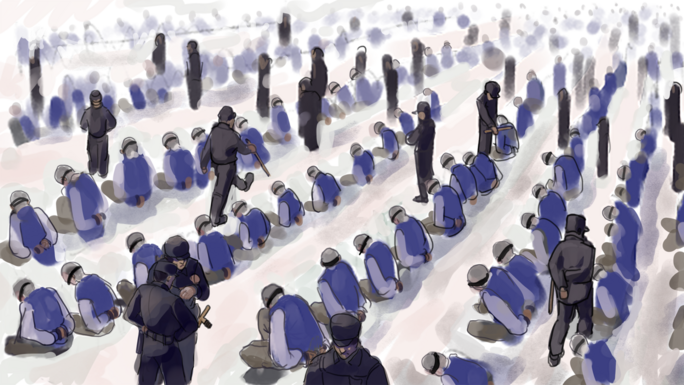
The fact remains that human rights in China are dire across a very wide spectrum, almost too long to describe in fact. They include no freedom of expression; atrocious and genocidal behaviour towards the Uyghurs and other Turkic peoples; Human Rights defenders who face long prison terms and torture; continuing repression in Tibet; the crackdown in Hong Kong and the execution of large numbers of its citizens – possibly equal to all the rest of the world put together. It is also aggressively pursuing overseas Chinese who criticise the country and persecutes any of their family members in China. Restrictions are getting steadily worse over time.

Azeem Ibrahim, speaking at the Humanist Convention this month, described the multi-pronged approach

adopted by the Chinese. It was a talk about the rising threat of autocracies which included Russia and Turkey. He pointed out that the country leads the world in surveillance and it has a massive programme using facial recognition technology. It is also working hard to gain access and control to international agencies in the UN for example. The Warsaw Institute describes how they use their commercial power and investments to shut down any Security Council criticisms of their human rights infringements. His basic message was that China in particular has an organised and well-funded programme to attack western values by any and all means available. He added that the West has been complacent in thinking that western values are a settled state of affairs.

So where does that leave the Labour government? It is reported to be softening its position now it is in government. Nine individuals have travel restrictions placed on them including 5 Conservatives: Ian Duncan Smith being one and Tom Tugendhat another. All because they criticised the treatment of Uyghurs. These restrictions might be lifted. The concern is that the government is desperate to achieve growth and seems willing to abandon all principles to achieve it although a trade deal is not on the cards. This site is concerned with human rights but the wider issue is western governments – like the UK – who seem very slow to wake up to the organised threat posed by autocracies like China who are determined to pursue their view of the world by all means possible.

Sources include: Human Rights Watch, Amnesty, Guardian, US Department of State, New China Human Rights.

Burma: a forgotten conflict


Violence continues in Burma while the West does little

August 2024

One thing which helps a tyranny to survive and prosper is for people to look the other way. In Burma, the military has held sway for many years now and there was a belief that they were invincible and would eventually win. Three million have been displaced according to the Burma Campaign although the UN calculates the figure to be 2.3 million. Burma seldom makes the news and certainly not in comparison with Gaza and Ukraine. This relative obscurity has enabled the military, the Tatmadaw, to continue its murderous campaign and the assumption of their eventual victory meant countries and companies kept their powder dry in terms of its relations with them.

The previous UK government’s responses ‘slowed to a standstill’ according to the Burma Campaign in their latest campaign news (Issue 46, 2024). A crucial issue was the supply of jet fuel and there has been a campaign to stop the supply of this fuel which is used by the military to bomb schools, hospitals and villages. At a meeting of the UN Security Council in April, the USA and Malta called on the Council to take action to stop the supply of this fuel. In itself this was a huge step. The UK government did not support this move and unfortunately, Britain leads on Burma in the Security Council (ibid).

The lack of attention by the British media meant little pressure was put on the Conservative government to take an active role. We now have a new government and Burma News asks ‘What does the new government mean for UK Burma policy?’ It is of course early days but it does not look promising. Sir Keir is focused on the domestic agenda but has spoken on the plight of the Rohingya in the past. Disappointingly, the Foreign Secretary, David Lammy has shown no interest both recently and while he was in opposition. Other Labour politicians have offered some support but they do highlight Rushanara Ali MP who was very active and was chair of the All-Party Parliamentary group on Burma and Rohingya. She is now a housing minister so cannot continue in that role.

Aung San Suu Kyi became a hero and her time under house arrest attracted considerable international attention and sympathy. It was a huge disappointment to discover upon release that the party she led, the National Lead for Democracy, was vigorously in favour of the Rohingya genocide. She defended the military at the Hague. Although the situation is complex the basic point is that there is no desire by the NLD for Burma to be a multi-ethnic state. They believe the Bamar to be superior and there is a desire is for it to be exclusively Buddhist. The West’s image of Buddhists also came in for a knock. She is however, a popular figure still in the country.

Attitudes and policies may need a rethink however because the military it now appears is losing ground. Far from being invincible, the People’s Defence Forces have been winning back territory in many parts of the country. The UK government’s softly, softly approach and the Foreign Secretary’s lack of interest may need to change.

Vigils continue


31st Vigil on 6 July. Labour’s relations with Israel now significant following the general election

July 2024

UPDATE 2: The new government has announced (8 July) that it is to drop its bid to delay the ICC’s intention to issue an arrest warrant for Netanyahu for alleged war crimes in Gaza.

UPDATE: It is rare for us to update a post only hours after its publication but we have mentioned the prime minister’s uncertain history in relation to Israel and today, 7 July, he has made a statement committing his party, and now the government, in support of a two state solution. This is to be welcomed.

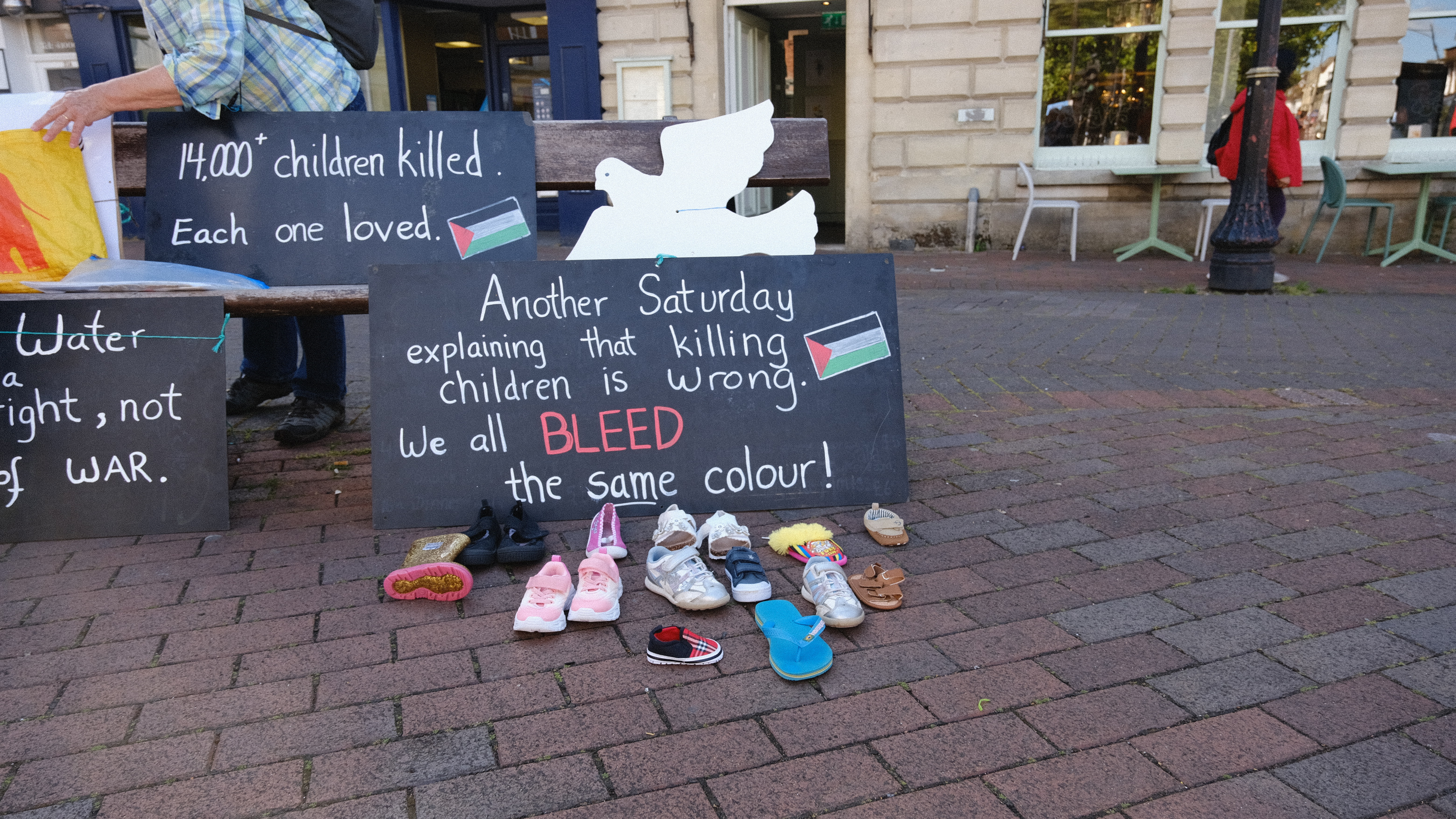
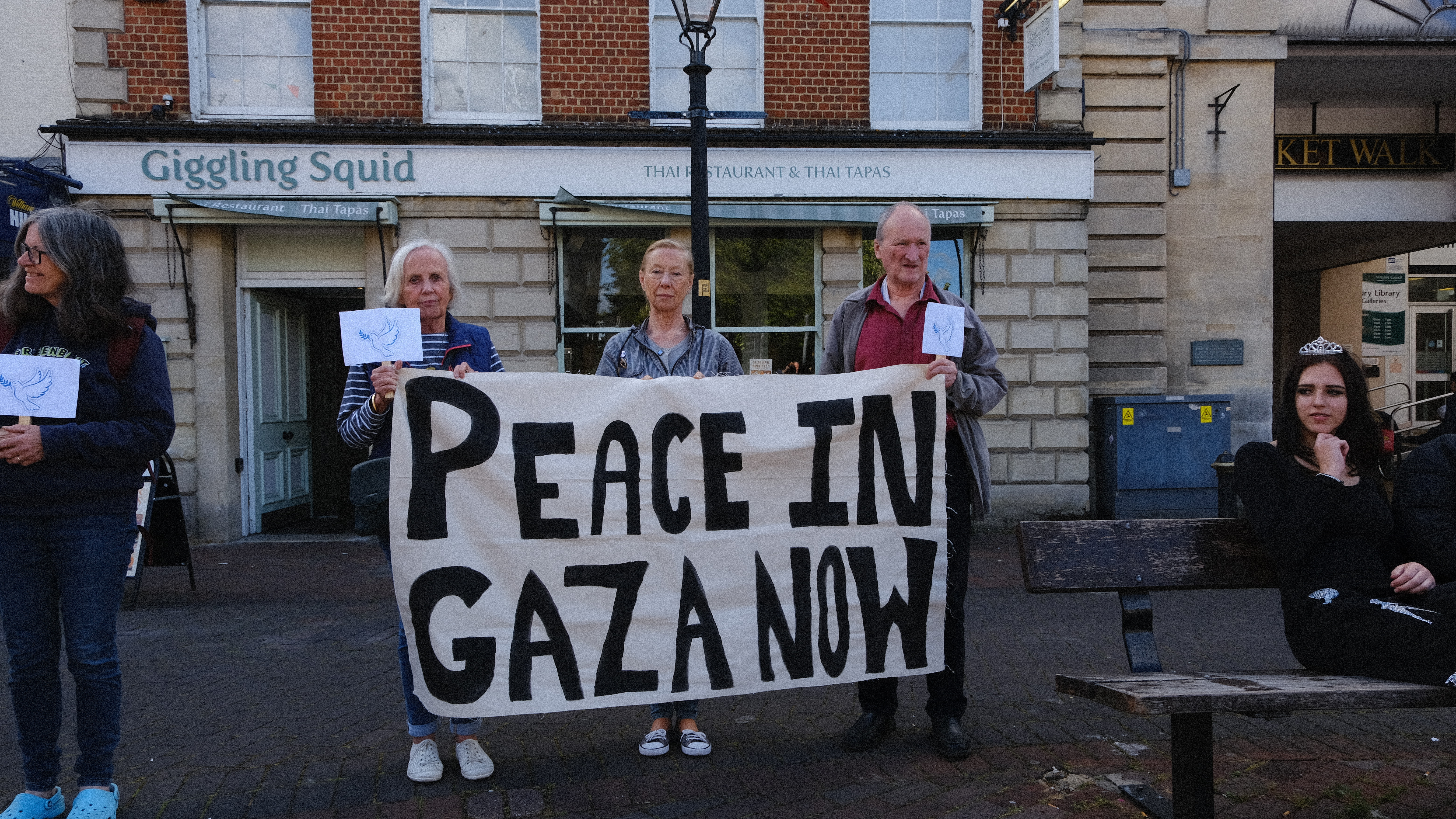
The vigils continue in Salisbury market place although attendance down to around 25. The conflict continues and although there are reports of peace talks, there is little confidence they will lead to a successful result. Around 38,000 Palestinians have now died including thousands of children.

The conflict spilled into the General Election which was held in the UK last week on 4 July and led to a landslide victory for the Labour party. However some seats were lost and others came close to being lost because of Sir Keir Starmer’s remark early in the election where he said that “Israel has the right to withhold power and water from the Palestinian people” then going on to say that “obviously, everything should be done within International law”. The problem is that collective action against civilians is against international law so the two comments contradict each other. Another, less noticed interview was with the Jewish Chronicle where Starmer was asked about apartheid in Israel and, despite the overwhelming evidence produced by a number of human rights organisations from both within Israel and outside the country that Israel was indeed running an apartheid system, said that Israel was not an apartheid state.

Arms to Israel

It is going to be interesting to see how the new administration handles the arms question and whether it allows further exports going to Israel. The problem for the party is that they struggled for some time to shake off the ‘anti-Semitic’ accusation following Jeremy Corbin’s time as leader. Arguably, this has led them to become fearful of making any criticism of Israeli actions and to become unquestioning supporters.

The Salisbury Amnesty group is 50 this year

Another problem for Israel – and by extension the western countries still continuing to support it – are credible reports of the widespread use of torture by the Israelis. These reports are from the UN; the International Center for Transition Justice; Middle East Monitor; Voice of America; al Jazeera and many others. In the current edition of Private Eye (No: 1627) in its ‘Gaza Watch’ column, is a report of the death in custody of Dr Iyad al-Rantisi in November last year. He was held in a Shin Bet interrogation facility. He was moving south with his family as directed by the IDF and was detained at a checkpoint. Six days later he was dead. A gag order forbade all publication of details of the case and the family have not been provided with an explanation.

He was not alone and a large number of other health care workers have also died. According to Health Care Workers Watch Palestine, 541 such workers have died at the hands of IDF to date, the highest number in any conflict in UN history. Other agencies report comparable numbers. Private Eye also quotes the EU’s European Civil Protection and Humanitarian Operations directorate which reports that 31 out of 36 hospitals in Gaza have been destroyed.

The next vigil will take place on Saturday 13th at 5pm and people concerned about the conflict are welcome to come along.

Protests

It’s perhaps also interesting to note that our protest is entirely silent and there are no loud-hailers. We undertake no violent actions and we do not chain ourselves to railings or other similar activities. We do not therefore infringe the previous government’s laws designed to limit protest. As a result we are ignored and we will not be reported on by local media. A matter on which to reflect for those who say they do not mind protests as long as they’re peaceful.

1720887540

  days

  hours  minutes  seconds

until

Salisbury Vigil

Execution spree continues in Florida


Man on death row for 34 years due to be executed May 2026 The pace of executions in Florida continues and the latest is Dusty Ray Spencer who has been on death row since 1992. Gov. De Santis has signed the warrant and the due date is noon on June 25th. Florida accounts for 40%…

Vigil following a horrific week


Global outcry following appalling treatment of flotilla activists May 2026 The world was shocked this week by the appalling scenes and the treatment of activists seized by Israeli forces on the high seas. A BBC video shows some of what went on. Around 430 activists were seized in the operation and were shown with their…

Podcast Episode: Rights Trade And Sustainability


Pip: Amnesty Salisbury keeps showing up — in the rain, at the park, in the footnotes of trade agreements nobody else is reading. Mara: That's the thread running through welland2's recent posts: rights under pressure, from ECHR reforms to death row to a sustainability fair in a local park. Let's start with where the pressure…

Taking the shine off Shein


Test for new Labour government over listing of Shein on LSE

July 2024

The new government – likely to be Labour after the election tomorrow – will have an early test in connection with the Chinese clothing firm Shein which wishes to list on the London Stock Exchange. Both Conservative and Labour politicians have been keen to support the bid whereas Wall Street declined for a variety of reasons and doubts about the firm.

Shein has grown at a phenomenal pace but there are many doubts about its finances. LSE is keen to list the firm and there are a range of banks including Goldman Sachs and JP Morgan ready and willing to assist. Today, it was announced the EU is changing the rules which enabled the firm to import millions of pounds of clothing yet avoid duties because each was individually packed thus taking them under the £135 rule.

But the main problem is how the raw material is sourced and the use of sweat shops via sub-contractors in Bangladesh and Vietnam. As we have noted before, about three quarters of the cotton produced by China comes from Xinjiang where there are credible reports of the use of forced labour. In addition is the appalling treatment of Uyghurs where nearly a million are being persecuted and whose culture is being systematically destroyed. It has been described as a crime against humanity and genocide. Shein rejects these allegations and says it is committed to good governance.

Another problem is that the firm is likely to be audited by one of the big four accountancy firms who have a dismal record when it comes to Chinese firms and have been fined on several occasions for accounting scandals.

The Labour party has been keen to court the City as part of its business friendly policy. Three shadow ministers have met Shein’s chairman. Will they play their part in welcoming Shein to the LSE to keep the city bankers happy or will they look closely at their labour practices, lack of transparency and the probable use of cotton from Xinjiang? Amnesty have said to allow them to list will be a ‘badge of shame’. It will be an early test for the new government: money v. morals.

Sources: Private Eye #1626; Guardian; Amnesty International; Stop Uyghur Genocide

Government’s anti-boycott bill a danger


Government’s anti-boycott, divestment and sanctions’ bill a threat to human rights

July 2023

This week (3 July) we have seen a major raid into the Jenin refugee camp by Israeli forces with reports of around 10 Palestinians dead and also deaths of Israeli soldiers (4 July). It is but the latest event in the long history of gradual dispossession of Palestinian land by settlers. Following the elections, settler forces have become more vocal. The justification for the raid is to root out terrorists who are killing Israeli settlers. In a previous post we noted that UK political parties are keen to deny that Israel operates an apartheid state with both Rishi Sunak and Sir Keir Starmer denying such a thing exists.

The government has introduced a bill giving special status to Israel, preventing the Secretary of State from exempting Israel and the territories it occupies from its provisions. It also treats Israel in the same way as the territories it occupies, which is contrary to UN Security Council Resolutions the UK has endorsed. 

The ‘anti-BDS’ Bill is another example of the UK government trying to shield Israeli authorities from criticism of their human rights violations, instead of ensuring they face concrete consequences for their breaches of international law. That’s why as well as opposing the Bill, Amnesty is calling for all UK Parties to support a ban on Israeli settlement goods. 

This bill is particularly dangerous given the Israeli prime Minister Benyamin Netanyahu announced plans just last week to press ahead with building even more illegal settlements in the Occupied Palestinian Territory, which is a crime under international law. This move will see more Palestinian communities lose their homes, more pain and more apartheid. 

Even if the bill becomes law, the government could and should still ban settlement goods, because they arise from clear breaches of international law.

Blog at WordPress.com.

Up ↑