Prisoner of conscience signing


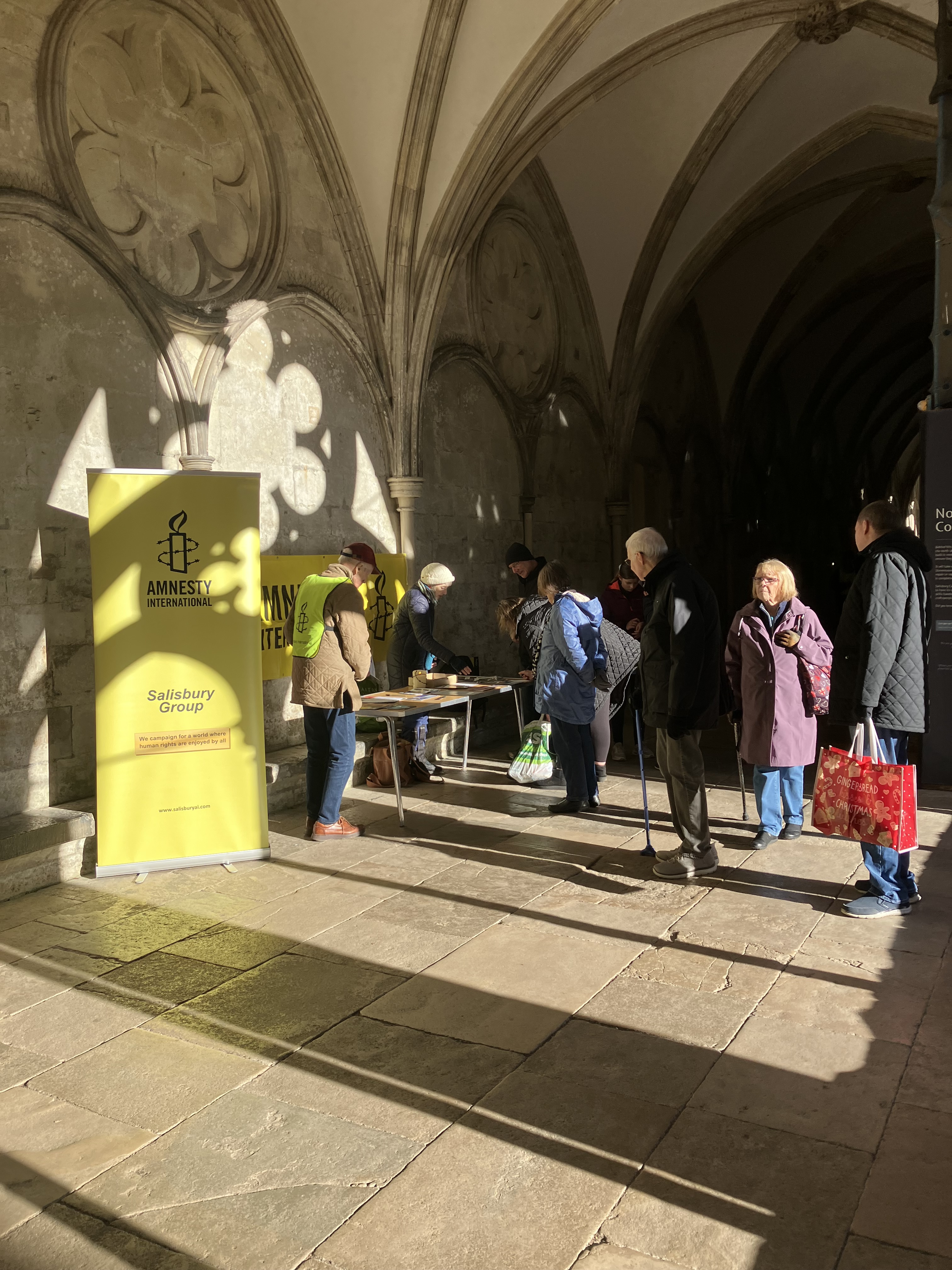
Salisbury group held its Write for Rights in the Cathedral

November 2025

The Salisbury group held a successful Write for Rights in the Cathedral Cloisters today and there was an unbroken file of people agreeing to sign. We highlighted two individuals and one group of individuals. The latter were Guerreras por la Amazonia who call themselves the ‘daughter of the earth’ who despite threats and intimidation, continue to demand climate justice for their communities. Climate issues are being seen more and more in human rights terms in recent years. The activities of resource firms who are deforesting large chunks of the Amazon, are having a dramatic effect on the wildlife and on he indigenous peoples. The group took action against Chevron-Texaco to limit the methane flares they emit.

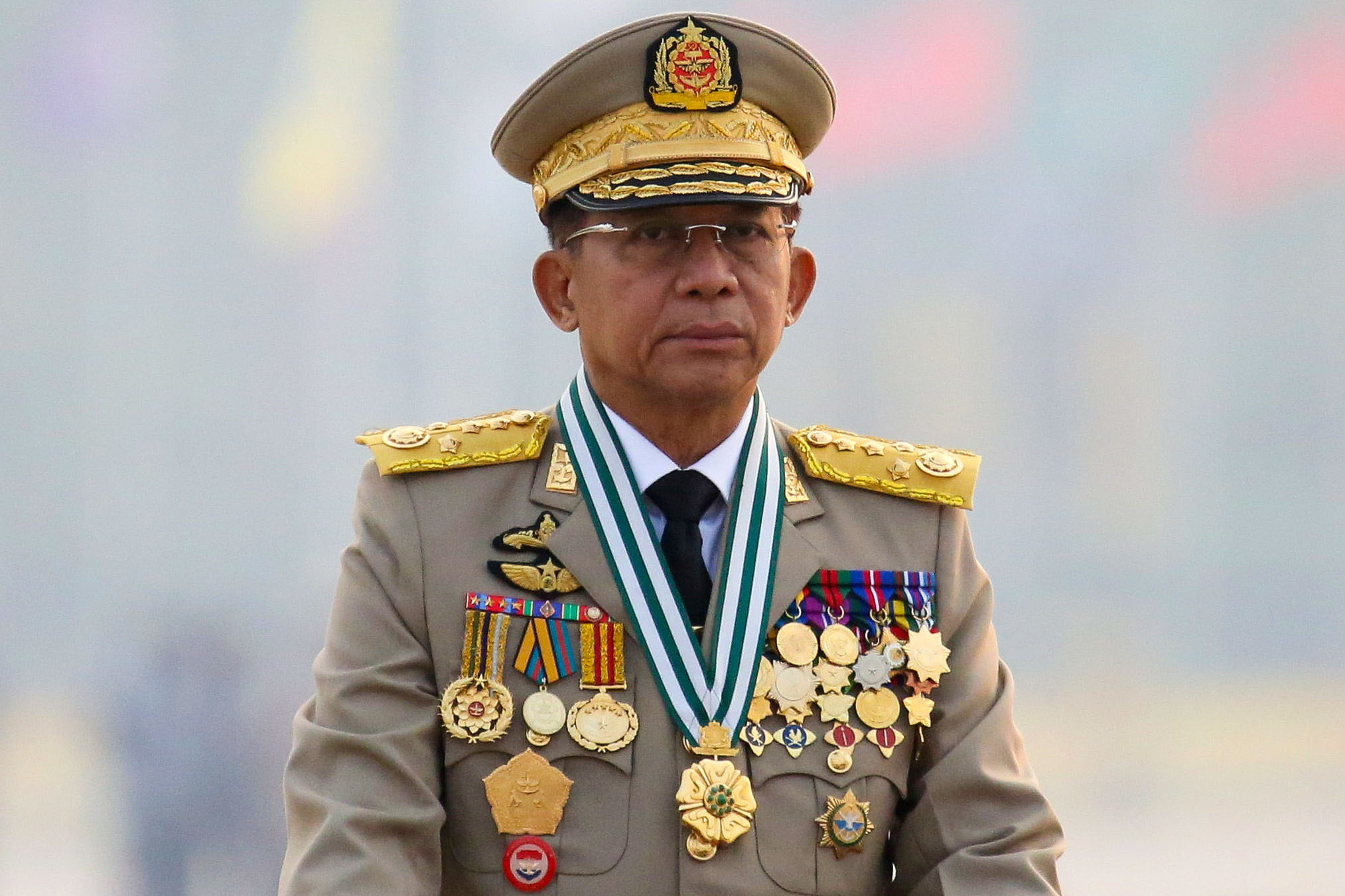
We highlighted Sai Zaw Thaike from Myanmar where the military junta still holds sway although a little less confidently these days. He is a photo journalist who was arrested 3 years ago and sentenced to 20 years of hard labour, tortured and held in solitary confinement for exposing what happened after cyclone Mocha.

Sonia Dahmani (pictured) from Tunisia was our third person. Sonia is a lawyer who has spoken out about racism, migration and prison conditions. She has been harassed and accused of spreading false news. She is under arrest and one of several who have been treated this way by the authoritarian president Kais Saied.

[Since preparing the Write for Rights, it appears that she has been released in the past few days. This is good news]

View of the signing.


Our thanks go to group members Andrew for arranging the event with the Cathedral, Fiona for organising the signing itself, and Tony, Val, Peter and Lesley for assisting on the day.

Latest posts:

Burma: the killing continues


Proposed elections are a sham. Sanctions are patchy and ineffective

August 2025

Myanmar, Sudan, Ukraine, Gaza: what links these current conflicts where thousands of women, children and the elderly die or have their homes destroyed? All are conflicts where the warring parties are equipped and supported by outside countries many of which are on the UN Security Council. Myanmar is armed and supported by Russia and China together with India and Austria with Singapore often acting as the go-between. Russia’s invasion of Ukraine is supported by China, Sudan by the UAE and Israel’s genocidal actions by America principally with other western countres in the frame including the UK.

It is unlikely these conflicts would be as deadly or last as long if it was not for this outside influence and support. The support takes different forms. The straightforward supply of weapons and military materiel. Providing the financial pathways to enable the regimes to engage in trade and pay for the weapons. Allowing western countries to trade with the regimes and buy their exports. And frustrating efforts by the UN to broker peace efforts or reign in the activities of the outside countries. The Security Council supporters of the regimes frustrate these efforts by vetoing motions and allow the carnage to continue. The noble aims of the post war era when the UN was formed and there was meant to be a new world order is in tatters.

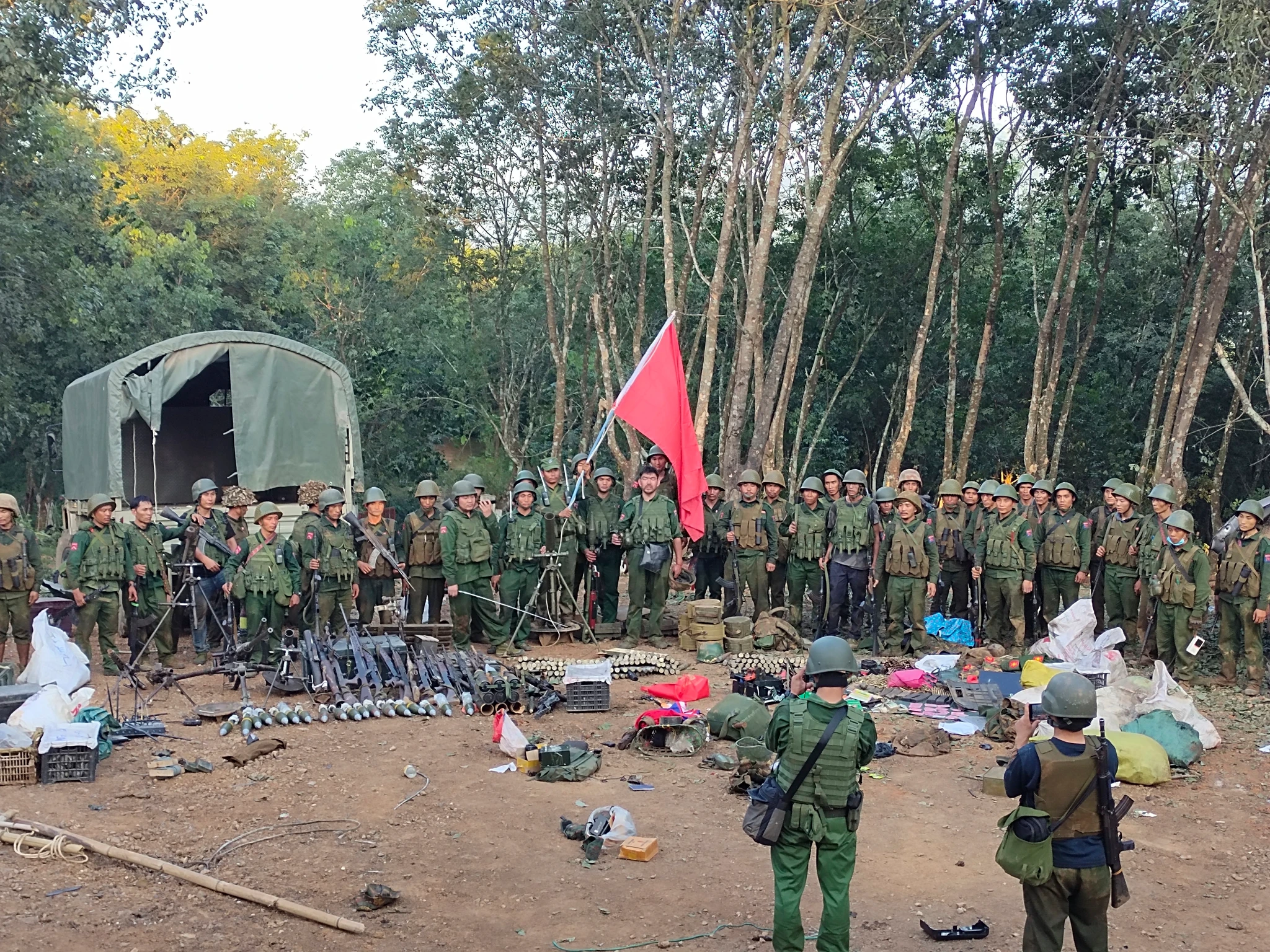
The latest edition of Burma Campaign News (Edition 48) is to hand and contains updates on the long running conflict in that country with 50,000 dead in the last four years. The country has slipped out of the news due largely to conflicts close to home and the difficulty and danger of reporting from there. After six decades of conflict, killings and attacks on minorities, the only good news is that the military is not having it all their own way. A combination of resistance, strikes, and economic boycotts, the military is slowly losing ground. The bombing of schools, hospitals and homes continues with around 5 million forced to flee. Elections are planned which will be a sham.

Many countries, including the UK, impose sanctions on the country. Unfortunately, as Office of the High Commission for Human Rights (OHCHR) points out in a report, these sanctions are not coordinated. This means there are gaps and what is sanctioned by one country may not be by another.

“There were 165 distinct entities sanctioned by the United States, European Union, and United Kingdom in response to the military coup in 2021.69 The report concluded that while the US, EU, and UK state that they are coordinating sanctions, there are significant missed opportunities to implement sanctions regimes in a coordinated manner. The report stressed that as of 1 February 2023, a mere 13 percent of the 165 entities were targeted by all three sanctions regimes, 20 percent by two, and 67 percent by only one. The report concluded that the gaps in the existing sanctions regime make it easier for the Myanmar military to evade sanctions. The report also noted that Member States seem reluctant to sanction high-impact targets such as Myanma Oil and Gas Enterprise (MOGE), which is sanctioned only by European Union, and aviation fuel, for which Canada has imposed wide ranging sanctions as of March 2023 and the UK has imposed targeted sanctions. 110. While these sanctions have been welcomed by the National Unity Government, Myanmar civil society, and international NGOs, they primarily regulate the engagement of persons under the jurisdiction of the Member State.70 As such, in the absence of economic sanctions imposed by the UN Security Council, third country actors are not legally prohibited from doing business with the sanctioned regime, person, or organization”. (Para 109)

A key source of revenue for the regime is the telecoms company Mytel described as the ‘jewel in the crown’ of the Burmese military and is highly profitable. The US sanctioned the company in January this year ‘for providing surveillance services and financial support to Burma’s military regime, enabling the regime to carry out human rights abuses through the tracking and identification of target individuals and groups’. The UK by contrast has not sanctioned them. Burma Campaign suggests contacting the Foreign Secretary asking for sanctions to be imposed: action.burmacampaign.org.uk/tell-british-government-sanction-mytel where there is a link.

A BBC report features the role of global arms firms in Burma.

A useful source of information on companies is to be found at the Business and Human Rights Resource Centre. Another useful site is Action on Armed Violence.

Recent posts:

Refugee report – October


October 2024

The problem of boat crossings has largely dropped out of the news recently with the conflict in the Middle East soaking up media attention. The Conservative party’s leadership election is also a focus of interest particularly as the two remaining candidates have hard line opinions on immigration.

As the new government prepares to reveal its Border Security, Asylum and Immigration Bill (largely designed to replace the jettisoned Illegal Migration Act), it is worth looking at the current situation with the small boats. Under the IMA, all applications are deemed inadmissible. This has left us with a backlog of 33,000 claimants in limbo (mainly Afghans and Syrians). Before the IMA, 90% of claims had been accepted. This might not be the case in the future as the Home Secretary also wants enhanced return procedures.

The high levels of pending cases has been exacerbated by the lower levels of acceptance (down to about 60% of cases) with a resulting big increase in the number of appeals. In passing, the Independent notes that the oldest asylum claim at the Home Office was made nearly 17 years ago. Also, Switzerland has improved its processing, which used to take up to 4 years, but is now about 100 days, which may be a pointer for a way forward.

The charity Safe Passage sees signs of improvement  (e.g. now allowing children to join relatives who are not parents) but meanwhile the total number of arrivals this year is over 25,000 – slightly more than last year but fewer than 2022. The government is keen to align with European procedures on irregular arrivals, but within Europe itself cracks are showing. This week 17 EU countries pushed for more effective return procedures for rejected applicants under the new Asylum and Migration Pact. At present the actual return rate for those to be sent back is only around 30%. An amended return process is presently stuck in the European Parliament.

Following the Ukraine war, the percentage of the world’s refugees in Europe has increased to over 20%. New research this week suggests that the numbers of irregular migrants in Europe is not increasing substantially (still at around 1% of the population for most countries). The MIrreM project calculate that between 2.6 and 3.2 million irregular migrants are living in the 12 countries they researched, with 594,000 to 745,000 in the UK. Figures are not completely reliable owing to many arrivals staying under the radar.

While we concern ourselves with the relatively small number of refugees arriving on the south coast, it is worth looking at the worldwide situation. With war zones in the Middle East, Sudan and Myanmar, not to mention Ukraine, the number of displaced persons has mushroomed in the last year. Ten million Sudanese have been displaced, 2 million to another country, 4.5 million Yemenis are internally displaced, while in Gaza 90% of the population and in Lebanon 1 million out of 5 ½ have had to move under Israeli attack, in some cases many times. In the larger Palestine, plus Jordan, Lebanon and Syria, there are 58 recognised camps housing 1.5 million refugees (1 in 3 of all Palestinians, some dating back to 1948. The UN authorities in the area (UNRWA and UNIFIL) have pointed out that many of the displaced inhabitants may well choose to head for Europe, adding to the pressure on countries there.

In Myanmar, not only  those under threat from the military, but also many Rohingya have left the country, about 1.3 million, mostly to Bangladesh.

AH

Burma: a forgotten conflict


Violence continues in Burma while the West does little

August 2024

One thing which helps a tyranny to survive and prosper is for people to look the other way. In Burma, the military has held sway for many years now and there was a belief that they were invincible and would eventually win. Three million have been displaced according to the Burma Campaign although the UN calculates the figure to be 2.3 million. Burma seldom makes the news and certainly not in comparison with Gaza and Ukraine. This relative obscurity has enabled the military, the Tatmadaw, to continue its murderous campaign and the assumption of their eventual victory meant countries and companies kept their powder dry in terms of its relations with them.

The previous UK government’s responses ‘slowed to a standstill’ according to the Burma Campaign in their latest campaign news (Issue 46, 2024). A crucial issue was the supply of jet fuel and there has been a campaign to stop the supply of this fuel which is used by the military to bomb schools, hospitals and villages. At a meeting of the UN Security Council in April, the USA and Malta called on the Council to take action to stop the supply of this fuel. In itself this was a huge step. The UK government did not support this move and unfortunately, Britain leads on Burma in the Security Council (ibid).

The lack of attention by the British media meant little pressure was put on the Conservative government to take an active role. We now have a new government and Burma News asks ‘What does the new government mean for UK Burma policy?’ It is of course early days but it does not look promising. Sir Keir is focused on the domestic agenda but has spoken on the plight of the Rohingya in the past. Disappointingly, the Foreign Secretary, David Lammy has shown no interest both recently and while he was in opposition. Other Labour politicians have offered some support but they do highlight Rushanara Ali MP who was very active and was chair of the All-Party Parliamentary group on Burma and Rohingya. She is now a housing minister so cannot continue in that role.

Aung San Suu Kyi became a hero and her time under house arrest attracted considerable international attention and sympathy. It was a huge disappointment to discover upon release that the party she led, the National Lead for Democracy, was vigorously in favour of the Rohingya genocide. She defended the military at the Hague. Although the situation is complex the basic point is that there is no desire by the NLD for Burma to be a multi-ethnic state. They believe the Bamar to be superior and there is a desire is for it to be exclusively Buddhist. The West’s image of Buddhists also came in for a knock. She is however, a popular figure still in the country.

Attitudes and policies may need a rethink however because the military it now appears is losing ground. Far from being invincible, the People’s Defence Forces have been winning back territory in many parts of the country. The UK government’s softly, softly approach and the Foreign Secretary’s lack of interest may need to change.

Burma


Hope is a possibility in Burma

April 2024

The news at present focuses on the terrible events in Gaza with over 33,000 dead and many thousands injured or missing. Even today, there is news of the death of aid workers three of whom are Britons. Russia’s invasion of Ukraine continues and there are problems in Sudan with thousands fleeing for their lives. News today seems to focus on one crisis at a time partly because of resources and partly because there is what some call ‘compassion fatigue’.

Burma and the terrible activities of the Burmese military has slipped off the radar somewhat but the latest news from the Burma Campaign has a hint of encouragement in it which is good news.

The situation up to now has been dire. The military, known as the Tatmadaw, have waged war on many of its own citizens and has run an apartheid state. Thousands have been driven from their homes, villages have been bombed and burned. Tens of thousands have fled to Bangladesh to escape the violence. Some of the methods used by the military are vicious beyond belief and include burning people alive.

The British government has not done enough to make life difficult for the regime. For example, the bombing is carried out by jets which need jet fuel to fly. The ships bringing in the fuel are insured in London and there seems little chance that this will cease. Recently, Lord Cameron headed a deputation of people to the far east, including Burma, and was accompanied by several representatives of arms companies. A big source of income for the regime is the export of gems by state owned companies and little has been done to restrict this.

But it seems there is hope. It appears the military is losing more territory as people fight to free their country from military occupation. The Economist has reported that more and more soldiers are deserting the army. There is real hope that the country could be free of the military. The Burma Campaign recently joined others outside the Foreign Office and showed placards with David Cameron’s head on an image of a snail. It was urging the government to act more quickly.

Sources: Burma Campaign, Amnesty UK, The Economist, CAAT.


The Salisbury group was established 50 years ago this year

Burma


Problems in Burma get overlooked because of events elsewhere in the world

August 2023

Burma crops up from time time in the news and this week (w/c 31 July) the partial release of Aung San Suu Kyi into house arrest briefly made it into news bulletins. These notes are taken mainly from Issue 44 of Burma Campaign News published by the Burma Campaign. The country remains subject to some of the worst treatment of people in the world with multiple examples of human rights infringements. Following a massive defeat of the military in elections in 2020, after half a century of control, they staged a coup the day after the newly elected government was due to take office and arrested Aung San Suu Kyi.

The effects of military control have been atrocious. Nearly 2 million have had to flee their homes. There are around 2000 political prisoners. The treatment of the Rohingya amounts to genocide. The military have been able to retain control because they can still acquire arms mostly from the Russian Federation but also from China, Singapore with smaller amounts from India and Thailand. The total amounts to around $1bn according to a UN report.

The Burma campaign has identified a ‘Dirty List’ of suppliers and have recently added 5 insurers who provide vital insurance cover without which the junta would not be able to acquire aviation fuel. They name the companies as UK P&I; Steamship Mutual; Britannia P&I and North Standard and Shipowners Club. The role of these companies was exposed by Amnesty in a report ‘Deadly Cargo‘. The UK government has so far failed to impose sanctions preventing British companies supplying aviation fuel.

While the situation in Burma is dire, the supply of arms and materiel from western countries is thought to have largely stopped according to the Campaign Against the Arms Trade. A major jewellery company has stopped sourcing rubies from the country. There have been two debates in the House of Commons and one in the House of Lords.

Little can be done to alter the situation especially while China, Russia and Singapore – the major conduit for arms – continue to supply the junta and enable them to stay in power. Singapore claims it has a policy to prohibit the transfer of arms to Myanmar, however, the UN report uncovered $253m of supplies shipped to the military between February 2021 and December 2023.

Cyclone Mocha hit the country in May and the military blocked aid to the Rohingya who were particularly badly hit as part of its genocidal policies towards them. An unknown number of people have died and many have lost homes, livestock and fields have been destroyed.

Attention on the country has often focused on Aung San Suu Kyi who was awarded the Nobel Peace Prize in 1991 and was admired in the West for her heroic stand against the generals. Her reputation suffered a precipitate slide during the Rohingya crisis where she seemed unwilling to condemn the military actions and even seemed to support them at the Hague. She was perhaps endowed with qualities which were unreal and her failure to condemn the brutality against a minority population was a truer indication of who she was. The decline in her heroic status is possibly a reason why attention has shifted away from the country and the continuing activities of the military.

An infographic can be accessed here.

Sources: UN, Burma Campaign, HRW, CAAT, Amnesty International, BBC

Death penalty report Nov/Dec


December 2022

The latest death penalty report for November/December is now available thanks to group member Lesley for the work in compiling it. At 8pp it shows there is a lot going on in the world and actions by Saudi authorities with their barbaric executions are particularly noteworthy. The distraction of the World Cup next door in Qatar no doubt helped to act as a shield. Note as ever that China remains the world’s worst executioner with numbers in the thousands but details are a state secret.

Good news!


Good news from Amnesty

30 September 2022

“With so much injustice spanning the globe, sometimes it’s hard to remain hopeful that things will change for the better. Trust me, I know – I am often the bearer of bad news, writing to you with urgency of crises, crackdowns, and individuals at risk who have had their human rights violated. But today, we wanted to let you know that the actions of Amnesty supporters around the world really do count. They’ve not only made a meaningful impact for human rights both at home and abroad – but thy’ve also helped change lives.

“Small actions from compassionate people like you, really do have big impacts. Here are just a handful from the past few months:

The first families from Myanmar, Syria and Afghanistan arrived in Australia under a new Community Sponsorship pilot

“After years of relentless advocacy, at the end of 2021 the Australian Federal Government not only announced the rollout of a new Community Sponsorship pilot – they also finally agreed to reduce dramatically the cost of Australia’s existing Community Sponsorship Program, making it more accessible for everyday Australians to participate and welcome refugees into their communities. In August of this year (2022), the first families from Myanmar, Syria and Afghanistan arrived in Australia to begin their new lives in safety.

Charges were dropped against a New South Wales legal observer

“Under NSW’s new and dangerous anti-protest laws, back in June a volunteer Legal Observer faced a maximum sentence of 2 years in jail and a $22,000 fine, after being arrested alongside 34 protesters.

“Amnesty made representations to the NSW police, calling on them to respect the right to protest, as well as the human rights of the Legal Observer. In August, her charges were dropped. Over 30,000 supporters continue to call on the NSW police to protect our right to protest.

“Legal Observers play a vital role in monitoring police & providing legal support to protesters. Thanks to the relentless advocacy from Amnesty International, Legal Observers NSW and Sydney City Crime, my charges have been recently dropped.” – Chloe Sinclair, Legal Observer

Texas: Ramiro Gonzalez’ execution was stayed

“Back in July, the Texas Court of Criminal Appeals (TCCA) stayed the execution for Ramiro Gonzales – just 48 hours before it was due to be carried out in Texas. Experts concluded that Ramiro does not pose a threat of future danger to society, due to the passage of time and his significant maturity. As of April 2021, 108 countries have abolished the death penalty for all crimes and 144 countries have abolished it in law or practice – all thanks to the power of ordinary people, continuing to stand up for what’s right! Our fight for global abolition continues.

People power freed Ahmed Samir Santawy from prison in Egypt

“Back in July, Ahmed Samir Santawy, a women’s rights and reproductive rights researcher, was convicted of spreading “false news” and sentenced to three years imprisonment. He was subjected to enforced disappearance for five days. Ahmed’s conviction was based solely on social media posts criticising human rights violations in Egypt.

“Over 10,000 people in Australia signed the petition demanding Ahmed’s release, and almost 5,000 people called the Egyptian embassy, putting further pressure on authorities – and it worked. In August, Ahmed was finally released from prison after being given a presidential pardon. Thank you for helping free Ahmed!

Ahmed reunites with his loved ones on the day of his release. ©Wies De Graeve

New York: We sued the NYPD for surveillance of protesters – and we won!

“In New York, facial recognition technology has been used to target people of colour in protests. Back in 2020, we asked the the New York Police Department (NYPD) to publish their data on facial recognition – and they refused. So we mapped their surveillance cameras with the help of 7,000 supporters, filed a lawsuit against them, and won.

“In August, they were ordered to disclose thousands of records of how they procured and used facial recognition technology against Black Lives Matter (BLM) protesters. This ruling recognizes that the NYPD broke the law in withholding this information and is a significant step in holding the NYPD accountable for its use of discriminatory surveillance.

LGBTQIA+ liberation soared across the globe 

“Thanks to LGBTQIA+ people and their allies at the forefront, back in July Switzerland’s same-sex marriage laws finally came into effect after overwhelming support of its legalisation in a national referendum last year. In August, the government of Singapore passed historic legislation to end LGBTQIA+ criminalisation. Shortly after, Vietnamese authorities said that being LGBTQIA+ should not be treated as an illness. The Vietnamese Ministry of Health called on medical professionals to ensure LGBTQIA+ people are not discriminated against, calling for an end to dangerous conversion practices – something over 40,000 supporters in Australia continue to campaign against, too. Solidarity!”

It is good to report successes from time to time.

(From and Amnesty message – lightly edited. The original contained photographs)

Death penalty report


August 2022

We are pleased to attach the current death penalty report for July/August 2022 thanks to group member Lesley for the work in compiling it. Iran and Oklahoma feature in this report together with Myanmar and Japan.

Latest death penalty report


We are pleased to attach our latest death penalty report thanks to group member Lesley for preparing it. It is a lengthy one – possibly the longest we have posted – as there is a lot going on, both positive and negative, on this topic. Note as ever that China is not reported on as information about executions are a state secret. China is believed to execute more of its citizens than the rest of the world combined.

Blog at WordPress.com.

Up ↑