125 and counting …


The vigils continue while terrible events take place in the Middle East

April 2026

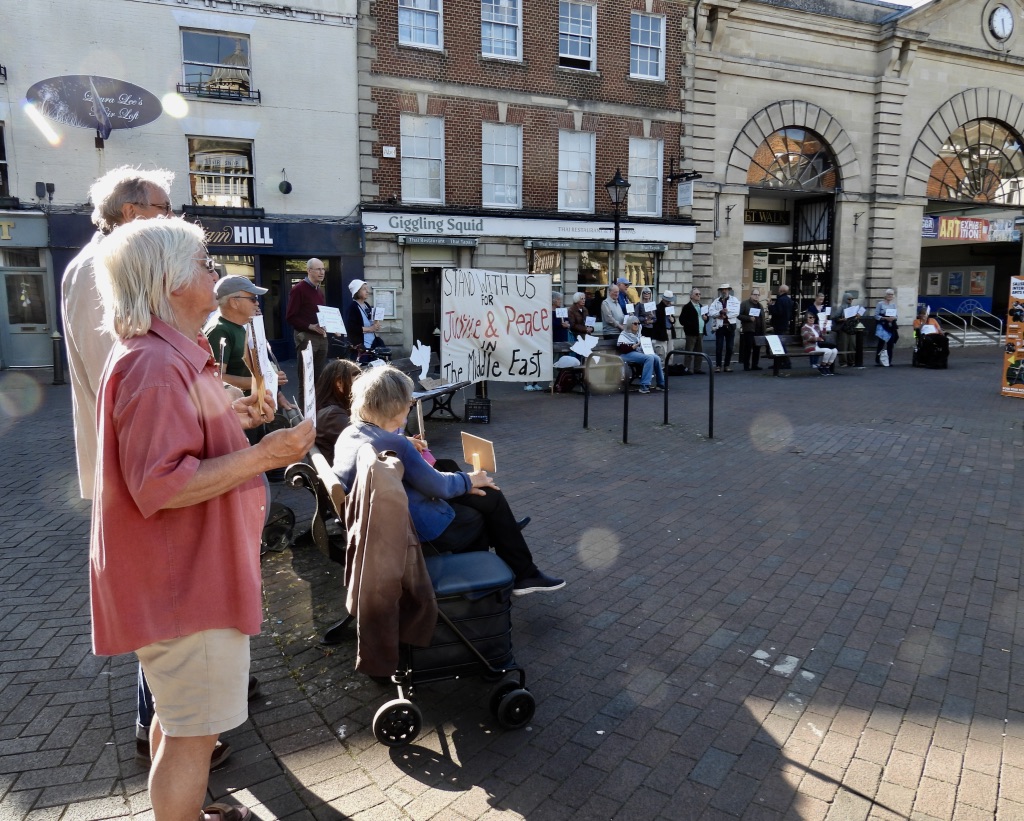
Over 30 attended our 125th vigil – an activity which we started with no intention of it lasting so long. But the violence continues, homes are being systematically destroyed in southern Lebanon, much of Gaza has been destroyed and the killings and starvation continue. So there is no let up and people need to be reminded of the terrible events which are taking place in the region and the suffering which is happening. The British government tries to play a double game of saying the right things and condemning the violence, but quietly continues to offer support and weapons to Israel.
Of interest is an article in the Observer newspaper concerning Forensic Architecture which forensically analyses and documents using architectural techniques, human rights abuses around the world. It was founded by a Jewish man Eyal Weizman who has just written a book Ungrounding: The Architecture of Genocide (Fern Press, pub. available on May 7th).  

He has devoted time to the genocide taking place in Gaza and his forensic methods enable a high degree of certainty to the crimes they describe. As usual with those pointing to these crimes, he has suffered de-platforming and the familiar accusations of anti-Semitism. This is especially inappropriate as not only is he a Jew but lost people ‘connected to my family’ as he put it, on October 7th massacre.

It is a long article but a particularly moving passages are:

“FA has also worked at a larger scale, mapping the pattern of expulsions driven by Israeli forces. On 13 October 2023, thousands of leaflets fell on Gaza City, telling residents to move out of what was now a “battlefield”.

“People were given 24 hours to evacuate. For some pro-Israeli commentators, this was a sign of humanity; that the IDF gave people the chance to avoid obliteration. Weizman calls the leaflets “some of the most lethal things to have fallen on Gaza”.

“They were the beginning of a pattern whereby people would be forced into hazardous journeys east and south towards the most barren parts of the [Gaza] strip, to the dunes where they would struggle to survive. Some would be attacked en route.

“Undergrounding tells how Israeli forces also attacked hospitals, schools, universities, mosques and churches. They destroyed orchards, farms, greenhouses, fishing boats, water desalination plants and wells. They polluted the land and the sea. They killed almost all the cattle, sheep, goats and poultry, blocked aid and attacked people who tried to receive it.

“According to Weizman “they engineered famine”. […]

He discusses the defence that Hamas are hiding in these facilities and therefore the destruction is justified. However, he argues that the scale of destruction show an intent that can only be called genocidal.

NGO Monitor the Jerusalem based organisation, says FA “through slick graphic presentations, [it] creates a façade of credibility to mask analyses that are consistently misleading, blatantly biased and based on unverifiable ‘evidence’,” (Israel does not allow independent journalists into Gaza).


May we draw your attention to the local CND website which has a number of posts of interest. Of particular note is the piece Murder Most Foul concerning the death of another journalist Amil Khalil and the practice of ‘double tapping’ that is after a bombing or missile attack waiting for medical staff to appear and mounting a second attack. In this case medical help was denied. The story was covered on Channel 4. At least 226 journalists have been killed in Gaza since October 7th making it the deadliest conflict in history.

72,344 have died in Gaza and over 172,000 injured, many of whom are children.

No sign of the local MP, Mr John Glen, who is a member of the well-funded Conservative Friends of Israel group and indeed, told the readers of the Salisbury Journal that he was a ‘proud member’ of the group.

Previous posts:

Photo: courtesy of Peter Gloyns

Human rights under threat


Many politicians lining up to weaken rights

September 2025

We have posted over the years of this site’s existence the near constant attacks on human rights, the act itself and more recently, the European Convention (ECHR) which is generating a lot of anger at present. Many of the attacks came from news outlets who were concerned about privacy issues in the light of their various hacking* activities. The attacks have morphed in recent years with greater emphasis on the ECHR and a widespread desire among politicians to leave it. The impetus for this latest surge follows the attempt to deport immigrants to Rwanda which was stopped at the last minute by the European Court from flying from an airfield a mile or two from where this is being typed. The policy was abandoned by Labour when it came into power.

This post draws heavily on an article in the Observer (14 September) by Rachel Sylvester entitled: Misinformation and myth: the UK’s phoney war on human rights. The article begins with the well worn disinformation stories the latest being the chicken nugget debacle. Immigration, asylum seekers, hotels and the boat crossings are making the political waves at present and a wide range of politicians are seizing on the unrest to make political hay. They include Nigel Farage (Reform), Robert Jenrick and Kemi Badenoch (Conservative). Locally, Danny Kruger MP for East Wiltshire, is a vocal opponent [Kruger switched from Conservative to Reform while this post was being written].

Chicken nuggets debacle

Chicken nuggets? The story was that an Albanian criminal could not be deported because his son disliked eating chicken nuggets. There was no such ruling. A senior judge made it abundantly clear that an aversion to chicken nuggets could never be enough to avoid deportation. The false story was latched onto by the politicians mentioned above. Since two are members of their political parties and one wants to become one, it is disappointing to observe that they keen to perpetuate myths.

The fury over the boat crossings has led to many politicians wanting to leave the ECHR despite the fact, the article notes, Strasbourg has only ruled against the UK three times in 45 years. In all the invective against the ECHR, its positive effects are seldom reported: Hillsborough being a prime example [Correction: 20 September. It was the HRA which was significant with this inquiry]. But in areas of the country where immigration is a particular problem, leaving the ECHR is a ‘test of ideological purity’ (ibid). It is also part of the Brexit story since many believed that when we left the EU we would leave the European Court as well.

Few friends

The court seems to have few friends however. Politicians who should know better, such as Richard Hermer the Attorney General, are talking in terms of ‘reform’. Reform might be all right but when reform = weaken it’s not all right. There seems to be a lack of stout defence of the act by politicians. Such is the ascendancy of Nigel Farage that it appears politicians of all stripes are desperate to ape his remarks or even try and outdo him. The Human Rights Act has made a significant difference to people’s lives in way many may not be aware of. It would be a huge loss to the country if as a result of hysteria over immigration, we were to lose some important rights.

*There is an ITV drama on this to air shortly.

Previous posts

The Maldives


Running with the hare, hunting with the hounds

The Campaign Against the Arms Trade CAAT, has recently shared with the Observer some research it has done into the record level of arms sales to countries with dubious human rights records (Britain sells record £3bn of weapons in a year to regimes that violate human rights, 29 May 2016).  We have over recent months posted several blogs concerning these arms sales to countries such as Saudi Arabia and also the involvement of British Service personnel in the bombing of civilians in Yemen.

We have also highlighted the government’s steady watering down of its human rights policies to enable more arms sales to take place.  The CAAT’s statistics show that more than £3bn of British-made weaponry was licensed for export to 21 of the Foreign Office’s 30 ‘human rights priority countries’ that is countries where the worst of the human rights violations take place.

Countries such as Saudi and Bahrain are familiar to us but less attention has been paid to the Maldives which does have a Salisbury connection.  The first elected leader of the Maldives Mohamed Nasheen (pictured) – who went to school in the city – has been sentenced to 13 years in prison allegedly for terrorist offences.  Amnesty has said the sentence was ‘politically motivated’.  It released a report in February which said that the government had been:

effectively undermining human rights protection by failing to strengthen the independent institutions of the state.

A local NGO, Transparency Maldives, issued a statement expressing concern about ‘irregularities’ in the legal process.

The MP for Salisbury Mr John Glen has also been busy making speeches, writing in the Salisbury Journal and on his blog about the situation there.  He says that Nasheed’s sentence was ‘illegal’ (Time to promote freedom in the Maldives, 17 May 2016).  He goes on to say:

Last year, Nasheed was put on trial on politically-motivated and completely false charges of “terrorism”, found guilty and sentenced for 13 years.  In the course of his trial Nasheed was prohibited from presenting any evidence or calling witnesses, with the court pre-emptively concluding that no testimony could refute the evidence submitted by the prosecution.

Another 1,700 people face criminal charges for peaceful political protest or speech, and journalists have been assaulted, arrested or disappeared.  Attacks on the Maldives’ independent press have intensified in recent weeks to the extent that the Maldives’ oldest newspaper, Haveeru, has been prohibited by court order from publishing its daily print edition.

He concludes his blog by arguing that pressure should be applied to the Maldivian government:

Pressure must be increasingly and continually applied to compel the Maldives Government to release its political prisoners and allow freedom of the press. I hope that CMAG [Commonwealth Ministerial Action Group] will be able to greatly improve the situation but if not we should not be afraid to countenance targeted sanctions, such as travel bans and asset freezes, on the leadership of the Maldivian Government.

All this is commendable and it is good to see an MP arguing forcefully for human rights in a place such as the Maldives.  The problem however is the arms sales.  As the Observer article makes clear, quoting Andrew Smith of CAAT ‘These arms sales are going to countries that even the Foreign Office accepts are run by some of the most brutal and repressive regimes in the world.’

So while we may praise Mr Glen for raising this matter in Parliament and in the Journal and on his blog, the fact remains that the department granting these licenses is the Department for Business Innovation and Skills in which Mr Glen is the PPS to the Minister.  The Ministry simply says that the department

The Government takes its arms export responsibilities very seriously and operates one of the most robust arms export controls regimes in the world.

Some may argue that Mr Glen’s position is inconsistent:  making speeches about human rights violations in the Maldives while working for a department which is busy allowing the sale of arms to them.  Others may choose to use a harsher word.


Blog at WordPress.com.

Up ↑