Hillsborough


Today, 15 April 2024, is the 35th anniversary of the tragedy

April 2024

Thirty five years ago today, 97 people died at the Leppings Lane end of Hillsborough stadium during an FA Cup semi-final between Liverpool and Nottingham Forest. Once the immediate shock of the death toll had passed, much of the media and South Yorkshire police put the blame on the supporters and in particular those from Liverpool for the tragedy. This blame became the standard narrative and was part of the judicial narrative as well. Plentiful lies were told and a headline in the Sun newspaper has meant the paper is no longer sold in Liverpool to this day.

The copious lies told by the police meant inquests were thoroughly unsatisfactory and the families of those who died spent decades in an attempt to get justice. Why it has appeared on this site is because justice was not achieved until the right to life provisions in the European Convention on Human Rights, now part of UK law, came into force. That, together with funding support, meant the police could be cross questioned and a jury returned a verdict of unlawful killing. Previous poor decisions by judges and a coroner were overturned. A report by the Hillsborough Independent Panel said:

The disclosed documents show that multiple factors were responsible for the deaths of the
96 victims of the Hillsborough tragedy and that the fans were not the cause of the disaster.
The disclosed documents show that the bereaved families met a series of obstacles in their
search for justice
“.

Today, in the light of the government’s desire to deport refugees to Rwanda – a final decision on which might be made in parliament this very week – will find that it is in direct conflict with ECHR. The Conservatives are divided on this and some, like local Devizes MP Danny Kruger, do not believe we need the court and object to Strasbourg effectively overriding our judicial system. He and others believe our system of justice based on the Common Law is sufficient protection. The prime minister Rishi Sunak in a recent statement believes that controlling immigration is more important than ‘membership of a foreign court’.

Common law, or indeed any law at all, did not save the Hillsborough families the decades of distress, dire judicial decisions, police lies and media denigration they have had to endure. The judicial system also failed to make anyone accountable for the wrongdoing and bad decisions which led to the disaster. It is interesting in researching this post and looking at the reports of the anniversary, how little or no mention is made of the ECHR in the the right-wing papers. Yet it was crucial in achieving justice for the families. Mr Kruger and others have a rosy view of our justice system despite what Conor Gearty refers to in a discussion of a succession of miscarriages of justice in his book On Fantasy Island*,The role of judges in all this was either passive legitimisers of state abuse or – more scandalously – as drivers of wrong convictions in the first place’ (p40). He goes on to refer to how they seem somewhat impervious to ‘a succession of judicial debacles’ (ibid).

Hillsborough showed conclusively that we need the protections of the ECHR since our own legal system so often fails to offer protection to the ordinary citizen.

*Oxford University Press, 2016

Refugee report


April 2024

This month, the report starts with the EU. The Freedom United charity note that so far this year more than 200 people have died trying to leave Libya, many shot by the Libyan Coast Guard. The EU continues to help fund the LCG, and the Institute of Migration say that 600,000 people are trapped in Libya seeking to get to Europe. Needless to say, there are many allegations of breaking international law in this crisis.

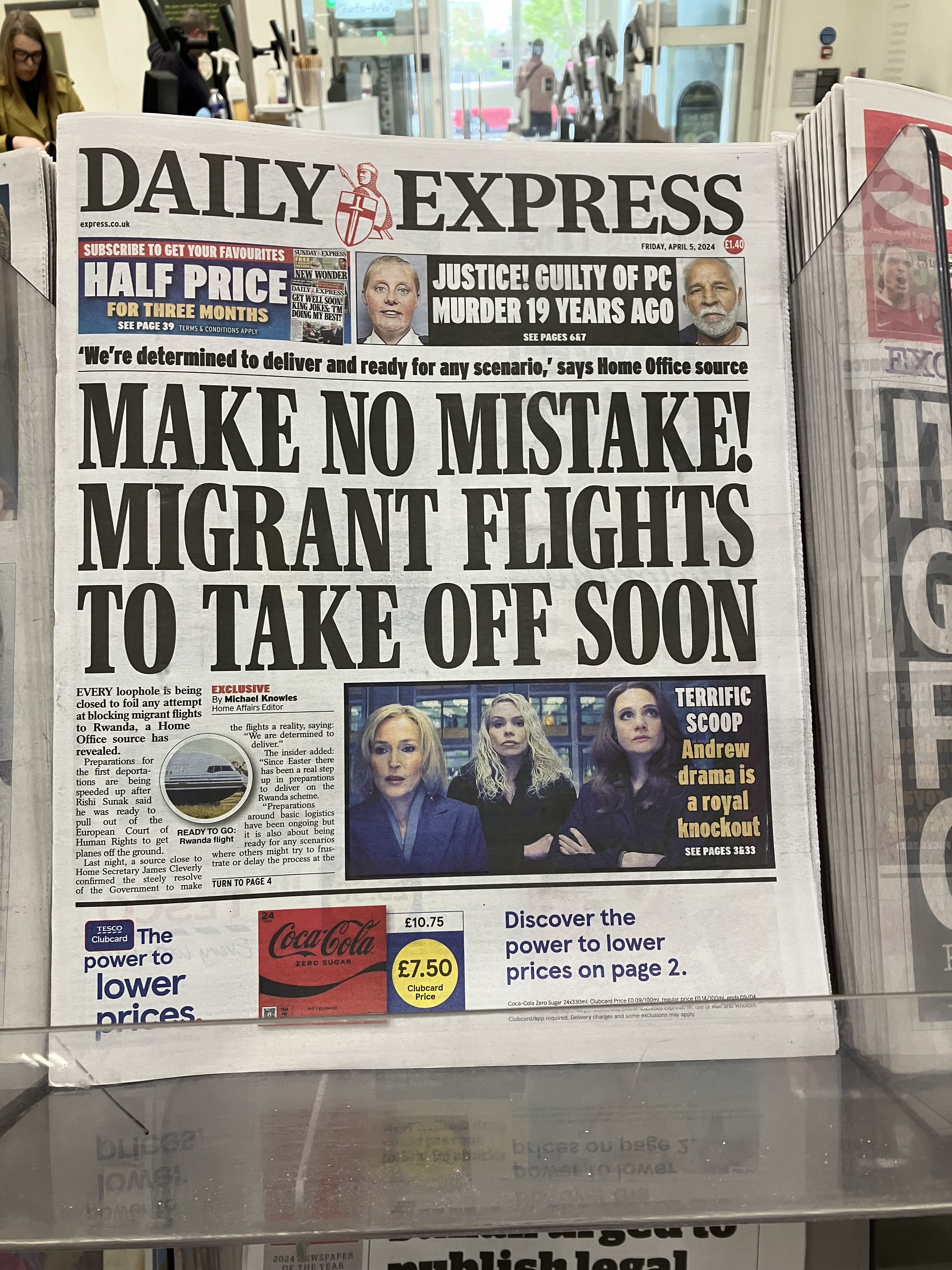
Also beyond the UK, the latest news from Rwanda is that, following the lack of progress in deportations, 70% of the properties allocated to receive deportees have now been sold to local buyers. On this topic, the Rwanda Bill returns next week for more ping pong – it could yet go for the Royal Assent within a few weeks. Judges are being given “special training” to ensure speedy delivery of those to be deported to Rwanda, according to the Daily Express. The airline Air Tanker is reported to be in discussions with the government about providing the transport, although they withdrew from previous similar discussions. RwandAir has already declined for fear of reputational damage.

The Prime Minister has claimed that 24,000 irregular migrants were deported last year. Full Fact have checked this and argue that only about 25% were enforced returns, the rest being voluntary. The number of arrivals in small boats this year stands at 4,644 at the end of March – bad weather has reduced the number in the last few days, but the figure is still higher than last year.

Charities and law firms have sent a letter to the Home Secretary seeking a Ukraine-style visa scheme for Palestinians who have family in the UK. The Home Office has also refused to decide on whether to drop the need for biometric data for reuniting family

arrivals from Gaza, although obtaining such data is virtually impossible in the crisis; the Upper Tribunal ruled against the Home Office in two test cases.

In their annual report, the Office of the Immigration Services Commissioner note that the number of immigration advisers at the Home Office is growing, but not fast enough to keep up (and large numbers are leaving).

Finally, back to Europe, where the European Parliament has passed the Pact on Migration and Asylum today (Wednesday 10 April) against votes from the extreme right and extreme left. The 10 provisions of the pact cover issues like relocating from over-immigrated countries, financial allocation, fast-track routes and exchange of data.

A group of 22 NGOs has issued a statement arguing that “while the adoption … is likely to lead to a detrimental degradation of people’s access to protection in Europe, the new Union Resettlement Framework (URF) adopted alongside the Pact offers a glimmer of hope.

“The URF signals the EU’s political support for global resettlement efforts and has the potential to be a step towards advancing solidarity, capacity-building and responsibility sharing. It must now be operationalised effectively to ensure that more people reach safety and find long-term solutions,” the groups, which include the International Rescue Committee and Oxfam, said.

Andrew Hemming

Burma


Hope is a possibility in Burma

April 2024

The news at present focuses on the terrible events in Gaza with over 33,000 dead and many thousands injured or missing. Even today, there is news of the death of aid workers three of whom are Britons. Russia’s invasion of Ukraine continues and there are problems in Sudan with thousands fleeing for their lives. News today seems to focus on one crisis at a time partly because of resources and partly because there is what some call ‘compassion fatigue’.

Burma and the terrible activities of the Burmese military has slipped off the radar somewhat but the latest news from the Burma Campaign has a hint of encouragement in it which is good news.

The situation up to now has been dire. The military, known as the Tatmadaw, have waged war on many of its own citizens and has run an apartheid state. Thousands have been driven from their homes, villages have been bombed and burned. Tens of thousands have fled to Bangladesh to escape the violence. Some of the methods used by the military are vicious beyond belief and include burning people alive.

The British government has not done enough to make life difficult for the regime. For example, the bombing is carried out by jets which need jet fuel to fly. The ships bringing in the fuel are insured in London and there seems little chance that this will cease. Recently, Lord Cameron headed a deputation of people to the far east, including Burma, and was accompanied by several representatives of arms companies. A big source of income for the regime is the export of gems by state owned companies and little has been done to restrict this.

But it seems there is hope. It appears the military is losing more territory as people fight to free their country from military occupation. The Economist has reported that more and more soldiers are deserting the army. There is real hope that the country could be free of the military. The Burma Campaign recently joined others outside the Foreign Office and showed placards with David Cameron’s head on an image of a snail. It was urging the government to act more quickly.

Sources: Burma Campaign, Amnesty UK, The Economist, CAAT.


The Salisbury group was established 50 years ago this year

Refugee News


March 2024

As usual, we lead with Rwanda. The Lords have been inflicting a number of defeats on the government over the provisions of the Bill, and the “ping pong” between the two Houses will reach a climax next week, when we will know which, if any, amendments the government will accept. Further issues have arisen over the role of the civil service in the planned scheme, with the FDA union threatening legal action against the government in the event of a clash with the European Court.

The National Audit Office has calculated the cost of the first (total?) 300 deportees to Rwanda to be £541 million, at £1.8 million per person. Indeed, the cost to date is £20 million with no flights. Ian Dunt has calculated that the cost per asylum seeker generally in 2015/6 was £7062, whereas in 2022/3 it was £20921.

The latest wheeze, as revealed in The Times today (Wednesday) is simply to pay failed claimants £3000 for a  “voluntary return” – to Rwanda.

Figures released this month show that, as of 23 December 2023 the number of asylum seekers waiting for an initial decision was 128,000. The Government, of course, has claimed to have removed most of the legacy backlog, so most of these are new.

The sacking of the Independent Chief Inspector of Borders and Immigration has resulted in the sudden release of the plethora of reports he wrote, which had not previously been published. They mostly concern the implementation of the Nationality and Borders Act 2022 and are generally critical of the Home Office’s performance. It is unlikely that a replacement for Mr Neal will be found before the end of this parliament.

Refusal rates for asylum seekers went up in the last quarter of 2023, with a  third of applications refused. This is unusual, as most applications end up being accepted.

The rules on Ukrainian refugees’ visas changed last week (with 4 hours notice of implementation) – The Family Scheme was closed though the Homes for Ukraine scheme is extended, but will not be processed until 2025.

This week the Council of Europe Commissioner for Human Rights, Dunja Mijatovic, criticised the Rwanda scheme along with certain French actions as acting above the law. She was concerned that two large European nations were giving a bad lead to the rest.

A small boat arrival, Ibrahima Bah, was sentenced this month to 9 ½ years in jail for “facilitating illegal entry, gross negligence and manslaughter “ following the deaths of fellow passengers. He is the first shipwreck survivor in the UK to face such charges and was not a people smuggler, but a refugee left in charge of the boat. The court concluded his age was 20, but he claimed to be 17.

Andrew Hemming


The Salisbury Group was established 50 years ago this year

The Salisbury Vigil


Strong presence for the Vigil continues in the cause of peace in Gaza

February 2024

A YouTube video composite of the twelve vigils so far held has been made and can be accessed here. We are grateful to Peter Gloyns for this.

A vigil is held every Saturday in the market square in Salisbury which receives a continuing high level of support. The twelfth one was held on 24th February, starting at 5:45 pm and lasting half an hour. Just over 50 attended. The aim is to promote the cause of peace in Gaza and Israel generally. Violence continues in Gaza and there is an expectation that the death toll will reach 30,000 this week. Thousands more have been wounded. Many of the dead are women and children.

There is talk of negotiations leading to a ceasefire but whether this is so is questioned: Hamas representatives say not, Israel negotiators say maybe. Let us hope there is success.

The scale of destruction is Gaza is immense and will take colossal sums of money to put right.

The Vigils will continue through March and all are welcome.

The Salisbury group was established 50 years ago this year

Scrap anti-protest laws


The government should scrap the anti-protest laws it has passed

February 2024

This call was made in the current edition of the Amnesty magazine and refers to various laws the government has passed to curb or prevent protests taking place. The first is the Police, Crime, Sentencing and Courts Act 2022 and the second is the Public Order Act 2023. They were introduced mainly as a result of climate change protestors who carried out a range of protests and campaigns which were not popular with the government, the right wing media or some of the public. 

Protests, violent or otherwise, have been a feature of Britain’s political life for centuries. Indeed, the Conservative politician Ian Gilmour, who served in Mrs Thatcher’s cabinet, wrote a book Riot, Risings and Revolution: Governance and Violence in Eighteenth Century England, (Pimlico, 1993) which described the considerable number of such things which were a regular feature of life at the time. So the activities of Extinction Rebellion are neither new nor especially harmful in the light of history. It’s possible that the two Home Secretaries who pushed through this legislation were both daughters of immigrants who may not have been aware of this history. 

It is also ironic that both politicians, who are female, owe their right to be an MP – or to vote at all – to the actions of suffragists and latterly, the suffragettes who campaigned violently for those rights It is also ironic that the suffragists campaigned peacefully for around four decades and made little progress – arguably none. There were many campaigns which have led to positive change viz: ending Apartheid in South Africa, the Chartist movement, ending slavery and protests leading to the Great Reform Act. It is true to say that many of the rights we enjoy today, owe their existence to a protest of some kind to achieve them. 

It is also a sad fact of life that peaceful protests usually get ignored. There are many marches, some quite large involving many thousands, which get no coverage. But once violence erupts, it becomes news. Governments do not like protest and see them as some kind of threat to their right to govern. But protest is about the only way ordinary people to make their concerns heard or to promote change.

Both acts should be scrapped.  


Nigerian protest


Members of the Salisbury group took part in Humanist protest in 2022

February 2024

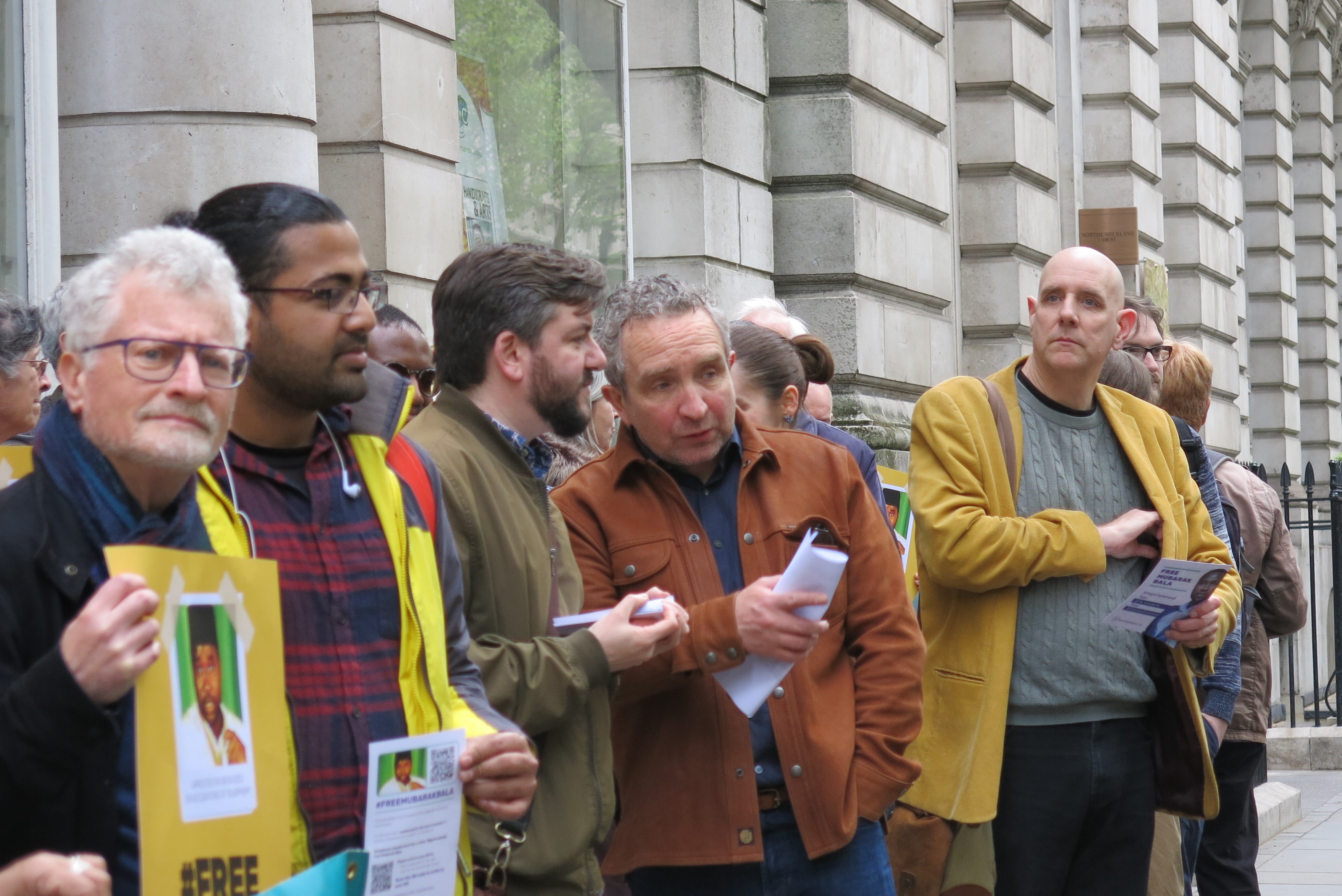
Pictured: Humanists UK’s #FreeMubarakBala protest outside the Nigerian High Commission, London, 2022. Two members of the Salisbury group can be seen, centre. Picture: Humanists

MPs have raised the case of Mubarak Bala, imprisoned President of the Nigerian Humanist Association, at a debate in Westminster Hall on Freedom of Religion or Belief in Nigeria. The debate was secured by Jim Shannon (Democratic Unionist Party), Chair of the All-Party Parliamentary Group on International Freedom of Religion or Belief (APPG FoRB) – of which Humanists UK is a stakeholder. 

Humanists UK has been calling for Bala’s release since he was arrested in April 2020. Two years later, Bala was convicted and sentenced to 24 years’ imprisonment for posting ‘blasphemous’ content on Facebook following an unfair trial: it was repeatedly delayed and the charges against him were duplicated. Procedural irregularities were rife. Bala remained incarcerated without charge for well over a year. He was denied access to his lawyers and family for an extended period. He was denied medical attention. The Abuja High Court’s ruling that he be released on bail was ignored by Kano State authorities. His case exemplifies the need to abolish blasphemy laws, which intrinsically contravene the right to freedom of religion or belief.

During the debate, Jim Shannon said that he, alongside other members of the APPG FoRB has visited Nigeria in 2022:

We used our visit to speak to some of the judiciary and judges in Nigeria… and made a very good case for the release of Mubarak. We thought we had made some headway on that, and the indications coming from the judiciary seemed to say that, but he is still in prison.’

Shadow Foreign Minister Lyn Brown said:

I can understand the anxiety about states in Nigeria continuing to imprison people for exercising religious freedoms. We all know the case of Mubarak Bala.’

Humanists UK campaigns for freedom of religion or belief (FoRB) around the world, particularly for non-religious people facing persecution. In many countries it is impossible to be openly non-religious. Laws that criminalise blasphemy and apostasy are often the source of such persecution – as they were in Mubarak Bala’s case. The repeal of such laws is therefore a vital step in guaranteeing FoRB for all.

Director of Public Affairs and Policy Kathy Riddick commented:

‘We thank Jim Shannon MP for securing the debate and raising the case of our colleague Mubarak Bala who has been imprisoned simply for expressing his humanist beliefs. 

‘The situation for humanists in Nigeria is dire. Blasphemy and apostasy are punishable by death and this is used to falsely justify the social persecution of the non-religious. Particularly worrying is that Nigeria is on the ‘safe country list’ under the Illegal Migration Act, which means that non-religious asylum seekers may face great risks if they are deported there.

‘We continue to call on the government to use all channels available to advocate for the repeal of all blasphemy and apostasy laws, and to secure not only the release of Mubarak, but the release of those convicted or imprisoned under such laws.’

Pictures: Salisbury Amnesty

UN Rapporteur ‘seriously concerned’ at crackdown in UK


UN Rapporteur on environment matters expressed ‘alarm’ ‘distress’ and ‘serious concern’ at the crackdown on environmental activists in UK

January 2024

Between 10 – 12 January 2024, David Forst, made his first visit to the United Kingdom since he was elected as UN Special Rapporteur on Environmental Defenders under the Aarhus Convention in June 2022.

On 23 January he issued a statement in the light of the extremely worrying information he received in the course of meetings regarding the increasingly severe crackdowns on environmental defenders in the United Kingdom, including in relation to the exercise of the right to peaceful protest.

These developments are a matter of concern for any member of the public in the UK who may wish to take action for the climate or environmental protection. The right to peaceful protest is a basic human right. It is also an essential part of a healthy democracy. Protests, which aim to express dissent and to draw attention to a particular issue, are by their nature disruptive. The fact that they cause disruption or involve civil disobedience do not mean they are not peaceful. As the UN Human Rights Committee has made clear, States have a duty to facilitate the right to protest, and private entities and broader society may be expected to accept some level of disruption as a result of the exercise of this right“.

Peaceful protests

During his visit, however, he learned that, in the UK, peaceful protesters are being prosecuted and convicted under the Police, Crime, Sentencing and Courts Act 2022, for the criminal offence of “public nuisance”, which is punishable by up to 10 years imprisonment. He was also informed that the Public Order Act 2023 is being used to further criminalize peaceful protest. In December 2023, a peaceful climate protester who took part for approximately 30 minutes in a slow march on a public road was sentenced to six months imprisonment under the 2023 law. That case is currently on appeal, but it is important to highlight that, prior to these legislative developments, it had been almost unheard of since the 1930s for members of the public to be imprisoned for peaceful protest in the UK.

He also expressed alarm to learn that, in some recent cases, presiding judges have forbidden environmental defenders from explaining to the jury their motivation for participating in a given protest or from mentioning climate change at all. It is very difficult to understand what could justify denying the jury the opportunity to hear the reason for the defendant’s action, and how a jury could reach a properly informed decision without hearing it, in particular at the time of environmental defenders’ peaceful but ever more urgent calls for the government to take pressing action for the climate.

He also received highly concerning information regarding the harsh bail conditions being imposed on peaceful environmental defenders while awaiting their criminal trial. These have included prohibitions on engaging in any protest, from having contact with others involved in their environmental movement or from going to particular areas. Some environmental defenders have also been required to wear electronic ankle tags, some including a 10pm – 7am curfew, and others, GPS tracking. Under the current timeframes of the criminal justice system, environmental defenders may be on bail for up to 2 years from the date of arrest to their eventual criminal trial. 

Such severe bail conditions have significant impacts on the environmental defenders’ personal lives and mental health and he seriously questioned the necessity and proportionality of such conditions for persons engaging in peaceful protest. In addition to the new criminal offences, he was deeply troubled at the use of civil injunctions to ban protest in certain areas, including on public roadways. Anyone who breaches these injunctions is liable for up to 2 years imprisonment and an unlimited fine. Even persons who have been named on one of these injunctions without first 2 being informed about it – which, to date, has largely been the case – can be held liable for the legal costs incurred to obtain the injunction and face an unlimited fine and imprisonment for breaching it. The fact that a significant number of environmental defenders are currently facing both a criminal trial and civil injunction proceedings for their involvement in a climate protest on a UK public road or motorway, and hence are being punished twice for the same action, is also a matter of grave concern to him.

Media derision

He was also distressed to see how environmental defenders are derided by some of the mainstream UK media and in the political sphere. By deriding environmental defenders, the media and political figures put them at risk of threats, abuse and even physical attacks from unscrupulous persons who rely on the toxic discourse to justify their own aggression. The toxic discourse may also be used by the State as justification for adopting increasingly severe and draconian measures against environmental defenders. In the course of his visit, he witnessed first hand that this is precisely what is taking place in the UK right now. This has a significant chilling effect on civil society and the exercise of fundamental freedoms.

As a final note, during his visit, UK environmental defenders told him that, despite the personal risks they face, they will continue to protest for urgent and effective action to address climate change. For them, the threat of climate change and its devastating impacts are far too serious and significant not to continue raising their voice, even when faced with imprisonment. We are in the midst of a triple planetary crisis of climate change, biodiversity loss and pollution. Environmental defenders are acting for the benefit of us all. It is therefore imperative that we ensure that they are protected.

A spokesperson for the UK Home Office, the government department that tackles policing and other elements of national security, said that “while decisions on custodial sentences are a matter for the independent judiciary, the Public Order Act brings in new criminal offences and proper penalties for selfish, guerrilla protest tactics.”

Sacha Deshmukh, Amnesty International UK’s chief executive, said: “The UN special rapporteur offers a damning indictment of the repressive crackdown climate activists in the UK face for exercising their right to peacefully protest.”

“The UK Government seems more intent on creating a climate of fear than tackling the climate crisis.“

The full report can be accessed here: Aarhus_SR_Env_Defenders_statement_following_visit_to_UK_10-12_Jan_2024.pdf (unece.org)

Sources: CNN; Guardian; UN, Mail on Line. [There does not seem to be a report on this in the Daily Telegraph]. All accessed 25 January 2024

Arsenal and human rights


Arsenal football club embroiled in an embarrassing human rights dispute

The UK’s Arsenal football club became embroiled in an embarrassing and potentially expensive dispute with the Chinese authorities this week concerning the statement made by one of its footballers, Mesut Özil. The problem arose because Mesut, a Muslim, said on Instagram, concerning the plight of the Uighurs in China:

East Turkestan, the bleeding wound of the Ummah, resisting against the persecutors trying to separate them from their religion. They burn their Qurans. They shut down their mosques. They ban their schools. They kill their holy men. The men are forced into camps and their families are forced to live with Chinese men. The women are forced to marry Chinese men. But Muslims are silent. They won’t make a noise. They have abandoned them. Don’t they know that giving consent for persecution is persecution itself?

Sport, money, human rights, politics brought together in one place

Blog at WordPress.com.

Up ↑