Key Changes in UK Asylum Seekers’ Rights


Refugees and asylum seekers remain a hot political issue

July 2026

With attention shifting to Andy Burnham and whether he will be the new prime minister in a matter of days, and the resignation of Nigel Farage from parliament resulting in a new by-election in his constituency, other topics like immigration have dropped – albeit temporarily – from the news. The latest effort by the Government to get a grip on the immigrant/asylum seeker issue, the Asylum and Immigration Bill, is now published, with the first debate to take place on July 13th. ย Much of this post will be related to the Bill.

As mentioned previously, the most contentious parts of the Bill are the amendment of the waiting period for prospective residents from 5 years with a promise of acceptance to 2ยฝ years, to be reviewed every six months. ย Family reunions are also being more restricted, and the Home Secretary has mooted making immigrants pay up to ยฃ10,000 once they are in work. ย Meanwhile, the โ€œone-in-oneโ€“outโ€ scheme agreed with the French authorities for boat arrivals, is to be ended in October; about 900 exchanges have been made so far.

On a related topic, the Home Office state that successful claimants must move on from temporary accommodation within 42 days: as the backlog of cases falls, this has added to the number of migrants seeking accommodation quickly, and the IPPR say that this is increasing the number of homeless migrants (up to a quarter of rough sleepers are now non-UK nationals).

A new appeals body proposed by the Bill, the Independent Immigration Appeals Authority, would not require all panellists to be legally qualified. ย The Law Society has opposed the measure, and it has been said that the idea, originally tried in Australia, was not a success.

Also in the Bill, the contentious Article 8 (right to family life) defence against deportation is addressed. ย Little change to existing rules are proposed, but the impact is reckoned to be that 11,700 claimants per annum will be rejected. Nevertheless, 55% of those declined permission to stay will likely remain, due to technical issues. ย The Home Office reckon that overall 34,000 asylum seekers have been granted leave to remain under Article 8.

Separately, the Home Secretary has announced a newย schemeย to allow local communities and educational bodies to sponsor refugees to settle in their area. A refugee work route is also expected to open next year. ย These are concessions to theย  critiqueย by the Refugee Council that the reason refugees make irregular journeys โ€“ including via small boat โ€“ is due to the lack of legal routes available.ย  Prof. Sarah Singer notes that community sponsorship already exists, and that putting the responsibility on local communities might be seen as the Home Office avoiding responsibility.

Performance politics

Amnesty Internationalโ€™s response to the Bill was summarised byย Steve Valdez-Symonds, Amnesty International UK’s Refugee and Migrant Rights Director:

“The introduction of yet more immigration legislation in the final days of Keir Starmer’s premiership, just before summer recess, will be a bitter disappointment for anyone hoping for a genuinely new direction from government. The Bill, and a series of recent immigration announcements, continue down a path laid by successive governments: reducing legal constraints on Home Office decision-making while making the immigration and asylum system increasingly punitive for migrants and refugees.

“Several proposals are deeply alarming: from attempts to weaken protections for families and sideline long-established human rights obligations, to plans for a Home Office-controlled appeals system without legally qualified judges, and proposals to warehouse people seeking safety in mass barrack-style accommodation centres, deny them the right to work, and then present them with a bill for it.

“Access to justice and the rule of law are not inconveniences to be worked around. Protections against torture, family separation and arbitrary state power are values this country has upheld for generations. ย Yet this government appears willing to cast them aside in pursuit of political headlines.

“This is politics as performance, not problem-solving. ย Abandoning principles that should never be negotiable, including by seeking to weaken the protections guaranteed by the European Convention on Human Rights, is weakness, not leadership.

“Whoever the new Prime Minister is, if they truly want a reset, then dignity, fairness and hope must be for everyone. ย Britain needs a new politics that rejects scapegoating and appeasement and returns to the values of justice, humanity and equal dignity.”

The House of Lords Justice and Home Affairs Committee has a newย reportย on the proposed changes, which repeats the criticisms of other bodies and fears that impacts may be harmful.

The new Independent Commissioner for Immigration and Border Inspection has criticised the asylum team at the Home Office for poor initial decision- making and a consequent long appeals backlog. ย The backlog of asylum appeals is now up to 87,000. ย Twice as many appeals are coming in as going out. ย New appeals are not likely to be resolved for 3 years.

Migration Observatory have a report on the long-term jobs market for immigrants. ย As of 2023, 13% of those granted leave 5 years earlier were earning ยฃ20k+. ย Home Office have figures for 16-24 year-olds between 2015-2023, 24% had work within a year, 48% within two.

A new move is reported for improving the settlement of new arrivals, an asylum dispersal pilot scheme, reputedly being offered for the Autumn. 200 local authorities have expressed interest, but none have heard anything more. ยฃ500 million has reputedly been allocated, but no information on funding has been revealed.

Beyond the UK, UNHCR note a trend in global refugees. ย The number of forcibly displaced people was down in 2025, the first drop in a decade. ย They warn, however, of the dangers of returning home for many exiles..

Sea rescue has been reported as an issue. ย The law on rescuing victims comes under 4 separate international laws, making responsibilities and enforceability difficult. ย It is believed that between 2014 and 2020 some 83,000 deaths occurred among sea bound refugees.

AH

UK Refugee Crisis: Strategies to Address Small Boat Arrivals


Refugees and boat crossings still making political waves

July 2025

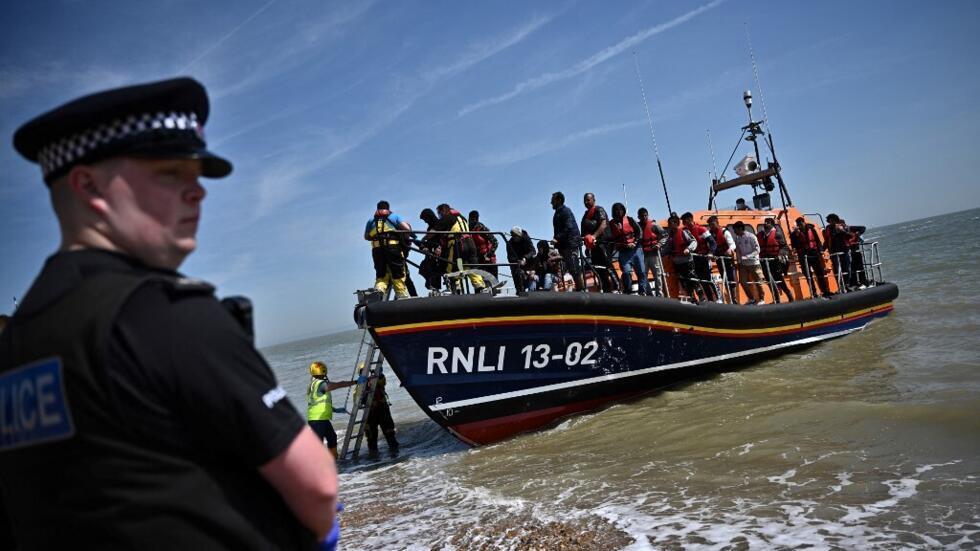
With the state visit of President Macron this week, the small boats are back in the headlines. As Macron and Starmer try to thrash out a deal to reduce the numbers arriving in the UK, the UK has been pressuring the French police to use new tactics against the irregular immigrants, allowing them to stop boats from up to 300 meters from the shoreline rather than only dealing with them on land. Presently they can only intervene if there is danger to life. The police are, in any event accused of puncturing inflatable boats as well as more heinously using tear gas and pepper spray on children.

An agreement between the UK and France on a โ€œone in one outโ€ basis, so that any arrival can be sent

back to France if replaced by a candidate deemed more worthy by dint of family connection, has been mooted, but the press conference will be on Thursday afternoon, so we will not know just yet. At all events, other EU nations are complaining about a possible deal which will make it more likely that arrivals in Europe will end up on their shores.

‘we have to make migration boring again’

Meanwhile, Amy Pope, the CEO of the (UNโ€™s) International Organisation for Migration, has suggested any proposed changes will be unlikely to work, bearing in mind the level of commitment the migrants have already put in before reaching the English Channel. She is also in favour of de-politicising the debate. Her comment โ€œWe have to make migration boring againโ€ is clearly  the most valuable contribution from anyone so far.

Arrivals

As noted last month, the number of arrivals in the UK on small boats continues to break records (20,000 by the end of June). This has been put down to good weather, smugglersโ€™ new techniques and increasing conflicts around the world (the largest number of hopeful asylum seekers in Calais are from Sudan).

The Government is hoping to save up to ยฃ1 billion by speeding up backlog processing. However, the backlog is now 90,000 rather than 50,000 in 2024. In 2024, there were84,000 asylum claims โ€“ In the EU as a whole there were nearly a million – 997,000.

With much discussion on what legal routes immigrants can take, here is a summary of the current situation in the UK: there are presently 7 options.

  1. UNHCR can select people it thinks appropriate to send (the places cannot be applied for, and amount to only 1% of all refugees).
  2. UK Resettlement Scheme. The status of this is unclear; it includes community sponsorship and accounts for about 700 arrivals last year.
  3. Mandate Scheme. This is for people with relatives in the UK. 23 cases were reported in 2024.
  4. Family Reunions. Applies after refugee status has been agreed by the UK.

Mostly Syrians , Iranians and Eritreans. 5000 in quarter 1 2025.

  • Hong Kong. Numbers low now as most cases already settled.
  • Afghanistan. ACRS and ARAOP have now been closed, with virtually no explanation. โ€œFurther measuresโ€ฆ[will be] announced later this year.โ€ More Afghans have been arriving by boats than under these arrangements anyway.
  • Ukraine. Numbers also down now to about 4000 a month. Only 1698 asylum claims since 2022.

The Refugee Council have a new report New Roots, New Futures, arguing for a national integration strategy for refugees in the UK. They are particularly exercised by the need for new arrivals to have access to help in obtaining work and housing once they have been given right to remain.

The Green Party have put forward a plan for the Home Office to be split, with various options for the immigration departments.

By way of context, it should be noted that 73% of the worldโ€™s refugees are in Low/Middle Income countries, 67% of them are in countries neighbouring the one they are fleeing. Per head of population the countries with the highest number of refugees are Lebanon (1 in 8 of the population), Aruba and Chad.

The European Convention on Human Rights has become an issue again with questionable claims being made about possible unfair exploitation of loopholes. It should be stated that the Convention does not affect individual countriesโ€™ immigration policy, and that it is rare for claimants to a right of โ€œfamily lifeโ€ and such to win their case. The ECHR has ruled against the UK twice in the last two years, in neither case about immigration/deportation issues. They have generally prevented removals from the UK about once every 4.5 years since 1980. Leaving the Convention over this issue would seem rather unnecessary.

Andrew Hemming


Recent posts:

Refugee report – June


Refugees continue to generate considerable political tension in the UK

June 2023

We are pleased present our monthly refugee report thanks to group member Andrew for preparing it. Refugees, immigration and the boat people continue to generate a considerable degree of political and media heat in the country.

The latest immigration figures for 2022 give a total of 606,000 arrivals, but most of these are legal, and mainly students. There were 7,000 applications for asylum (by 91,000 people). In the first quarter this year 3,793 applications were received, compared to 4,548 last year. It is worth noting that the numbers are higher in France, Germany and Spain. Arrivals in the UK amount to just 7% of the European total.

Arrivals to the UK are just 7% of the European total

20,000 claimants were in detention in March, 20% fewer than last year, but the average period of detention was longer.

Few forced returns based on asylum claims have taken place, the majority of them being to Albania, where the new agreement has resulted in 90% of arrivals from Albania being returned there.

The Illegal Migration Bill is this week in committee stage in the House of Lords, and a vast number of amendments are being debated. The largest bone of contention currently is the lack of an economic impact assessment of the measures, which the government has said it will produce โ€œin due courseโ€. The BBC has claimed that the cost of the new rules will be up to ยฃ6 billion over the next two years. The Refugee Council have more precisely reckoned it at ยฃ8.7 to 9.5 billion over 3 years. The Home Office have admitted that numbers would have to be below 10,000 for the Act to be operational. On the plus side for the Government, former senior judge Lord Sumption has argued that justification for overruling their Rwanda plan by the ECHR would be โ€œslender.โ€ On this point, the Sun is reporting that the Home Office think they can make their first flight to Rwanda in September if the Court of Appeal rules in their favour.

The Prime Minister, on his visit to Dover this week, claimed that his policies were working, as the number of asylum seekers arriving in small boats was down 20% this year. Others have suggested this has had more to do with the weather in the English Channel, and the fact that most crossings take place between July and September.

It is reported that the two new vessels commissioned to house asylum seekers are cruise liners. Apart from the plan for a barge to be moored at Portland, other locations are presently unknown.

The Refugee Council has been protesting this week about the size of the accommodation made available to claimants. Operation Maximise is a deliberate initiative to cram as many claimants as possible into the available accommodation. The leader of Westminster Council has said it โ€œdefies common sense and basic decency.โ€

The UNHCR has produced an audit of the UK asylum system and declared it to be โ€œflawed and inefficient.โ€  The report particularly points to a lack of training at the Home Office, inadequate information on claimants, lack of skill in interviewing, and an inability to assess childrenโ€™s ages accurately.

An article in Coda Media has drawn attention to the EUโ€™s International Centre for Migration Policy Development, a shady body based in Vienna that has been supplying Maghreb governments with material to aid disempowering boats aiming to cross the Mediterranean.

AH

Blog at WordPress.com.

Up ↑