Letter published on the vigil


A letter was published this week in the Salisbury Journal on line

October 2025

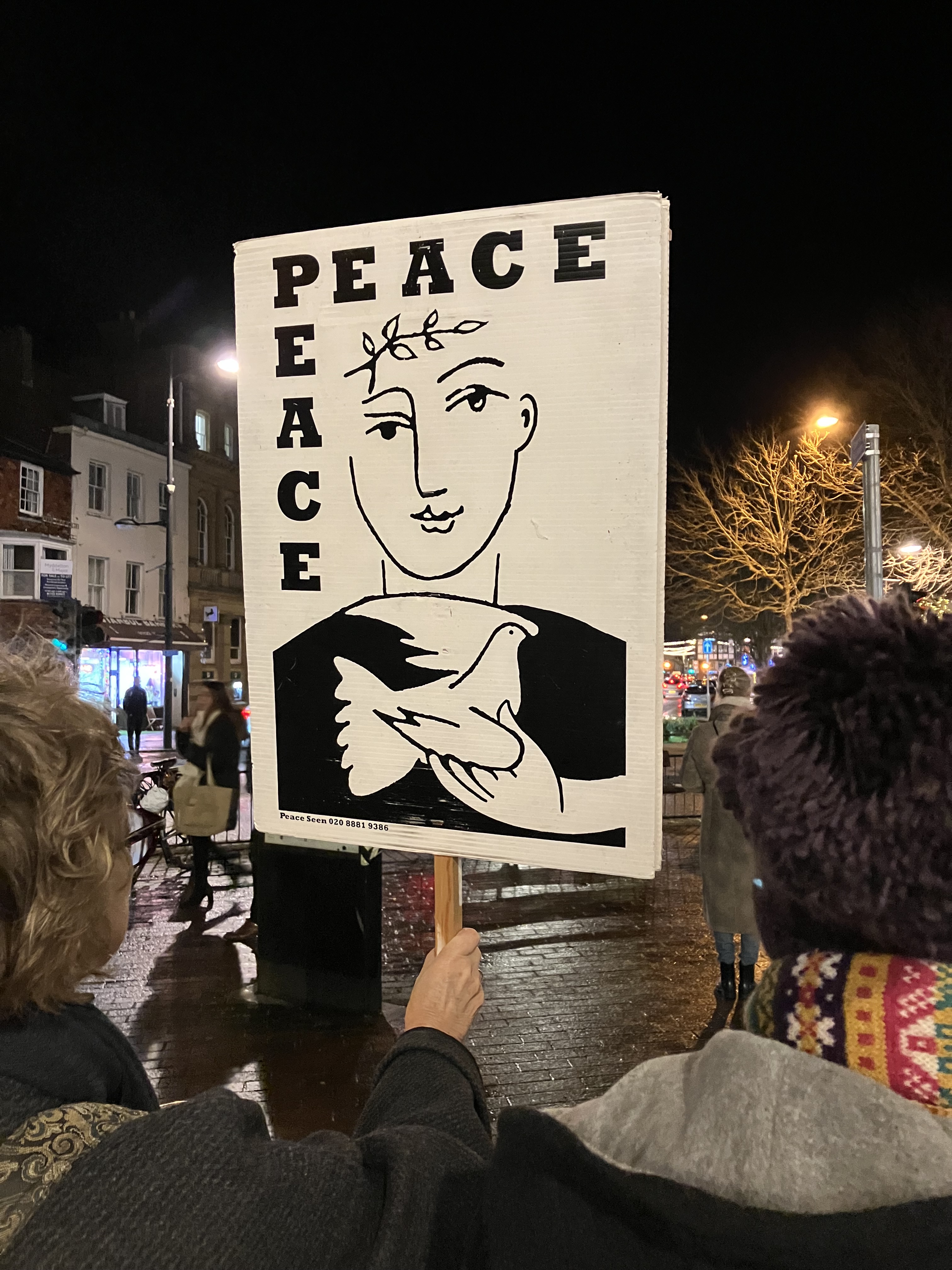
“There is a group of people in Salisbury who have given their time to spend 97 Saturdays [actually 98] in a row standing outside the library at 5 pm calling for peace for all those in the Middle East, particularly for the people in Gaza. I am proud of these, mainly elderly, citizens for standing quietly and with dignity, to bear witness to the horrifying events we have seen every day on TV and on our phones and to call for it to stop.

“Last week at the Vigil, I heard a passer-by ask why it was all old people standing there? Perhaps it’s

because they are a generation who lived closer to World War 2 with parents who were directly affected by the senseless horror of war. Perhaps they can imagine what it means when UNICEF reports that ‘an average of 28 children are killed in Gaza every day, the equivalent of an entire classroom’. Perhaps they just have more wisdom than the rest of us and know “hate breeds hate”, as one of their posters reads.

“This is not a demonstration but rather a silent vigil. As one of the group says, “silence is more powerful than words”. There are no chants and no arguments. As the weeks have passed, more people attend, and sometimes there have been more than 50 people there. Now the world waits as we hope the fragile ceasefire will hold. I think that the group will continue to bear witness to the actions on all sides. We hope for a just peace and safety for all.

“The group would love to have more younger members. Growing our numbers is still important even with the ceasefire, as the situation is not resolved. Our government must take notice that UK citizens want it to fulfil its pledge to support a viable Palestinian State.

On November 1, the 100th Peace Vigil will take place. Will you join us outside the library at 5 pm and give 30 minutes of your time?

Sarah Nicholson Barbour

See Facebook page: Sarum Concern for Israel / Palestine

See Instagram: @salisburypeacevigils

The letter was published in the print edition on 23 October.


There is a really good YouTube video of a discussion of the current situation with Daniel Levy and a journalist from Declassified UK. Levy points to many failings in the current process including the point that any idea of a Palestine state is just an exercise in creating a kind of Bantustan: the homeland for black people creating by the then South African state as part of their Apartheid policy. This is of a piece with the Apartheid policy operating in Israel and recognising that they are operating a colonial enterprise. He enjoins us not to be distracted from the real issues and the need for accountability to take place. Politicians are all too keen to say ‘move on’ these days. He doesn’t think much of Tony Blair’s mooted role in nation building.

A letter critical of Israel’s actions in Gaza written by Jewish people has been published. They say the ‘unconscionable actions by Israel amount to genocide’.

Recent posts:
Angry response to vigil article


January 2025

There has been an angry series of responses to the article published in the Salisbury Journal

Our last post was to draw attention to a piece in this week’s Salisbury Journal (30 January) reporting on the vigils which have taken place in Salisbury for over a year now. They are silent, last half an hour and the main theme is peace in Gaza. It is worth noting that the death toll is around 46,000 but the Lancet suggests it is higher because many bodies lie undiscovered in the rubble.

The article has prompted a large number of almost exclusively critical ‘below the line’ comments some of which have attracted 70, 80 or more ‘likes’ [accessed 31.01.25, 21:38]. Two drew attention to the fact it was published on Holocaust Memorial Day and said that whoever on the Journal decided to publish it ‘should be fired’, that it was ‘not appropriate’ and they ‘should hang their heads in shame’. This is to misunderstand the themes behind the day which the Holocaust Memorial Trust points out is about empathising with people today and helping to build a better future. Of course it is about the terrible events during the war and the millions of Jews and others murdered by the Nazis. But is also reminding us that violence on the scale we have seen in Gaza and its indiscriminate nature is also a cause of great concern. [UPDATE: 2 February. The adverse comments attracted over 700 ‘likes’]

Another called it ‘unbelievably crass’ to pass on unfiltered pro-Hamas views. It is difficult to see where a description of a peaceful vigil can be described as ‘pro-Hamas’. It was also described as a ‘demonstration’. It was not. One wrote: ‘on Holocaust Memorial Day 2025, Isabella Holliday [the journalist who’s by-line was at the top of the article] has failed in her professional duty as a journalist, to write an accurate unbiased article on the Israel/Hamas conflict’. It was not such a piece.

Other wild comments include the assertion that ‘Hamas is responsible for all the civilian deaths in Gaza and that most of the casualties are Hamas terrorists’. Since around 15,000 of the deaths are children this is a bold claim and demonstrably untrue. The hostility of the comments might come as a surprise since the vigil is just that: between 30 or 40 people typically, who come together each week to express their concern for the violence that is taking place. There is no visible or overt support for Hamas. It might be worth remembering that it was Benjamin Netanyahu who did support Hamas according to the Times of Israel and others.

Last week was meant to be the last, and we welcomed the cease fire and the release of some of the hostages with more to come out. But the increase in violence on the West Bank, the ending of aid provided by Unwra, and the possible appointment of Mike Huckabee as the US ambassador, led to the decision to continue.

Hamas has not been destroyed. Gaza has been reduced to rubble. At least 46,000 Palestinians have died and many thousands injured. Channel 4 News featured some distressing images of injured children unable to get proper medical help (31 January). Almost nothing has been achieved and certainly not the long term security of Israel. It is disappointing to see so many hostile comments and the large numbers of people who appear to like them i.e. approve of them.


The next vigil will take place tomorrow, 1st February as usual.

Salisbury Journal piece


Journal acknowledges Vigils held in Salisbury

January 2025

The Salisbury Journal published a short piece describing the Vigils we have been holding each week in this week’s edition (30 January 2025). It said:

“A silent vigil took place outside the library to express a hope for the of violence in the Middle East. On Saturday the 60th silent vigil took place outside Salisbury Library with around 50 people attending. The weekly vigils are an expression of hope for an end to violence and a peaceful future in the Middle East and in the most recent [event] people carried flowers and candles and displayed heartfelt messages.

The messages emphasised the message for a permanent ceasefire. A spokesperson from vigil said “we call on the UK government to take immediate action to ensure accountability and justice for Palestinians. All arms sales to Israel muse be suspended. This is a moment of truth for the UK. To continue shielding Israel from accountability is to abandon the principles of justice and human rights that the UK claims to uphold.”

These vigils are supported by local groups of Amnesty International, Campaign for Nuclear Disarmament, Christian Aid, Quakers, Sarum Concern for Israel Palestine and many others.”


The vigils will continue and the next is this Saturday 1st February at 5pm as usual for half an hour. All welcome.

Also in the Journal, the local MP Mr Glen, spoke of his presence at the Holocaust memorial which took place in the city. He has not acknowledged in his weekly columns any of the 60 vigils so far held.

Salisbury Journal and refugees


Journal publishes forthright piece on the subject of refugees

March 2023

The Salisbury Journal is a local paper in the United Kingdom and is fond of publishing self-promoting puff pieces by our local MPs, so a forthright article by Martin Field in the March 16 2023 edition is worth highlighting. It concerned the controversy surrounding the suspension, and subsequent reinstatement, of Gary Lineker who presents the Saturday night BBC programme on football called Match of the Day. It arose following the publication of Illegal Migration Bill the previous week and Gary’s tweet comparing aspects of the bill to the actions of the National Socialists in ’30s Germany. The tweet caused a huge outrage against both Lineker and the BBC by a number of Conservative politicians together with sections of the right wing media.

Several commentators have wondered, like Field, whether the intensity of the furore was intended to be a distraction from the underlying issue. Field reminds us that the bill proposes that people who are fleeing persecution, who may have a legitimate claim for asylum and have family and relatives here, will never be able to have their claim heard and will be deported.

He says that they [refugees] are not being treated as individuals, as fellow human beings but classified generically, as members of a group, defined not by human characteristics, but by their manner of arrival in the UK.

“Make no mistake. This is a slippery slope. Removing people’s humanity through language is the first step; through law which criminalises them and takes away their rights the second; extremists emboldened the third; [then] inhumane and degrading treatment will follow. The lesson from history is unequivocal”.

In the same paper was a piece by Tom Bromley also referring to the Lineker affair and wider issues around allegations of impartiality by the BBC.

Refugees, and the boat people in particular, have raised great passions in the UK so it is interesting – and encouraging – to read of two commentators in the Journal expressing doubts about the bill and the subsequent events at the BBC.

The Archbishop of York, Stephen Cottrell, declared the bill ‘[it] amounts to cruelty without purpose’ and to be ‘immoral and inept’.

To note that Salisbury MP John Glen and Devizes MP Danny Kruger both voted for the second reading of the bill on 13 March.

Letter in Journal


Letter published in the Salisbury Journal

A letter in support of the Human Rights Act was published in the Salisbury Journal today – 8 November 2018.  We have often discussed the threat to the act in this blog as it remains Conservative policy to abolish it.  There is little chance of this happening in view of the enormous amount of time and energy being expended on Brexit negotiations, nevertheless, the intention is there.  We do not know what will happen after March 31st of course. 

We have a meeting tonight, 8 November at 7:30, Attwood Road.

Salisbury refugee arrested


UPDATE: 22 February

Reported in the Salisbury Journal that Reza in ‘in a really bad place’ physically and mentally.  See the Journal article.


A Salisbury refugee has been arrested and is under threat of deportation

A refugee who has been living in Salisbury for 2 years was back in the news this week following his arrest in Melksham.  He was scheduled to be deported back to Afghanistan, the second most dangerous country in the world according to the FCO.

Reza Magsoudi fled Afghanistan in 2004 when he was 13 and travelled alone to the UK.  Early in November 2017 he was summoned to Melksham police station for the routine procedure of declaring his whereabouts in the UK, whereupon he was arrested.  He was taken to Tinsley House in Gatwick from where he was due to be deported.

He was granted leave to remain in 2008 and has applied for asylum but for the most part without legal assistance.  His English is said to be poor.  There is now to be a judicial review.  A Change.org petition has achieved 73,000 signatures.

He has been supported during his stay in Salisbury by Derri Southwood who has had considerable difficulty in making contact since his incarceration in Gatwick.  BBC Wiltshire had several pieces on this topic on their morning show this week and a reporter has gained access to Tinsley House but was unable to tape an interview with him.

Issues

The case raises a number of issues concerning asylum policy in the UK and highlights the country’s poor record in offering a home to those fleeing war-torn countries.  The UK does however contribute a great deal of aid to those countries who have high levels of refugees but is reluctant to help those who come here.

Part of the reason is the myth that large numbers of people are ‘flooding’ into the country.  The facts do not support this myth.  Countries such as Turkey, Pakistan and Jordan have a much, much higher numbers in their countries out of a world wide population of around 14 million refugees.  By contrast, in quarter 2 of this year for example, there were 6,172 applications for asylum of which 65% were refused.  This sort of statistic is fairly constant quarter by quarter (Source: Refugee Council).  This is a tiny number of people in view of the world wide figure yet the impression created by some sections of the media is that we are somehow the principal port of call for refugees.

The UK no longer has a welcoming attitude to refugees and successive policies have sought to make it tougher and tougher to achieve leave to remain.  An analysis of statistics and policy by four newspapers (Guardian; Le monde; Der Spiegel and El Pais) found that:

The analysis found that Britain takes fewer refugees, offers less generous financial support, provides housing that is often substandard, does not give asylum seekers the right to work, has been known to punish those who volunteer and routinely forces people into destitution and even homelessness when they are granted refugee status due to bureaucratic delays.

This was worse than any other country except Italy.

What is often overlooked in these debates is that the reason why there is conflict and a country riven by war is partly the result of our colonial and imperial activities in the past.  Most obviously the Israeli and Palestinian conflict; the division of lands in the middle east after the fall of the Ottoman Empire following the Great War; the Yemen conflict today where we continue to sell arms to the Saudis causing enormous hardship to the people there, and our invasion of Libya which has led to instability, violence and also allowed people smugglers to prosper.  So we had a major historical impact and continue to do so by supplying arms which increases the level of conflict.

Looking at the below the line comments in the Salisbury Journal article, one gets a taste of the vitriol that the whole question of refugees generates.  Someone who calls him or herself ‘art91e’ says:

He has no right to be here, he serves no useful purpose, he’s illiterate after 13 years here, so he certainly did not do an apprenticeship … that is a lie!  Send him home asap.

The great majority of comments were sympathetic however.

Mr Glen, the Salisbury MP, has become involved and has promised to make contact with the minister’s office and to do what he can.  The problem – not unique to MPs like Mr Glen – is that the Home Office is carrying out government policy which has been supported by him.  It illustrates the problem of myths in the media being left unchallenged but which have a huge influence on how people think.  This drives policy and has created a harsh environment for asylum seekers.  They have become a problem best solved by keeping them out in the first place and then throwing them out if at all possible if they do make it here.

We await developments.


Don’t forget to visit our refugee photo exhibition in the Library which is running until the end of December.  Please sign or comment in the visitor’s book if you do go.  Follow us on Facebook and Twitter, Salisburyai.

We shall be card signing in the Library passage on Saturday morning 16th between 10 and noon.

Human rights and armed forces


Claire Perry writes in the Salisbury Journal

Claire Perry MP. Picture: thedrum

Claire Perry, the Conservative MP for Devizes in Wiltshire, said in her piece in the Salisbury Journal that:

[at the recent Tory party conference] … there were other important announcements to celebrate including the news that the government will put an end to the vexatious and damaging legal claims against members of the Armed Forces that arise from applying European Court of Human Rights judgements in the battlefield.

It is scandalous that highly trained and professional soldiers have been subjected to vexatious legal claims second-guessing their decision-making and that since 2004, the MoD has spent over £100 million on Iraq-related investigations, inquiries and compensation – money that should be spent on our troops not lawyers.   Salisbury Journal 27 October 2016

The problem with Claire Perry’s piece – largely copied from the statement by the Defence Minister at the conference – is that it is highly selective and largely untrue.  The picture painted is of our soldiers, operating in difficult and extremely dangerous environments, being pursued by lawyers, sorry ‘vexatious lawyers’, on the make.  The reality is quite different.

Firstly, it is part of a consistent and long running campaign by the right-wing media and tabloids against the Human rights Act and the European Court.  They do not like it because it provides protections for ordinary citizens and in particular, against the invasion of privacy by those self-same papers.  So at a party conference, appealing to that part of the media is only to be expected.

But more specifically, to take one element the statement: ‘claims against members of the armed forces …’ gives the impression that the claims are only about the soldiers themselves.  Many of the claims are against the MoD for not taking sufficient or reasonable care of their men.  So one claim for example was on behalf of a soldier who died of heatstroke serving in 50 degrees of heat in Iraq.  There is also the whole business of Deepcut and the soldiers who died there.  Others involve the Army sending men off in insufficiently protected land rovers.

The phrase ‘applying European Court of Human Rights judgements in the battlefield’ is doubly disingenuous.  Firstly, it is the application of the Human Rights Act which is causing the problem.  Adding the ECHR is just to appeal to those who do not like Europe and trying to shift the blame to Strasbourg who often have little if anything to do with it.  ‘Battlefield’ is also slipped in to create the impression of brave soldiers being pursued by lawyers (keep forgetting – vexatious lawyers) with outrageous claims.

What many of the claims are about is how prisoners are treated once they are taken captive, not on the battlefield.  One such claim was a man thrown into a canal in Baghdad and left to drown.  Many others relate to beatings and other mistreatment of prisoners.  If the courts have investigated claims and the MoD has been forced to pay compensation it argues that something is adrift.

Perhaps Claire Perry should ask herself why do we go to war in the first place?  Part of the answer is to promote our values.  We want to promote democracy and the rule of law.  We become involved in part to try and instill those values.  If our soldiers – not on the battlefield but back at base – are mistreating prisoners then those are not our values.  Although there was a lot of nonsense about weapons of mass destruction, one reason we went into Iraq was because Sadam Hussein treated his people abominably.  The results of bad treatment in places like Syria are visible to us every day with the refugee crisis.

It is a great pity that nonsense like this is both written and then published without challenge.


Unpublished letter


Text of letter sent to Salisbury Journal

The following letter was sent to the Journal in Salisbury but regrettably for space or other reasons it was not published (14th April).  We do not know at present what the current situation is with the promised bill to abolish the Human rights Act and replace it with a British Bill of Rights (or whatever it is to be called).  It is a manifesto promise and a draft was to be published in the Autumn but has not yet appeared.  It is possible that the arrival of Michael Gove into the Justice Dept. had something to do with it.

Now that we are in full swing with the debate about leaving the European Union, it is possible that this has been shelved for the moment.  Mr Gove is a leading proponent for the Brexit camp who – if current polls are to be believed – are doing well at the moment.  The calculation may therefore be that if they win then the scene is set to dump the HRA as well.

On the other hand, there will be a heavy workload in managing our exit and carrying out the negotiations to secure access to the European market once we leave, so there will be limited civil service and parliamentary time to spend on a new Bill of Rights.

But back to the letter and our local MP John Glen is keen to abolish the HRA and it would be a pity if he is given space in the Journal again to put forward his views and the opportunity is not given to those who disagree with him.  The unpublished letter:

Britain has had a proud history of leading the charge on human rights progress from the aftermath of the Second World War when we were key drafters of the European Convention of Human Rights, to the suffragette movement, to gay rights and other equality legislation. We have often been champions of progress.
What a shame, then, that this year the UK was singled out for criticism in Amnesty International’s annual report on the state of the world’s human rights.  Amnesty is warning that the government’s plan to tear up the Human Rights Act is a gift to dictators all over the world.  Russia recently drafted legislation which allows it to ignore human rights rulings it doesn’t agree with. Far from being able to condemn that action and call on Putin to uphold basic human rights, the UK is actually talking about following suit.  Music to the Kremlin’s ears, no doubt.
Here in Salisbury, the local Amnesty group is campaigning to save the Human Rights Act.  Britain should be a world leader on human rights.  The Human Rights Act protects ordinary people – from the elderly to hospital patients, to domestic violence victims – and we want to see those protections spoken about with pride by our politicians.  We should be redoubling our commitment to enduring human rights principles in these troubling times, not undermining them.
Let’s hope next year’s annual report on the UK reads: “much improved”.

Follow us on Twitter and Facebook

Blog at WordPress.com.

Up ↑
