The China Unity law is an act of cultural genocide
The China Unity Law came into force in July and is intended to establish Chinese dominance over all its ethnic minorities. Mandarin will become the dominant language and all 51 of China’s minorities will be affected, around 9% of the total population. We are focusing on the Uyghurs who are being persecuted as part of Amnesty’s Uyghur Awareness Month. The law will be used to justify ever more repression and discrimination over its minorities.
We have to be aware of the wider context however and the threat to human rights inside and outside China. An article By Simon Tisdall in the Guardian (8th August) discusses these wider issues. The new law has been condemned but not too loudly by western governments but more loudly by Amnesty. We must not forget the repression which went on Tibet and also Mongolia: the Uyghurs are just the latest in a line of minorities persecuted by an increasingly authoritarian Xi Jinping.
Tisdall argues that a kind of ‘debilitating fatalism’ has taken hold of the western powers who just watch the ever increasing exercise of power by China. They are threatening Taiwan and with US military stocks reported to be much reduced by the Iran excursion, is now the time when an assault is right for them? They also threaten Japan.
Hong Kong is another example and thousands left the former colony to come to the UK. Free speech is no longer possible. The publisher Jimmy Lai was sentenced in December to 20 years in prison and is in solitary confinement and in poor health. His family say he is denied medical attention which is denied by the Chinese but they do not allow independent verification.
The sad fact is that the cause of human rights in that country and those of its minority populations in particular is bleak. As China becomes more economically and politically powerful and western countries more divided, China is able to pursue its plans with ever greater vigour. Its desire to build the biggest embassy in the west in London seems unstoppable. It is almost certainly to be used for espionage and to exert control over Chinese people living in the UK. Donald Trump’s divisive policies against US allies plays into China (and Russia’s) hands.
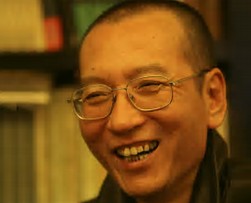
On Thursday, the Chinese dissident, Liu Xiaobo died of liver cancer. He had been in prison since 2008 mainly because he argued for greater democracy in China and was convicted of ‘inciting subversion’. He was awarded the Nobel Peace Prize in 2010 which infuriated the Chinese government and he was not permitted to go to Norway to receive it. He was only the second laureate to have been in prison at the time of the award. Once the cancer was diagnosed he was released to a hospital where he was still under heavy guard. According to Human Rights Watch, even as his illness worsened the Chinese government continued to isolate him and denied him freely choosing his medical treatment.
On Saturday he was hastily cremated and his ashes scattered at sea almost certainly to prevent a grave on land becoming a centre for protest. Activists were reported by the South China Morning Postto be ‘outraged at the humiliating arrangements’. His second wife, Liu Xia, is under house arrest.
Liu was a supporter of Charter 08 which argued for a fundamental change in the one party state, a whole series of reforms that would result in a separation of powers, a new constitution and legislative democracy. It was suppressed by the Chinese government.
This is a sad day for human rights, but Liu Xiaobo leaves behind a powerful legacy to inspire others to continue the struggle for human rights in China and around the world
Boris Johnson, the Foreign Secretary, made the following lukewarm statement:
I am deeply saddened to hear that Liu Xiaobo has passed away. He was a Nobel Peace Prize Laureate and a lifelong campaigner for democracy, human rights and peace. His death is a huge loss and our hearts go out to his wife Liu Xia, his family, and his many friends and supporters.
Liu Xiaobo should have been allowed to choose his own medical treatment overseas, which the Chinese authorities repeatedly denied him. This was wrong and I now urge them to lift all restrictions on his widow, Liu Xia. 13 July 2017
This from a man not afraid to be outspoken at any given moment. Focusing on the restricted nature of his medical treatment is the least of the crimes the Chinese government has committed. ‘Has passed away’ gives the impression of a natural death not one hastened by harsh prison conditions, poor medical treatment and confining him right to the last. This is but the latest example of our government failing to stand up to breaches of human rights internationally. This is only set to get worse as the need to augment reduced European markets in the post Brexit world.
Under China’s president, Xi Jinping, there has been a major crackdown on any form of dissent. Restrictions on press freedom are well known and access to the internet is tightly restricted. Booksellers in Hong Kong stocking books detailing the corruption of the Politburo elite have been abducted. Details of this corruption among what are called the ‘Princelings’ has been revealed in the Panama Papers*. President Xi’s brother in law is implicated, along with other senior party people, in squirreling away billions in tax havens using the services of the Panamanian law firm Mossack Fonseca.
Any discussion of democracy is taboo in China as it is contrary to one of the Four Cardinal Principles one of which is to ‘uphold the people’s democratic dictatorship.’ One can see straight away that ideas of freedom of the press and ideas of running the country on more democratic lines are not going to get far with the government.
The future
China has pursued a policy of economic growth which so far has been successful and has led to the country being second only to the USA. It is expanding militarily most notably in creating false islands in the South China Sea. It is present all around the world where natural resources are to be found. The trick has been to maintain economic growth in return for maintaining its hold on political power. How long this growth can be maintained is open to question.
On the other hand, China wants to be more of key player in the world and is to be seen at G7 and G20 meetings as well as having a seat on the UN Security Council. As it grows in economic and military power, it seeks political recognition as well. This is difficult to achieve if at home it denies basic freedoms and human rights to its citizens; executes more than all the other countries in the world put together; locks up its dissidents; denies access to the internet and treats the people of Tibet appallingly. Using its power it is able to suppress criticism – cancelling contracts with Norway for example after Liu was awarded the Nobel prize – and tells other countries not to interfere in its internal affairs.
Fundamentally Chinese social policy is not progressing indeed, under Xi Jinping, it has regressed. So long as they can maintain their tight grip on power and the levers of power, the CPC will continue. But the lesson of history is that when a crack appears, as with a sheet of ice, it spreads rapidly and unpredictably.
*The Panama Papers, 2017, Bastian Obermayer and Frederik Obermaier, Oneworld, London (3rd edition). Details tax evasion by criminals, dictators and politicians – not just the Chinese – as revealed by a release of papers from Mossack Fonseca
Sources: Human Rights Watch; New York times; The Guardian; Amnesty International; South China Morning Post