Death penalty report


Report for mid February-March

March 2025

We are pleased to attach the latest report on this topic thanks to group member Lesley for the work on compiling it. The situation in US is mixed with the new president wanting to widen the scope of the penalty. To note as ever that China executes more than any other country but statistics are a state secret.

Harmful effects of the death penalty


The effects on those responsible for carrying out executions is often overlooked

February 2025

In discussions about executions the focus is, naturally enough, on the individual who is about to be put to death. We forget that there are many prison officers who are closely involved with those on death row, sometimes for many years, even decades. This post draws on material produced by the Death Penalty Information Center in the US for which we are grateful. The Salisbury group is focusing on the state of Oklahoma. We are grateful to group member Lesley for the work in compiling this.

Executions can cause prison staff to suf­fer psy­cho­log­i­cal dis­tress sim­i­lar to what vet­er­ans expe­ri­ence

after war. A 2022 NPR inves­ti­ga­tion found that cor­rec­tions offi­cers faced symp­toms such as insom­nia, night­mares, pan­ic attacks, sui­ci­dal thoughts, per­son­al­i­ty changes, and sub­stance abuse – all hall­marks or comor­bidi­ties of post-trau­mat­ic stress dis­or­der. Of the 16 peo­ple NPR inter­viewed who par­tic­i­pat­ed in exe­cu­tions, none sup­port­ed the death penal­ty in their wake. Psychologists use the term ​“moral injury” to describe how com­mit­ting an act that con­tra­dicts one’s deeply held beliefs, such as caus­ing anoth­er person’s death, cre­ates a severe psy­cho­log­i­cal dis­rup­tion. Robert Jay Lifton and Greg Mitchell coined the term ​“executioner stress” to describe the spe­cif­ic men­tal impact of car­ry­ing out the death penalty. 

The stress may also extend to guards who do not par­tic­i­pate in the exe­cu­tion itself, but devel­op close rela­tion­ships with death-sen­tenced pris­on­ers over the course of decades work­ing on death row. Some cor­rec­tions offi­cers have remarked that they spend more time with the peo­ple on death row than their own fam­i­lies. They may come to see the con­demned pris­on­ers as friends, or wit­ness the pris­on­ers’ men­tal or phys­i­cal vul­ner­a­bil­i­ties. In stud­ies, offi­cers have expressed con­cerns about the arbi­trari­ness of the death penal­ty, not­ing that they had worked with many peo­ple with life sen­tences who com­mit­ted equiv­a­lent or worse crimes than the peo­ple the offi­cers helped put to death. 

There is a part of the war­den that dies with his pris­on­er,”

The psy­cho­log­i­cal toll of per­form­ing exe­cu­tions is not a new phe­nom­e­non. Donald Cabana and Jerry Givens both con­duct­ed exe­cu­tions in the begin­ning of the mod­ern era, in the late 1970s and ear­ly 1980s, and went on to pub­licly oppose the death penal­ty. ​“There is a part of the war­den that dies with his pris­on­er,” Mr. Cabana often said.

Journalist Jennifer Gonnerman researched New York’s last four exe­cu­tion­ers, who over­saw the use of the elec­tric chair from 1913 through 1963, a peri­od dur­ing which hun­dreds of peo­ple were put to death. Several of the men expe­ri­enced med­ical issues around the time of exe­cu­tions, such as migraines or faint­ing spells. One, Robert Elliot, lat­er became a promi­nent death penal­ty abo­li­tion­ist. Two of the men, John Hulbert and Dow Hover, died by suicide. 

Yet prison staff have long faced a cul­ture of silence about exe­cu­tion-relat­ed trau­ma. ​“We don’t talk about it,” said Justin Jones, direc­tor of the Oklahoma Department of Corrections from 2005 to 2013, who joined the effort to increase the time between exe­cu­tions (see Oklahoma below.)  ​“Correctional offi­cers are pub­lic ser­vants on the low­est salaries in state gov­ern­ment, and they get home at the end of the day and just absorb it.” NPR’s inves­ti­ga­tion revealed that some exe­cu­tion team mem­bers had nev­er even told their fam­i­lies they par­tic­i­pat­ed. ​“We all knew to keep it silent,” said Catarino Escobar, who worked on the exe­cu­tion squad in Nevada. Mr. Escobar was strapped to the gur­ney when he played the pris­on­er dur­ing a prac­tice ses­sion, and he grew pan­icked and became con­vinced he was going to die. NPR found that only one of the offi­cers they inter­viewed had ever received men­tal health care relat­ed to their posi­tion, and even when care was offered, it was ​“over­whelm­ing­ly option­al” and ​“many of them avoid­ed ask­ing for it so as not to seem weak.” 

Oklahoma

In this con­text, uni­fied efforts by cor­rec­tions staff to address the psy­cho­log­i­cal effects of exe­cu­tions rep­re­sented a mile­stone. In March 2024 a group of nine for­mer Oklahoma cor­rec­tions offi­cials wrote a let­ter to Attorney General Gentner Drummond and, based on the detri­men­tal impact of the job and the lack of men­tal health sup­port, asked for an increase from a time of 60 to 90 days between executions. They not­ed that exe­cu­tion team mem­bers expe­ri­ence an increased risk of PTSD, sui­cide, and sub­stance abuse, and the gruelling prepa­ra­tion sched­ule puts staff mem­bers through­out the prison on edge due to ​“near-con­stant mock exe­cu­tions being con­duct­ed with­in earshot of pris­on­ers’ cells, staff offices, and vis­it­ing rooms.” With few state resources at their dis­pos­al, some employ­ees even resort­ed to talk­ing with defence men­tal health experts vis­it­ing the prison ​“about the dis­tress they are expe­ri­enc­ing due to the non­stop executions.” 

This com­pressed exe­cu­tion sched­ule also increas­es the risk of some­thing going wrong dur­ing the exe­cu­tion process because the stress cre­at­ed by each exe­cu­tion com­pounds the dif­fi­cul­ty of an already com­plex pro­ce­dure. If even a rou­tine exe­cu­tion can inflict last­ing harm on cor­rec­tions staff, the trau­mat­ic impact of a botched exe­cu­tion is expo­nen­tial­ly worse. Oklahoma has expe­ri­enced this harm on mul­ti­ple occa­sions and should not need­less­ly place its hard­work­ing cor­rec­tion­al staff at risk of anoth­er such mistake.

“Prison staff need to ‘man up'” Judge says

Judge Gary Lumpkin dismissed these concerns, telling officials that prison staff needed ‘to suck it up’ and ‘man up’.  Prison staff were report­ed­ly angered by Judge Lumpkin’s com­ments that they need­ed to ​“man up” and the sug­ges­tion that their con­cerns were not valid. ​“Anybody that thinks that exe­cut­ing some­body is no prob­lem has not been a part of the process,” said Justin ​“JJ” Humphrey, the state assem­bly chair of a crim­i­nal jus­tice and cor­rec­tions com­mit­tee and 20-year vet­er­an of the cor­rec­tions depart­ment. The Oklahoma Court of Criminal Appeals even­tu­al­ly grant­ed the exten­sion request in May. 

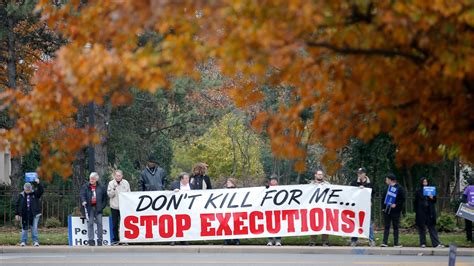
(Source: Death Penalty Information Centre – December 2024). Image: USA Today.

Follow us on Bluesky

Death penalty report


February 2025

Here is the death penalty report for mid January to mid February thanks to group member Lesley for the work in compiling it. It is quite long! That is partly due to a lot of activity in America where executions are proceeding apace and the various executive orders being issued by President Trump.

Another event is the call for the return of the death penalty in the UK particularly by the Reform party. This occurs after a particular murder or murders in this case the dreadful murders of three little girls in Southport last year. Amnesty’s position is that it is never right to inflict a death sentence on someone, it does not act as a deterrent and mistakes cannot be put right if there is a wrongful conviction.

Death penalty report


Report for mid December to mid January 2025

January 2025

We are pleased to attach the latest death penalty report thanks to group member Lesley for the work in compiling this. Iran features in this report with the suspension of its draconian legislation on women who do not dress appropriately. As ever, we note that China is believed to be the world’s largest executioner of its citizens but details are a state secret.

Death penalty: good news


President Biden commutes 37 out of the 40 prisoners on death row

December 2024

It is gratifying to be able to report some good news concerning the death penalty particularly at this time of year. Yesterday, 22 December, President Biden commuted 37 death sentences turning the sentences into life without the possibility of parole. This, which will be one of his last acts of his presidency, was widely welcomed in the States and elsewhere.

Biden has come some way from his time as a Senator when he championed a bill to widen the scope of the death penalty to a further 60 new offences. It is ironic that some of those who are having their sentences commuted – with a preponderance of Black people – were condemned as a result of his bill.

Part of the reason is the worry about when President-elect Trump takes office in a month or so. Trump put more people to death than the previous ten presidents combined. He is committed to the penalty and with a compliant Supreme Court, there will be little to stop him. Biden said: “In all conscience, I cannot stand back and let a new administration resume executions that I halted”.

These are Federal death penalty cases and it does not affect state actions.

Amnesty is opposed to the death penalty in all circumstances. The local group produces a monthly report on its use around the world.

Sources: The White House; BBC; NBC; ACLU; USA Today

Recent posts:

Death penalty report


December 2024

We are pleased to attach our latest death penalty report covering the period mid November to mid December 2024 with thanks to group member Lesley for the work in compiling this. As ever we must note that China is believed to execute more of its citizens than the rest of the world combined but the details are a state secret. This month saw the toppling of the Assad regime in Syria. People were able to gain access to the prisons where thousands were tortured and executed.

Recent posts:

We are now on Bluesky and Mastodon

Urgent action: Oklahoma


We attach an urgent action concerning the death penalty in Oklahoma

November 2024

DEATH PENALTY ACTION FOR NOVEMBER, 2024

This  action is part of our continuing campaign calling on the Governor of Oklahoma to issue a moratorium on all executions, and ultimately to move towards the permanent abolition of the death penalty in the state.  Letters (preferably) or emails should be sent to Governor Stitt, focusing in particular on the history of racial discrimination within the State and how this has impacted on Oklahoma’s application of the death penalty.

Contact details:

The Honorable J Kevin Stitt

Governor of the State of Oklahoma

Oklahoma State Capitol

2300 N. Lincoln Blvd; Suite212

Oklahoma City

OK 73105

USA.

Emails can be tried at:   https://oklahoma.gov/governor/contact/general-information/contact-the-governor.html which gives access to a form.

Please take this action before the end of November.

Racial Discrimination/Bias in the Application of the Death Penalty in the State of Oklahoma

In 2017 the Death Penalty Review Commission concluded the system in Oklahoma was ‘broken’ and unanimously recommended a moratorium on executions ‘until significant reforms were accomplished’.  They also questioned ‘whether the death penalty could be administered in a way that ensured no innocent person was put to death.  They made 47 recommendations but it is understood – over 6 years later – none have been implemented.

In 2022 the report Deeply Rooted: How Racial History informs Oklahoma’s Death Penalty’ by Dr Crutcher, Founder and Executive Director of the Terence Crutcher Foundation, was issued – and updated in  September 2024.

The report places Oklahoma’s death penalty in its historical context of lynchings and mass violence against Black Oklahomans and the forced migration of Native Americans. It documents the historical role that race has played in the State’s death penalty and details the pervasive impact that racial discrimination continues to have in the administration of capital punishment.

The report ties Oklahoma’s use of the death penalty to its troubled history of racial violence and segregation. It observed that Oklahoma was at an inflection point in its administration of the death penalty and argued that, if the State was to establish a fair and humane system of justice, it was crucial to acknowledge and redress the effects of the Jim Crow laws and racial violence that persist into the present day.

Racial discrimination, especially the race of the victim, continues to infect all aspects of the death penalty in Oklahoma.  A study of homicides in the state between 1990 and 2012 found that the odds a person charged with killing a white female victim would be sentenced to death were 10 times greater than if the victim was a minority male. Of the 25 executions scheduled between August 2022 and December 2024, 68% involve white victims. Data throughout the report suggest that valuing white victims more than others has resulted in disproportionate punishment for Black defendants who murder white people.

An examination of the age and race of the men scheduled for execution reflects the bias that Black youth are perceived as older and less innocent than white youth. Seven of the 10 Black men set for execution were 25 years old or younger at the time of the crime. By contrast, only one of the 13 white men set for execution was 25 or younger at the time of his crime. Three of the Black men were 20 or younger and one of them, Alfred Mitchell, was only two weeks past his 18th birthday.

Of the 142 people in the U.S. who have been removed from death row because of intellectual disability (following the U.S. Supreme Court’s ruling that their executions are barred), the majority (83%) have been people of colour. This suggests that people of colour, especially Black people, with intellectual disability are at a greater risk of being subjected to capital punishment. Oklahoma has limited the ability for people on death row to seek relief based on intellectual disability. As the report notes, Michael Smith, a Black man, had a documented, lifelong intellectual disability[i]. Despite his medical diagnosis, Oklahoma denied Mr. Smith a hearing on his intellectual disability.

At least five cases of those scheduled for execution in Oklahoma may have involved official misconduct, including Clarence Goode, a Black and Muscogee man set to be executed on August 8, 2024, (but see below) who was convicted after the testimony of a detective who later served time in federal prison for misconduct in other cases. Nationwide, nearly 80% of wrongful capital convictions of Black people involve official misconduct by police, prosecutors, or other government officials.

Native American Sovereignty

The report states that Oklahoma has a history of defying U.S. Supreme Court decisions that would provide some measure of racial justice. For example, the Oklahoma Court of Criminal Appeals refused to apply McGirt v. Oklahoma (holding that the State lacked jurisdiction to prosecute crimes committed by or against Native American people on tribal lands)

In 2020 the US Supreme Court recognised that Oklahoma has continually prosecuted criminal cases in violation of long-standing treaties with Native American tribes.  At least 3 Native Americans have been executed in violation of tribal sovereignty, and at least 4 people remain on death row despite these violations.

Thirty-seven Native American men and women have been sentenced to death in Oklahoma, more than in any other state. Two people currently scheduled for execution –  Clarence Goode, Jr[ii]  and Alfred Mitchell[iii] are Native American.

Sources:  Death Penalty Information Centre


[i] my update: executed on 4th April 2024 – despite a 4 to 1 recommendation for clemency from the Pardon and Parole Board

[ii] my update: execution stayed 8th August 2024 pending new date

[iii] my Update: execution stayed 3rd October 2024 pending new date

Death penalty report – November


November 2024

We are pleased to attach the bi-monthly report on the death penalty around the world prepared by group member Lesley. A lot on the US this month as there is a lot of activity, certainly in the southern states, at present. In view of the recent presidential election, it is worth noting that although there is a lot of ‘noise’ about President elect Donald Trump’s desire to ramp up the use of the penalty, what frequently matters is what happens at state level. Who the governor is and his or her attitude to executions matters more than federal attitudes.

Note as ever that China does not feature although it is the world’s biggest executioner, details and statistics are a state secret.

The Controversy of Executions in Oklahoma


Oklahoma executes more of its citizens per capita than any other state in the US.

October 2024

The State of Oklahoma has executed the second largest number of prisoners in the US (after Texas) since the re-legalisation of the death penalty in 1976. It has carried out the highest number of executions per capita in the country.  It was the first jurisdiction in the world to adopt lethal injection as a method of execution.

The Salisbury group has decided to focus on the state and is writing to Governor Stitt in an effort to persuade him to stop this practice in his state.

There is a wide number of offences which can lead to a sentence of death in the state. First-degree murder is punishable by death in the following circumstances:

  1. The defendant was previously convicted of a felony involving the use or threat of violence to the person;
  2. The defendant knowingly created a great risk of death to more than one person;
  3. The person committed the murder for remuneration or the promise of remuneration or employed another to commit the murder for remuneration or the promise of remuneration;
  4. The murder was especially heinous, atrocious, or cruel;
  5. The murder was committed for the purpose of avoiding or preventing a lawful arrest or prosecution;
  6. The murder was committed by a person while serving a sentence of imprisonment on conviction of a felony;
  7. The existence of a probability that the defendant would commit criminal acts of violence that would constitute a continuing threat to society; or
  8. The victim of the murder was a peace (police?) officer, or correctional employee of an institution under the control of the Department of Corrections, and such person was killed while in performance of official duty.

In addition, the statute books carry the death penalty for first degree rape, extortionate kidnapping and rape or forcible sodomy of a victim under 14 where the defendant has a prior conviction of a person under 14, although since 2008 capital punishment is no longer constitutional for these crimes.

As of 27th September 2024 there are 33 prisoners on death row in Oklahoma, only one of whom (Brenda Andrew) is female.

Background facts

Oklahoma is one of two States allowing more than three methods of execution – lethal injection (the primary method), nitrogen hypoxia, electrocution and a firing squad.  They are to be applied in that order if earlier methods are unavailable or found to be unconstitutional.  Nitrogen hypoxia became available as an option in 2015 but to date has never been used in the State.  When the prosecution seeks the death penalty, the sentence is decided by the jury and must be unanimous.  In the case of a hung jury during the penalty phase of the trial, a life sentence is imposed, even if a single juror opposed the death penalty, and there is no re-trial.

Under the constitution of the State, the Governor of Oklahoma may commute a death sentence, but only following the advice and consent of the five-member Pardon and Parole Board. During Governor Lee Cruce’s administration (1911-1915), he commuted every death sentence. Governor Kevin Stitt (pictured) has granted clemency only once (to Julius Jones) during his tenure (2019 – present). This occurred despite 5 (possibly 6) recommendations from the Board. These have included the very recent case of Emmanuel Littlejohn, executed on 26th September 2024.

From 1915 to March 2024, 156 executions took place, three of them of women.  Executions were halted for six years. This followed the botched execution in 2014 of Clayton Lockett. There was also a drug mix-up that led to the ‘incorrect’ lethal injection of Charles Warner in 2015.

14 executions have been carried out under the governorship of Kevin Stitt.   In the most recent case – that of Emmanuel Littlejohn – there has been a great deal of controversy.  The execution took place

despite conflicting evidence regarding his guilt, mitigating evidence regarding his troubled childhood and undeveloped brain at the time of the crime, the admission of some jurors of misunderstanding the implications of a life without parole sentence, and the fact that the Parole Board had voted 3-2 to spare his life.  He had always maintained his innocence of the actual killing.

In 2022 a series of 25 executions were scheduled over a 2-year period, with one execution set for nearly every month through 2024.  A report was issued by the Death Penalty Information Center tying the State’s use of the death penalty to its troubled history of racial violence and segregation. 

The Death Penalty Information Center advises that current research shows that for every 8.2 prisoners on death row in the US in the modern era of the death penalty, one person has been exonerated.

The Reason Foundation Criminal Justice Policy Explainer – Abolishing the Death Penalty gives the following information:

  • Since 1981 ten people in Oklahoma have been exonerated while on death row
  • 6 cases involved perjury or false executions
  • 7 cases involved official misconduct
  • Oklahoma County, Oklahoma, has had the 4th highest no of death row exonerations among all counties in the US.  4 of the 5 death row exonerations in Oklahoma County involved misconduct by officials.
  • The longest sentence served by a death row exoneree was 21 years.

The Foundation also provides evidence of the high costs in the State of the death penalty as opposed to life imprisonment:

  • A study prepared for the Oklahoma Death Penalty Review Commission found that Oklahoma spends $110,000 more on capital cases than on comparable non-capital cases.  The study authors noted that this is a very conservative estimate because many prosecution and court costs were excluded.
  • Even at that conservative rate, with 42 (Note: figure differs from the 33 quoted earlier) individuals currently on death row, Oklahoma could have saved $4.64 million by trying the cases as life without parole rather than seeking the death penalty.
  • Using estimates from other studies suggests Oklahoma could have saved between $33.6 million and $42 million by pursuing life without the possibility of parole rather than the death penalty.
  • Moreover, the 117 (?) executions conducted in Oklahoma since 1990 are estimated to have cost the state between $12.9 million and $117 million.

Letters may be sent to:       

Honorable J Kevin Stitt

Governor of the State of Oklahoma

Oklahoma State Capitol

2300 N. Lincoln Blvd, Suite 212

OKLAHOMA CITY

OK 73105

Emails can be tried at:   https://oklahoma.gov/governor/contact/general-information/contact-the-governor.html which gives access to a form.

Sources: Wikipedia; Death Penalty Information Center; Amnesty International; World Coalition Against the Death Penalty; The Reason Foundation – Criminal Justice Policy 

Bi-Monthly Death Penalty Report – October 2024


October 2024

We are pleased to attach the latest bi-monthly report on the death penalty thanks to group member Lesley for the work in preparing this. It is worth remembering that the 10 October was the World Day Against the Death Penalty. As usual we note that China is believed to execute more of its citizens than the rest of the world combined but details are a state secret.

Blog at WordPress.com.

Up ↑