Slavery was abolished in 1807* – Not in Xinjiang


Slavery and forced labour is alive and well in Xinjiang. Major retailers complicit. Welcome to ‘cotton laundering’

August 2026

Many people believe that slavery ended sometime in the 19th Century and many – certainly older people reading this – think that Britain led the way. Slavery continued for many years afterwards. The reality is that slavery is alive and well and that you are wearing the products of this vile system while sat reading this. You may feel that you have purchased your cotton garments from a respectable high street retailer so this surely cannot be the case. If you watch the video in the RTE programme [link below], they will explain how retailers such as M&S who feature strongly in the film, are evading controls with vague labelling.

The story of cotton

Around 80% of cotton production in China comes from Xinjiang, using forced labour from the Uyghur which represents 20% of the global cotton production. Following an uproar and call to action in 2020 that called on numerous fashion brands (such as Nike, Adidas, Zara, H&M, Amazon, etc) to sever ties with Uyghur forced labour, many of these brands decided apparently to stop sourcing cotton from Xinjiang. If we were to ask these brands today about their commitment to Uyghur rights, they would answer that Uyghur forced labour has been cut from their supply chain. (Photo is one of the major companies involved in China).

However, the reality is not that simple. Cotton production has not reduced in the region since 2020; instead, Chinese manufacturers have resorted to โ€œcotton launderingโ€. Once the cotton has been transformed into yarn or fabric, the cotton enters the supply chain through third countries such as Bangladesh or Vietnam. This results in cotton that is extremely difficult to trace.

Cotton laundering

Some brands may claim that having the label ‘Better Cotton’ to claim that their supply chains are ethical. However as investigated by RTร‰, it appears that โ€œthe Better Cotton can be mixed or blended with what they call conventional cotton very early on in the supply chain, and that includes cotton from the Uyghur region“. The RTE film (5 mins) can be viewed here.

Although companies have acted on demands to stop using suppliers that rely on Uyghur forced labour, it can be easy to imagine that cotton harvested in Xinjiang finds its way to those factories through cotton laundering. That is why we are asking you today to write a question to a company that produces apparel which contains cotton to ask them what processes and safeguards are in place to ensure forced labour is not present in their supply chains.

Research published by Sheffield Hallam University shows in detail how the system works and contains much evidence. They say that previous research has provided significant evidence indicating that these programmes are indeed tantamount to forced labour, human trafficking, and modern slavery and that this system of repression is particularly deployed in the cotton and textile industries, which for China are centred in the Uyghur Region. Reports have shown that much of the regionโ€™s cotton is hand-picked by people who are forced to do so, that textile factories in the Uyghur Region employ forced labour, and that minority citizens of the region have been โ€œtransferredโ€ thousands of miles into the interior of China to work in factories for major textile and apparel exporters.

The notion of slavery today is universally condemned. Britain was heavily involved in the trade for nearly two centuries transporting well over 3 million in the triangular trade. Many are often surprised to discover that the slave owners (not the slaves) were compensated and the debt was only paid off in 2015.

As we have noted before, although Xinjiang seems a long way off and few will have been there, the products of this obnoxious and cruel system are sitting on the clothing racks of our major high street retailers and hence in your wardrobes. Truly we are all involved.

[*Quite when slavery ended is difficult to be precise. Many ships simply reflagged to avoid patrols. Slavery persisted for decades in the Caribbean and America. Slaves were still transferred between countries. A separate act was later passed to end the practice in India. Freed slaves simply became indentured.]

Letter

This is a sample letter to a retailer or manufacturer to model yours on. It is likely you will receive a standard reply but it will register with the retailer that they are being watched and if not careful, they could receive reputational damage:

Dear xx,
I am writing to express my concern as to the possibility that your cotton products contain cotton produced in Xinjiang using Uyghur forced labour.
One tactic used by Chinese manufacturers to sell cotton produced by forced labour and internal displacement of Uyghur population is โ€œcotton launderingโ€. These companies will transform cotton into yarn or fabric and then introduce them to global chains through third countries such as Bangladesh or Vietnam. As a result, the origin of the cotton is extremely difficult to trace.
In addition, the label โ€œBetter Cottonโ€ does not prevent products from containing cotton produced through forced labour. The Better Cotton Initiative does not have a traceability protocol and enable mixed or blended cotton with ethically sourced material. Cotton from the Uyghur region may very well be present in those mixes or blends.
As a concerned consumer, I would like to ask you: what protocols and safeguards do you have in place to absolutely ensure that none of the cotton present in your garments is a result of Uyghur forced labour? How do you verify that the cotton used in your garment does not come from Xinjiang?
Thank you in advance for your reply.
Yours sincerely,

We have drawn from material produced by RTE (Ireland), Sheffield Hallam University, Statista and from the Uyghur Solidarity Team with thanks.


Uyghurs: getting the word out


Try telling a friend or neighbour about how the Uyghurs are treated

August 2026

Bringing back media and governmental attention on the Uyghurs is an essential step in ensuring that the current crisis is not simply ignored and forgotten. But these actions are only as strong as the wider support from the population. The more people know, care, and act for the Uyghurs, the stronger the influence we can have will be.ย That is why we are asking you today to simply talk to someone you know – a friend, a neighbour, or a colleague for example – about the Uyghur crisis.

Earlier posts will give you a flavour of the issues, the cruelty and repression these people are experiencing so we hope that with the information we have shared this far you will feel empowered to discuss the issue if in simple terms.

Nobody has all the answers to all the questions that may be asked, but creating that spark of curiosity within someone, who may learn more on their own, is so important and powerful. A simple conversation can make all the difference. You may get a response that it has little to do with us. It is sad and terrible that these things are happening but what can we do? Some points to consider:

  • You are involved. If you have cotton garments in your wardrobe, there is a 25% chance that the cotton was harvested by Uyghurs using forced labour.
  • Repression and denial of free speech is not confined to the Uyghurs. Mongolia and Tibet has also suffered and more recently Hong Kong. Britain has taken in many thousands of people fleeing the territory. There is great anxiety about immigration and considerable political and media attention to the Channel crossings. The thousands of Chinese who have come here receive little attention.
  • We discussed the new China Unity Law in our last post and this has incorporated repression and discrimination into all of China’s minorities.
  • As China becomes ever more powerful, Xi Jinping’s ambitions increase. Taiwan is in his sights and he is fomenting unrest in Japan and elsewhere in Asia
  • China is providing massive weapons assistance to Russia in its war with Ukraine. The war has resulted in many thousands of Ukrainians coming to Britain as well.
  • China is demanding a massive embassy be allowed in Britain which is almost certainly to be used for espionage it is alleged.

Although the Uyghurs may seem a long, long way away, they are but the latest victims of China’s relentless desire for power and commercial domination. The effects of this will increasingly be felt in the UK. Regrettably, it does not get the attention it deserves and governments are keen to pursue trade interests. China is said to be sensitive to criticism and claims that human rights and other matters are raised behind the scenes are to be questioned. They certainly had little or no effect in Hong Kong.

So please mention the Uyghurs to your friends and add that China is becoming ever more important in our lives and it is beginning to affect all of us.


Uyghurs part of repression of all minorities in China


The China Unity law is an act of cultural genocide

The China Unity Law came into force in July and is intended to establish Chinese dominance over all its ethnic minorities. Mandarin will become the dominant language and all 51 of China’s minorities will be affected, around 9% of the total population. We are focusing on the Uyghurs who are being persecuted as part of Amnesty’s Uyghur Awareness Month. The law will be used to justify ever more repression and discrimination over its minorities.

We have to be aware of the wider context however and the threat to human rights inside and outside China. An article By Simon Tisdall in the Guardian (8th August) discusses these wider issues. The new law has been condemned but not too loudly by western governments but more loudly by Amnesty. We must not forget the repression which went on Tibet and also Mongolia: the Uyghurs are just the latest in a line of minorities persecuted by an increasingly authoritarian Xi Jinping.

Tisdall argues that a kind of ‘debilitating fatalism’ has taken hold of the western powers who just watch the ever increasing exercise of power by China. They are threatening Taiwan and with US military stocks reported to be much reduced by the Iran excursion, is now the time when an assault is right for them? They also threaten Japan.

Hong Kong is another example and thousands left the former colony to come to the UK. Free speech is no longer possible. The publisher Jimmy Lai was sentenced in December to 20 years in prison and is in solitary confinement and in poor health. His family say he is denied medical attention which is denied by the Chinese but they do not allow independent verification.

The sad fact is that the cause of human rights in that country and those of its minority populations in particular is bleak. As China becomes more economically and politically powerful and western countries more divided, China is able to pursue its plans with ever greater vigour. Its desire to build the biggest embassy in the west in London seems unstoppable. It is almost certainly to be used for espionage and to exert control over Chinese people living in the UK. Donald Trump’s divisive policies against US allies plays into China (and Russia’s) hands.


Thought of subscribing?

Reading books can get you killed


Reading a Uyghur book can lead to serious punishment

August 2026

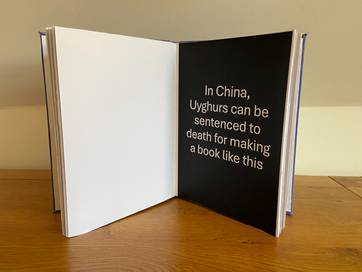
This is not the Middle Ages. This is the 21st Century. But the desire of the Chinese to extinguish Uyghur culture can lead to draconian consequences. This short piece and the book, were created by the Amnesty Death Penalty project.

So often, we take our books for granted.ย But if you are Uyghur, reading, promoting or writing books in the Uyghur language – even childrenโ€™s text books – can land you in serious trouble.ย In fact it can and has on a number of occasions, resulted in a death sentence.ย This is all part of the Chinese governmentโ€™s attempts to suppress the Uyghur language, culture and identity.ย Too many governments around the world use the death penalty as a means of intimidating ordinary people into compliance.ย ย Books, things that we take for granted in the West, can be very dangerous for Uyghurs which is why the Anti-Death Penalty Project has created a book (ูƒู‰ุชุงุจ) to show our solidarity. ‘Thank you so much Death Penalty Network for such a beautiful and thoughtful project!ย ย 

The Salisbury group publishes a report each month on the use of the penalty around the world. It does not include China as executions are a state secret. The country is believed to execute more of its citizens than the rest of the world put together.


Blog at WordPress.com.

Up ↑