Today (10 October 2020) is the 18th World and European Day Against the Death Penalty
Amnesty is opposed to the use of the death penalty in all circumstances and we have campaigned for many years against the practice. There has been a gradual decline but still there are too many countries which continue the barbaric practice. It is neither humane nor effective. It does not deter violent crime or murder and studies in America have shown that there is no difference in murder rates between those states which retain the penalty and those that don’t.
While working towards the total and complete abolition of the death penalty worldwide for all crimes, it is crucial to alert civil society and the international community to the necessity that, at all stages of the legal proceedings, those facing the cruel, inhuman and degrading punishment of execution should at least have access to effective legal representation. Such legal aid can provide the basic protection of either avoiding the sentence or appealing the verdict.
The death penalty in Saudi Arabia: Salisbury group action
Thursday 10th October 2019 will be the 17th World Day Against the Death Penalty so we are writing to invite you to take part in our Group Action.
This year we are focusing on the practice of the death penalty in Saudi Arabia. A report by Baroness Kennedy, presented to the 42nd session of the UN Human Rights Council, has highlighted the ‘alarming’ rise in state executions, including crucifixions. It states that more than 134 people have been executed this year, with at least 24 more prisoners at imminent risk, including three children.
We are asking supporters to write to John Glen MP on 10th October, drawing his attention to the report, and calling on him to make representations to the Government to support its recommendations and to condemn Saudi Arabia’s use of the death penalty.
I have attached a copy of a suggested letter to Mr Glen (the member of parliament for Salisbury), which you are welcome to use, or to adapt into your own words. The letter contains a link to Baroness Kennedy’s report.
We have a number of events planned in the period between now and Christmas so these are listed below. Please note that some are yet to be fully confirmed and dates may change for one or two so please check here or on our Facebook or Twitter pages for updates.
7 September Coffee morning at St Thomas’s church in Salisbury. After an absence of several years we are pleased to be able to host this event again in this church. It would be a good time to make yourself known if wish to join us. We hope to show a looped film.
8 October THIS EVENT HAS BEEN CANCELLED Author and journalist Paul Mason is coming to speak at the Salisbury Methodist church starting at 7:30. Paul has written a book Clear Bright Futureand the issue of human rights in the modern age is discussed. We are awaiting confirmation from his agent over the date. Note this event is postponed from June hence the link text saying it was ‘cancelled’.
10 October World Day Against the Death Penalty. Details of any event nearer the time. See our latest DP report.
24 October As part of schools Citizenship programme, we shall be giving a presentation at Bishops Wordsworth. We rather regret few schools take part in this so if any teacher in the Salisbury area is reading this and would like a presentation in their school, please get in touch.
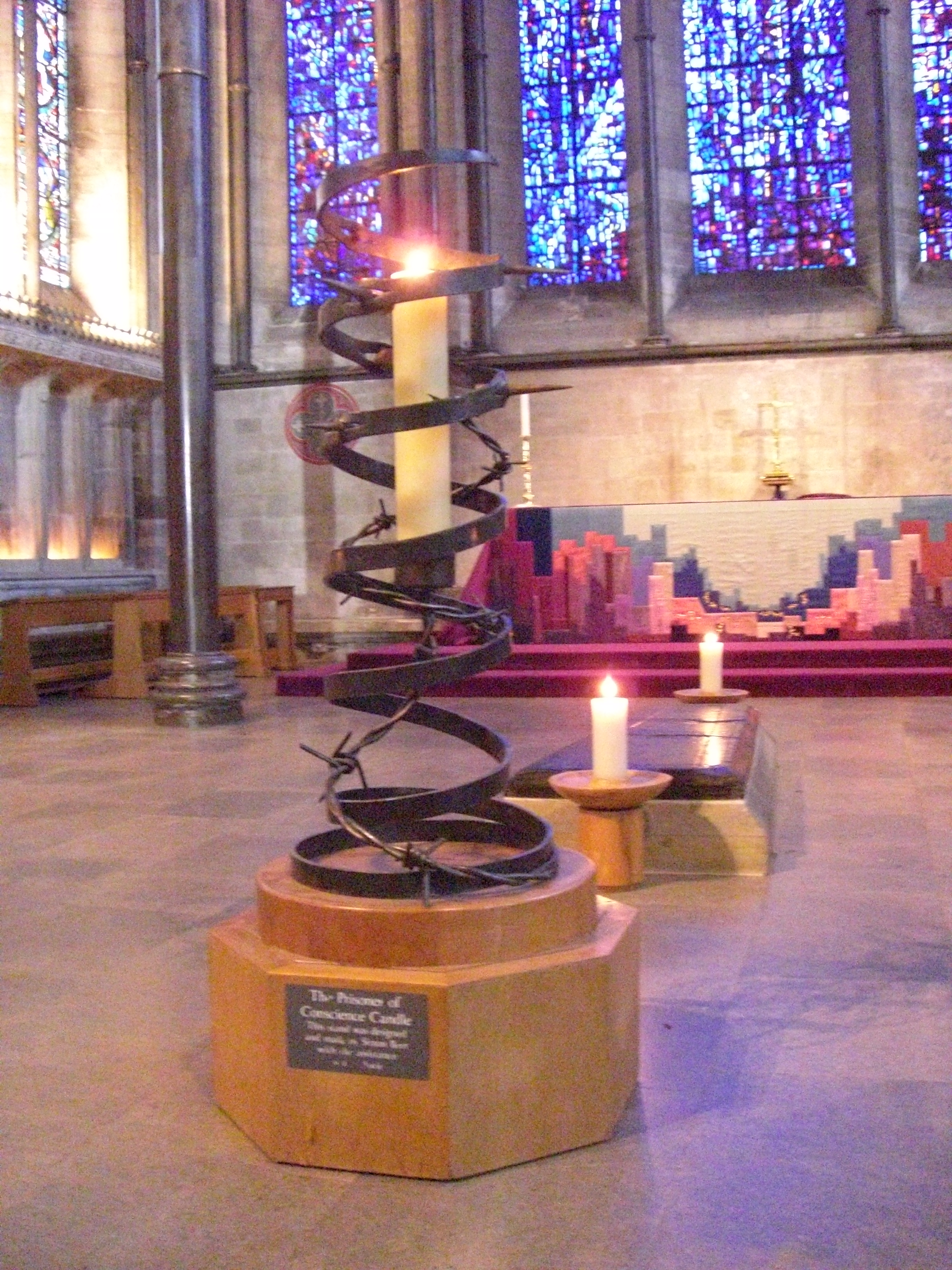
December Evensong at the Cathedral. Date to be agreed. All welcome. Photo shows the Amnesty candle in the Cathedral.
13 November Film at the Arts Centre. The film is Nae Pasaran about a group of Scottish workers refusing to repair aircraft engines destined for the Chilean government after the coup which took place there.
17 December Our annual carol singing event in the Victoria Road, College Street, Marlborough Road area with members of the Farrant Singers. This is a popular event and several families come into the street to listen to a selection of carols properly sung by this choir.
We look forward to seeing you at one or more of these events.
The World Day Against the Death Penalty was created in Rome on 13th May 2002, with 10th October established as the date for its annual commemoration in 2003. The World Coalition against the Death Penalty has 158 member organisations, made up of NGO’s, Bar Associations, local bodies and Unions.
Amnesty International is a member of the Coalition. It has been working to end executions since 1977, when only 15 countries had abolished the death penalty in law or in practice. That number has now risen to 140.
Since that date –
By the end of 2015, 102 Countries had completely abolished the death penalty.
1,634 executions were carried out in 2015 (excluding China – figures unknown) – an increase of 54% over 2014
89% of executions in the course of the year took place in three countries – China, Iran and Iraq – often after unfair trial
The United Nations Moratorium on the Death Penalty calls for States maintaining the death penalty to establish a moratorium on its use, with a view to abolition, and in the meantime to restrict the number of offences punishable by execution, and to respects the rights of those on death row. It also calls on States that have abolished the death penalty not to reinstate it. (Note: UN resolutions are not binding).
Amnesty International is calling for:
Countries that still use the death penalty to halt all executions immediately
Countries that have stopped executing prisoners to remove the death penalty from their legal books, for all crimes, permanently
All death sentences to be commuted to terms of imprisonment
The Salisbury Group have included the abolition of the death penalty in its campaigns from the
Members of the group at the NWR conference
beginning. It is currently focusing on the sentencing to death and execution of juveniles, in particular in Iran and Saudi Arabia.
For this year’s World Day, Amnesty are highlighting the case of the Japanese prisoner, Matsumoto Kenji. The Salisbury Group manned a stall at the NWR Conference on Saturday, (see photo) in the course of which they collected 50 signatures on cards calling on the Minister of Justice to halt the execution, to end the use of solitary confinement for death row prisoners and to end the use of the death penalty in Japan.



 Amnesty in Salisbury & South Wiltshire