UK government signals change re: Israel


New Foreign Secretary indicates tougher approach to new settlements

September 2026

Ed Miliband, the Foreign Secretary has stated in the Commons that the government is prepared to adopt a tougher approach to the proposed new E1 settlement on the West Bank. This highly contentious development is particularly important because it splits the area into two parts thus making any prospect of a viable Palestinian state near impossible.

Israel has just issued tenders for the development of part of the project consisting of around 1,200 homes covering some 4.5 sq miles. Miliband joins a number of other states criticising Israel including Germany which has up to now, been a firm supporter. The UK has joined around 20 other countries and the European Union claiming the development to be unacceptable.
Government ministers have been under increasing pressure to take a firmer stance in relation to Israel. Andy Burnham has apologised for the previous stance of the Labour government. The ever increasing settler violence as well as the destruction of great swathes of Gaza is becoming harder to ignore politically. The encroachment is increasing all the time with over 60% of the land under Israeli control. There are now 2 million Palestinians living in an area of 150 sq km. This is approximately the same area as Havant in Hampshire which has a population of 127,000.

The Israeli embassy has referred to previous comments by the Ambassador saying ‘If Britain acts against the state of Israel, the state of Israel will act against Britain. We have the tools.” The Jewish Chronicle repeated this warning.

Erasure

Amira Hass, writing in the Ha’aretz newspaper (September 1st) quoting the opposition leader Gadi Eisenkot says:

Erasure is the nightmare solution being written into reality every day. Knesset laws, politicians’ declarations, military orders, school textbooks and the holy real estate battalions operating in Gaza, the West Bank and the Negev all work, together and separately, to advance this “solution” diligently and without fear of international condemnation.”

Some argue that genocide, and the elimination of all Palestinians from Israel, has always been the policy of the government. As the Jewish writer Omar Bartov writes:

” […] for the past two years Israel has engaged in a genocidal operation in Gaza and all the indications are this was part of an intentional policy consistent with political and military rhetoric meant to “encourage” Palestinians to leave the Strip altogether (p 190)” [1]

The theme of the elimination of all Palestinians is amply described in the Jewish academic Ilan Pappe’s book The Ethnic Cleansing of Palestine [2]. He notes that right from the start, Ben-Gurion led the Zionist movement to achieve ‘absolute Jewish domination’ of Palestine (p23 ff).

The grim toll of death continues in Gaza with the death toll now put at over 73,000, including 12,500 women, over 20,000 children and 174,500 injured.

The change in stance by the UK government is welcome. As the Ha’aretz article notes, the overwhelming military power possessed by Israel courtesy of the USA, has led it to pursue violent and military solutions. We are rapidly approaching the horrific October 7th massacre with no end of hostilities in sight.

Vigil

Vigils will continue in Salisbury and the next is this Saturday 5th September at 5pm for half an hour. The local MP Mr John Glen has never attended or acknowledged the vigils and is a proud member of the Conservative Friends of Israel group.

[1] Israel: What Went Wrong, Omar Bartov, 2026, Fern Press

[2] The Ethnic Cleansing of Palestine, Ilan Pappe, 2006 (first published), One World

Sources: Guardian, Middle East Eye, Ha’aretz, Jewish Chronicle. Image created by AI.


Uyghur campaign: last day (for now)


Today is our last post for now on this successful campaign

August 2026

This is our last post in our current campaign although we will be featuring the plight of the Uyghurs in future posts. The campaign has had some successes and the organiser reports:

“It has been a huge success by almost all metrics – we have received news coverage in Uyghur, Mandarin, French [and] Turkish languages, we have received well over 100,000 views on Instagram, we’ve exhibited at SOAS University Library, we’ve received a wide range of thanks from Uyghu community members… we will be sharing more thanks in our final newsletter, but for now, I am so proud and grateful [the] incredible achievements [of local groups].

Chinese arrest and imprison protestors

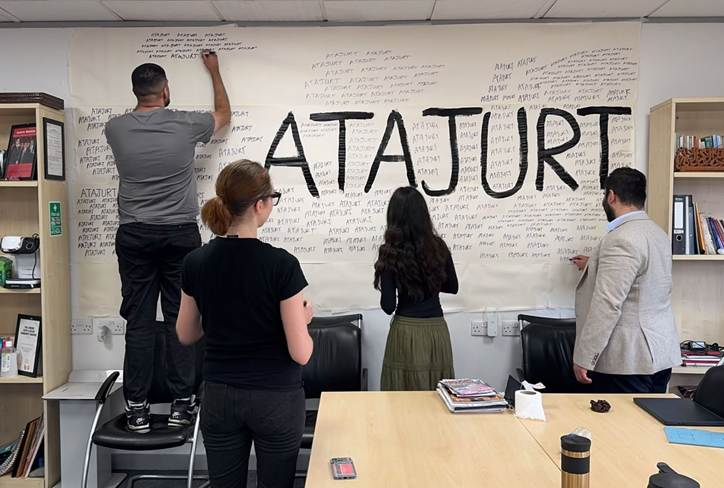
Today, we highlight Nagyz Atajurt, a Kazakhstan-based human rights organization that documents the detention and persecution of ethnic Kazakhs and other Muslim minorities in the Uyghur region.

The curator of the Xinjiang Victims Database at shahit.biz, Gene Bunin, talks in this video about how Atajurt were instrumental in campaigning on behalf of the Uyghur region: https://www.youtube.com/watch?v=Ao1keGNxl1w. After a peaceful protest in November 2025, held over human rights abuses in the Uyghur region, 19 members of Atajurt have been convicted and sentenced this April 2026 – 11 were handed five year prison sentences, and 8 were sentenced to “restrictions of freedom” sentences.

At the Afghanistan and Central Asia Association (ACAA), an organisation focusing on rights of refugees in the UK and rights defenders across the Central Asia region, volunteers worked with us to create a temporary wall mural for Atajurt in their main meeting space –  writing for Atajurt in the simplest way we knew how, remembering how Atajurt wrote for Uyghurs.

Report

We shall be reporting on the results of the Salisbury group’s small part in this campaign but the main thing we shall be highlighting is the extremely high level of views from within China itself and Hong Kong. Because of the firewall, the number of views from there in the past has been tiny. As we have seen in the reporting of the devastating floods in Nepal, the Chinese have released few details and reporters are not allowed into the region, all part of the secrecy and restrictions imposed by the CCP on its citizens and on the world.

The oppression of the Uyghurs and other minorities in the area is massive. One of the main things we have highlighted is that, although a long way away, some of the clothes you wear and the solar panels on your roof contain elements of the forced labour that is taking place there. We are all truly involved…

Photo: Amnesty campaign team. Most of the text of this post is by the campaign team.


Recent posts:

Thought of subscribing?

Good response to our 143rd vigil


We still turn out each week as the need is still there
Proposal to make a film
August 2026

One hundred and forty three vigils for peace in the Middle East supported by around 30 people yesterday (29 August). The photo shows one of our number standing on the traffic island and there were around 35 ‘honks’.

There has been some coverage of the situation in Gaza last week with reports on the yellow line which is slowly creeping across the territory forcing the Palestinians into a smaller and smaller area. According to the LA Times it is now 64% of Gaza. Nearly all the cultivable land has now been seized. According to recent estimates, the death toll is now over 73,000 and continuing despite the ceasefire. 174,000 have been injured. Around 1,300 have been killed since the ‘ceasefire’ and 4,361 injured. Settler violence has intensified in the West Bank.

We still await government action concerning our relations with Israel following the election of Andy Burnham as prime minister who apologised for the government’s stance in July. Although this apology was welcomed, few in the media noted that Burnham is a member of Labour Friends of Israel. On the web site Track Israel Lobbying Mr Burnham heads the page Hall of Shame as having received over ยฃ200,000.

The total received by MPs from Israeli organisations is a massive ยฃ1,574,262 (updated this month). It is reasonable to ask how independent are our members of parliament and to what extent are they representing the interests of those people whom they purport to represent when they are in receipt of such largesse?

Film

We are considering making a short film to be called ‘Because …’ which will have brief interviews with some of those who attend these vigils. We will be carrying out the interviews over the next few Saturdays. Anyone reading this who attends is willing to volunteer. The aim is for people to say they come to the vigils because … and to give their reasons.

We note once again that there has been no sign of the local MP Mr John Glen who is a member of the Conservative Friends of Israel group (see above) and has never mentioned them in his weekly column in the Salisbury Journal.

Photo: courtesy of Peter Gloyns.


Recent posts:

Exeter University in the spotlight


Serious doubts raised over their deal with Saudi Arabia

August 2026

Any organisation preparing to engage in a commercial transaction with a state like Saudi Arabia, needs to ask itself some serious questions. Exeter University is reported in the Guardian newspaper (29th August) to have agreed to offer a MA course ‘applied security and strategy’ with a Saudi University. Whether the university asked itself those questions is unknown but having agreed to offer it they seemed keen to keep it quiet.

The University was in the news earlier in the year when it announced that it was axing 150 jobs in the humanities and social sciences departments and along with other universities, is struggling financially. The main reason is the drop in the number of overseas students due to government restrictions which ended a lucrative income stream. They need to work hard to ward off more serious financial problems.

Little positive to say about Saudi Arabia

What can we say about Saudi, their proposed partner? Firstly, there is no realistic free speech in the country and those who displease the authorities are arrested and imprisoned for long periods. It executes large numbers of people and 2025 was a record at 347 (although it is likely to be more) which was just ahead of 2024’s total of 345. Charges are vague and confessions are often acquired using torture. Apostasy is still a crime. Few have any legal defence. Executions are carried out in public and the most frequent method is beheading with a sword.

Women’s rights are dismal and the ‘guardianship’ system is still in place. This law formally enshrines male guardianship over women, requiring them to obtain a male guardianโ€™s consent for marriage and giving husbands significant authority over wives, including financial support contingent on โ€œobedienceโ€ and marital cohabitation.

Migrants have few rights.

They have wreaked terrible destruction in Yemen with a war against the Houthis backed by Iran.

If the university considered these issues they would had to have weighed up organising a masters programme against the dire human rights situation in Saudi. They may have drawn comfort from the UK’s relaxed attitude allowing arms sales and other commercial deals to take place making them one of our largest countries for our weaponry. Selling arms and helping Saudi with their assault on Yemen is surely worse than running a teaching course in Exeter they might reason.

The issue comes down to integrity and morals. How much do you, as a university, take into account the large number of executions, torture, lack of human rights, lack of an opposition and women treated as vassals, against a lucrative income training some people from the National Defense University in Riyadh?

The University’s college union, UCU, is not impressed and has said ‘they (the university) is more interested in flogging military training to despotic regimes than in defending world class humanities and social sciences teaching.’ It looks as though the university chose money over morals.

Sources: Guardian; Death Penalty Information Center; Human Rights Watch; Amnesty; Exeter University.

Image generated by AI.


It’s not just cotton from Xinjiang …


The Uyghurs are exploited across several different sectors

August 2026

We have focused on cotton in previous posts with estimates of around 20% of the cotton clothes we wear has been produced using forced labour. But it’s not only cotton, a large amount of raw materials, and products, are manufactured in Xinjiang also using Uyghur forced labour. This production includesย 35% of polysilicon – the raw material used to make solar panels – is created in Xinjiang, along with 10% of global PVC production.ย 

Although the UK is trying to combat modern slavery through the Modern Slavery Act 2015, this act has no enforceable legislation to prevent those products from entering the UK. As the EU and the US have stronger legislation in place, the UK risks being the dumping ground for products issued from Uyghur forced labour. 

One way to tackle this issue is to contact your local council to urge them to adopt more stringent practices in their procurement contract to ensure the goods and services used by public bodies are not a result of Uyghur forced labour. 

To shine some light on this issue, we are encouraging you to submit a question to Wiltshire Council to ask about processes and safeguards currently in place to prevent public bodies from procuring goods or services that are issued from forced labour. Some local councils have already adopted measures to address Uyghur forced labour, but you can still ask what is done practically to ensure the motion is respected.ย  The address is:

Wiltshire Council, Bythesea Road, TROWBRIDGE, BA14 8JN. We could find no general point of contact and searches of their site revealed no relevant policies.

Some local councils give the chance to submit questions to be addressed by the mayor and councillors during meetings. For other councils, you may need to ask them directly how to submit a question, or contact a local councillor directly to engage with them. 

Image: Amnesty USA


Vigil No. 142


Nearly 30 attend the latest vigil in Salisbury

August 2026

The vigils continue and the 142nd was held yesterday in the Market Place, Salisbury. Recognition was good with around 100 or so seeming to take some kind of note of our presence. It’s quite a while now since we have had any serious criticism of our action.

There may be signs that things are changing on the political front. The new prime minister seems aware of the damage done by Sir Keir Starmer’s almost blinkered approach to Israel. Starmer was determined he said to ‘root out anti-Semitism from the party’ and claimed he had done so in his final PMQ. ‘Rooting it out’ was a fine objective but giving Israel almost unqualified support despite their atrocious actions in Gaza, and now the West Bank, quite another. The violence has increased markedly in the last few months with the IDF or Israeli police doing very little to stop it. Leaders of the party are fully behind the actions. Thirteen new settlements have been approved and they are designed to make any hope of a coherent Palestinian state impossible.

Andy Burnham is facing demands at next month’s party conference to declare Israel’s actions in Gaza to be genocide which he is reported to be reluctant to do. At his inauguration it appeared he understood the immense harm done by the government’s one-sided support. We shall have to see if words are turned in action.

Why we need to worry about Palantir


Palantir making inroads into government institutions including the NHS

August 2026

Increasing concern is being expressed by the ever widening presence of Palantir into the fabric of British society. Who are they and what are the concerns? Palantir is an American company which has the technology to enable its clients to see all the data they have, all at once. Organisations often have multiple sets of data but scattered among different systems. Harvesting information in a holistic way is often beyond their capability. Palantir uses AI to integrate, analyse and make sense of fragmented data sets. Where information sits in different ‘silos’ the firm’s technology enables it to combine that data into something meaningful and useful.

Clearly it can be realised that in something like health and a massive organisation such as the health service in the UK, putting this information together has the potential to produce clinical benefits and efficiencies in the NHS’s operations. What’s not to like? It is called the Federated Data Platform (FDP).

Problems

There are many problems however:

  • Firstly it is an American company and like other US high tech firms, there is precious little control over them as they are based in the US. There is limited transparency and they have access to a wide range of sensitive personal and medical information.
  • As we have seen with recent actions with the Trump administration, the US has diminishing concerns for international norms of behaviour. Where once we viewed America as a defender of western values of human rights and the post war ‘new world order’ (however imperfectly) these have increasingly been ignored with the ‘America first’ policy. Entrusting patient data with American firms is inherently risky therefore.
  • The firm has deep ties with US agencies including ICE which is rounding up thousands of immigrants ready for deportation. More alarmingly, two years ago, Palantir signed a contract with the Israeli military to use its technology in support of ‘war related missions’. This was signed while Israel was engaged in genocidal actions in Gaza and enabled the IDF to harmonise its data more efficiently. This suggests the firm has few if any moral qualms about how its technology is used.
  • The firm – in common with other tech companies – is a profit making enterprise and indeed there are probably hundreds of companies involved in supply materials and services to the NHS. But this firm is at the heart of the system and there are real doubts about how the data will be used by them and how secure it is in their hands.

How effective are they anyway? The BMJ has questioned that data from a supposed success story at the Chelsea and Westminster Foundation Trust is flawed and that two key claims overstate the benefits of the software. The current issue of Private Eye (No: 1681) also cast doubt over its claims to have improved the level of delayed discharges. The Health Foundation think tank found ‘no noticeable improvement’ in discharge rates although Palantir disputes their findings.

The major worry is that the government is desperate to reduce the NHS bill. Their record of IT projects has been dismal with millions lost in failed or abandoned schemes. Are they more concerned with using firms like Palantir who offer to save them money than they are with the safety of patient information? How ready are they to consider human rights and patient security issues even knowing that the firm is a willing participant in genocide and the deeply unpleasant activities of ICE? How trustworthy are the firm’s claims to protect that information? Does a desire to save money override genuine concerns over rights and safety?

ADDITION: We have received the following comments from someone working in the NHS:

“Palantirโ€™s software is clunky. Many of its tools are basic and regressive. Some of the built in apps donโ€™t have the functionalities thatย NHSย organisationsย actuallyย need. And Palantir provides very limited support when issues need resolving.

“But itโ€™s not just about the software. When we work with Palantir, we donโ€™t just use their tech, we import their ideology โ€“ and Palantirโ€™s ideology is at best deeply uncomfortable and at worst ethically bankrupt.

“Palantir was founded for surveillance and military operations. So I am being forced to use software thatโ€™s enabled the deaths of thousands of my global healthcare colleagues. This has had a devastating impact on my wellbeing. I used to love my job so much, and now it makes me sad and sick.

Thatโ€™s why I am doing all I can to get Palantirโ€™sย NHSย contract cancelled, and I am proud to work with groups like Just Treatment who are fighting for this too”.

Amnesty is pointing out that it is not mandatory for local trusts to use the firm. It is up to people to contact their MP or the trust directly to oppose the use of the technology in their local hospital, in our case Salisbury District Hospital. At the very least to express their concerns. The BMA is opposed to increasing roll out of FDP.

‘Human rights abuses thrive in silence, hidden in contracts, buried beneath complex systems’ (AI).

It’s not just the NHS and Palantir is involved with the police and the Ministry of Defence. Further information.

We are grateful to Amnesty’s recent Fact File from which we have drawn material for this post.


Coercion by the Chinese of the Uyghur diaspora


Chinese government seeks to coerce Uyghurs living overseas

August 20206

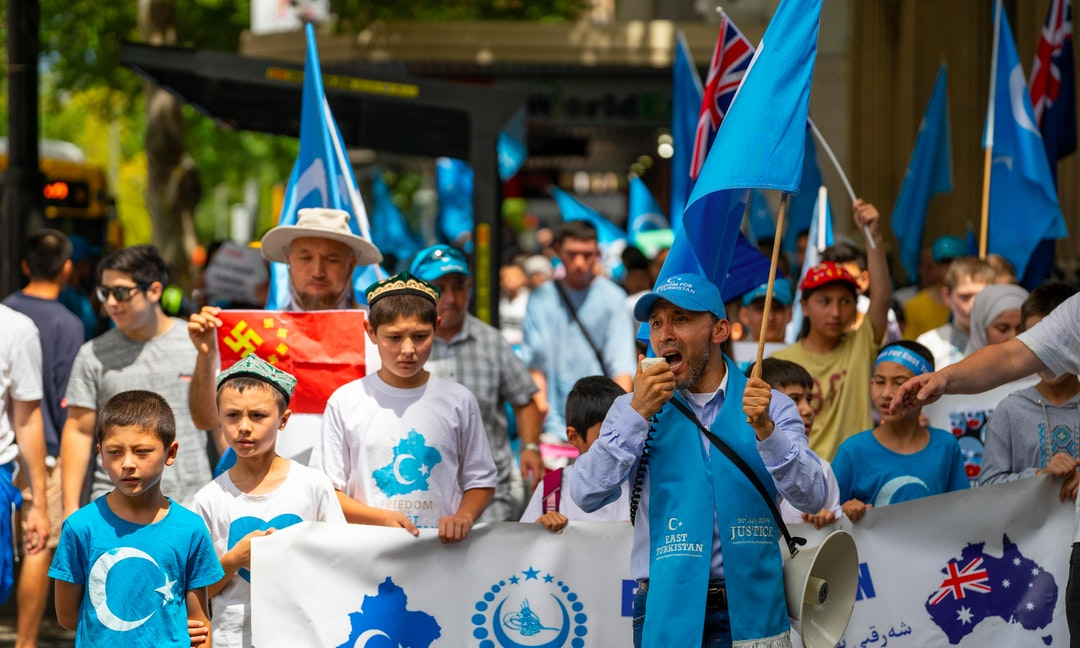
Not content with seeking to extinguish a people and a culture in its own backyard, the Chinese are engaged in a variety of coercive tactics overseas. In Australia theย Chineseย government is interrogating Uyghur Australians visiting Xinjiang, pressing them to collect information on Uyghurs inย Australia, Human Rights Watch said today as its executive director, Philippe Bolopion, visited Australia.ย 

Chinese authorities have long engaged inย transnational repressionโ€”human rights abuses committed beyond a countryโ€™s borders to curtail dissentโ€”against Uyghurs living abroad and their relatives in Xinjiang, by targeting activists critical of the Chinese government. By pressing visitors to provide information about Uyghur activists, organizations, and language schools in Australia, the authorities are repressing the rights of Uyghurs in Australia to freedom of expression, association, culture, and family life.

โ€œThe Chinese government exploits the vulnerability of separated Uyghur families as an opportunity for surveillance and disruption of communities abroad,โ€ saidย Philippe Bolopion, executive director at Human Rights Watch. โ€œInterrogating Uyghurs visiting Xinjiang and strict monitoring of diaspora activities have a chilling effect emblematic of Beijingโ€™s transnational repression in Australia.โ€

Transnational repression

Visitors to Xinjiang can only do so under very strict conditions and are required to report to the authorities every day. Another Uyghur Australian said authorities interrogated him more than a dozen times, once for more than seven hours: โ€œThey asked for addresses and phone numbers of several prominent Uyghur activists in Australia.โ€ When he said he did not have that information, the police pressed him to monitor the activistsโ€™ activities upon returning to Australia and photograph them during events.ย 

Beijingโ€™s transnational repression derives its impact abroad from these crimes. Chinese authorities use the vulnerability of relatives in Xinjiang, restrictions on travel and communication, and fear of retaliation to pressure Uyghurs abroad.

Since the start of Chinese leader Xi Jinpingโ€™s Strike Hard Campaign in Xinjiang in late 2016, the authorities have arbitrarily confiscated Uyghursโ€™ passports in the region, and punished Uyghurs for contacting family members and others abroad. While the authorities are now permitting select Uyghurs to travel internationally or to visit family members in Xinjiang, they continue to exert tight control over those who travel.

Although this is a description of the CCP’s actions in Australia, it will be replicated around the world including the UK.

Massive destruction of mosques

We have concentrated in these posts on people aspects which of course is extremely important. But the UK government also discusses actions by the Chinese against culture including mosques. Satellite imagery and witness reports indicate that around 16,000 mosques, approximately 65% of the total in Xinjiang, have been destroyed or damaged by the government, with about 8,500 demolished entirely and much of the land left vacant. Additionally, 30% of key Islamic sacred sites, including shrines and cemeteries, have been demolished, and 28% of altered mosques have been repurposed (see State treatment of Muslims in Xinjiang province – Mosques and Islamic spaces). The full analysis by the UK government of the tragedy taking place there can be read here.

These actions represent a crime against humanity and are receiving too little attention in the West as we have noted previously.

We are grateful to Human Rights Watch for much of the material in this post. Image: protestors in Australia.


Zoom meeting on the Uyghur campaign


Well attended meeting added useful insights into the campaign

August 2026

Several new topics and concerns emerged from this well attended Zoom meeting including from four Uyghurs living in the West. It is worth reflecting on the wider issues that the repression of minorities in China – of which the Uyghur people are just one – and that is the extent of the barbarity being perpetrated by the Chinese state and the CCP. This is a highly organised and well planned series of actions against an entire community of people which is unparalleled in the modern era. It is being committed by a state which was closely involved in the preparation and signing of the Universal Declaration after the War. China is also on the Security Council of the United Nations a position and status which is entirely undeserved.

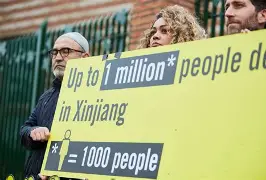
The numbers are massive with 1.8 million taken away from their homes to be ‘re-educated’ but a further half million have been sentenced and forced to work in China itself.

We were introduced to the observable fact that there is little press or media interest in the fate of these people. Indeed, one can mention the campaign and the plight of the Uyghurs usually to receive blank looks. Awareness is low. The reasons are not hard to find: it is a long way away and the Chinese have banned almost all journalists from entering the region. So what extra did we learn this evening?

First from a Uyghur woman living in the US whose father is in prison for life for speaking out. He has not been heard from since 2017. She does not know whether he is alive and a request for ‘proof of life’ has not been answered. It is hard to imagine an action so cruel as this.

Another Uyghur who is living in the UK has witnessed the pain in her parent’s lives as they have lost contact with their culture. Contact is banned and contacts from overseas can result in punishment for those receiving them in Xinjiang. She is often asked about Uyghur culture but in fact seldom knows how to reply since all contact is lost. Another spoke of his brother in gaol for his journalism and he believes his conditions have got harsher.

Organ harvesting

The most chilling of the comments however concerns organ harvesting. Visitors might want to read the Hansard debate on this topic ten years ago which discussed this disgusting activity or a more recent UN report. The focus at the time was the Falun Gong but it has spread to Tibetans, Mongolians and now the Uyghur. The harvesting of organs is on a massive scale. According to the allegations received, the most common organs removed from the prisoners are reportedly hearts, kidneys, livers, corneas and, less commonly, parts of livers. They are extracted from prisoners often without anaesthetic. The role of a British university in the trade has been recently revealed.

Transnational repression

Other speakers told of Chinese transnational repression. Nobody in the Chinese diaspora is safe from the activities of the Chinese state which expends enormous efforts to silence critics overseas. This is why plans to build the massive embassy in London is so dangerous. Not only will it enhance and facilitate Chinese espionage activities but it will also help in their attempts to intimidate, threaten or coerce those who criticise China. That this embassy is even being considered is extremely unwise.

There was brief mention of the reach of our posts into China with views from over 50 cities and from Hong Kong.

The CCP and its leader Xi Jinping seems almost paranoid. The state has the most extensive video surveillance system in the world. Media and the internet are closely controlled. It is hellbent on extinguishing any non-Chinese culture such as the Uyghurs, having done the same in Tibet and Mongolia. Freedoms in Hong Kong were quickly extinguished.

But we hear little of this in the UK. Politicians are largely mute. The Chinese are sensitive to direct or forthright criticism and so western politicians express their disquiet in private (they claim). But do they? There is next to no media interest or reporting. Issues in which Beijing diverges from the norms of the current system, such as human rights, it seeks to undermine those values and create alternative institutions and models. China works with otherย authoritarian powersย such as Russia to create standards that reflect their interests for example internet governance.

The campaign continues …


Recent posts:

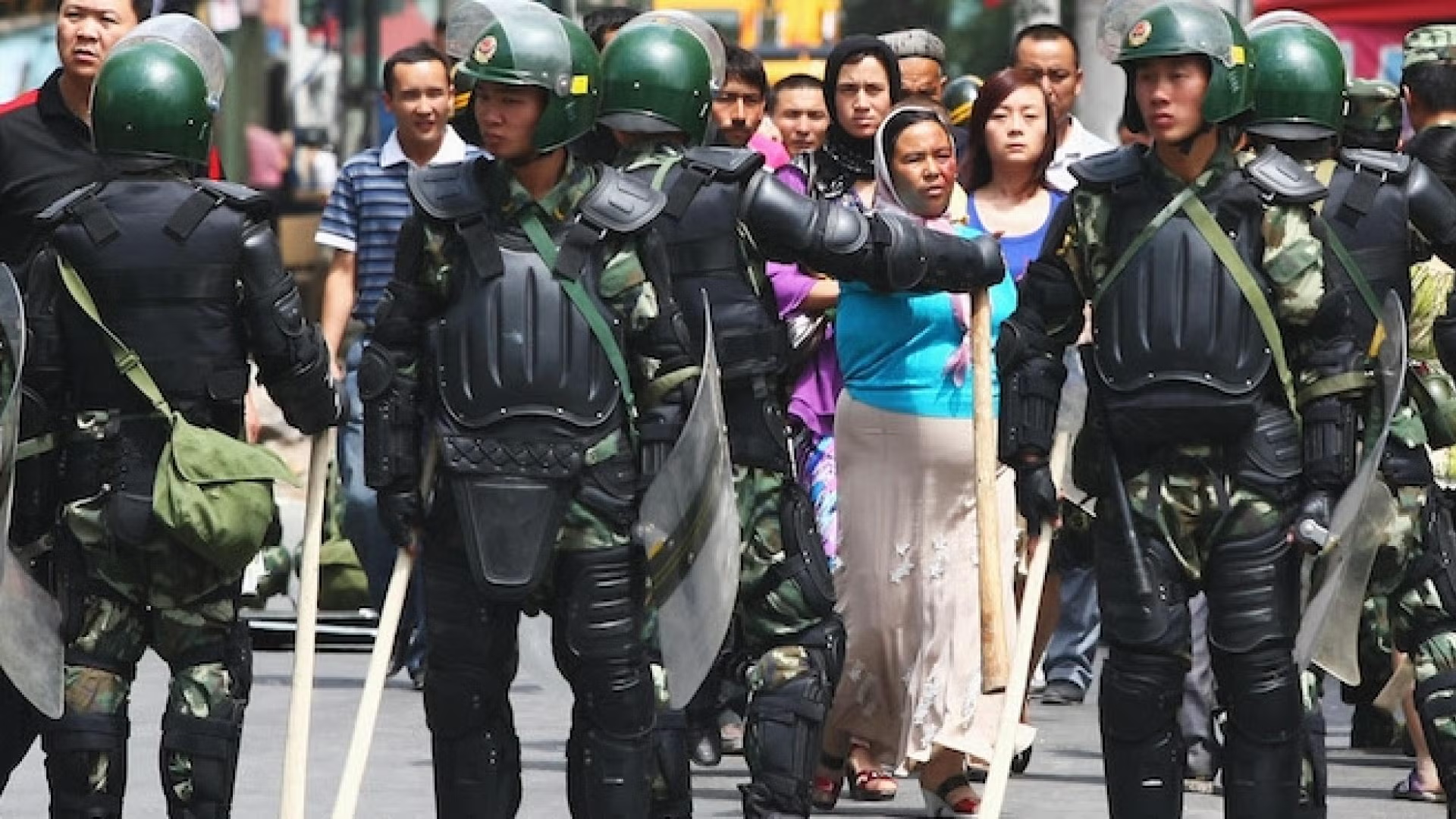
Image: repression in Xinjiang, Hudson

Thought of subscribing?

Podcast Episode: Xinjiang Forced Labour Campaign


Pip: A local Amnesty group in Salisbury posts about Uyghur rights โ€” and suddenly cities across China are reading. That is either heartening or a sign that someone in Beijing is taking notes.

Mara: This episode covers Salisbury Amnesty’s recent posts on the Uyghur campaign, from the surprising reach of their online presence to the forced labour hidden inside your high street wardrobe. Let’s start with the campaign itself and what those viewing figures actually revealed.

Uyghur Campaign Reaches Across the Firewall

Pip: The Salisbury group ran a daily posting campaign on Uyghur rights โ€” and the audience that showed up was not quite the one anyone expected.

Mara: The campaign newsletter reported figures that stopped people mid-scroll. Here is what it said: “Around 70% were from China and Hong Kong SAR, a figure we have never seen before. Usually, views from China seldom reach double figures.”

Pip: So a small Wiltshire group is somehow punching through one of the most sophisticated censorship systems on earth. That is the real story here โ€” not the post count, but who is reading.

Mara: The breakdown gets more specific. Fifty-six cities across China are represented in the data, with 31 views from Beijing and 15 from Shanghai. The newsletter notes that “views from nine cities in China even exceeded the views of people from Salisbury.”

Pip: Which suggests ordinary people actively routing around the Great Firewall to find this material โ€” not just state monitors checking in.

Mara: Facebook told a different story. The same posts drew only around twenty views each there, with almost no engagement from the eighteen-to-twenty-four age group. The campaign also secured a letter in the Salisbury Journal, which the newsletter describes as a paper that does not usually publish material on topics outside the local area.

Pip: Harder to get into than Beijing, apparently.

Mara: The Uyghur Crisis Response Team acknowledged the group’s posts on Bluesky, which rounds out a campaign the newsletter calls “altogether a satisfactory response.” And the month was not yet over when those figures were filed. That reach into China sets up the harder question โ€” what exactly are people in Xinjiang living under?

Forced Labour in the Clothes on Your Back

Pip: The post titled “Slavery was abolished in 1807 โ€” Not in Xinjiang” opens with a blunt premise: the system did not end, it just became harder to see on a label.

Mara: The post draws on Sheffield Hallam University research, which states that “previous research has provided significant evidence indicating that these programmes are indeed tantamount to forced labour, human trafficking, and modern slavery and that this system of repression is particularly deployed in the cotton and textile industries.”

Pip: Xinjiang produces around eighty percent of China’s cotton โ€” which is roughly twenty percent of global supply. The brands that pledged to cut ties in 2020 did not necessarily solve anything.

Mara: That is the mechanism the post calls “cotton laundering.” Once raw cotton becomes yarn or fabric and passes through a third country like Bangladesh or Vietnam, its origin becomes nearly impossible to trace. Even the “Better Cotton” label offers no guarantee โ€” the post notes it “can be mixed or blended with what they call conventional cotton very early on in the supply chain.”

Pip: So the ethical label is doing the laundering for them. Efficient.

Mara: The post names M&S specifically, via an RTร‰ investigation, as a retailer featured in footage about vague labelling practices. The campaign asks readers to write directly to retailers โ€” a sample letter is included โ€” asking what safeguards they have in place to verify their cotton’s origin.

Mara: The post closes with a line worth sitting with: “The products of this obnoxious and cruel system are sitting on the clothing racks of our major high street retailers and hence in your wardrobes. Truly we are all involved.”

Pip: And that is the thread connecting both posts โ€” the question of who is paying attention, and whether attention is enough.


Pip: A record month of hits from inside China, and forced labour woven into everyday retail. The local and the global keep colliding.

Mara: They do. Next time, we will see where that thread leads.

Blog at WordPress.com.

Up ↑