The vigils continue and the 142nd was held yesterday in the Market Place, Salisbury. Recognition was good with around 100 or so seeming to take some kind of note of our presence. It’s quite a while now since we have had any serious criticism of our action.
There may be signs that things are changing on the political front. The new prime minister seems aware of the damage done by Sir Keir Starmer’s almost blinkered approach to Israel. Starmer was determined he said to ‘root out anti-Semitism from the party’ and claimed he had done so in his final PMQ. ‘Rooting it out’ was a fine objective but giving Israel almost unqualified support despite their atrocious actions in Gaza, and now the West Bank, quite another. The violence has increased markedly in the last few months with the IDF or Israeli police doing very little to stop it. Leaders of the party are fully behind the actions. Thirteen new settlements have been approved and they are designed to make any hope of a coherent Palestinian state impossible.
Andy Burnham is facing demands at next month’s party conference to declare Israel’s actions in Gaza to be genocide which he is reported to be reluctant to do. At his inauguration it appeared he understood the immense harm done by the government’s one-sided support. We shall have to see if words are turned in action.
Palantir making inroads into government institutions including the NHS
August 2026
Increasing concern is being expressed by the ever widening presence of Palantir into the fabric of British society. Who are they and what are the concerns? Palantir is an American company which has the technology to enable its clients to see all the data they have, all at once. Organisations often have multiple sets of data but scattered among different systems. Harvesting information in a holistic way is often beyond their capability. Palantir uses AI to integrate, analyse and make sense of fragmented data sets. Where information sits in different ‘silos’ the firm’s technology enables it to combine that data into something meaningful and useful.
Clearly it can be realised that in something like health and a massive organisation such as the health service in the UK, putting this information together has the potential to produce clinical benefits and efficiencies in the NHS’s operations. What’s not to like? It is called the Federated Data Platform (FDP).
Problems
There are many problems however:
Firstly it is an American company and like other US high tech firms, there is precious little control over them as they are based in the US. There is limited transparency and they have access to a wide range of sensitive personal and medical information.
As we have seen with recent actions with the Trump administration, the US has diminishing concerns for international norms of behaviour. Where once we viewed America as a defender of western values of human rights and the post war ‘new world order’ (however imperfectly) these have increasingly been ignored with the ‘America first’ policy. Entrusting patient data with American firms is inherently risky therefore.
The firm has deep ties with US agencies including ICE which is rounding up thousands of immigrants ready for deportation. More alarmingly, two years ago, Palantir signed a contract with the Israeli military to use its technology in support of ‘war related missions’. This was signed while Israel was engaged in genocidal actions in Gaza and enabled the IDF to harmonise its data more efficiently. This suggests the firm has few if any moral qualms about how its technology is used.
The firm – in common with other tech companies – is a profit making enterprise and indeed there are probably hundreds of companies involved in supply materials and services to the NHS. But this firm is at the heart of the system and there are real doubts about how the data will be used by them and how secure it is in their hands.
How effective are they anyway? The BMJ has questioned that data from a supposed success story at the Chelsea and Westminster Foundation Trust is flawed and that two key claims overstate the benefits of the software. The current issue of Private Eye (No: 1681) also cast doubt over its claims to have improved the level of delayed discharges. The Health Foundation think tank found ‘no noticeable improvement’ in discharge rates although Palantir disputes their findings.
The major worry is that the government is desperate to reduce the NHS bill. Their record of IT projects has been dismal with millions lost in failed or abandoned schemes. Are they more concerned with using firms like Palantir who offer to save them money than they are with the safety of patient information? How ready are they to consider human rights and patient security issues even knowing that the firm is a willing participant in genocide and the deeply unpleasant activities of ICE? How trustworthy are the firm’s claims to protect that information? Does a desire to save money override genuine concerns over rights and safety?
ADDITION: We have received the following comments from someone working in the NHS:
“Palantirโs software is clunky. Many of its tools are basic and regressive. Some of the built in apps donโt have the functionalities thatย NHSย organisationsย actuallyย need. And Palantir provides very limited support when issues need resolving.
“But itโs not just about the software. When we work with Palantir, we donโt just use their tech, we import their ideology โ and Palantirโs ideology is at best deeply uncomfortable and at worst ethically bankrupt.
“Palantir was founded for surveillance and military operations. So I am being forced to use software thatโs enabled the deaths of thousands of my global healthcare colleagues. This has had a devastating impact on my wellbeing. I used to love my job so much, and now it makes me sad and sick.
“Thatโs why I am doing all I can to get Palantirโsย NHSย contract cancelled, and I am proud to work with groups like Just Treatment who are fighting for this too”.
Amnesty is pointing out that it is not mandatory for local trusts to use the firm. It is up to people to contact their MP or the trust directly to oppose the use of the technology in their local hospital, in our case Salisbury District Hospital. At the very least to express their concerns. The BMA is opposed to increasing roll out of FDP.
‘Human rights abuses thrive in silence, hidden in contracts, buried beneath complex systems’ (AI).
It’s not just the NHS and Palantir is involved with the police and the Ministry of Defence. Further information.
We are grateful to Amnesty’s recent Fact File from which we have drawn material for this post.
Chinese government seeks to coerce Uyghurs living overseas
August 20206
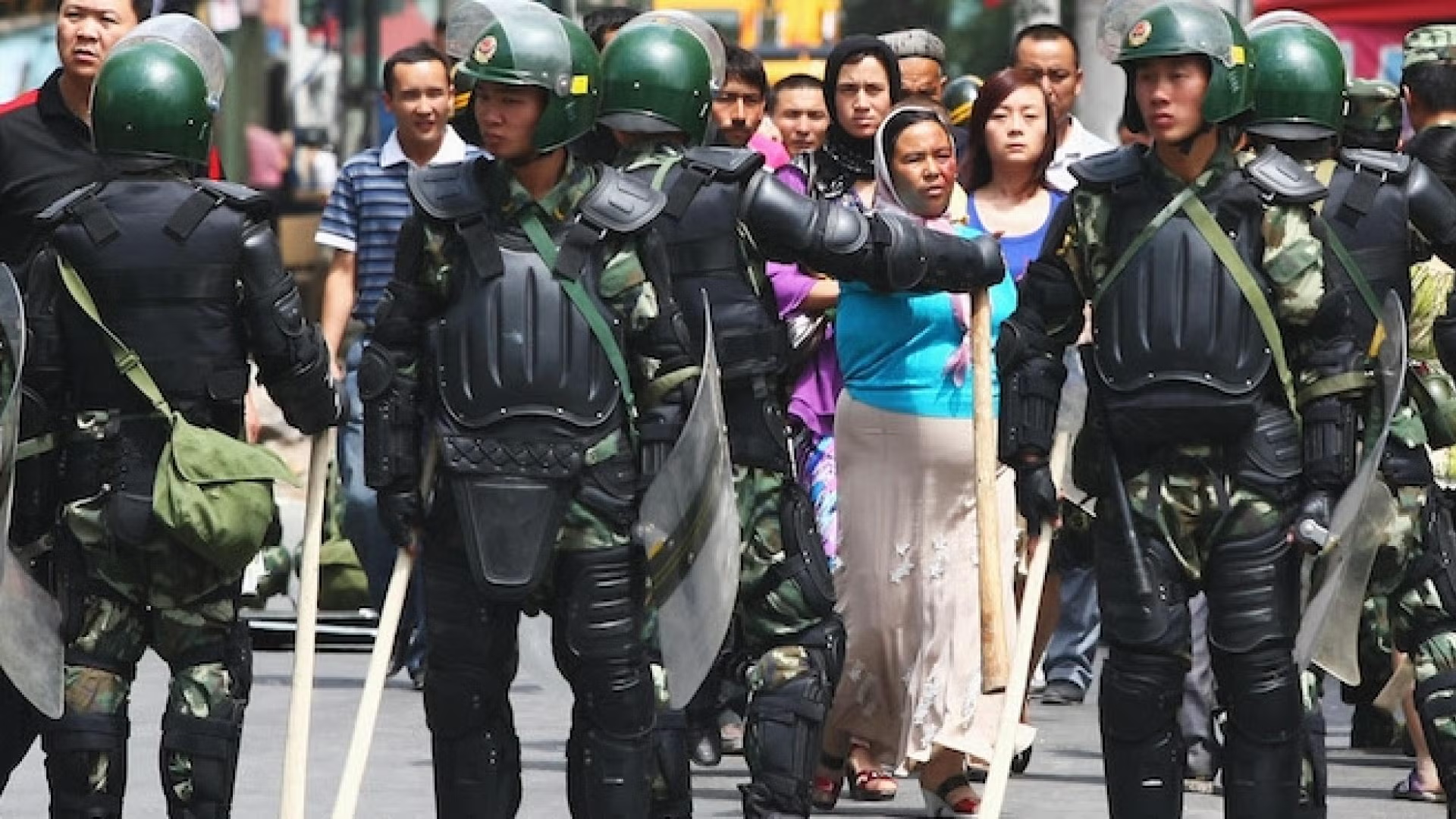
Not content with seeking to extinguish a people and a culture in its own backyard, the Chinese are engaged in a variety of coercive tactics overseas. In Australia theย Chineseย government is interrogating Uyghur Australians visiting Xinjiang, pressing them to collect information on Uyghurs inย Australia, Human Rights Watch said today as its executive director, Philippe Bolopion, visited Australia.ย
Chinese authorities have long engaged inย transnational repressionโhuman rights abuses committed beyond a countryโs borders to curtail dissentโagainst Uyghurs living abroad and their relatives in Xinjiang, by targeting activists critical of the Chinese government. By pressing visitors to provide information about Uyghur activists, organizations, and language schools in Australia, the authorities are repressing the rights of Uyghurs in Australia to freedom of expression, association, culture, and family life.
โThe Chinese government exploits the vulnerability of separated Uyghur families as an opportunity for surveillance and disruption of communities abroad,โ saidย Philippe Bolopion, executive director at Human Rights Watch. โInterrogating Uyghurs visiting Xinjiang and strict monitoring of diaspora activities have a chilling effect emblematic of Beijingโs transnational repression in Australia.โ
Transnational repression
Visitors to Xinjiang can only do so under very strict conditions and are required to report to the authorities every day. Another Uyghur Australian said authorities interrogated him more than a dozen times, once for more than seven hours: โThey asked for addresses and phone numbers of several prominent Uyghur activists in Australia.โ When he said he did not have that information, the police pressed him to monitor the activistsโ activities upon returning to Australia and photograph them during events.ย
Beijingโs transnational repression derives its impact abroad from these crimes. Chinese authorities use the vulnerability of relatives in Xinjiang, restrictions on travel and communication, and fear of retaliation to pressure Uyghurs abroad.
Since the start of Chinese leader Xi Jinpingโs Strike Hard Campaign in Xinjiang in late 2016, the authorities have arbitrarily confiscated Uyghursโ passports in the region, and punished Uyghurs for contacting family members and others abroad. While the authorities are now permitting select Uyghurs to travel internationally or to visit family members in Xinjiang, they continue to exert tight control over those who travel.
Although this is a description of the CCP’s actions in Australia, it will be replicated around the world including the UK.
Massive destruction of mosques
We have concentrated in these posts on people aspects which of course is extremely important. But the UK government also discusses actions by the Chinese against culture including mosques. Satellite imagery and witness reports indicate that around 16,000 mosques, approximately 65% of the total in Xinjiang, have been destroyed or damaged by the government, with about 8,500 demolished entirely and much of the land left vacant. Additionally, 30% of key Islamic sacred sites, including shrines and cemeteries, have been demolished, and 28% of altered mosques have been repurposed (see State treatment of Muslims in Xinjiang province – Mosques and Islamic spaces). The full analysis by the UK government of the tragedy taking place there can be read here.
These actions represent a crime against humanity and are receiving too little attention in the West as we have noted previously.
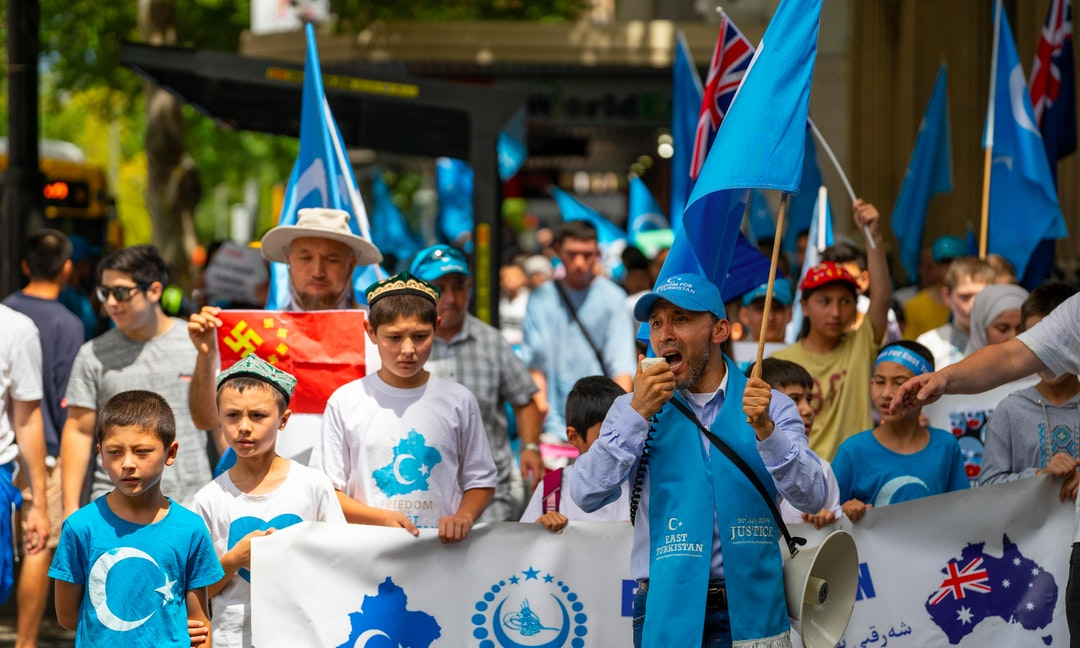
We are grateful to Human Rights Watch for much of the material in this post. Image: protestors in Australia.
Well attended meeting added useful insights into the campaign
August 2026
Several new topics and concerns emerged from this well attended Zoom meeting including from four Uyghurs living in the West. It is worth reflecting on the wider issues that the repression of minorities in China – of which the Uyghur people are just one – and that is the extent of the barbarity being perpetrated by the Chinese state and the CCP. This is a highly organised and well planned series of actions against an entire community of people which is unparalleled in the modern era. It is being committed by a state which was closely involved in the preparation and signing of the Universal Declaration after the War. China is also on the Security Council of the United Nations a position and status which is entirely undeserved.
The numbers are massive with 1.8 million taken away from their homes to be ‘re-educated’ but a further half million have been sentenced and forced to work in China itself.
We were introduced to the observable fact that there is little press or media interest in the fate of these people. Indeed, one can mention the campaign and the plight of the Uyghurs usually to receive blank looks. Awareness is low. The reasons are not hard to find: it is a long way away and the Chinese have banned almost all journalists from entering the region. So what extra did we learn this evening?
First from a Uyghur woman living in the US whose father is in prison for life for speaking out. He has not been heard from since 2017. She does not know whether he is alive and a request for ‘proof of life’ has not been answered. It is hard to imagine an action so cruel as this.
Another Uyghur who is living in the UK has witnessed the pain in her parent’s lives as they have lost contact with their culture. Contact is banned and contacts from overseas can result in punishment for those receiving them in Xinjiang. She is often asked about Uyghur culture but in fact seldom knows how to reply since all contact is lost. Another spoke of his brother in gaol for his journalism and he believes his conditions have got harsher.
Organ harvesting
The most chilling of the comments however concerns organ harvesting. Visitors might want to read the Hansard debate on this topic ten years ago which discussed this disgusting activity or a more recent UN report. The focus at the time was the Falun Gong but it has spread to Tibetans, Mongolians and now the Uyghur. The harvesting of organs is on a massive scale. According to the allegations received, the most common organs removed from the prisoners are reportedly hearts, kidneys, livers, corneas and, less commonly, parts of livers. They are extracted from prisoners often without anaesthetic. The role of a British university in the trade has been recently revealed.
Transnational repression
Other speakers told of Chinese transnational repression. Nobody in the Chinese diaspora is safe from the activities of the Chinese state which expends enormous efforts to silence critics overseas. This is why plans to build the massive embassy in London is so dangerous. Not only will it enhance and facilitate Chinese espionage activities but it will also help in their attempts to intimidate, threaten or coerce those who criticise China. That this embassy is even being considered is extremely unwise.
The CCP and its leader Xi Jinping seems almost paranoid. The state has the most extensive video surveillance system in the world. Media and the internet are closely controlled. It is hellbent on extinguishing any non-Chinese culture such as the Uyghurs, having done the same in Tibet and Mongolia. Freedoms in Hong Kong were quickly extinguished.
But we hear little of this in the UK. Politicians are largely mute. The Chinese are sensitive to direct or forthright criticism and so western politicians express their disquiet in private (they claim). But do they? There is next to no media interest or reporting. Issues in which Beijing diverges from the norms of the current system, such as human rights, it seeks to undermine those values and create alternative institutions and models. China works with otherย authoritarian powersย such as Russia to create standards that reflect their interests for example internet governance.
Pip: A local Amnesty group in Salisbury posts about Uyghur rights โ and suddenly cities across China are reading. That is either heartening or a sign that someone in Beijing is taking notes.
Mara: This episode covers Salisbury Amnesty’s recent posts on the Uyghur campaign, from the surprising reach of their online presence to the forced labour hidden inside your high street wardrobe. Let’s start with the campaign itself and what those viewing figures actually revealed.
Uyghur Campaign Reaches Across the Firewall
Pip: The Salisbury group ran a daily posting campaign on Uyghur rights โ and the audience that showed up was not quite the one anyone expected.
Mara: The campaign newsletter reported figures that stopped people mid-scroll. Here is what it said: “Around 70% were from China and Hong Kong SAR, a figure we have never seen before. Usually, views from China seldom reach double figures.”
Pip: So a small Wiltshire group is somehow punching through one of the most sophisticated censorship systems on earth. That is the real story here โ not the post count, but who is reading.
Mara: The breakdown gets more specific. Fifty-six cities across China are represented in the data, with 31 views from Beijing and 15 from Shanghai. The newsletter notes that “views from nine cities in China even exceeded the views of people from Salisbury.”
Pip: Which suggests ordinary people actively routing around the Great Firewall to find this material โ not just state monitors checking in.
Mara: Facebook told a different story. The same posts drew only around twenty views each there, with almost no engagement from the eighteen-to-twenty-four age group. The campaign also secured a letter in the Salisbury Journal, which the newsletter describes as a paper that does not usually publish material on topics outside the local area.
Pip: Harder to get into than Beijing, apparently.
Mara: The Uyghur Crisis Response Team acknowledged the group’s posts on Bluesky, which rounds out a campaign the newsletter calls “altogether a satisfactory response.” And the month was not yet over when those figures were filed. That reach into China sets up the harder question โ what exactly are people in Xinjiang living under?
Forced Labour in the Clothes on Your Back
Pip: The post titled “Slavery was abolished in 1807 โ Not in Xinjiang” opens with a blunt premise: the system did not end, it just became harder to see on a label.
Mara: The post draws on Sheffield Hallam University research, which states that “previous research has provided significant evidence indicating that these programmes are indeed tantamount to forced labour, human trafficking, and modern slavery and that this system of repression is particularly deployed in the cotton and textile industries.”
Pip: Xinjiang produces around eighty percent of China’s cotton โ which is roughly twenty percent of global supply. The brands that pledged to cut ties in 2020 did not necessarily solve anything.
Mara: That is the mechanism the post calls “cotton laundering.” Once raw cotton becomes yarn or fabric and passes through a third country like Bangladesh or Vietnam, its origin becomes nearly impossible to trace. Even the “Better Cotton” label offers no guarantee โ the post notes it “can be mixed or blended with what they call conventional cotton very early on in the supply chain.”
Pip: So the ethical label is doing the laundering for them. Efficient.
Mara: The post names M&S specifically, via an RTร investigation, as a retailer featured in footage about vague labelling practices. The campaign asks readers to write directly to retailers โ a sample letter is included โ asking what safeguards they have in place to verify their cotton’s origin.
Mara: The post closes with a line worth sitting with: “The products of this obnoxious and cruel system are sitting on the clothing racks of our major high street retailers and hence in your wardrobes. Truly we are all involved.”
Pip: And that is the thread connecting both posts โ the question of who is paying attention, and whether attention is enough.
Pip: A record month of hits from inside China, and forced labour woven into everyday retail. The local and the global keep colliding.
Mara: They do. Next time, we will see where that thread leads.
Slavery and forced labour is alive and well in Xinjiang. Major retailers complicit. Welcome to ‘cotton laundering’
August 2026
Many people believe that slavery ended sometime in the 19th Century and many – certainly older people reading this – think that Britain led the way. Slavery continued for many years afterwards. The reality is that slavery is alive and well and that you are wearing the products of this vile system while sat reading this. You may feel that you have purchased your cotton garments from a respectable high street retailer so this surely cannot be the case. If you watch the video in the RTE programme [link below], they will explain how retailers such as M&S who feature strongly in the film, are evading controls with vague labelling.
The story of cotton
Around 80% of cotton production in China comes from Xinjiang, using forced labour from the Uyghur which represents 20% of the global cotton production. Following an uproar and call to action in 2020 that called on numerous fashion brands (such as Nike, Adidas, Zara, H&M, Amazon, etc) to sever ties with Uyghur forced labour, many of these brands decided apparently to stop sourcing cotton from Xinjiang. If we were to ask these brands today about their commitment to Uyghur rights, they would answer that Uyghur forced labour has been cut from their supply chain. (Photo is one of the major companies involvedinChina).
However, the reality is not that simple. Cotton production has not reduced in the region since 2020; instead, Chinese manufacturers have resorted to โcotton launderingโ. Once the cotton has been transformed into yarn or fabric, the cotton enters the supply chain through third countries such as Bangladesh or Vietnam. This results in cotton that is extremely difficult to trace.
Cotton laundering
Some brands may claim that having the label ‘Better Cotton’ to claim that their supply chains are ethical. However as investigated by RTร, it appears that โthe Better Cotton can be mixed or blended with what they call conventional cotton very early on in the supply chain, and that includes cotton from the Uyghur region“. The RTE film (5 mins) can be viewed here.
Although companies have acted on demands to stop using suppliers that rely on Uyghur forced labour, it can be easy to imagine that cotton harvested in Xinjiang finds its way to those factories through cotton laundering. That is why we are asking you today to write a question to a company that produces apparel which contains cotton to ask them what processes and safeguards are in place to ensure forced labour is not present in their supply chains.
Research published by Sheffield Hallam University shows in detail how the system works and contains much evidence. They say that previous research has provided significant evidence indicating that these programmes are indeed tantamount to forced labour, human trafficking, and modern slavery and that this system of repression is particularly deployed in the cotton and textile industries, which for China are centred in the Uyghur Region. Reports have shown that much of the regionโs cotton is hand-picked by people who are forced to do so, that textile factories in the Uyghur Region employ forced labour, and that minority citizens of the region have been โtransferredโ thousands of miles into the interior of China to work in factories for major textile and apparel exporters.
The notion of slavery today is universally condemned. Britain was heavily involved in the trade for nearly two centuries transporting well over 3 million in the triangular trade. Many are often surprised to discover that the slave owners (not the slaves) were compensated and the debt was only paid off in 2015.
As we have noted before, although Xinjiang seems a long way off and few will have been there, the products of this obnoxious and cruel system are sitting on the clothing racks of our major high street retailers and hence in your wardrobes. Truly we are all involved.
[*Quite when slavery ended is difficult to be precise. Many ships simply reflagged to avoid patrols. Slavery persisted for decades in the Caribbean and America. Slaves were still transferred between countries. A separate act was later passed to end the practice in India. Freed slaves simply became indentured.]
Letter
This is a sample letter to a retailer or manufacturer to model yours on. It is likely you will receive a standard reply but it will register with the retailer that they are being watched and if not careful, they could receive reputational damage:
Dear xx, I am writing to express my concern as to the possibility that your cotton products contain cotton produced in Xinjiang using Uyghur forced labour. One tactic used by Chinese manufacturers to sell cotton produced by forced labour and internal displacement of Uyghur population is โcotton launderingโ. These companies will transform cotton into yarn or fabric and then introduce them to global chains through third countries such as Bangladesh or Vietnam. As a result, the origin of the cotton is extremely difficult to trace. In addition, the label โBetter Cottonโ does not prevent products from containing cotton produced through forced labour. The Better Cotton Initiative does not have a traceability protocol and enable mixed or blended cotton with ethically sourced material. Cotton from the Uyghur region may very well be present in those mixes or blends. As a concerned consumer, I would like to ask you: what protocols and safeguards do you have in place to absolutely ensure that none of the cotton present in your garments is a result of Uyghur forced labour? How do you verify that the cotton used in your garment does not come from Xinjiang? Thank you in advance for your reply. Yours sincerely,
We have drawn from material produced by RTE (Ireland), Sheffield Hallam University, Statista and from the Uyghur Solidarity Team with thanks.
We are pleased to report that the activities of the Salisbury group feature in part of today’s (16th August) action by the campaign team. We have put up a post on most days of the campaign using material provided by the team and we have a letter published in the local paper.
What has been remarkable however, is the numbers viewing the posts from China itself. China rarely appears in our viewing figures, we suspect because our posts are blocked. We reported the latest figures – accessed yesterday (15th August) – i.e. half way through the month and these are reproduced in the newsletter:
“The Salisbury group has experienced considerable interest in the Uyghur campaign on its website with a record number of views from China itself. The numbers are high for the site and the month looks as though it is heading for a record number of hits likely to exceed 3,000ย for the first time led by the Uyghur campaign although there is other material posted.
“No less than 88% of the hits were posts on the campaign partly because we have posted something on almost every day. Around 70% were from China and Hong Kong SAR a figure we have never seen before. Usually, views from China seldom reach double figures. And it is not just China as a country, further analysis reveals it is cities all over China which are viewing. There were 88 from Hong Kong, 31 from Beijing and 15 from Shanghai. A total of 56 cities throughout China are represented.
“One might expect the CCP to monitor posts about their country but the fact that views are coming from all over suggests that ordinary people may be evading the tight controls over access to foreign sites such as ours. Views from nine cities in China even exceeded the views of people from Salisbury. The group also managed to get a letter published in the Salisbury Journal which sees itself as very much a local paper and does not usually publish material on topics outside the area.
“Sadly, this interest was not reflected on Salisbury Amnestyโs Facebook page with only twenty or so views for each of the posts. Almost none were in the 18-24 age group. We are pleased to note the Uyghur Crisis Response Team thanked us for our posts on Bluesky @ucrt.bsky.social.
“Altogether a satisfactory response and we are of course not at the end of the month. The group is proud to have played a small part in this campaign. Salisbury groupโs website:ย https://salisburyai.comย and Bluesky: @salisburyai.bsky.social. We no longer post on X.”
Around 35 attended the latest vigil held in Salisbury’s market place and it is remarkable that they continue week after week. As we have said before, there is a mixture of people who come every week and those who turn up occasionally. Recognition is high and news of the terrible events in the region continue to appear on our screens and in the media.
The rising tide of settler violence achieved significant coverage last week even from the BBC which is extremely nervous of covering news from the area for familiar reasons. We noted a shift in attitudes in America in our last post and a forthright criticism by Mike Huckabee, the American ambassador, calling the settlers ‘Israeli terrorists’. This from a Zionist and Israeli apologist. What was important was not just the comment itself but that he felt able to make them.
Once again we note the absence of the Salisbury MP Mr John Glen who has never attended a vigil or ever mentioned them in his weekly column in the Salisbury Journal. 141 weeks of silence is a powerful message. He is a member of Conservative Friends of Israel along with around 140 other MPs.
Israeli support for violence and the lack of healthcare for Palestinians claimed
A distressing report in Haaretz discusses the attitude of many Israelis towards Palestinians and particularly their health care or rather lack of it. They report:
“The majority of Israel’s Jewish public supports the worsening conditions of Palestinian patients, caused by their inability to receive necessary treatments. This isn’t the finding of any pollster โ no one includes in their surveys a question like, “Do you support the elimination of Palestinian public healthcare?
“Yet this conclusion is inevitable, considering the fact that Israel’s Ministry of Finance continues unimpeded to steal the Palestinian Authority’s income from taxes and customs. Those revenues are meant for medical treatments, medications, medical staff salaries and the maintenance and development of hospitals and clinics”.
The article describes the lack of condemnation by a wide range of Israeli organisations and the writer concludes:
“[…] With great pain, you have to conclude that, in the eyes of too many Jews in Israel, also the slow killing of Palestinians, simply because they are Palestinians, is a legitimate policy.”
Public opinion in Israel is important especially with elections imminent. The hard right politicians who support the destruction of Gaza, the increasing West Bank settler violence and the prevention of health care described in the article, are in the ascendant. If the article is right, it does not look as though there will be much in the way of pressure to change the political climate.
Evidence that young Americans attitudes to Israel are changing
August 2026
Over the past few days (12th & 13th August) there have been a number of reports on BBC radio and TV and on Channel 4 concerning the latest violent actions by settlers in the village of Qusra on the West Bank. Palestinian families have been attacked by large groups of settlers and some have been besieged in their homes. The Israeli army is on the scene but is unable or unwilling to do more than make ineffectual efforts to curb the violence. There is footage of homes being trashed by the settlers.
In one way, this is not unusual. Settler violence against Palestinians has been a feature of the past few years with the IDF and Israel police doing nothing to stop it. But something changed with this attack. Firstly, it has received extensive coverage as noted with packages of 10 or 15 minutes devoted to the violence. More significantly, Mike Huckabee described the actions as ‘a horrific act of terror’ and those perpetrators as ‘Israeli terrorists’. Huckabee is the US Ambassador and a staunch supporter of Israel. The question is therefore: is there a change in the US attitude to Israel? Will the carte blanche support continue?
Changing American attitudes
The Pew Research Center has produced evidence which seems to record a shift in opinion. They and other commentators suggest that 60% of Americans have a less favourable view of Israel now compared with previously. Among young people especially, there are strong negative views about Netanyahu. There is a divide in the opinion with the young having negative views and older people maintaining their loyalty.
The Institute for Global Affairs suggest that more Americans are seeing Israel as a liability. Many want the flow of arms to be reduced or constrained. American help for Israel has been open ended and has amounted to around $300bn to date. Increasingly, they don’t see Israel as ‘worth a war’.
For UK people, a major factor has been the destruction and killings which have taken place in Gaza. For Americans, it has been Iran and the feeling that the US was embroiled in an expensive project at the behest of Israel. Violence on the West Bank has not gone down well. Americans are seeing the effects in the price of gas (petrol) and other commodities because of the blockade of the Straight of Hormuz. There is a view that Israel is no longer seen as a ‘pioneer democracy’ but more of an ‘oppressive state’.
It is claimed that that the powerful AIPAC organisation – one of the most powerful in the States – has a ‘stranglehold’ over Congress. They have significant contacts and are known to give support to politicians early in their careers. As in the UK, members are taken on carefully curated tours of Israel. They spent $100m to try and influence recent elections.
Problems
Despite the spending and efforts to control the debate and neutralise critics, Americans can see the results on their screens which no amount of sanitising can hide. In the Senate the numbers of Senators calling for restrictions on arms being sent to Israel is increasing.
The biggest group of supporters is from American Evangelicals who see that part of the world in Biblical terms. They see it also in terms of the second coming. They are a key part of the electorate and are very influential.
A problem however with pointing at AIPAC (American Israel Public Affairs Committee) is that it casts Israel, and more particularly Jews, as ‘having control’, a sensitive issue. This simply adds to the anti-Semitic claims made by Israel about any or all people who criticise them. It has an effect on critics.
Is American opinion going to change and will that bring about a re-calibration of their support to Israel? Some observers think it is a while off yet. Although younger Americans are no longer uncritical supporters, their influence is not yet great but it is growing. That Mike Huckabee spoke out in such terms is significant, not just the words themselves but that he felt able to utter them. All in all, the Israeli government is likely to be concerned at the changing mood towards them.
We must hope that a change will happen for the sake of the thousands who suffer in Gaza and the instability in Lebanon. The ceaseless violence will not ultimately help Israel. To cede control to thugs going out and terrorising Palestinians while your army and police stand by is no way for a civilised state to behave. The settlers know they have support for their actions from the highest level of government.
Sources: Channel 4 News (and a podcast); Pew Research Center; Al Jazeera; BBC; Christian Science Monitor; Institute for Global Affairs; Carnegie Endowment for International Peace.
We are pleased to attach the latest report with thanks to group member Lesley for the work in compiling it. The highlights in the report are
Conditional pardon offered to Ruth Ellis who was the last person to be hanged in Britain
In Lebanon aย law has been passed abolishing the death penalty.ย It will be the only country in the Middle East formally to end the penalty
Florida continues with its spate of executions including two on one day and Governor DeSantis is busy signing fresh warrants
Jermaine Wright, Delaware, becomes the 203rd person exonerated since 1973 and is declared innocent after 34 years on death row.
As ever we note that there is no data from China – believed to execute more of its citizens than the rest of the world put together – because they are a state secret. It is another aspect of the persecution of the Uyghurs the subject of a series of posts elsewhere on this site.