Tapestry: detailed pictures


In a previous blog we showed the now complete tapestry which is on display, with kind permission of the Cathedral Authorities, outside the Chapter House where one of the extant copies of Magna Carta is displayed.  The tapestry illustrates the 30 articles of the Universal Declaration of Human Rights ratified in December 1948 in Paris.  In this, and subsequent blogs, we will be showing detailed pictures of the panels with appropriate attribution to their creators.  We will be showing them in batches of five.  Overall credit must go to Caroline Butler, the South Region Representative (AI), whose idea this was and who worked hard to bring this tapestry to its successful conclusion.

Most reading this will not be in the Salisbury area and thus may not be able to see it, but it has generated a lot of interest from visitors to the Magna Carta.  We hope in due course that it will go on to be displayed elsewhere in the south region.
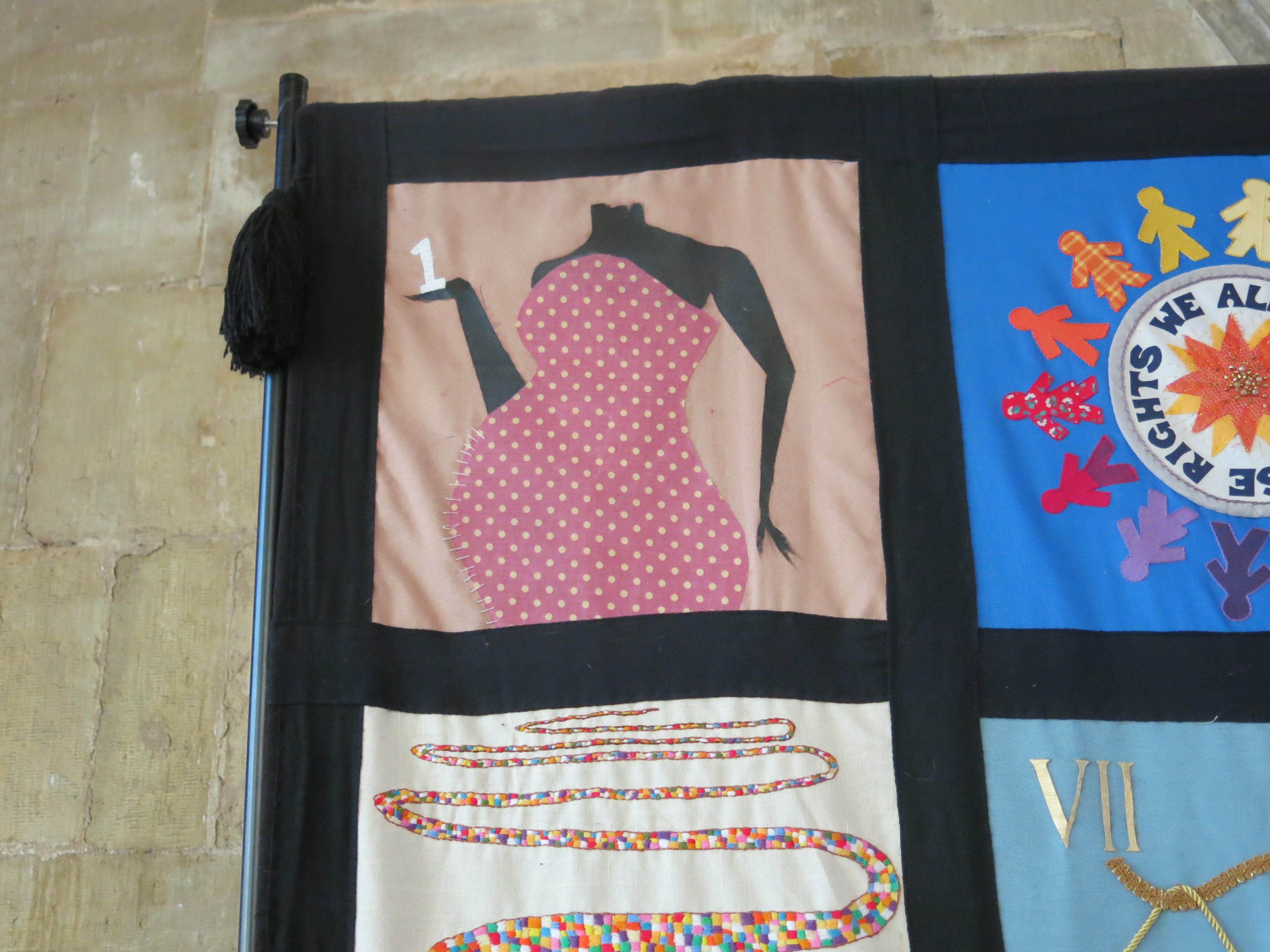
Article 1This is Article 1: All human beings are born free and equal in dignity and rights.  Prepared by Liz James-Froud on behalf of the Bath Group.
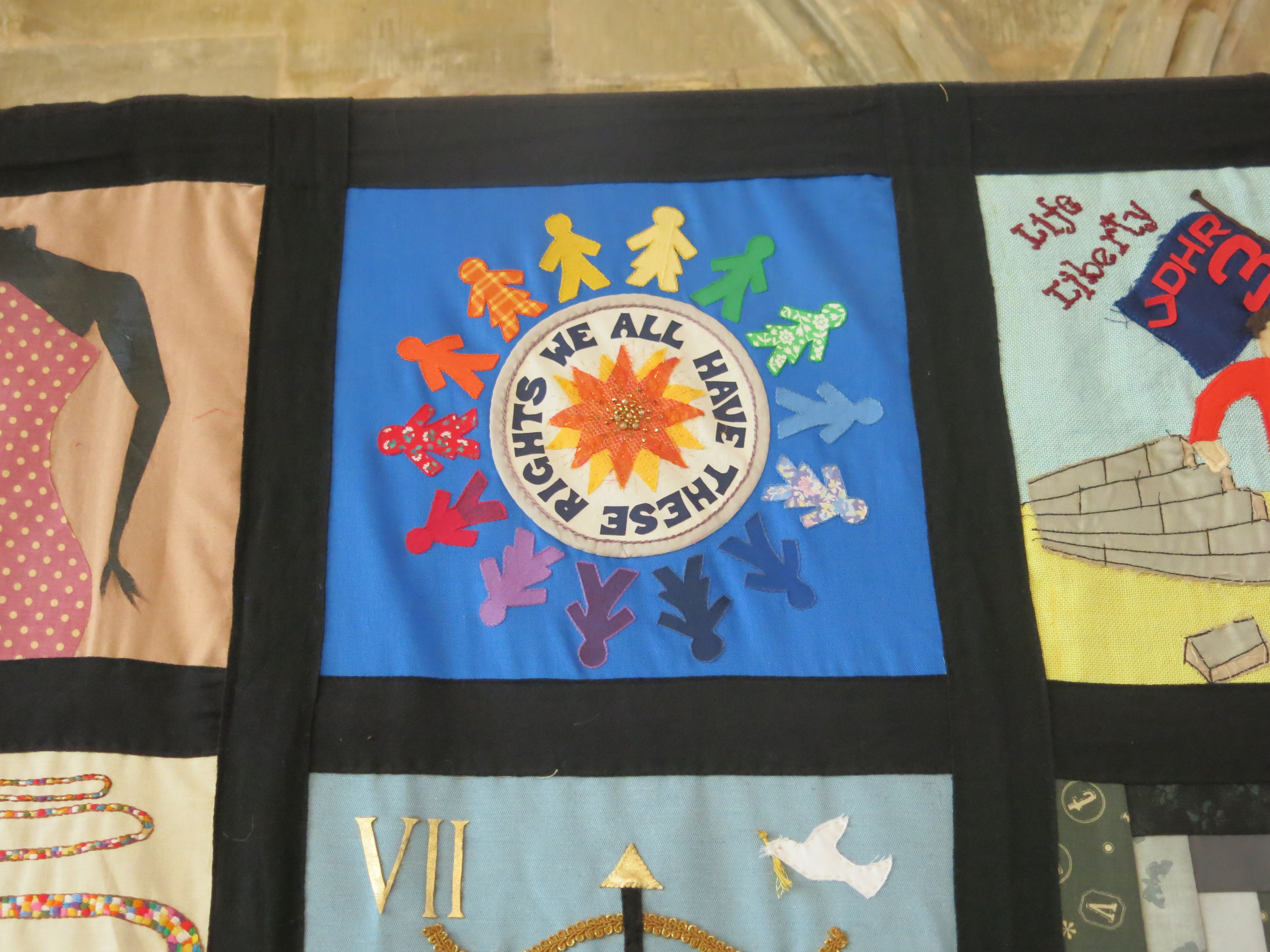
Artilcle 2Article 2: Everyone is entitled to all the rights and freedom regardless of race, colour, sex, language, religion, belief, race or origin.  Prepared by Liza Lishman a member of the Swindon and Marlborough group.
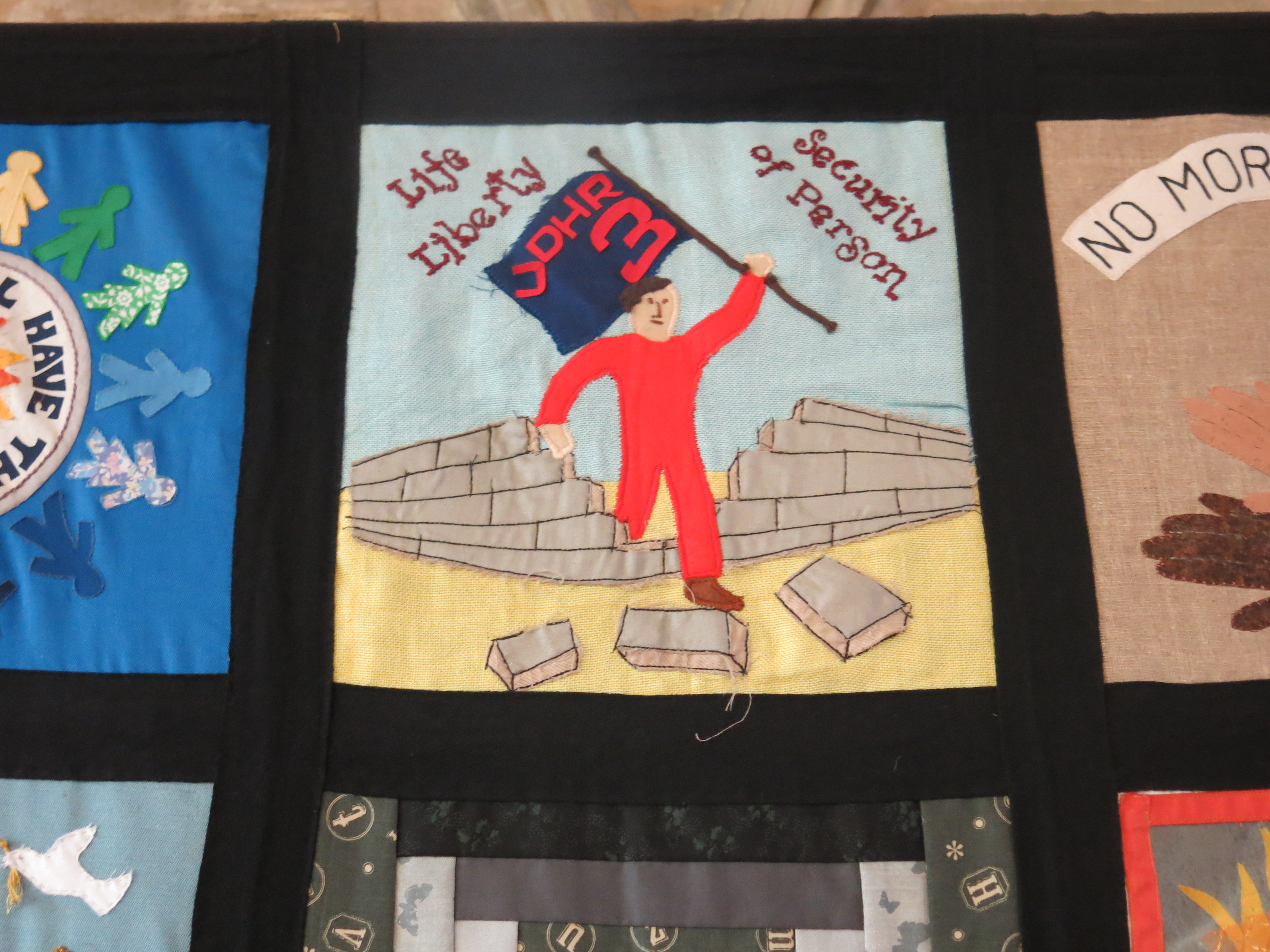
Article 3 3Article 3: Everybody has the right to life, liberty and security of person.  This panel prepared by someone from the Bournemouth, Poole and Christchurch group.
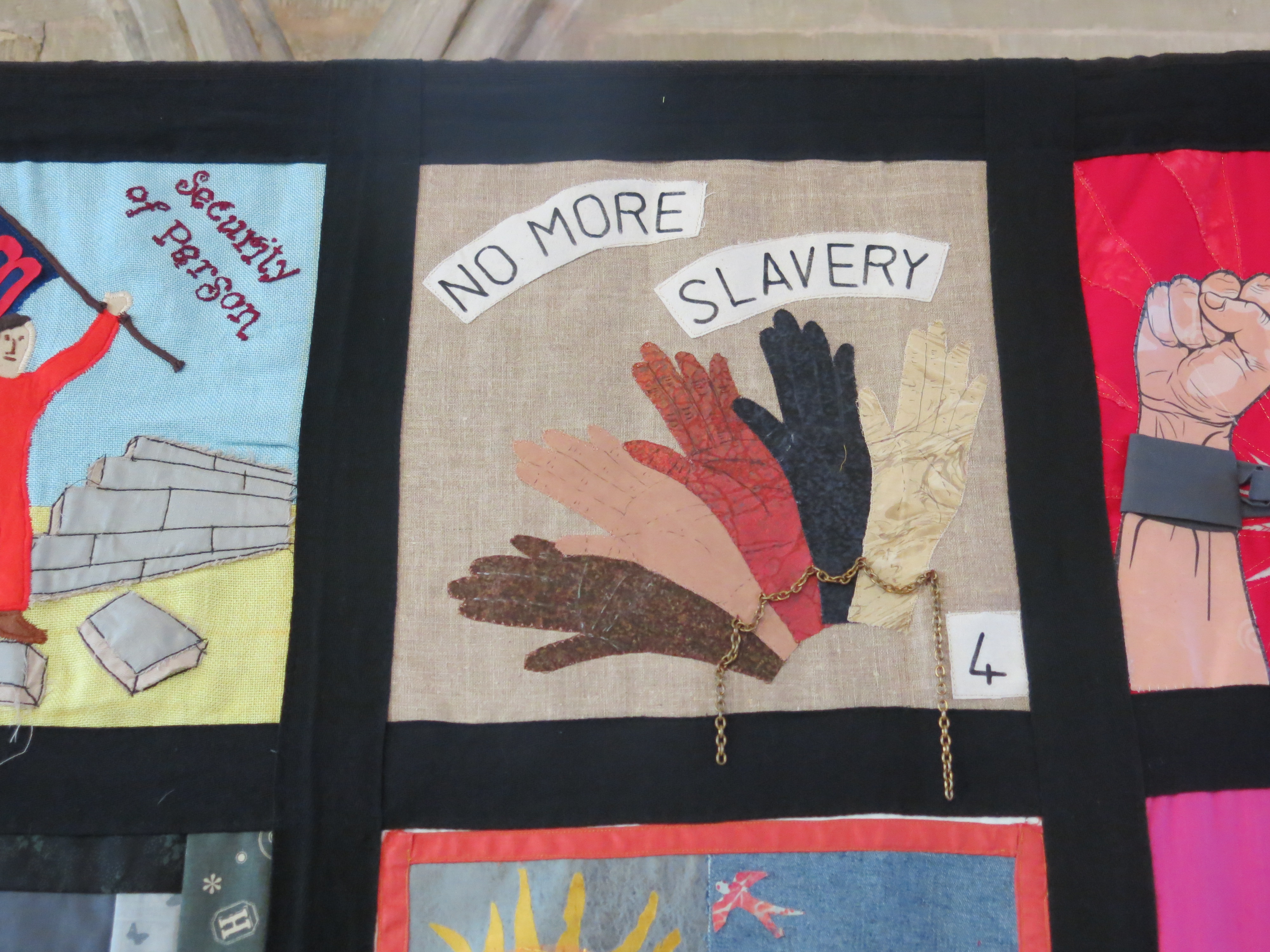
Art 4Article 4: No one shall be held in slavery or servitude.  Dot Atkins of the Isle of Wight group.
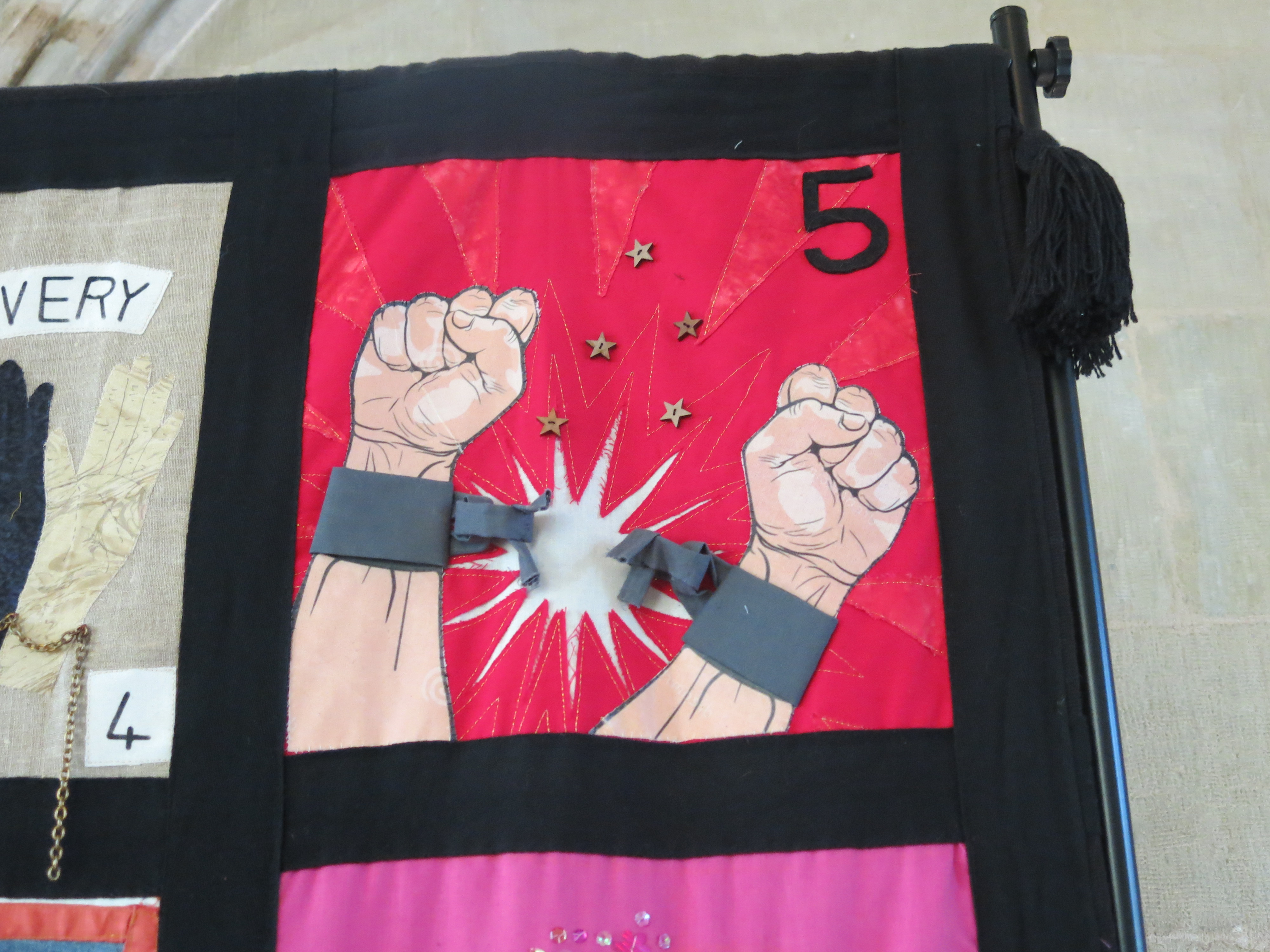
Art 5Article 5: No one should be subjected to torture or to cruel, inhuman or degrading treatment or punishment.  This panel prepared by Rachel Berry of the Mid Gloucester group.

If there are any corrections or additions, please get in touch.  The next set of panels will be posted up soon.

Tapestry


Tapestry on display

OLD POST

The tapestry assembled by members of the South Region of Amnesty International, is now on display at the entrance to the Chapter House in Salisbury Cathedral.  Each panel represents one of the clauses of the UN Convention on human rights which led ultimately to the Human Rights Act in the UK.  It is this act that the current Conservative government wants to abolish.  The Chapter house is where one of the surviving copies of Magna Carta is displayed.  We are extremely grateful to the Cathedral Authorities for giving us this space to display the tapestry.  It will be on display for a few months and then will go on display elsewhere in the south region.

Tapestry

UN Security Council: North Korea


North Korea is not forgotten

The UN Security Council has a chance to show that the world has not forgotten about the victims of crimes against humanity that continue to be committed in North Korea, and that those responsible will face justice

said Nicole Bjerler, Deputy Representative at Amnesty International’s UN office in New York.

This meeting should serve as a wake-up call to the North Korean authorities to put an immediate end to the systematic, widespread and grave human rights violations that persist in the country. A starting point would be for them to cooperate with the UN and let independent human rights monitors into the country.

The meeting on Thursday is a significant step forward in the UN Security Council’s commitment to address the horrific human rights situation in North Korea alongside peace and security.

“Peace and security cannot be separated from respect for human rights, accountability for perpetrators and justice for victims and their families. These issues urgently demands the Security Council’s continued attention,” said Nicole Bjerler.

International pressure on North Korea has been building since the publication of the UN Commission of Inquiry report in February 2014.  The damning report documented widespread human rights violations including forced labour, deliberate starvation, executions, torture, rape, infanticide, and up to 120,000 men, women, and children detained incommunicado in North Korea’s political prison camp system – a situation described as “without parallel in the contemporary world”.

Last December, the UN General Assembly overwhelmingly passed a resolution which, among other measures, called on the UN Security Council to take appropriate action to ensure accountability, including through consideration of referral of the situation in North Korea to the International Criminal Court.  The General Assembly is reiterating its call in this year’s resolution, which was adopted by the Third Committee on 19 November and is to be formally adopted in the Plenary next week.

“The UN Security Council must seize the opportunity today to tell perpetrators of crimes against humanity in North Korea that ultimately they will be held accountable,” said Nicole Bjerler.


Death penalty report: December


We attach the death penalty report for this month thanks to Lesley for her work on this.  The news about No to the death penaltyReggie Clemons is most welcome after years of campaigning, with the decision to ‘vacate’ the previous judgement.  It shows that persistent campaigning does work.  The decision by Mongolia to end the death penalty is welcome especially when you consider the barbaric activities of their neighbour.

On the dark side, Saudi continues to execute with a promise to put 50 people to death.


The arming of the Islamic State


Amnesty publishes a report on arming of IS

Last week we had the debate in Parliament about bombing the Islamic State IS or Da’esh as some call it.  This was occasioned by the outrage in Paris and the massacre of ordinary people in that city.  Parliament voted in favour of bombing and since then we have had recriminations in the Labour party between those who voted for and those against.

It is timely therefore that a report has been published by Amnesty International called Taking Stock: the Arming of the Islamic State.  All politicians should read it.  As we have noted several times on this blog, one cannot but help notice that when pictures are shown of IS fighters, they are well equipped and armed to the teeth.  So where do all these arms come from?  The report explains where and how in great detail.

The major source is Iraq supplemented by materiel taken from the Syrian army.  The Iraq weapons were supplied by the coalition forces but because they were irresponsibly guarded, it was easy for them to be stolen or looted.  As the report puts it, ‘there were decades of irresponsible arms transfers to Iraq principally by Russia, France and China.’

The supply and transfer of weapons was governed by a global treaty adopted by the UN in 2013.  It places international human rights law, humanitarian law and criminal law standards alongside other international benchmarks for assessing the authorisation of exports and other transfers of conventional arms.

The report documents the astonishing amount of weaponry possessed by IS (the range and types are listed at the end).  Although a total of 25 countries have been identified as suppliers – including some from the former Soviet Union – it is the Security Council members P5 who are the main culprits.

The Iraq invasion cast a long shadow over the region.  Arms were poured in and in the chaos, thousands of weapons were lost to the militants.  The Arms Trade Treaty was designed to put a stop to irresponsible activity and it will take a long time to take effect.  We noted in an earlier blog that the UK and the US continues to supply Saudi Arabia which is bombing Yemen creating fertile ground for the next wave of insurrection.

It is much to be regretted that the House of Commons would not be packed or buzzing with excitement if the question of arms supplies was being debated.  Yet unless and until arms supplies are curtailed to regions such as the middle east, organisations like IS will prosper in the chaos.  Bombing the result seems a little pointless.  


IS arms report

Iran: death penalty urgent action


No to the death penaltySalar Shadizadi

We attach an urgent action for a Young man who is facing execution in Iran.  Iran is one of the world’s leaders in executions second only to China.  Urgent actions are at the core of Amnesty’s work and involves writing to the country concerned and usually to its embassy here in the UK.  There is some evidence that they have an effect, as in this case, where execution was at least delayed as a result of international pressure.

The attachment gives all the information and the back story so if you do have time to write that would be appreciated.

Urgent action details (word)

Timbuktu


The award winning film Timbuktu was shown at the Salisbury Arts Centre tonight and it was a gripping and powerful film.  If you did not see it here try and catch it somewhere else.  Most of the people attending signed the cards to Cameroon – thank you for those that did.

Blog at WordPress.com.

Up ↑