Corruption and Arms Trade: The UK’s Enduring Dilemma


Will anything change in the government’s approach to weapons sales?

August 2026

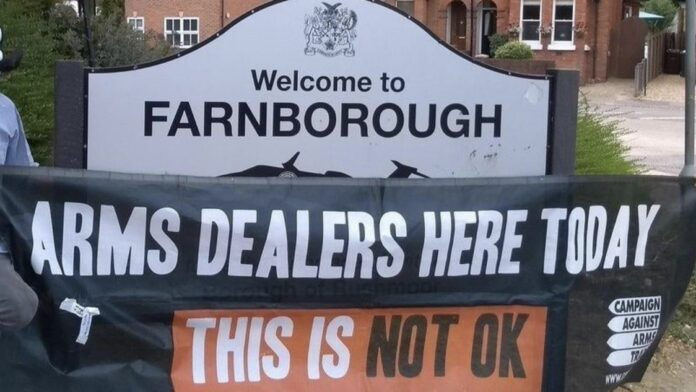
We questioned the extent of help offered to arms companies in a previous post. The Farnborough show featured a range of such companies including Elbit Systems deeply implicated in the appalling death toll in Gaza. We noted the vast sums – around £3 trillion – of tax payers money underpinning the industry when they are not paid. We drew attention to the infamous ‘revolving door’ where senior military, civil service and government ministers sidle off into lucrative directorships or consultancies with arms firms when they retire using their contacts to secure yet more funding. A system so steeped in corruption it is amazing it is still allowed.

So we now have a new leader of the Labour party who was quick to say on July 9, that Labour “didn’t get it right” on Gaza. His video message also included a pledge to bar arms sales to Israel wherever weapons could be deployed in Gaza or the West Bank. Sounds good. So what happened?

The second time we saw our PM’s face on a video message discussing arms was a mere 11 days later. Beamed onto the big screen at Farnborough Air Show, he gleefully emboldened the arms industry, placing them as a core pillar of his ambition to re-industrialise’ the nation by working together with brilliant businesses, like those at Farnborough’ – Farnborough being an international arms fair hosting over 1,000 exhibitors, including the likes of BAE Systems, Lockheed Martin, Elbit Systems, Rafael, Israel Aerospace Industries and Boeing.

Shortly after, his Defence Secretary, Wes Streeting, took to the stage and announced a £708 million government contract with BAE. He remarked at ‘what an opportunity we have with this Prime Minister’ and ‘the enormous contribution that Defence [defense] can make to the Prime Minister’s vision for this country.”

It’s getting worse

Campaign Against the Arms Trade have analysed the current situation and if anything the situation is worse than previous administrations. A key element is Wes Streeting’s desire for speed in commissioning and delivering new systems. He is aware of the prolonged time scales, endless delays and cost overruns involved in arms procurement. He is against unnecessary red tape and bureaucracy. Part of that bureaucracy is assessing risk and potential damage to human rights for those at the end of the arms sales. Putting speed above these assessments carries obvious risks.

He is also keen on joint ventures which makes it difficult for the UK to extract itself from sales where weapons are used by regimes bent on oppression or killing people. The F35 is a classic example which is being used by Israel to bomb Gaza, Iran and Lebanon. We cannot ban components made in the UK (around 15%) because they go off to the States.

Streeting ended his speech with a glowing rhetorical flourish: ‘It is not yet clear whether the 21st century will be defined by tyranny or freedom. But we need not let others define the answer to that question…. We know which side we are on.’ As CAAT argues ‘others’ does rather leave the door open to alternative interpretations. Streeting and Burnham were both members of governments who have engaged the UK in Afghanistan, Iraq and Palestine involving the deaths of a million people. Iraq led to instability and the creation of ISIS; Afghanistan has left the country in the hands of the Taliban with its draconian controls of women and a flourishing heroin trade, and Palestine has seen the wasting of Gaza and the death of 20,000 children.

Have they learned nothing?

You would think that they might have learned a thing or two about violence. Yet here they are, lauding the firms who make the weapons and hell bent on making things worse. Over and over we have argued that making and selling weapons with their ability to create jobs is put above moral or human rights considerations. Claims of a ‘robust policy’ on sales is no longer credible. Does ‘re-industrialising’ the nation have to involve selling weapons to awful regimes? Is that really what Andy Burnham and his new team really want?

We are grateful to CAAT for use of some of their text. No AI has been used.


Britain’s support for the arms trade


The UK hosts a major international arms fair

July 2026

UPDATE: Journalists attending the Fair from Declassified and Byline Times faced threats from the personnel on the Elbit Stand and other Israeli weapons stands. We are grateful for Salisbury Concern for Israel Palestine for bringing this link to our attention.

The UK is an enthusiastic supporter of the arms trade, organising a fair at Farnborough ever other year in Hampshire. A thousand firms will attend and the ‘strategic sponsor’ is Barclays. It is curious to note in passing that the bank was founded by two Quakers and their early history was supporting Quaker businesses in the New World. Now they are supporting weapons firms. One of their values is ‘[being] passionate about leaving things better than we found them‘. One wonders what someone who has had a weapon dropped on them or a limb blown off feels about this value?

The firms themselves supply weapons to a range of conflicts around the world including the genocide in Gaza, Yemen, Lebanon and Syria. Some of UK weapons find their way to Sudan via the UAE one of our largest customers. Our old friends Elbit Systems are in evidence as well as Rafael, Israel’s largest missile maker.

Government support

The fair depends crucially on British government support which includes a dedicated arms sales unit in government, organisation of the fair, providing insurance cover in case firms do not get paid and finally, ready access to ministers and civil servants through what is called the ‘revolving door’. This is the highly dubious process by which ex ministers, former civil servants and ex military officers secure lucrative consultancy work or directorships with the firms to help lobby for their activities.

The insurance is provided by Exports Credit Guarantees and the amount may surprise readers. A total of 20 countries have defaulted on payments: some you might expect like Iraq, Cuba and Serbia because of conflicts, but others include Pakistan, Egypt and Argentina. The total is just under £3 trillion which is added to the national debt. It is worth pondering this for a moment because one of the hotly disputed political debates at present is over the welfare bill and some politicians and pundits are arguing for it to be cut to enable tax cuts. The quite staggering level of funding support for arms companies is never mentioned by these same politicians. Three trillion is £3,000,000,000,000. This figure may be an underestimate because the report makes clear some data has been lost.

Establishing facts difficult

Discovering quite what is being exported is not easy. The government likes to claim it has a robust arms sales policy but the facts seem to suggest otherwise. One has only to look at the countries to which we sell to see that ‘robust’ is not a word one would use. It issues what are called Standard Individual Export Licences [SIEL] of which there were 10,400 in 2025. The problem is approximately half of sales are under ‘open license’ making the reporting unreliable.

Ministers cannot always be trusted. David Lammy MP said in parliament that sales to Israel were being reduced once the destruction of Gaza became too great to ignore. Later analysis of Israel’s import data showed sales by the UK had in fact increased.

When we speak of arms sales, the photographs often show fighter jets, missile systems and other items of large scale military kit. We must not overlook that it is the millions of small weapons such as rifles, machine guns, grenades and so forth which cause so much damage to ordinary people. It is these weapons which kill and maim especially women and children.

Our continued support for the likes of Elbit Systems who make the drones which have killed many and made the lives of the people of Gaza such a misery, is shaming. Huge efforts have been made to stamp down on protests and hundreds of protestors have been arrested and gaoled.

There will be much glad-handing at Farnborough and no doubt a minister will speak about the contribution to our economy and jobs created. But we cannot escape the plain fact that this is an industry who’s products are designed to kill people. It could be argued that we need to defend ourselves and our partners in NATO for example. While that may be true, firms are busy supplying weapons to unstable, undemocratic and often brutal regimes who are using them to inflict misery on millions of people. Few questions are asked and the notion of a ‘robust regime’ is for the birds. The revolving door is alive and well – a process so steeped in corruption it is astonishing it has survived so long.

Sources: CAAT, SIPRI (Sweden), MoD, Barclays Bank, Salisbury CND

Picture: Dorset Eye


Arms trade news


Grim reading in Campaign Against the Arms Trade’s latest newsletter

May 2025

The CAAT Newsletter (Spring 2025, Issue 272) has details of what’s happening in the world of arms sales a world in which the UK is a big player. Our previous post discussed the continuing sale of arms to Israel which is subject to an Appeal Court hearing starting on 13th. Also we mentioned the role of the RAF in carrying out hundreds of flights over Gaza and quite what is being done with the information gleaned is not revealed.

Arms sales are important for several reasons. Weapons have an enormous capacity to do great harm in the wrong hands. Governments need to exert great control over licensing to ensure that arms do not fall into such hands. British governments are frequently to be heard claiming it exercises ‘robust’ controls. It is doubtful that this is the case and CAAT have often noted the considerable use of open licences which means little effective control exists.

The current Labour government has a policy of growth which seems to dominate thinking. As the court case will reveal, and papers have already revealed, this seems to trump considerations of human rights. CAAT News has the following examples:

  • The Defence Secretary has held meetings with counterparts in Saudi Arabia and Turkey to discuss opportunities for expanding military cooperation which is likely to involve arms sales. Both countries have woeful human rights records. Saudi has a full array of violations including public executions, use of torture, restrictions on women’s rights and repression of any opposition or free speech. Turkey has carried out baseless prosecutions against journalists, human rights defenders and opposition leaders, thousands of whom are in gaol.
  • Eurofighter sales – which the UK co-produces – are planned for Qatar and Turkey. The latter is involved in bombing Kurdish groups in its own country and Iraq. Qatar is another repressive Gulf state and is highly corrupt.
  • We have noted before the question of the Revolving Door where politicians, ministers, senior civil servants and military personnel leave their posts and head off for lucrative appointments/directorships/consultancies with arms firms. It is an open invitation for corruption and the ACOBA system seems powerless to stop it. The Aerospace, Defence and Security Group, (ADS) the trade body for the defence industry representing all of the major arms makers, holds an annual dinner at the Grosvenor House Hotel in which, in the words of CAAT ‘The dinner’s purpose is to introduce them to one another and allow them to schmooze and entertain their powerful friends from Parliament and the Civil Service‘ … These kinds of dinners are where relationships are formed and built and where the next round of arms deals are made, over fine food and wines.’
  • And it doesn’t end there. The Defence and Security Equipment International (DSEI) resumes in September at the ExCel Centre in London. This may be the largest such exhibition in the world. It is popular because the UK government invites representatives from a wide range of countries including those with appalling human rights records, some even on its own watch list. The thousands of attendees will be met by ‘a cast of compliant senior civil servants and politicians on hand to make sure things run smoothly’ (CAAT).
  • … or even there because the Farnborough International Exhibition and Conference Centre is to host Security and Policing run by the Home Office. Again, a range of countries with dreadful human rights are cordially invited to view the latest in surveillance, tear gas and ammunition. Journalists are banned. Britain seems happy to be host to regimes who use this equipment to repress and intimidate oppositions, journalists or human rights people.
Growth or rights?

The government seems keen to actively support these activities and to do all it can to promote arms and surveillance equipment to repressive regimes. It does this while piously claiming that:

This Government is fully committed to the protection of human rights both at home and abroad. We are committed to the international human rights framework and the important role that multilateral organisations like the Council of Europe play in upholding it. (Ministry of Justice, November 2024, ref: CP 1192)

It is hard to square the multi-level activities to promote arms sales and in the process currying favour with some of the world’s worst regimes, with their stated desire to be upholders of human rights and the wellbeing of those at the end of it all. While politicians, civil servants, military brass and ministers ‘schmooze’ with the arms manufacturers in expensive London hotels, it may be hard for them to empathise with those who have been bombed, starved, driven from their homes or incarcerated, tortured or executed for no reason. All facilitated by the weapons and equipment they so admire whilst quaffing the Bollinger. Is it growth above all else?

Sources include: CAAT, The Canary, Amnesty

Blog at WordPress.com.

Up ↑