The latest death penalty report covering the period 13 January to 9 February is attached and thanks to group member Lesley for compiling it. The report notes that many of the countries which feature in the report have close links with the UK as we have described in previous posts.
Amnesty publishes a report today on the programme of mass executions in Syria
A terrifying and sickening report on the execution of possibly 13, 000 Syrians is published in a major report by Amnesty. The report makes chilling reading as testimony from survivors and guards describe the horrific process of killing and disposal of bodies by the regime. A summary of the report is published in the Guardian today. There is also a piece by Kate Allen, director of Amnesty describing the prison as a slaughterhouse.
On Friday 3rd February the group hosted a showing of the film Fire at Sea in the Arts Centre in Salisbury. This film won the Golden Bear award at the Berlin film festival and tells the story of immigrants seeking to reach Europe, in this case the island of Lampedusa. There are in effect two parallel story lines: one involving a small boy of around 12 who spends his time, with a friend, making and shooting a catapult and on his father’s fishing boat. The other involves the immigrants packed onto boats bobbing about for days in the Mediterranean in their desperate efforts to reach Europe. Some die of dehydration and others get burned by diesel fuel splashes as they refill the engines. These burns can be serious and even fatal. There are harrowing scenes of bodies being retrieved from the boats.
Picture: Spindle magazine
The feature of the film is that the two stories never overlap. The islanders carry on their lives completely divorced from the drama that is taking place in the sea around them and in the holding centre where the immigrants are looked after. The doctor is featured who is involved with vetting the immigrants and speaks matter of factly about the dire state of their health and how some of them die. He is then shown treating the boy who is concerned about his breathing difficulty, which we are led to believe is imaginary. These two contrasting scenes seem to sum up the theme of the film.
We took the opportunity to ask people to sign a petition on the refugee situation in Greece.
We are grateful to the Arts Centre for hosting this event.
We attach a link to the Guardian‘s obituary of Sir Nigel Rodley who was a key member of Amnesty and did so much to get the legal tools enacted in the anti-torture campaign and also worked hard to end the death penalty.
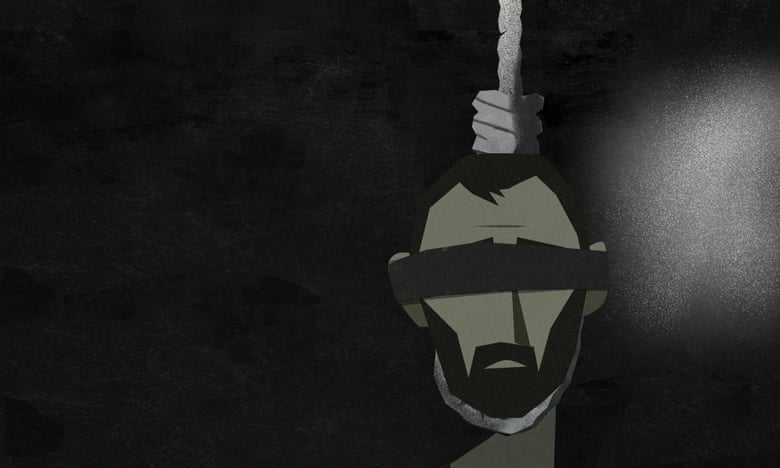
Imminent execution of a young man convicted whilst a juvenile and by the alleged use of severe torture. This is an update of an earlier UA but there have been recent significant developments and his execution is now more probable. The full details are attached. If you can find time to write or send emails this would be appreciated. Thank you
Donald Trump’s favourable comments on the use of torture have put this topic back on the agenda
As early as the third century A.D, the great Roman Jurist Ulpian noted that information obtained through torture was not to be trusted because some people are “so susceptible to pain that they will tell any lie rather than suffer it”.
President Trump said last week that ‘torture absolutely works’ and threatened its use at Guantanamo. I want to do everything within the bounds of what you’re allowed to do legally but do I feel it works? Absolutely I feel it works.” It now seems he is resiling from this after an outcry.
Amnesty disagrees that torture works. And here’s five reasons why…
1: Torture is illegal under international law. It reflects the widespread belief that torture is cruel, inhumane and morally wrong. The physical and psychological damage it causes is often permanent. Even if it was effective, it would still be wrong.
2: No ends justify torture as a means. You might be able get useful information out of torture in the short term, but in the long term it’s counter-productive. It does more damage to the reputation of the country that commits torture than any criminal or terrorist. Statistics prove that American use of torture is Al Qaeda’s number one recruiting tool.
3: Torture produces false intelligence. Some victims will say anything to make the torture stop. At best this wastes only time and resources. At worst people may be implicated and even convicted for crimes they did not commit, on the basis of false evidence.
4: While it remains illegal, information extracted through torture cannot be used as evidence in court of law. It actually makes it harder to bring people to justice for any crime they have committed.
5: You can’t condone torture even in ‘special cases’, otherwise it becomes normalised and a “torture culture” emerges across the chain of command. In the USA the CIA used waterboarding on Khalid Sheikh Mohammed 183 times, and low-ranking soldiers tortured for sport in grotesque ways in Abu Ghraib prison, in Iraq.
Of the more than 700 men held at Guantanamo Bay since 2002, many are now acknowledged as ‘merely guilty of being in the wrong place at the wrong time.’ Originally described as “the worst of the worst,” by Vice President Cheney, many were subjected to torture particularly waterboarding. More than 400 of these men have now been released or cleared for release (Center for Constitutional Rights, 2009).
A common justification for the use of torture is the implausible ticking-time-bomb scenario. This is beloved by Hollywood and was the opening scene in the TV series 24 staring Kiefer Sutherland. It rests on several questionable assumptions: that a specific piece of “actionable” information could be used to avert the disaster; that somehow interrogators know for certain that the suspect possesses specific information about the location of the bomb; that the threat is imminent; that only torture would lead to disclosure of the information; and that torture is the fastest means of extracting this valid, actionable information.
Of course, part of the appeal of this scenario is that it also portrays the torturer as a principled, heroic figure who reluctantly uses torture to save innocent lives. This carefully rigged, forced-choice scenario pits the temporary pain of one evil person against the deaths of thousands (or even millions) of innocent people. And, once we have acknowledged that there might possibly be a situation where torture could yield precious, life-saving information, it is then a small step to conclude that we are sometimes morally obliged to use torture. While this scenario might provide a useful stimulus for discussion in college ethics courses, or an interesting plot device for a television drama, there seems no evidence that it has ever occurred. As one scholar put it, “Even though torture is not, on balance, effective or rational, it persists through its deep psychological appeal, to the powerful and the powerless alike, in times of crisis. The reality of torture is unpleasant as one FBI agent put it:
On a couple of occasions, I entered interview rooms to find a detainee chained hand and foot in a fetal position to the floor, with no chair, food or water. Most times they had urinated or defecated on themselves, and had been left there for 18 to 24 hours or more. FBI agent on visiting Guantanamo
CIA report
Picture: Washington Post
The Inspector General of the CIA conducted a review in 2004 and although great chunks of the report were redacted, they found that interrogators assumed detainees were withholding valuable information but this was not always supported by objective evaluation of available information. Guilt was assumed despite the dubious nature of their capture. Very little actionable information was obtained and there was little evidence to show that it could not have been got by ordinary means.
Morality
Setting aside its effectiveness – or rather lack of it – the main objection is morality. Around the world governments and the various agencies working for them, use torture sometimes routinely to brutalise, suborn, humiliate and coerce their citizens. Amnesty has credible evidence that it is used by 141 countries. As the leader of the free world, America should be setting an example not joining with the sordid list of countries still carrying out this barbaric practice.
We hope President Trump’s change of mind is permanent.
Sources: Amnesty International; CIA, Inspector General Report, 2004; New York Times
The Effects and Effectiveness of Using Torture and an Interrogation Device: Using Research to Inform the Policy Debate Costanzo, Mark, Gerrity Ellen, in Social Issues and Policy Review, Vol 3, No: 9 2009
Good news on cluster bombs
Just before the Christmas holidays, the Government finally admitted that Saudi Arabia had indeed dropped UK cluster bombs in its bombing campaign in Yemen and in doing so, confirmed that our research was entirely correct. When we alerted the UK government to this in May 2016, the Government strongly denied it, as did Saudi Arabia. This is a major victory for our research work and campaigning to keep the government under pressure on this issue.
Amnesty joined with 100s of other organisations around the world to campaign to ban cluster bombs because of the risks they pose to civilians. Cluster bombs scatter 100s of lethal bomblets that can continue to kill and cause horrific injuries long after the conflict has ended. The UK rightly banned these horrific weapons and their use in Yemen provides yet more evidence of indiscriminate nature of the Saudi Arabian led coalition’s bombing campaign.
There are many reasons to be pessimistic about human rights in the year ahead. The election of Theresa May and Donald Trump are both bad omens and the rise in importance of China and Russia is also a bad sign. On almost every front, the post-war ideal of steady improvement in both democracy and human rights around the world now seems under assault. In the UK, the majority of the media keep up a relentless attack on human rights painting them as a threat to justice and social order. It is hard to believe that we are now debating the merits or otherwise of torture following President Trump’s remarks this week. How have we come to this?
Post war
Graphic: Linkedin
Perhaps the most important factor, and one difficult to discern, is the recent decline in optimism which was visible following WWII. That war and the terrible events which took place with the murder of Jews, Gypsies and homosexuals, led the world to say ‘never again’ and led to the Universal Convention on Human Rights. This led in time to the European Convention on Human Rights a convention strongly driven by Winston Churchill. There was a feeling in the years that followed, with such conventions and other subsequent treaties, that the world was on an improving path and the horrors of the Second World War would not be repeated. Improvements included a steady reduction in the number of countries using the death penalty. The cold war eventually came to an end. On the other hand, the use of torture around the world is still widespread with 141 countries still practising it according to Amnesty and this is specifically banned by the Universal Convention.
It was not of course plain sailing and we now realise that Chairman Mao murdered many millions of Chinese and there have been other monsters such a Pol Pot. Nevertheless, there was this feeling that things were steadily improving and the UN provided a forum for nations to settle disputes short of going to war. There was an assumption of western values of fairness, justice, free speech and the rule of law were becoming the norm.
Following Syria it is clear that this is no longer the case. Human rights in China are poor in the extreme. Thousands are executed and torture is routine. There is no free press and it is a one party state. Things are also deteriorating in Russia under President Putin. Russia’s ‘victory’ in Syria has changed the dynamic.
UK
Last year, we celebrated the 800 years since the signing* of Magna Carta. This was an attempt by the barons of the day to wrest some powers from the king. It would be unwise to summarise British history in a paragraph, but an element of our history has been a steady attempt – sometimes peaceful, sometimes not – to secure rights for ordinary people against whoever was the elite or in power at the time. It might be landowners or it might be factory owners for example. They had the wealth and the power and were extremely reluctant to release any of it to the benefit of those at the bottom of the social order. The lives of farm workers and those in factories was grim indeed and attempts to form unions was fiercely resisted. The legal system did little to ameliorate the plight of the powerless in society.
The modern day Human Rights Act incorporated the ECHR into British law and meant that every citizen could defend his or her rights in the courts and that public organisations had to treat everyone with fairness, dignity and respect.
But we would argue that the fundamental thing the act did was to spell out what those rights are and it represented a major shift from rights being grudgingly given to the people to them being theirs as of right. As Gearty expresses it in his book On Fantasy Island;
The Human Rights Act has a enables a range of individuals to secure legal remedies that in pre-act days would never have been achieved, perhaps even contemplated. […] it has been particularly valuable for those whose grip on society is fragile, whose hold on their lives is precarious, whose disadvantage has robbed them of means of adequate engagement with adversity. (Conor Gearty, OUP, 2016, p131)
[…] it is clear that the human rights act is a documents that is profoundly subversive of the partisan national interest . To put it mildly some people – often quite powerful people – do not like this. (op cit, p8)
It is this shift of power that is so deeply resented and ‘some people,’ which includes some politicians, have grown to dislike the loss of power and assumed patronage that they had become used to. The virtual ending of legal aid in the UK was a symptom of this desire to remove the ability of ordinary people to achieve redress or argue for their rights.
Picture: Left Foot Forward
Others of the ‘some people’ include chunks of the media. The HRA created a right of privacy and this represented a huge problem for the ‘kiss and tell’ end of the media world. These stories depended on substantial infringements of privacy, by phone hacking, not to expose corruption, but to find intimate details of politicians, celebrities and people in the public eye. Owners of newspapers – all of whom live overseas – were exempt from this scrutiny and intrusion of course.
The result of this assault on their business models is of great concern to them and this is most probably the main reason why they have produced relentless series of negative stories about Europe and the HRA. Rupert Murdoch was famously quoted in the Evening Standard as saying:
I [Stephen Hilton] once asked Rupert Murdoch why he was so opposed to the European Union. ‘That’s easy,’ he replied. ‘When I go into Downing Street they do what I say; when I go to Brussels they take no notice.
It must also be why there are few political champions for the Act or the ECHR. Any politician speaking up for it risks at best being ignored or at worst, having his or her private life raked over for something with which to denigrate them. There is instead an almost unseemly rush to join in the claims to ‘bring sovereignty back’ or to take control of our laws.
Brexit
Graphic: Huffington Post
A real worry has to be Brexit. The plan is to seek trade deals around the world sufficient to counter the effects of losing our access to the European market. This is likely to be tough as we will no doubt soon learn from the USA. To achieve these trade deals it is likely that our insistence on human rights will be weakened or even jettisoned altogether. As we have noted in many previous blogs concerning Saudi and Yemen, our principal interest there has been in selling them weapons. Despite considerable and irrefutable evidence of infringements of international humanitarian treaties, selling weapons is the primary aim of policy.
Until very recently, ministers have not needed to worry too much about the atrocities in Yemen. Most attention was on Syria. We did not even know British personnel were involved until it was blurted out by a Saudi prince. In the last few months however, there have been two debates in the Commons and press interest is now at a slightly higher level. The two debates revealed ministers more interested in promoting arms sales because of the economy and the jobs created, rather than in promoting human rights.
Public reaction
Perhaps the greatest worry of all however is the attitude of the public at large. How concerned are they about human rights issues? There seems little evidence that they are. The Investigatory Powers Bill – referred to as the ‘Snooper’s Charter’ – passed easily through parliament with little public outcry. Kate Allen, director of Amnesty said:
The UK is going in the wrong direction on rights, protections and fairness. Public safety is paramount but not at the cost of civil liberties. [Said in connection to the Snooper’s Charter]
It is hardly surprising when the major part of our media has carried out a sustained campaign against all things European leading, some might argue, to the decision to leave it. It is truly ironic that for many years the Daily Mail has carried out a campaign against what it calls ‘Frankenstein Foods’. The introduction of genetically modified foods has been seriously restricted by the European Union. The trade deal with USA is likely to involve the import of GM foods of varying kinds as ministers will be unwilling or unable to resist the pressure if we want to continue to export to them.
The general tone of press coverage has been that we do not need the act. It’s only of benefit to terrorists and assorted criminals who escape justice because of it (they argue). The benefits of the act to ordinary people are rarely mentioned and often one can scour a story for any mention it where it was used.
Putting all these elements together, the sense that the steady progress of western values has come to an end, a hostile media keen to bad mouth human rights and to denigrate the Human Rights Act, the Conservative government’s prolonged threat to abolish it, the decision to leave the EU needing a concerted effort to secure trade deals at any cost, and many of the public who are not concerned about such matters, means that the prospect for human rights does not look promising.
Over a thousand refugees and migrants are being exposed to disease and inhuman living conditions by the Serbian authorities who are failing to provide accommodation, food and healthcare to them. They are being forced to endure the extreme cold winter temperatures by lighting fires and squatting in derelict warehouses in the capital.
If you can find time to write that would be appreciated.
Three men were executed today, 15 January 2017, in Bahrain. This has taken place in a country which likes to claim its commitment to human rights. The convictions were allegedly procured using torture which – according to local human rights groups – included suspension from the ceiling, beatings, electric shock to the genitals and elsewhere, food and sleep deprivation. Violent demonstration are said to have broken out.
The human rights situation in Bahrain is described as ‘dismal’ and in addition to the use of torture, there has been an orchestrated crack-down on the right to free speech and human rights activists and opposition politicians face arrest and repression.
Britain is closely involved in the Kingdom and Theresa May visited the country recently as part of a bid to boost trade. This has raised the issue of our relationship with a country with such poor human rights. She was quoted as saying:
There will be some people in the UK who say we shouldn’t seek stronger trade and security ties with these countries because of their record on human rights. But we don’t uphold our values and human rights by turning our back on this issue. We achieve far more by stepping up, engaging with these countries and working with them
It doesn’t seem to be going so well. There is indeed something to be said for engagement if it does over time secure better standards. It was reported today that Yarls Wood detention centre received a visit by Bahraini officials from the very prisons where torture is alleged to take place. The funding was from the secretive Conflict Stability and Security Fund which a select committee of MPs has been unable to find out much about. But once again it looks like fine words when in reality there is no improvement and all that seems matter is securing business. The UK has just opened a naval base in the state so our ability to apply pressure is further limited.
A Salisbury based firm has allegedly been supplying spyware equipment to enable the Bahraini security forces to penetrate mobile phones and computers.
Sources:
Mail Group Newspapers; Guardian; Observer; Amnesty International; Reprieve; Bahrain Center for Human Rights



 Imminent execution of a young man convicted whilst a juvenile and by the alleged use of severe torture. This is an update of an earlier UA but there have been recent significant developments and his execution is now more probable. The full details are attached. If you can find time to write or send emails this would be appreciated. Thank you


