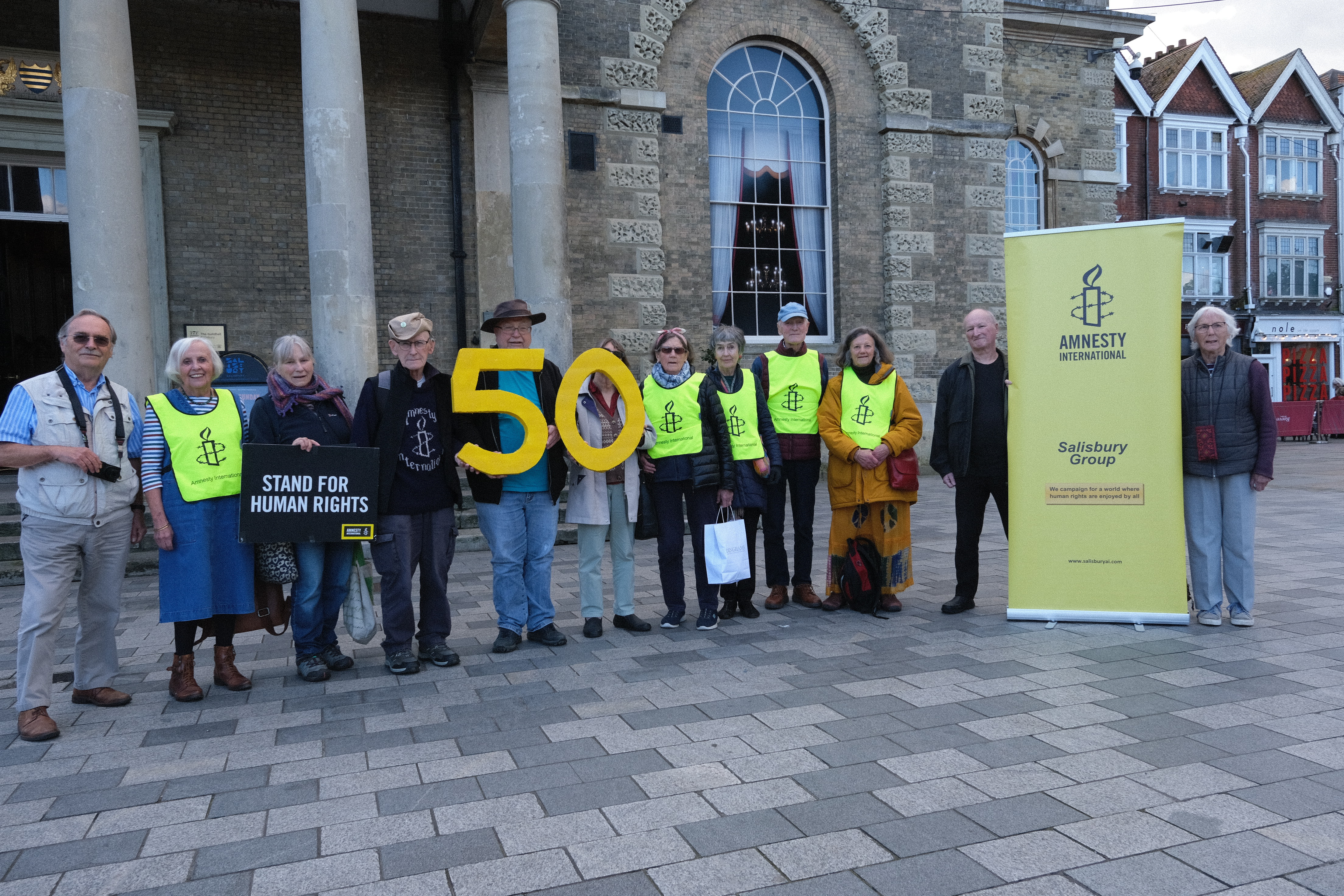
Group celebrates 50 years!


Salisbury Group was established half a century ago

October 2024

The Salisbury Amnesty group was established 50 years ago this year and some of the current members met briefly for a photo in the Market Square. It was probably not imagined in those distant days that we would still be active. After all, the purpose of a charity is to work itself out of existence. Unfortunately, human rights are in a fairly parlous state in many parts of the world. Almost wherever you look, people are imprisoned for their political beliefs. Media organisations are tightly restricted or banned. Journalists are murdered, with three quarters of recent murders in Gaza alone. Terrible events are taking place in the Middle East. Atrocities continue in Burma, almost completely unreported. Individuals are tortured and justice is denied for millions. The post-war hope ushered in by the Universal Declaration has had only mixed results.

Depressingly, it is not just foreign countries where human rights are under threat. In the UK there has been a prolonged campaign to repeal the Human Rights Act led by a vocal section of the press. Several acts have been passed making protest harder and reducing access to judicial review. Police powers have been increased. Facial recognition technology does not seem to be far away. One of the leadership contenders for the Conservative party wants the UK to leave the European Convention of Human Rights.

Sadly, we are the only extant group in Wiltshire. So the next 50 years begins …

Members and supporters outside the Guildhall on 3 October. We were particularly pleased that one of the founder members from 50 years ago was able to attend. (Picture: Salisbury Amnesty)

50 years! Don’t forget!


October 2024

Don’t forget that we shall be in the Market Square, Salisbury today, Thursday, at 2:30 for a photo to celebrate the 50 years since the formation of the Salisbury Amnesty group. If you are able to spare half an hour or so, that would be wonderful. Whether you are a member, supporter or want to celebrate with us – doesn’t matter.

Celebrate protest


Amnesty webinar on the state of protest in Europe

May 2024

It seems that the UK is not alone in its attempts to stifle protest and passing laws to restrict individual’s abilities to protest. Recent tensions with ministers and some of their media supporters concerned Extinction Rebellion, Rwanda and the related issue of the boat people and more recently, the events in Gaza and the treatment of the Palestinians. Amnesty International recently hosted a webinar to look at the issue of protest and some of the points made are discussed below.

Protest has a curious position in British culture and law since there is no direst right to protest: it is not a specific human right. There is a right to free speech and a right of assembly and these combine to enable people to come together to protest.

The value of protest is something that seems to be forgotten. The anger at the noise of disruption of a protest march overshadows the fact that this is a means to enable people to highlight a cause of concern. There are some who complain about the disruption and who say that they would not mind a peaceful protest, it’s the noisy and disruptive ones they object to. The problem with a peaceful and noiseless protest which causes no disruption is that no one takes any notice. Many people report that visiting one’s MP or writing letters to them is largely a waste of time. It is also forgotten that nearly all social reforms in the UK have come as a result of protest, some lasting decades. The positive history of protest is not generally known or recognised. It is seen as a nuisance and something to be curtailed or even better, stopped.

Webinar

The results of the survey will be published on July 9th and it will show some regional trends which include casting protest as a threat, claiming it is a privilege rather than a right and the increasing use of supposed public safety measures to curtail them. They conclude it is generally getting worse with a heavy police presence used to intimidate. Complaints against the police and the use of excessive force are difficult because of the lack of identification.

A lot depends on language and protestors are frequently described as ‘rioters’ with no justification. There are also attempts to cast protestors as ‘illegitimate’.

One speaker from Clidef – with a focus on climate protest – spoke about the ‘pincer movement’. This includes new legislation introduced by government together with the stretching of old laws. Police action and powers have been strengthened as already mentioned together with the greater use of prison sentences against alleged offenders: 138 Just Stop Oil protestors have been imprisoned for example. They are also trying to use conspiracy laws.

Secondly, private actors and the use of SLAPP actions [Strategic Litigations Against Public Protest] which are a means to use the law to intimidate those seeking to take action against wrongdoers. They are a means by the wealthy to use the law to silence critics since they can afford to effectively bankrupt them with costs.

Thirdly, the judiciary and he might have mentioned the legal system itself. Judges have been in the firing line for not allowing those on trial to say why they were protesting, fearful no doubt that once a jury realises that they were promoting a climate action, they would acquit. The final speaker asked ‘who are they protecting? The activists or the companies?’

The theme of the webinar and the speaker contributions was that governments are increasingly dumbing down on protest whether it be the climate, Palestine or anything else. They give the impression of not liking dissent in any form and are using increasingly draconian tactics to inhibit, arrest and imprison those to engage in it.

Media

A theme not explored was the role of the tabloid media who almost without fail demonise protestors calling them things like ‘eco-zealots’, ‘eco-mob’, ‘a rabble’, and their actions amounting to ‘mob rule’. Article after article describes protests in entirely negative terms and seldom give readers much (in fact next to nothing) in the way of an explanation of why they are protesting and the nature of their cause. It is to be presumed that they are reflecting public opinion and the views of their readers. Recent reports on the climate are extremely worrying. The fossil fuel companies are able to mount expensive lobbying campaigns to ensure their interests are looked after and extraction can continue. Protestors do not enjoy this privileged access to those in power and taking to the streets is the only way they can be heard. It is a shame that sections of the media are not able – or are disinclined – to reflect this imbalance of power and the inevitable effects it will bring to the climate.

Our right to protest is precious and should be defended.

The Salisbury group was established 50 years ago

Exeter conference


Salisbury group members take part in the regional conference in Exeter

April 2024

Members of the Salisbury group went to Exeter last Saturday, 20 April, to take part in the regional conference organised by the Exeter group. We heard presentations on the somewhat forgotten problems in Kashmir where the Indian government is committing a wide range of human rights violations. These include disappearances, indefinite detention, using financial laws to persecute and, by such means, closed Amnesty’s office in the country. And – in similarity with India itself – giving preference to Hindus over other faiths. The speaker drew similarities to the situation in Gaza. She also pointed out that JCB is selling construction equipment which is being used to demolish Kashmiri homes.

There was also a very informative talk on the issue of racism including the ‘7 pitfalls’. This was given by Peter Radford.

It was altogether an interesting event and it was good to meet other Amnesty groups from the region and all praise to the Exeter group for organising it.

Photo: Exeter Amnesty

Obituary: Benedict Birnberg


Pioneering lawyer who campaigned for the abolition of the death penalty in the UK

November 2023

This post based on an obituary in the Guardian, 14 November 2023

Younger and foreign readers may not have heard of Derek Bentley who became a cause celebre in the UK and was one of the last people to be executed. He and an accomplice Christopher Craig were engaged in robbing a warehouse in Croydon, south London when they were spotted by a policeman who was shot by Craig. Bentley shouted ‘let him have it, Chris’ and these words were sufficient to see him hang. Of course these words are open to considerable interpretation since they can mean both shoot him or they can mean give him the gun. They were sufficient to see him hang.

Birnberg pursued the case relentlessly until in 1993 a royal pardon was issued revoking the death sentence because Bentley had been denied a fair trial and because of a partisan summing up by the judge Lord Goddard. His 30 year campaigning led, 30 years later in 1969, to the death penalty being abolished for nearly all crimes.

The case illustrated that where the penalty is used mistakes can never be rectified. It is one of the reasons Amnesty campaigns for the death penalty to be abolished around the world. Each month, we publish a report on the use of penalty around the world.

Human Rights and poverty


June 2023

Poverty a key element in depriving people of their rights

One of the criticisms of human rights and those who seek to promote them is the proliferation of what is regarded as a ‘right’. One such critic is Prof Eric Posner who has argued that the numbers and proliferation of rights makes them less and less effective. Others have joined in including the current Home Secretary who cites Posner in her various criticisms of human rights and how they are applied in the UK. On examination, much of what is termed ‘proliferation’ is in reality a refinement of a basic right often in the light of current circumstances. The world of social media and electronic communications with its contingent threat to the rights of individuals due to increased surveillance by states and others, would not have been anticipated by the drafters of the UN Declaration after the war. Increasing corporate power and globalisation has enable firms to move or outsource their manufacturing operations to countries with limited or no regard to the rights of their workers.

In its summer 2023 magazine, Amnesty International focuses on poverty as a key human rights issue. As James Griffin notes in his book On Human Rights (OUP, 2008) rights have little value unless people have the means to exercise them. Article 17 gives people the right to own property for example which is of little significance to those unable to get a mortgage, increasingly a concern for young people today. The government’s own statistics on poverty paint a dire situation in what, after all, one of the richest countries in the world. 11 million are in relative poverty before housing costs and 14.4 million after housing costs and there are 2.9 million children in poverty according to the report. We can argue about definitions (and these are explained in the report) but the fact remains that those who cannot afford to eat three meals a day and have to resort to food banks, who live precarious lives with low paid, uncertain jobs, or on zero hours contracts, are not going to be able to exercise many of their rights. Poverty is thus a key underlying factor.

It is one of the problems of a legally based system of rights. The law is only of comfort to those who can afford to gain access to it. For the vast majority it is expensive, extremely uncertain and of little direct value. Tackling poverty means addressing the ideas and politics which are the root causes of the problem.

Amnesty is part of a group ‘The Growing Rights Instead of Poverty Partnership‘ GRIPP. In a report it says ‘[It] reveals how the UK government has created a system that keeps communities poor, ill, divided and isolated then blames them for the conditions they are living in.’ It was submitted to the UN Committee on Economic, Social and Cultural Rights (CESCR). The government would argue that they have introduced a variety of schemes to tackle poverty but fact remains that very large numbers of people are struggling. Recent rises in food prices – which hit the poorest the hardest as they spend a large proportion of their budget on food – rising interest rates and energy prices will have made matters worse for many. Article 25 of the UN Declaration says that ‘everyone has the right to a standard of living adequate for health and wellbeing.’

What is clear about poverty in the UK is how regionally disbursed it is. There are extremely prosperous areas and by contrast, large areas and numbers of communities where there is widespread deprivation. No one can argue that all those in such areas are somehow deficient or are responsible for their collective disadvantage. Clearly it is a systemic issue and a matter of political will or lack of it. Politicians have spoken about the problem and action has been promised, most recently with the levelling up programme. It does not seem to make a difference. The result is a significant number of people and shamefully, young people, who for no fault of their own, have significantly reduced life chances, health outcomes and opportunities mostly to do with poverty.

Poverty is thus a key factor in individual’s ability to secure a range of rights which, for the more prosperous, is taken for granted.

Good news!


Good news from Amnesty

30 September 2022

“With so much injustice spanning the globe, sometimes it’s hard to remain hopeful that things will change for the better. Trust me, I know – I am often the bearer of bad news, writing to you with urgency of crises, crackdowns, and individuals at risk who have had their human rights violated. But today, we wanted to let you know that the actions of Amnesty supporters around the world really do count. They’ve not only made a meaningful impact for human rights both at home and abroad – but thy’ve also helped change lives.

“Small actions from compassionate people like you, really do have big impacts. Here are just a handful from the past few months:

The first families from Myanmar, Syria and Afghanistan arrived in Australia under a new Community Sponsorship pilot

“After years of relentless advocacy, at the end of 2021 the Australian Federal Government not only announced the rollout of a new Community Sponsorship pilot – they also finally agreed to reduce dramatically the cost of Australia’s existing Community Sponsorship Program, making it more accessible for everyday Australians to participate and welcome refugees into their communities. In August of this year (2022), the first families from Myanmar, Syria and Afghanistan arrived in Australia to begin their new lives in safety.

Charges were dropped against a New South Wales legal observer

“Under NSW’s new and dangerous anti-protest laws, back in June a volunteer Legal Observer faced a maximum sentence of 2 years in jail and a $22,000 fine, after being arrested alongside 34 protesters.

“Amnesty made representations to the NSW police, calling on them to respect the right to protest, as well as the human rights of the Legal Observer. In August, her charges were dropped. Over 30,000 supporters continue to call on the NSW police to protect our right to protest.

“Legal Observers play a vital role in monitoring police & providing legal support to protesters. Thanks to the relentless advocacy from Amnesty International, Legal Observers NSW and Sydney City Crime, my charges have been recently dropped.” – Chloe Sinclair, Legal Observer

Texas: Ramiro Gonzalez’ execution was stayed

“Back in July, the Texas Court of Criminal Appeals (TCCA) stayed the execution for Ramiro Gonzales – just 48 hours before it was due to be carried out in Texas. Experts concluded that Ramiro does not pose a threat of future danger to society, due to the passage of time and his significant maturity. As of April 2021, 108 countries have abolished the death penalty for all crimes and 144 countries have abolished it in law or practice – all thanks to the power of ordinary people, continuing to stand up for what’s right! Our fight for global abolition continues.

People power freed Ahmed Samir Santawy from prison in Egypt

“Back in July, Ahmed Samir Santawy, a women’s rights and reproductive rights researcher, was convicted of spreading “false news” and sentenced to three years imprisonment. He was subjected to enforced disappearance for five days. Ahmed’s conviction was based solely on social media posts criticising human rights violations in Egypt.

“Over 10,000 people in Australia signed the petition demanding Ahmed’s release, and almost 5,000 people called the Egyptian embassy, putting further pressure on authorities – and it worked. In August, Ahmed was finally released from prison after being given a presidential pardon. Thank you for helping free Ahmed!

Ahmed reunites with his loved ones on the day of his release. ©Wies De Graeve

New York: We sued the NYPD for surveillance of protesters – and we won!

“In New York, facial recognition technology has been used to target people of colour in protests. Back in 2020, we asked the the New York Police Department (NYPD) to publish their data on facial recognition – and they refused. So we mapped their surveillance cameras with the help of 7,000 supporters, filed a lawsuit against them, and won.

“In August, they were ordered to disclose thousands of records of how they procured and used facial recognition technology against Black Lives Matter (BLM) protesters. This ruling recognizes that the NYPD broke the law in withholding this information and is a significant step in holding the NYPD accountable for its use of discriminatory surveillance.

LGBTQIA+ liberation soared across the globe 

“Thanks to LGBTQIA+ people and their allies at the forefront, back in July Switzerland’s same-sex marriage laws finally came into effect after overwhelming support of its legalisation in a national referendum last year. In August, the government of Singapore passed historic legislation to end LGBTQIA+ criminalisation. Shortly after, Vietnamese authorities said that being LGBTQIA+ should not be treated as an illness. The Vietnamese Ministry of Health called on medical professionals to ensure LGBTQIA+ people are not discriminated against, calling for an end to dangerous conversion practices – something over 40,000 supporters in Australia continue to campaign against, too. Solidarity!”

It is good to report successes from time to time.

(From and Amnesty message – lightly edited. The original contained photographs)

Women and the Death Penalty


Today is World Day Against the Death Penalty
This Amnesty report highlights the effects of the penalty on women

The use of death penalty has further impacts on women relatives and supporters of those on death row, as existing structural socio-economic inequalities, stigmatization and discrimination have been deepened by the sentencing to death of their loved ones. The campaigning briefing highlights some of the prevailing human rights concerns associated with the impact of the death penalty on women and calls for action to end the injustice and arbitrariness of the death penalty. Amnesty International opposes the death penalty in all cases without exception, as a violation of the right to life as proclaimed in the Universal Declaration of Human Rights and the ultimate cruel, inhuman and degrading punishment. Amnesty International is a founding member of the World Coalition Against the Death Penalty, which coordinates this global day of activism against the death penalty every 10 October.

The effect of the death penalty on women

Available as a podcast

Coalition formed to counter review of the Human Rights Act


A coalition of over a hundred organisations has been brought together to try and counter the threat to the Human Rights Act and proposed changes to the process of judicial review. The Conservative government has introduced a range of bills to try and curb or limit protest, human rights and judicial review of their actions. The coalition has been put together by the Humanists.

The unprecedented coalition of over 220 organisations has spoken out against the UK Government’s new plans to reduce the scope of judicial review. They have together formed a coalition [the link provides a list of supporters] to defend human rights and judicial review from Government attack. The coalition, established by Humanists UK, is believed to be the largest human rights coalition in UK history. Those joining include charities, trades unions, human rights bodies including Amnesty, and religion or belief groups. On 21 July 2021 the Government published a new Bill that will curtail judicial review, if it becomes law.

The coalition reflects widespread concern that the various moves made by the current government are taken together, a threat to our freedoms. The Conservatives have long disliked the HRA, characterising it as ‘Labour’s HRA’ when in fact it was cross-party. We await the review itself but there is little doubt it will recommend changes that will weaken it.

Sources: Each Other, Humanists, Amnesty, Politics.co.uk

Sixtieth Anniversary!


Amnesty International celebrates its 60th anniversary this year and the local group braved the inclement weather to take a group shot to mark the occasion. The Salisbury group was established a few years after AI was formed and is still going strong. The need for human rights organisations is even stronger than ever with many examples around the world of people’s rights being infringed.

In Yemen there is the continuing war and bombing of civilians continues unabated; the genocide of Rohingya in Burma (Myanmar); Syria; wars in the Horn of Africa are just some examples.

In the UK we remain concerned at government attempts to stifle freedoms of assembly, the Judiciary and their long term desire to curtail or abolish the Human Rights Act.

If you live in the south Wiltshire area and would like to join us, you would be very welcome.

Blog at WordPress.com.

Up ↑