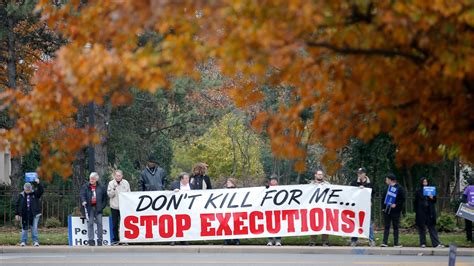
We are pleased to attach the bi-monthly report on the death penalty around the world prepared by group member Lesley. A lot on the US this month as there is a lot of activity, certainly in the southern states, at present. In view of the recent presidential election, it is worth noting that although there is a lot of ‘noise’ about President elect Donald Trump’s desire to ramp up the use of the penalty, what frequently matters is what happens at state level. Who the governor is and his or her attitude to executions matters more than federal attitudes.
Note as ever that China does not feature although it is the world’s biggest executioner, details and statistics are a state secret.
Oklahoma executes more of its citizens per capita than any other state in the US.
October 2024
The State of Oklahoma has executed the second largest number of prisoners in the US (after Texas) since the re-legalisation of the death penalty in 1976. It has carried out the highest number of executions per capita in the country. It was the first jurisdiction in the world to adopt lethal injection as a method of execution.
The Salisbury group has decided to focus on the state and is writing to Governor Stitt in an effort to persuade him to stop this practice in his state.
There is a wide number of offences which can lead to a sentence of death in the state. First-degree murder is punishable by death in the following circumstances:
The defendant was previously convicted of a felony involving the use or threat of violence to the person;
The defendant knowingly created a great risk of death to more than one person;
The person committed the murder for remuneration or the promise of remuneration or employed another to commit the murder for remuneration or the promise of remuneration;
The murder was especially heinous, atrocious, or cruel;
The murder was committed for the purpose of avoiding or preventing a lawful arrest or prosecution;
The murder was committed by a person while serving a sentence of imprisonment on conviction of a felony;
The existence of a probability that the defendant would commit criminal acts of violence that would constitute a continuing threat to society; or
The victim of the murder was a peace (police?) officer, or correctional employee of an institution under the control of the Department of Corrections, and such person was killed while in performance of official duty.
In addition, the statute books carry the death penalty for first degree rape, extortionate kidnapping and rape or forcible sodomy of a victim under 14 where the defendant has a prior conviction of a person under 14, although since 2008 capital punishment is no longer constitutional for these crimes.
As of 27th September 2024 there are 33 prisoners on death row in Oklahoma, only one of whom (Brenda Andrew) is female.
Background facts
Oklahoma is one of two States allowing more than three methods of execution – lethal injection (the primary method), nitrogen hypoxia, electrocution and a firing squad. They are to be applied in that order if earlier methods are unavailable or found to be unconstitutional. Nitrogen hypoxia became available as an option in 2015 but to date has never been used in the State. When the prosecution seeks the death penalty, the sentence is decided by the jury and must be unanimous. In the case of a hung jury during the penalty phase of the trial, a life sentence is imposed, even if a single juror opposed the death penalty, and there is no re-trial.
Under the constitution of the State, the Governor of Oklahoma may commute a death sentence, but only following the advice and consent of the five-member Pardon and Parole Board. During Governor Lee Cruce’s administration (1911-1915), he commuted every death sentence. Governor Kevin Stitt (pictured) has granted clemency only once (to Julius Jones) during his tenure (2019 – present). This occurred despite 5 (possibly 6) recommendations from the Board. These have included the very recent case of Emmanuel Littlejohn, executed on 26th September 2024.
From 1915 to March 2024, 156 executions took place, three of them of women. Executions were halted for six years. This followed the botched execution in 2014 of Clayton Lockett. There was also a drug mix-up that led to the ‘incorrect’ lethal injection of Charles Warner in 2015.
14 executions have been carried out under the governorship of Kevin Stitt. In the most recent case – that of Emmanuel Littlejohn – there has been a great deal of controversy. The execution took place
despite conflicting evidence regarding his guilt, mitigating evidence regarding his troubled childhood and undeveloped brain at the time of the crime, the admission of some jurors of misunderstanding the implications of a life without parole sentence, and the fact that the Parole Board had voted 3-2 to spare his life. He had always maintained his innocence of the actual killing.
In 2022 a series of 25 executions were scheduled over a 2-year period, with one execution set for nearly every month through 2024. A report was issued by the Death Penalty Information Center tying the State’s use of the death penalty to its troubled history of racial violence and segregation.
The Death Penalty Information Center advises that current research shows that for every 8.2 prisoners on death row in the US in the modern era of the death penalty, one person has been exonerated.
The Reason Foundation Criminal Justice Policy Explainer – Abolishing the Death Penalty gives the following information:
Since 1981 ten people in Oklahoma have been exonerated while on death row
6 cases involved perjury or false executions
7 cases involved official misconduct
Oklahoma County, Oklahoma, has had the 4th highest no of death row exonerations among all counties in the US. 4 of the 5 death row exonerations in Oklahoma County involved misconduct by officials.
The longest sentence served by a death row exoneree was 21 years.
The Foundation also provides evidence of the high costs in the State of the death penalty as opposed to life imprisonment:
A study prepared for the Oklahoma Death Penalty Review Commission found that Oklahoma spends $110,000 more on capital cases than on comparable non-capital cases. The study authors noted that this is a very conservative estimate because many prosecution and court costs were excluded.
Even at that conservative rate, with 42 (Note: figure differs from the 33 quoted earlier) individuals currently on death row, Oklahoma could have saved $4.64 million by trying the cases as life without parole rather than seeking the death penalty.
Using estimates from other studies suggests Oklahoma could have saved between $33.6 million and $42 million by pursuing life without the possibility of parole rather than the death penalty.
Moreover, the 117 (?) executions conducted in Oklahoma since 1990 are estimated to have cost the state between $12.9 million and $117 million.
Sources: Wikipedia; Death Penalty Information Center; Amnesty International; World Coalition Against the Death Penalty; The Reason Foundation – Criminal Justice Policy
We are pleased to attach the latest bi-monthly report on the death penalty thanks to group member Lesley for the work in preparing this. It is worth remembering that the 10 October was the World Day Against the Death Penalty. As usual we note that China is believed to execute more of its citizens than the rest of the world combined but details are a state secret.
After spending one and a half hours unsuccessfully trying to find a vein, sticking the needle into various parts of his body including arms, neck and feet, they suspended the prisoner upside down for 20 minutes in the hope of finding one but failed to execute him and returned him to his cell. Two years later they used nitrogen hypoxia after which he shook for 2 minutes and after six minutes of gulping, he died. Thus ended the life of Allan Eugene Miller on Thursday last week (26th September).
This is not a description of an execution from some barely civilised country but in USA in the state of Alabama. It was one of 5 executions last week the others being Emmanuel Littlejohn; Travis Mullis; Marcel Williams and Freddie Owens.
The case of Marcel Williams, 55, is particularly troubling since he was almost certainly innocent. Despite copious blood at the scene, none matched his DNA. Key evidence was either lost or destroyed. Witnesses had an incentive to give false evidence to receive a $10,000 reward.
Republican prosecutors seemed to have become more aggressive in pushing for the ultimate penalty. This may be linked to current politics and ‘Make America Great Again‘ rhetoric from Donald Trump. During his time as president, he altered the composition of the Supreme Court which now has an ultra-right super-majority.
Anyone who has followed Clive Stafford-Smith or read his books will know the process is far from perfect in many states in the Union. Poor trial procedures, withheld evidence, packed juries and defendants represented by inexperienced lawyers are not at all unusual. Many states have abandoned the death penalty but a number still keep it of which Alabama is one. It is no accident that despite only representing 13% of the population, 34% of black people are on death row.
There are many who believe the penalty is a deterrent. The problem of course is that mistakes cannot be put right. As the Death Penalty Information Center points out, since 1973, 200 former death row prisoners have been found innocent of all charges.
The issue has become a political one. It has been noted that Kamala Harris, the deputy president standing for election to become the president this November, makes no mention of abolition in her speeches or literature. She opposed the penalty in 2019. However, the promise to do so has not survived. This shift partly results from a change of mood following some high profile police murders. Trump is solidly in favour as part of his ‘tough on crime’ policy. There is a lot of discussion in the American press and there are suggestions that such a principled stand was not popular even with fellow Democrats.
Sources: Death Penalty Information Center; Washington Post; The Guardian; NBC; Amnesty International; Mother Jones.
We tend to think of Japan as a modern democracy and a sophisticated society having cast off the problems of its warlike past. It is a G7 nation and enjoyed a post war boom leading to considerable commercial success. But there are elements of the society which have not changed one of which is the legal system.
Japan still has the death penalty a particular cruel feature of which is that prisoners do not know of their execution until a few hours before it takes place.
The news that the Appeal court in Japan has declared Hakamada Iwao as innocent has been a long time in coming – 56 years in fact. Hakamada was convicted of murdering his boss in 1966. He spent a staggering 46 years on death row. Much of it was in solitary. The only problem was that he is almost certainly innocent. Key evidence was fabricated. He was forced to sign a confession after 20 days of intense interrogation and beatings by the police. He was not allowed a lawyer.
Bloodstained clothing – a key element in the prosecution’s case – turned out not to be Hakamada’s blood. It may have been planted. There are many things wrong with the whole process and further details can be found on the background provided by Amnesty. The role of the police was a key part of the miscarriage of justice. This led to probably the longest death sentence ever. Historically, this was a familiar story in the UK with forced confessions after long hours of interrogation. It led to the introduction of PACE which has led to improvements in police practice here.
One of the problems is the attitude of the Japanese public. It is reported that 80% of the Japanese are in support of the penalty. It is unlikely therefore that change will happen quickly.
Although it is encouraging to see Hakamada exonerated from this crime, the case raises several concerns. The use of the death penalty which, had he been executed, would have resulted in the state killing an innocent man. As in all these cases of police coercion, the real killer(s) have never been found or prosecuted. It also reveals a legal system which seems amazingly slow both to act and ultimately acquit. It also seems reluctant to admit mistakes. Finally, his treatment in prison with years spent in solitary confinement are unreasonably cruel. Altogether, this does not reflect well on the Japanese state.
We are pleased to attach the latest death penalty report covering the period mid-August to mid-September thanks to group member Lesley for the work in preparing it. Note as ever that China does not appear in the report despite being the world’s largest executioner as details of executions are a state secret.
We are pleased to attach the latest monthly report on the state of the death penalty around the world thanks to group member Lesley for her work in compiling it. Note as ever that China does not feature where the use of the penalty is a state secret and who are believed to execute more of their citizens than the rest of the world combined.
We are pleased to attach the latest report on this topic thanks to group member Lesley for the work involved in its preparation. Although China is mentioned in the report, details of the numbers executed are a state secret. It is believed they execute more of its citizens than the rest of the world combined.
Many troubling aspects to this case. Urgent action with full details available here
July 2024
Keith Gavin is scheduled to be executed in Alabama next week on 18 July 2024. He was convicted in 1999 of a murder committed in 1998 and sentenced to death on a jury vote of 10-2 for the death penalty. In 2020, a federal judge found that his legal representation at the sentencing phase had been constitutionally inadequate, but in 2022 the Court of Appeals reversed this decision. International legal standards require that anyone facing the death penalty be provided effective legal assistance at all stages of the case. This standard was not met. We urge the Governor to commute this death sentence.
There are a number of troubling aspects to this case not least the poor and ill-prepared defence (defense) he received. After the trial, appeal lawyers discovered much mitigation evidence not heard by the jury, including multiple psychological risk factors from Keith Gavin’s childhood and adolescence, including his exposure to violence at home and in the community. He was one of 12 siblings growing up in a dilapidated apartment in Chicago’s notorious public housing projects; his closest siblings all had histories of incarceration and drug dependencies. He was subjected to more paternal beatings than the others because he “accepted responsibilities for things he had not done because he felt he was strong enough to accept the whippings”. Outside the home, the exposure to violence took the form of pervasive gang activity. Seven of the 12 children ultimately joined gangs, and several became victims of gang violence.
The Governor of Alabama said “Although I have no current plans to grant clemency in this case, I retain my authority under the Constitution of the State of Alabama to grant a reprieve or commutation, if necessary, at any time before the execution is carried out,” Ivey said in her letter to Alabama Department of Corrections Commissioner John Hamm. (Source: Montgomery Advertiser)
Full details of this case can be accessed here and we urge those reading this to write to the Governor (model letter available) as soon as you can. The US is the only country in the Americas to retain the death penalty.
Urgent Action for Marcellus Williams who is scheduled to be executed for a crime he did not commit
June 2024
Marcellus Williams is scheduled to be executed on Sept. 24 for a crime DNA evidence proves he did not commit. The St. Louis County prosecuting attorney in Missouri USA, reviewed these DNA results and filed a motion to vacate Mr. Williams’ conviction because he believed the DNA results proved by clear and convincing evidence that Mr. Williams did not commit this crime. Although the circuit court has not yet scheduled a hearing to address this motion — and no court has ever considered the new exculpatory evidence — the Missouri Supreme Court set an execution date for Mr. Williams.
That same DNA evidence led Governor Eric Greitens to convene a board of inquiry and halt Williams’ scheduled execution just hours before he was slated to die. That inquiry later stalled, and Governor Mike Parson disbanded the board before it issued any findings (which led to a lawsuit by the Innocence Project, which still pending).
We have less than 100 days to stop the execution of an innocent person. Add your name to stop this injustice before it’s too late.