Lecture by Prof Phillippe Sands at Southampton University
Phillippe Sands
It was a pleasure to attend the annual lecture organised by the Romsey and Southampton Amnesty group given by Phillippe Sands (the link is to several of his articles). It was based on his book East West Street concerning in part the city of Lviv which was known at Lemberg in the nineteenth century and was also known as Lwów. Under the Soviets it was called Lvov. Its importance in his story was that two people came from the town who were very influential in the post-war developments of human rights.
Hersch Lauterpacht. Picture: the Guardian
First was Hersch Lauterpacht who was born just north of Lemberg and moved there in 1911, and the second was Rafael Lemkin who was born in Ozerisko and moved to Lemberg in 1900. They both worked behind the scenes during the Nuremberg trials. But their claims to fame are that Lauterpacht was instrumental in getting the world to agree the need for action on crimes against humanity and Lemkin on the concept of genocide. It is surprising that these two concepts are fairly recent and both date from 1945: one assumes they have been around for a lot longer. But that they both emanate from two men from the same town in east Poland is even more remarkable. Despite this and despite the fact they worked in the same field, they never met as far as is known.
Lauterpacht it was who wrote the International Bill of the Rights of Man which invoked Churchill’s commitment to the ‘enthronement of the rights of man.’ His book was key in the development of the UN declaration.
Sands discussed the arguments concerning whether ‘genocide’ should be included and in
the early years it was sometimes in and sometimes dropped. It met resistance because of legal doubts. Lemkin was keen to introduce this as a crime largely because of the German’s crimes in the war an in particular the activities of Hans Frank who oversaw the slaughter in his former town and Poland generally. Frank was hanged after the Nuremberg trials.
He finished his lecture by discussing briefly, the current state of affairs with regard to human rights. He expressed an ‘acute sense of anxiety at what stirs in our midst’ referring part to the far right groups in eastern Europe especially as they suffered so much under the Nazis.
He said he had a ‘sense of going backwards’ with our own politicians wanting to come out of the European convention which he thought was ‘unbelievable’. The platitudes of many of the current politicians seems to reflect a lack of knowledge of post-war events.
East West Street: On the Origins of Genocide and Crimes Against Humanity is published by Weidenfeld & Nicolson (£20).
Government plans to withdraw from the European Convention of Human Rights
The Conservative government has long disliked the European Convention and is now proposing to put withdrawal in the next manifesto. This will be a serious mistake and will affect the human rights of many individuals in the UK. It will also send a message to many other countries around the world whose record on human rights leaves a lot to be desired.
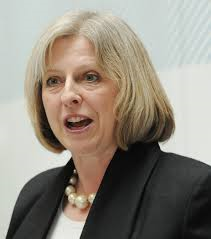
Theresa May MP. Picture: ibtimes
One of the problems with discussing this issue is that it is clouded by a programme of disinformation by the tabloid press. Being a European creation it is damned by association. It is also, in their eyes, a serious threat because it gives people some rights concerning privacy. Since large parts of the British press are concerned with the private lives of celebrities and profit from such stories (which to be fair have an avid readership), anything which inhibits their ability to publish such material is going to harm profits. There has thus been a continuous series of stories which rubbish the Human Rights Act and the European Convention (ECHR). Small wonder therefore that politicians follow this line and brave it is for those few who stand up for the Act.
Theresa May has a particular animus against it and is famous for her fatuous remark about someone not being deported because of a cat. “I’m not making this up” she famously said: only she was. The person involved was a Bolivian who wasn’t an illegal immigrant anyway but was a student who had overstayed his visa. At the tribunal and later at appeal, part of the evidence for his right to stay, was his relationship with a British woman, various other domestic matters, and their ownership of a cat.
A more serious case which caused Mrs May angst whilst at the Home Office was the case of Abu Qatada. The Home Office spent many years trying to deport him and the HRA was blamed by her and the right wing media for being unable to do so. In simple terms, he could not be deported because either he – or the witnesses against him – would be tortured by the Jordanian authorities. He was eventually deported following diplomatic negotiations which led to Jordan agreeing to renounce torture. It was never really explained during all the months of dispute about the need to deport him, why he was never put on trial here.
In a speech in April last year Theresa May (then Home Secretary) set out her reasons for wishing to depart from the ECHR:
[…] The ECHR can bind the hands of Parliament, adds nothing to our prosperity, makes us less secure by preventing the deportation of dangerous foreign nationals – and does nothing to change the attitudes of governments like Russia’s when it comes to human rights. So regardless of the EU referendum, my view is this. If we want to reform human rights laws in this country, it isn’t the EU we should leave but the ECHR and the jurisdiction of its court. (26 April 2016)
Almost every part of this paragraph is nonsense but one element is ‘[it] does nothing to change the attitude of governments like Russia’s’. We have just seen the brutal activities of Russian forces in action in Syria and prior to that, in Ukraine and Chechnya. Human rights in Russia are at a low ebb and the murder of opposition leaders and journalists a fairly frequent occurrence. But Russia has been subject to the ECtHR for some years and something like half their judgements are against Russia, Turkey, Romania and Ukraine. It is, in a small way, a civilising influence. It has had an effect on their activities.
On the other hand there has been a miniscule number of judgements against the UK – 10 in 2012 for example. Indeed if one looks at the statistics, between 1959 and 2015 there have been 525 judgements concerning the UK of which 305 decided that there was at least one violation. That is 305 over a period of 56 years. From all the sturm and drang in the media you would imagine it was at least ten times greater.
The chief worry is that if we – one of the founders of the European Court – pull out it will give the Russians the perfect excuse to do so as well. One of the lawyers acting for the survivors of the Beslan massacre in Russia said:
It would be and excuse for our government to say we don’t want it either. Putin would point at the UK straight away. It would be a catastrophe. [the UK] has to understand; we all live in the same world and we all have impact on one another. (quoted in A Magna Carta for all Humanity by Francesca Klug, Routledge, 2015, p193)
At the end of the extract from Theresa May’s speech she goes on to say ‘if we want to reform human rights laws in this country, it isn’t the EU we should leave but the ECHR and the jurisdiction of its court.’ But what laws do we want to reform? We still wait after more than five years for sight of the British Bill of Rights although it is still promised.
There are two aspects to the proposed withdrawal: internal and external. Internally, it will reduce the rights of individuals in their claims against the state. People like the Hillsborough survivors would never have succeeded in their quest for justice without article 2. The parents of the Deepcut shooting would never have received justice without the ECHR. On that subject, Theresa May also wants to remove the armed services from the act, a view echoed by the local MP for Devizes.
Behind all this anti-ECtHR rhetoric, are the assumptions that all EU rulings are wrong and that we have a superior and infallible legal system. We do indeed enjoy a very good system – witness the low number of rulings against us by the European Court – but it is not perfect and judges have shown themselves to be too keen on supporting the establishment. There is also the issue of sovereignty and a belief that it is only our parliament who should decide our laws. The problem here is the weakness of parliament in challenging the executive.
Externally, it will send a harmful message to countries like Russia and Turkey where human rights are fragile. It is astonishing to recall that it was a conservative, Sir Winston Churchill who was instrumental in forming the Convention. Yet now it is the same conservatives who want to abolish it because, now and again, we fall foul of it and have to change our procedures or right a wrong.
Coming out of the European Convention would be a serious error and a backward step. Our influence in the world would be diminished. As a result of Brexit, we will be desperate to secure trade deals with whoever we can. Such limited concerns as we do have for human rights will all but disappear in the rush to sign a deal. Witness our activities in the Yemen where we are more concerned with selling £3bn of arms than we are with the results of the bombing. In the UK, the ability of ordinary people to uphold their rights in every day situations will be diminished.
The local group hopes to campaign in favour of the Human Rights Act and related issues as when we get some details from government. If you believe these matters are important, as we do, both for people’s rights in this country and our influence overseas, you would be welcome to join us. Details will be here and on twitter and Facebook
The Human Rights Act is under threat by the Conservative government and they want to withdraw from the European Convention which we helped found. It is timely therefore that we celebrate the achievements of the ECHR which receive too little attention by our media and by politicians such as the prime minister and our local MP Mr John Glen.
A senior judge at the Court of Justice of the European Union (CJEU) has concluded that powers letting police and public bodies grant themselves access to people’s communications data with no external oversight or suspicion of serious criminality breach human rights law.
It is difficult to generate much interest among the public to the proposals by the government – drafted by Theresa May when she was Home Secretary – to introduce the Investigatory Powers Bill. A few weeks ago, the country voted against staying in Europe which was interpreted by many as a protest against government and the governing class who were seen as out of touch and indifferent to their plight. There were other matters such as immigration and the EU itself, but it was a cry by the ‘left behinds’ who are finding life, jobs and housing an increasing trial.
Yet they seem relaxed at giving the government yet more powers to pry into their lives. Of course it is presented as a fight against terrorism and that these powers are needed to fight this ever present menace. But, in addition to the police and security services, local councils and various government agencies such as the Food Standard Agency will also enjoy these rights. It is hard to see how the FSA can be dealing with serious crime. And are there half a million serious crimes a year? That is the number of requests.
The previous act Data Retention and Investigatory Powers Act [DRIPA] was introduced in a desperate hurry by Theresa May because of a previous ruling by the European Court. This meant that there was an urgent need to introduce legislation to legitimise the high level of interception that was taking place without proper oversight. Hardly any time was allowed for parliamentary debate.
The new law will go further and the CJEU has fired a warning shot concerning the breach of liberties. Ah you might say, ‘aren’t we about to leave the EU so we can give two fingers to them.’ The problem is that the EU will want to ensure that we are protecting fundamental rights when the come to negotiate with us as an external partner.
The new PM is not known as a libertarian and this promises to be an interesting struggle. We do not yet know whether the new Home Secretary will simply trot along behind what the PM left her. So far the public has remained relaxed having bought the line that this all part of the battle against terrorism. One day however, one or other of the tabloids might wake up and have a go in which case the mood will change quickly.
Human rights will be diminished if we leave Europe
Human rights have not directly figured much in the vexed debate about whether to remain or leave the European Union. The arguments seem to have settled on immigration, which has become a toxic topic, with the Brexiters claiming that a leave vote will enable us to regain control of our borders. The Conservative government has promised to repeal the Human Rights Act but progress has been slow so far. Reporting on the many issues has been poor with the main focus on the scrapping between the Tory party factions rather than on a measured debate.
The crucial question on how our rights will be affected after a vote to leave – if that should happen on Friday – has received little coverage. Partly this is because of the complexity of the subject and also detailed discussions of legal judgements does not make for racy copy. As ever, Rights Info has done an excellent job of discussing the issues with a link through to the Independent newspaper (now only online) which has also done a detailed analysis.
Despite its faults, the European Convention, which in turn led to the Human Rights Act, has been of considerable benefit to ordinary people. For many this will come as a surprise and for readers of the right wing press in the UK, a statement at variance to the facts as they know them. And this has been a large part of the problem: a deliberate and sustained attack on the act which has included misreporting, non-reporting and the running of scare stories many of which have no foundation in fact. For readers of the Daily Mail in particular but also the Sun, the Daily Telegraph and the Daily Express, they are treated to lurid stories of terrorists going free, criminals living the high-life in prison and murderers demanding pornography as their ‘human right’ (they didn’t).
Why the right wing media should be so hostile to the act (as opposed to airing proper criticism of it) is discussed by Francesca Klug in her book A Magna Carta for all Humanity (Routledge, 2015).
As the late, great former Lord Chief Justice Lord Bingham put it: there is ‘inherent in the whole of the ECHR … a search for balance between the rights of the individual and the rights of the wider society.’ For the press to mention this inherent approach would not only spoil a good story, it could draw attention to an inconvenient truth: that Article 10 ECHR, the right to free expression, explicitly states that free speech comes with ‘duties and responsibilities’. This is not a very popular statement with many journalists. But, I suppose – with notable exceptions – the press is hardly alone in thinking that responsibilities apply to everyone but themselves. (p265)
She goes on to explain that there was little legal remedy against press intrusion before the act was passed. Common law provided no real protection. An example was Gordon Kaye, the star of the TV series Allo, Allo who was recovering in hospital after a car accident. Two Sunday Sport journalists entered his hospital room and interviewed and photographed him. In view of his medical state it is unlikely he knew what was happening. Under existing English law he had no redress.
Brexiters like to portray English law as some kind of noble construct which has been diminished by Europe and that by leaving, we will be able to get rid of all this interference by ‘unelected European judges’ and get back to the way we were. Europe is presented in purely negative terms and acting to diminish our rights. British law is indeed a fine system in many respects, but without the HRA we would never have had the investigation into the activities of the press and phone hacking; no Leveson enquiry and the Murdochs (father and son) being asked to come before a select committee.
The benefits of the act to ordinary people in their struggles for justice against the police or public authorities are seldom mentioned. The use by the media themselves to defend their sources or to prevent unjust interference by the police or security services is likewise rarely mentioned. The rights ordinary people enjoy have almost in every case been achieved after a struggle and the current government is keen to erode these rights still further. Access to the courts and the availability of legal aid has been seriously curtailed; further legislation to diminish the – already limited – rights of trades unions is planned, and the Snooper’s Charter is well on its way to becoming law.
The idea therefore that we will be better protected if we leave is not supported by the evidence. If we leave Europe and the process begins to abolish the Human Rights Act (which our MP, Mr John Glen is keen to do) and other treaties, it will only result in diminished rights for the ordinary people of this country.
Theresa May, the Home Secretary said in a speech today that the UK should leave the European Convention on Human Rights. We have been waiting for some time now for this announcement – or something like it – and it was expected to be made by the Justice Secretary.
Mrs May’s proposal to tear away from the European Convention on Human Rights would strike at the very architecture of international protections, and betray the British people who built the convention at the end of the Second World War.
The Convention has done so much for the rights of the free press, gay people, women, people with disabilities and other ordinary people here and across Europe.
Some see this as part of Mrs May’s pitch to become prime minister if and when David Cameron quits the scene. There is considerable media pressure to quit the convention often based on misleading information. We shall have to see how this develops and we still await the Bill of Rights long promised but slow to appear.
As one of the countries which promoted the convention after the war it would be a tragedy if we left it. As the Amnesty spokeswoman says it has done so much to promote rights not only in this country but elsewhere in Europe. It is a surprise to many people when told what a beneficial effect it has had in countries such as Russia.
A spokesman from Liberty called the speech ‘desperate’.
Illustrated left is the tapestry made by Amnesty groups in the south region currently on display in the Cathedral Chapter House, which shows the clauses of the Un Convention on Human Rights on which the ECHR was based.
On Friday 19 February, the Southampton and Romsey groups of Amnesty hosted a debate on the HRA. The speakers were Dr Clare Lougarre of Southampton University and Dr Alan Whitehead, the MP for Southampton Test. A representative from the Conservatives was invited but did not take up the invitation.
Clare began by placing the HRA in its context as a natural consequence of the Euroean Convention on Human Rights [1950]. In the context of the debate on the current government’s manifesto commitment to annul the HRA, articles 2, 3 and 4 were significant.
art 2 says that court’s decisions must take into account the decisions, declarations or advisory opinion of the European Court
art 3 UK laws are compatible with the European Convention
art 4 says that if our laws are not in accordance with the convention they may issue a declaration of incompatibility.
She said there were two options for the government: they repealed the act but we stayed within the convention or, it withdraws its signature from the convention altogether. In the first case, there would be little difference as we would ultimately be bound by the European Court. In the second instance however there would be no recourse to the EC and the most likely affected by this are the vulnerable in society.
Dr Whitehead said he was puzzled by what the government wanted to do. The animus against the HRA was based on myth, semi-truths and half truths he said. One myth was that it was ‘Labour’s Human Rights Act.’ This was a frequent phrase used by conservative critics. It simply wasn’t true he said, it was a cross party bill supported by many conservatives. He was moved to ask ‘what part of the act don’t you like?’ He reminded the audience that it was a conservative – Winston Churchill – who was one of the prime movers in creating the ECHR in 1950.
One of the charges against it was that the court had ruled on areas which were never intended by the original convention, in other words there was ‘mission creep.’ This was inevitable since the articles were widely drawn and also, attitudes had changed over time with, for example, our approach to abortion.
The case that is frequently brought up is Abu Qatada. This was presented as a failing of the HRA. It was not. The Home Office had made mistakes in its original paperwork and the reason he could not be sent back [to Jordan] was because either he, or the witnesses, would be subject to torture. [He might have added that abolition of torture was subject to another treaty altogether.]
A further point made by Dr Whitehead was that it should not be for a single government to make law on something as important as this. He did not think we would see anything before the end of the parliament and what would emerge would be a ‘mouse’ of a bill.
It was a lively and informed debate and all credit to the two Amnesty groups for organising it. For further information on the HRA go to (among other sites) British Institute for Human Rights and Rights Info. Now that the movement to come out of the EU is getting underway, the HRA will be a whipping boy for those that want us to leave the union. Both these sites help counter the frequent flow of misinformation by some sections of the media and some politicians.
The tapestry assembled by members of the South Region of Amnesty International, is now on display at the entrance to the Chapter House in Salisbury Cathedral. Each panel represents one of the clauses of the UN Convention on human rights which led ultimately to the Human Rights Act in the UK. It is this act that the current Conservative government wants to abolish. The Chapter house is where one of the surviving copies of Magna Carta is displayed. We are extremely grateful to the Cathedral Authorities for giving us this space to display the tapestry. It will be on display for a few months and then will go on display elsewhere in the south region.
Rights Info has only been going four months but has already begun to establish itself in the human rights world. It is dedicated to providing accurate information on the subject of human rights. This is extremely important now because the present government would like to repeal the Human Rights Act (HRA) and replace it with their own Human Rights and Responsibilities act (or whatever it may be called). This has been promised for several years and we await details in due course.
The government is egged on by a media which regularly produces inaccurate or exaggerated stories of the workings of the act, often tying it into the European Convention on Human Rights, presenting it as an unwarranted intrusion into our legal processes. The fact that it was British and French lawyers who prepared the ECHR – at Churchill’s behest – based on basic principles of justice established over many years, seems to have been forgotten. As we have noted before, the act is of great benefit to ordinary citizens in the UK who use it to secure justice from authorities.
Rights Info has been providing a source of information to counter the tide of misinformation from newspapers and some politicians. They have just launched a similar exercise to provide information about the European Court which also gets a bad press. It is called The European Court of Human Rights Uncovered. One of the examples it gives concerns the total number of applications and judgements. There have been 22,781 applications against the UK. Number of judgements is just 513 of which the court found at least one violation to be 301. 301 over 22,781 is 1.32%. The Sun newspaper reports this as ‘UK loses 60% of cases’.
Terrorism cases get a lot of publicity with the impression given that they are winning cases all over the place. In 40 years (1975 – 2015) out of 297 cases, just 14 were terrorists. 203 were ‘other people’ that is ordinary citizens in their fights against authorities of one kind or another.
Over the coming months we are likely to see an increase in bad news stories about the HRA and the European Court as the government seeks to soften up the public ahead of its plans to abolish it. It is useful to know that there is a source of accurate information to go to.
UPDATE: 5 May … still no sign of a draft of what the British Bill of Rights will contain. People go to the polls in a couple of days time without knowing what is planned. Since the election campaign has been based largely on the deficit and who is going to spend the most on the NHS, oh and being run by Scotland: what is, or is not, in the BBoR may seem trivial. But it touches on all our rights and on our relationship with Europe so it is important.
The #Conservative party #manifesto was published today 14 April and as promised, there is a plan to scrap the Human rights Act #HRA. The manifesto says on p73:
We will scrap Labour’s Human Rights Act and introduce a British Bill of Rights which will restore common sense to the application of human rights in the UK. The Bill will remain faithful to the basic principles of human rights, which we signed up to in the original European Convention on Human Rights. It will protect basic rights, like the right to a fair trial, and the right to life, which are an essential part of a modern democratic society. But it will reverse the mission creep that has meant human rights law being used for more and more purposes, and often with little regard for the rights of a wider society. Among other things the Bill will stop terrorists and other serious criminals who pose a threat to our society from using spurious human rights arguments to prevent deportation.
This will have profound implications in our relations with Europe and we still do not know what the new bill will look like even after many years of discussion about the abolition of the HRA. Incidentally, although the Act was introduced under the Labour administration, it was voted for by many Conservatives as well.
A draft of the BBoR has been a long time a coming and the latest we heard was that it was to be published before Christmas. One assumes a draft will now appear before polling so that voters can see in more detail how it differs from the existing HRA.
The Conservatives seem to have got themselves into something of a bind with this Act. They were happy to go along with the anti-European sentiment expressed by most of our newspapers and were obviously spooked by the Ukip surge over the last few years. There has been a torrent of misinformation and disinformation about the workings of the HRA which, apart from the honourable exception of Dominic Grieve MP, they have made little or no attempt to counter with facts.
What got them steamed up most of all – and got our tabloids into a fearsome lather – was the case of Abu Qatada or the ‘preacher of hate’ as he was called. Many attempts were made to deport him but the problem was not just the HRA but the fact that he might be tortured when he was returned to Jordan, or the Jordanians would convict him using evidence obtained from torturing others. Is this an example of ‘spurious human rights arguments’? Since, quite apart from the ECHR, we are signatories to treaties banning the use of torture, there was a problem in getting him out of the country in any event. We might note in passing that the Jordanians had to clean up their judicial act as part of the agreement to send him back.
A puzzle though is that the other area which gets politicians steamed up is the issue of a right to life yet this is quoted as being ‘an essential part of a modern democratic society.’ Something about a cat.
The fact remains that many ordinary people are beneficiaries of the Act. Lawyers can use it in their day to day work with individuals and their dealings with authorities of one kind or another. Little of this gets published in the media and most are unaware of it unless by chance they know of someone who has benefited.
As far as the Strasbourg court is concerned, the UK are the ‘good guys’ since we still have a largely uncorrupted police and judiciary and people can appeal decisions in cases of injustice. Our police operate under PACE and suspects have a right to a lawyer. Very few of the cases which go to Strasbourg get overturned – we believe there were only eight last year.
As one of the original countries, along with France, who prepared the ECHR after the war at the behest of Winston Churchill – a Conservative – if we leave the Convention it will have significant repercussions in places like Belarus, Turkey and Russia. Belarus is the last country in Europe with the death penalty and human rights are largely ignored.
It will be interesting to see how our local Conservative candidate John Glen reacts to this. When he came to see the local group to discuss this topic he did agree to be more balanced in his comments which we welcomed. This followed an article in the Salisbury Journal saying he wanted it abolished. But now it is part of the manifesto for his party we shall have to see…