Members from groups in the South West gathered in Exeter last Saturday for an interesting day on human rights issues. All credit to the Exeter group who have organised this for several years now enabling us to meet other groups in the region. We held our usual photo opportunity in front of the fine Exeter Cathedral (almost as fine as Salisbury’s!), and this picture was to highlight the problems of being a woman in Afghanistan.
The violence continues. Israel has ended the ceasefire and over a hundred have been killed in the recent bombing in Gaza. Encouraged by President Trump and his desire to see some kind of Riviera on the Mediterranean coast, the IDF has restarted its bombing campaign. There can be little pretence that peace and a two state solution is anywhere present in current thinking.
To criticise Israel is to court being called ‘antisemitic’ a kneejerk reaction which has been immensely powerful. Many publications are wary of inviting this slur. It is very encouraging therefore to read of criticisms coming from within Israel itself and in particular in the Haaretz newspaper. A recent article by its editor Aluf Benn, is testimony to this [registration may be needed].
The images on our screens are truly horrific. A landscape of demolished buildings; mountains of rubble; hoards of people moving from one ‘safe zone’ to the next; rows of corpses and parents clutching dead infants. The scale of the response, with Netanyahu promising even worse to come, is demonstrably a crime against humanity. All supported by the United States and now Donald Trump with vague notions of moving 2 million Palestinians out of the territory to some other country.
Britain continues to support Israel and the RAF are reported to be overflying Gaza a largely unreported fact. And of course we are still selling them arms. We are thus complicit in these terrible events.
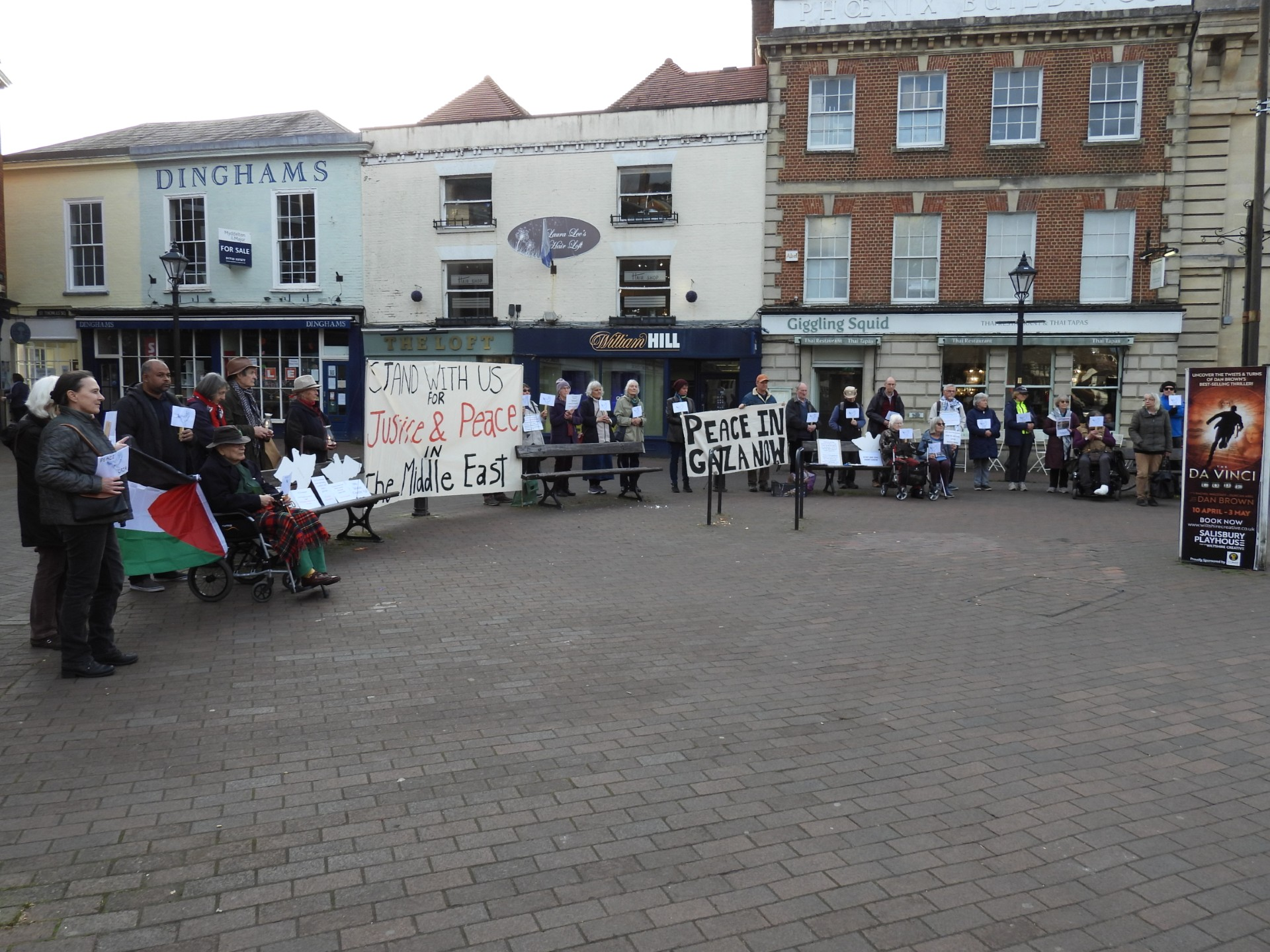
The 68th Vigil was held yesterday in the Market Place in Salisbury with around 35 in attendance. We are grateful to Peter Gloyns for a moving video.
Salisbury group assembles to mark planting of its tree
March 2025
Last year (2024) marked the fifty years since the group was founded and here we are, still going strong if sadly the only group left in Wiltshire. We had the opportunity for a tree to be planted in honour of this anniversary and today (4 March) some of the local group assembled for a photograph in Victoria Park. We were delighted to welcome two surviving members who formed the group half a century ago.
The need to keep human rights issues on the agenda is needed now more than ever. It was perhaps the belief all those years ago that the need for a human rights group would slowly melt away in the wake of the post war ideal of the new world order following WWII. This has not been the case. Rights are being slowly chipped away at home as governments have not liked protest groups drawing attention to their climate and environment failings and continued arming of Israel for example. The previous government introduced several pieces of legislation reducing rights, increasing police powers and limiting access to justice. The new government shows little inclination to repeal them. Some MPs – including both our local ones – generally vote against human rights matters according to the They Work for You website.
Overseas – well, where to start. China continues to persecute the Uyghurs and western firms continue to buy cotton produced by effectively slave labour. War and destruction continues in Sudan and other parts of sub Sahara Africa. The situation in Burma continues with the military attacking people and villages of minority groups. We continue to sell them jet fuel to enable them to carry on. The terrible death toll continues in Gaza.
So the need to keep the spotlight on human rights is needed today as it was 50 years ago. Power, in whatever form, does not like giving it up and will go to great lengths to keep it for themselves and their supporters.
If you would like to join us you would be welcome. See a list of current and future events where you can come and make yourself known. We welcome people who want to pursue a particular human rights theme – more rights for women for example.
Equited after eight-year ordeal comes amid new wave of repression of rights defenders
February 2025
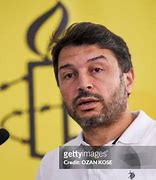
The dire human rights situation in Türkiye has largely dropped out of the news in recent years but repression of rights defenders, journalists and academics continues. The case of Taner Kılıç, who was finally acquitted today after a judicial process that has lasted almost 8 years, is a stark example of the Turkish authorities’ politically motivated attempts to criminalize human rights defenders, said Amnesty International. We first mentioned his arrest in a post on this site in 2019.
Taner Kılıç, a refugee rights lawyer and former Chair of Amnesty International’s Türkiye section, was arrested in June 2017 and detained in prison for more than 14 months. Despite a complete absence of any credible evidence, in July 2020, he was convicted of “membership of a terrorist organisation” and sentenced to more than six years in prison. The end of the almost eight year ordeal for Taner Kılıç comes amid a new wave of detentions in which rights defenders, journalists, political activists and others have been targeted.
His acquittal follows the Court of Cassation’s rejection of the prosecution’s appeal against its previous decision to overturn Taner’s baseless conviction.
“Today, as we mark the end of Taner’s agonizing ordeal, our feelings are bittersweet. The cruelty inflicted on Taner – the years stolen from him and his family – can never be forgotten. His tenacity and resilience, coupled with our determination to undo this injustice, demonstrates that when we come together, we can move mountains,” said Agnès Callamard, Amnesty International’s Secretary General who spoke with Taner by video call today.
“For me this nightmare that has gone on for almost eight years is finally over. My imprisonment for more than a year has caused great trauma to my family. This unfair trial was like a sword of Damocles hanging not just over me but over the head of the entire human rights community in Türkiye. While it was for the prosecution to prove my guilt, this case went on for years despite my repeatedly proving my innocence,” said Taner Kılıç.
“The ordeal has created huge uncertainty in my life. The only thing I was sure of throughout this process was that I was right and innocent, and the support from all over the world gave me strength. I thank each and every one who stood up for me.”
In May 2022, the European Court of Human Rights reaffirmed that the authorities in Türkiye did not have “any reasonable suspicion that Taner Kılıç had committed an offence” when they remanded him in pre-trial detention for over 14 months in 2017/18. It found that his imprisonment on terrorism-related charges was “directly linked to his activity as a human rights defender”.
In November 2022, the Court of Cassation in Turkey ruled to overturn the conviction of Taner Kılıç on the grounds that the investigation was “incomplete”. The trial court agreed with the Court of Cassation ruling in June 2023, but the prosecutor appealed the decision, insisting that Taner Kılıç’s conviction should stand. With this latest and final decision, the Court of Cassation rejected the prosecution’s appeal, ending the ordeal for the human rights defender.
Courts used to silence critics
“Taner’s protracted prosecution is emblematic of how Turkish courts have been weaponized to silence critical voices and of the ongoing crackdown by Turkish authorities on rights and freedoms and those who defend them. The flagrant miscarriage of justice he was subjected to for so long is sadly just one of many. But we will take strength from Taner’s acquittal in our fight against the curtailing of human rights in Türkiye, and on behalf of those who refuse to be silenced by the authorities’ threats,” Agnès Callamard.
The acquittal comes amid a crackdown in which more than 1,600 people have reportedly been investigated for their alleged links to the Peoples’ Democratic Congress, a platform for civil society organizations and political parties. Last week, at least 50 people were detained in several provinces and 30 among them unlawfully remanded in prison on ‘terrorism’ related allegations after being questioned about their peaceful activities dating from more than a decade ago.
Background
Taner Kılıç is a founding member of Amnesty International Türkiye. Over the last 20 years, he has played a crucial role in defending human rights as part of the organization and the wider human rights community in Türkiye.
We are grateful to Amnesty UK for the bulk of the text in this post.
Amnesty publishes a report warning of the perils of predictive policing
February 2025
Many TV detective series have technology at their core as our heroes vigorously pursue the wrongdoers. CCTV cameras are scrutinised for movements of the criminals, DNA evidence is obtained and of course fingerprints are taken. The story lines of countless detective series feature forensic evidence as a key component of police detection. The series and stories are reassuring by displaying law enforcement officers using all the techniques – scientific and technological – to keep us all safe and lock up the bad guys. Using science and algorithms to enable police forces to predict crime must be a good idea surely?
It is not. The Amnesty report, and other research, explain in great detail the problems and what the risks are. One of the persistent biases in the justice system is racism and it would be worth reading the book The Science of Racism by Keon West (Picador, pub. 2025). The author takes the reader through copious peer reviewed research conducted over many years in different countries explaining the extent of racism. Examples include many cv studies (US: resume) where identical cv’s, but with different names which indicate the ethnicity of candidates, produces markedly different results. There are similar examples from the world of medicine and academia. Racism is endemic and persists. As Keon West acknowledges, a similar book could be written about how women are treated differently.
The Amnesty report notes that Black people are twice as likely to be arrested; three times as likely to be subject to force and 4 times as likely to be subject to stop and search as white people. With such bias in place, the risk is that predictive policing might simply perpetuate existing prejudice and bias. The concern partly centres around the use of skin colour, where people live and their socio-economic background all used as predictive tools.
People have a deep faith in technology. On a recent Any Answers? programme (on BBC Radio 4), a debate about the death penalty and the problem of mistakes, several people showed a touching faith in DNA in particular inferring that mistakes cannot happen. People are mesmerised by the white suited forensic officers on television giving a sense of science and certainly. Technology is only as good as the human systems which use it however. There have been many wrongful arrests and prison sentences of innocent people despite DNA, fingerprints, CCTV and all the rest. Mistakes are made. The worry is that predictive policing could enhance discrimination.
People who are profiled have no way of knowing that they have been. There is a need to publish details of what systems the police and others are using. The police are reluctant to do this the report notes. What is the legal basis for effectively labelling people because of their skin colour, where they live and their socio-economic status?
The police are keen on the idea and around 45 forces use it. The evidence for its effectiveness is doubtful. The risks are considerable.
The Salisbury Journal published a short piece describing the Vigils we have been holding each week in this week’s edition (30 January 2025). It said:
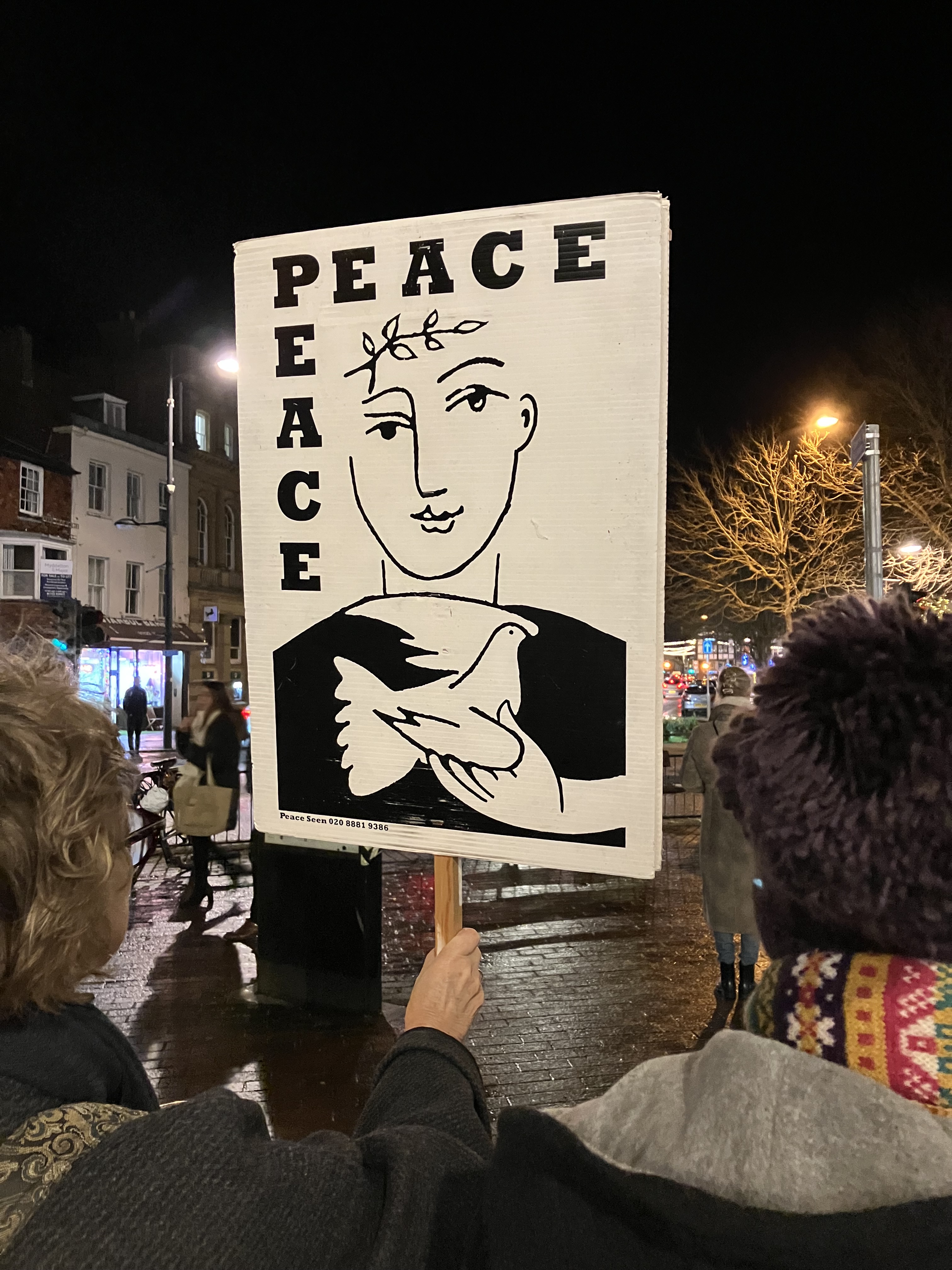
“A silent vigil took place outside the library to express a hope for the of violence in the Middle East. On Saturday the 60th silent vigil took place outside Salisbury Library with around 50 people attending. The weekly vigils are an expression of hope for an end to violence and a peaceful future in the Middle East and in the most recent [event] people carried flowers and candles and displayed heartfelt messages.
The messages emphasised the message for a permanent ceasefire. A spokesperson from vigil said “we call on the UK government to take immediate action to ensure accountability and justice for Palestinians. All arms sales to Israel muse be suspended. This is a moment of truth for the UK. To continue shielding Israel from accountability is to abandon the principles of justice and human rights that the UK claims to uphold.”
These vigils are supported by local groups of Amnesty International, Campaign for Nuclear Disarmament, Christian Aid, Quakers, Sarum Concern for Israel Palestine and many others.”
The vigils will continue and the next is this Saturday 1st February at 5pm as usual for half an hour. All welcome.
Also in the Journal, the local MP Mr Glen, spoke of his presence at the Holocaust memorial which took place in the city. He has not acknowledged in his weekly columns any of the 60 vigils so far held.
HRW’s World Report for 2024 critical of the UK on several fronts
January 2025
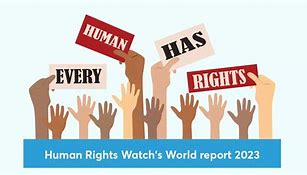
It comes as a shock when a respected international human rights organisation produces a report containing a number of criticisms of the UK government over its human rights record. There are some in this country who think that our role in developing the Universal Declaration in 1948 and incorporating that into the Human Rights Act fifty years later, somehow gives us some kind of moral status as champions of rights. HRW’s report disabuses us of that. The UK is a cause for concern on several fronts it says.
There are others who think the opposite and consider the act to have gone too far, enabling murderers, rapists and terrorists not getting their just deserts presenting spurious arguments based on the act. The Conservative government has in its various manifestos promised to abolish it and more recently has suggested it wants a bill of rights to replace the act. There has been a concerted press and media campaign over many years arguing for it to be abolished and which has, arguably, engendered in many people that the idea that the legislation is somehow against them. The positive benefits of the legislation are seldom mentioned.
There are still many who want the UK to come out of the European Convention including the MP for East Wiltshire, Danny Kruger.
The World Report discusses several areas of concern where it considers the UK to be falling short on human rights issues.
Poverty
Poverty means people are less able to live fulfilling lives, have poorer health outcomes, and often cannot afford to heat their homes adequately. The UK has the one of the highest levels of income inequality in Europe. It notes that the Labour government has not abolished the two-child limit a factor driving up child poverty. There is a cost of living crisis. It often means people cannot pursue their rights in the courts, not only because the system is hideously expensive and legal aid has all but vanished, but because of years of delay before a case can be heard.
It notes that 7 years have passed since the Grenfell Tower fire yet no one has been brought to justice. It might also have noted that years have gone by following the publicity concerning grooming gangs – more accurately called rape gangs – with little sign of serious action and no one brought to account. And there is the Post Office scandal and what has happened in the Anglican church and the resignation of the Archbishop of Canterbury. There has been a spate of hospital scandals.
Curtailment of freedoms
Several laws introduced to curtail freedoms. They point to the 2023 Public Order Act and the 2022 Police, Crime, Sentencing and Courts Act which have increased police powers of arrest. They express concern about increasing surveillance including of peaceful protests. Facial recognition is being introduced apace amounting to mass surveillance of the populace. We are more like China than perhaps we like to think. They draw attention to the UN rapporteur’s concerns about clampdown on environmental protests.
There are other matters of concern in the UK and these can be seen in the full report starting on page 505. The past year has once again highlighted an often-disregarded reality: liberal democracies are not always reliable champions of human rights at home or abroad.
They discuss the role of the United States in connection to Gaza and note that “US President Joe Biden’s foreign policy has demonstrated a double standard when it comes to human rights, providing arms without restriction to Israel despite its widespread atrocities in Gaza, while condemning Russia for similar violations in Ukraine, and failing to address serious rights abuses by partners like the United Arab Emirates, India, and Kenya. Donald Trump’s return to the White House not only threatens rights within the US but will also affect, by commission and omission, respect for human rights abroad. If the first Trump administration’s attacks on multilateral institutions, international law, and the rights of marginalized groups are any indication, his second term could inflict even greater human rights damage, including by emboldening illiberal leaders worldwide to follow suit.”
This is probably the key message of the report as a whole. The promise of the Universal Declaration and the hope of ‘never again’ seems to be dead in the water. If countries like the US and the UK cannot give a lead, acting honourably and taking full account of human rights both at home and in their foreign policies, there is slender hope that countries led by a variety of despots will take any heed. As we noted in our last post on arms sales, the selling of arms to whomsoever causing death and terrible harm to millions seems to matter over any kind of moral consideration. The HRW report is a sober read.
A useful review of the year as far as human rights in the UK is concerned has just been produced by Each Other. They point to a number of human rights concerns in the UK. One issue were the calls for the country to leave the European Convention of Human Rights (ECHR). A leading proponent of this was the East Wiltshire MP Danny Kruger. According to Politics he says the ‘Conservatives will not get back into power unless they make a commitment to leave the Convention’. The anger felt by Kruger and some of his colleagues concerns the issue of immigration and how we deal with people arriving here.
Immigration has indeed been one of the hot political topics during the year and was a key feature during the July election. There was a long drawn out proposal to send people to Rwanda and the first flight with the first of the deportees was due to leave from nearby Boscombe Down airfield. At the last moment, the European Court stepped in. It said more time should be allowed to consider the issue. It was this intervention which angered so many in the then government. Rwanda was abandoned by the Labour government.
Another important development during the year was the effects of the Police, Crime, Sentencing and Courts Act 2022 which increased police powers to prevent or limit protests. We have the right to free speech and to assembly. Protests frequently anger governments of all stripes and it does not seem the Labour government is in any rush to repeal the act. The act has a deadening effect on protests – at least that was its intention. Protests have taken place with climate and the Palestine issue chief among them.
The Online Safety Bill is another contentious issue. It pits the right to free expression against guarding against hate speech. The murder of three little girls in Southport brought the issue to a head. Social media accounts alleged the alleged murderer was a Muslim and had arrived by boat. He is neither. It sparked widespread rioting and attacks on police and asylum hotels.
However, although most of the opprobrium was directed at social media, legacy media have maintained a prolonged campaign against immigrants, the boat people and Muslims. The Media Diversity Institute provides a number of examples and others are not difficult to find. They laid a groundwork for demonising ‘others’ and the response to the murders in Southport was arguably a result. Blame focused almost entirely on the rioters (correctly) and social media. The role of print media largely escaped censure.
Democracy and human rights are under threat in the UK. Elon Musk’s alleged major investment in a party in the UK will distort our politics if it happens. Musk is strongly against trade unions, for example. He has turned his X platform into a mouthpiece of far-right views. He regards the UK as a ‘tyrannical police state’. The point is not the expression of his views, which are shared by many, but that he has enormous wealth to put them into action.
Tribunal finds that police illegally spied on journalists
December 2024
Viewers of news programmes last evening (17 December) will have noticed journalists and David Davies MP standing outside the Royal Courts of Justice holding Amnesty signs saying ‘Journalism is not a Crime’. This was as a result of the Investigatory Powers Tribunal ruling that both the Police Service of Northern Ireland and the Metropolitan Police had acted unlawfully by spying on journalists during the Troubles*.
Journalism is an important part of our society and is sometimes the only means we have of getting some glimpse of the truth. Police actions in spying on journalists is to be deprecated. Two journalists, Trevor Birney and Barry McCaffrey produced a film called No Stone Unturned which documented the alleged collusion between the Police and the suspected murderers in the massacre which took place in Loughinisland in 1994. Six Catholic men were shot dead in the UVF attack, which was later found to involve collusion. In making enquiries to the PSNI this set off the surveillance operation in a bid to find the sources the journalists had relied on. It seemed relatively easy for the police at the time to acquire these orders.
‘Landmark case for press freedom‘ – Amnesty
Responding to a judgment from the Investigatory Powers Tribunal (IPT) which today ruled that the police acted unlawfully and breached the human rights of Northern Ireland journalists, Amnesty declared it a ‘landmark case for press freedom’.
The Investigatory Powers Tribunal, which is the only British court with statutory powers to investigate secret police surveillance, ruled that the Police Service of Northern Ireland (PSNI) and the Metropolitan Police Service unlawfully spied on the journalists in a bid to uncover their sources.
At the conclusion of a five-year investigation, the Tribunal found that the PSNI had repeatedly acted unlawfully, in breach of the European Convention of Human Rights and the Human Rights Act 1998. The unlawful behaviour reached all the way to the top of the PSNI with the then Chief Constable Sir George Hamilton being found by the Tribunal to have acted unlawfully by failing to “consider whether there was an overriding public interest justifying an interference with the integrity of a journalistic source” when he authorised a spying operation against an official at the Office of the Police Ombudsman of Northern Ireland.
There are increasing concerns about police and security service surveillance, which is becoming easier with new technology. Software can be placed on phones to intercept messages, whether the phone is switched on or not.
Sources: Amnesty International; Irish Times; Irish News; The Guardian
*The ‘Troubles’ were an ethno-nationalist conflict in Northern Ireland that lasted for about 30 years from the late 1960s to 1998. Also known internationally as the Northern Ireland conflict, it began in the late 1960s and is usually deemed to have ended with the Good Friday Agreement of 1998. Although the Troubles mostly took place in Northern Ireland, at times violence spilled over into parts of the Republic of Ireland, England, and mainland Europe. (Wikipedia)








 Amnesty in Salisbury & South Wiltshire