Forthcoming meetings etc


September 2025

This is a short list of things we have planned for the coming months. If you were thinking of joining us, one of these would be a good opportunity to come and make yourself known. Joining the group is free.

  • World Day Against the Death Penalty is on 10 October. The group has focused on Oklahoma this year as part of Amnesty’s campaign of asking groups to focus on a particular state in the Union. There will be a separate post about this shortly. For anyone who wants to be involved with stopping the use of this penalty which is the ultimate cruel punishment and where mistakes cannot be rectified, let us know.
  • Our annual carol singing takes place on 23 December.
  • The next group meeting is on 9th October at 2pm in Victoria Road.
  • We have a coffee morning booked for February next year in St Thomas’s church, Salisbury. Details nearer the time.
  • Members of the group attend the weekly vigil for peace in the Middle East outside the Library each Saturday starting at 5pm for half an hour.

Keep an eye out here or on Facebook or Bluesky for updates @salisburyai.

Coffee morning


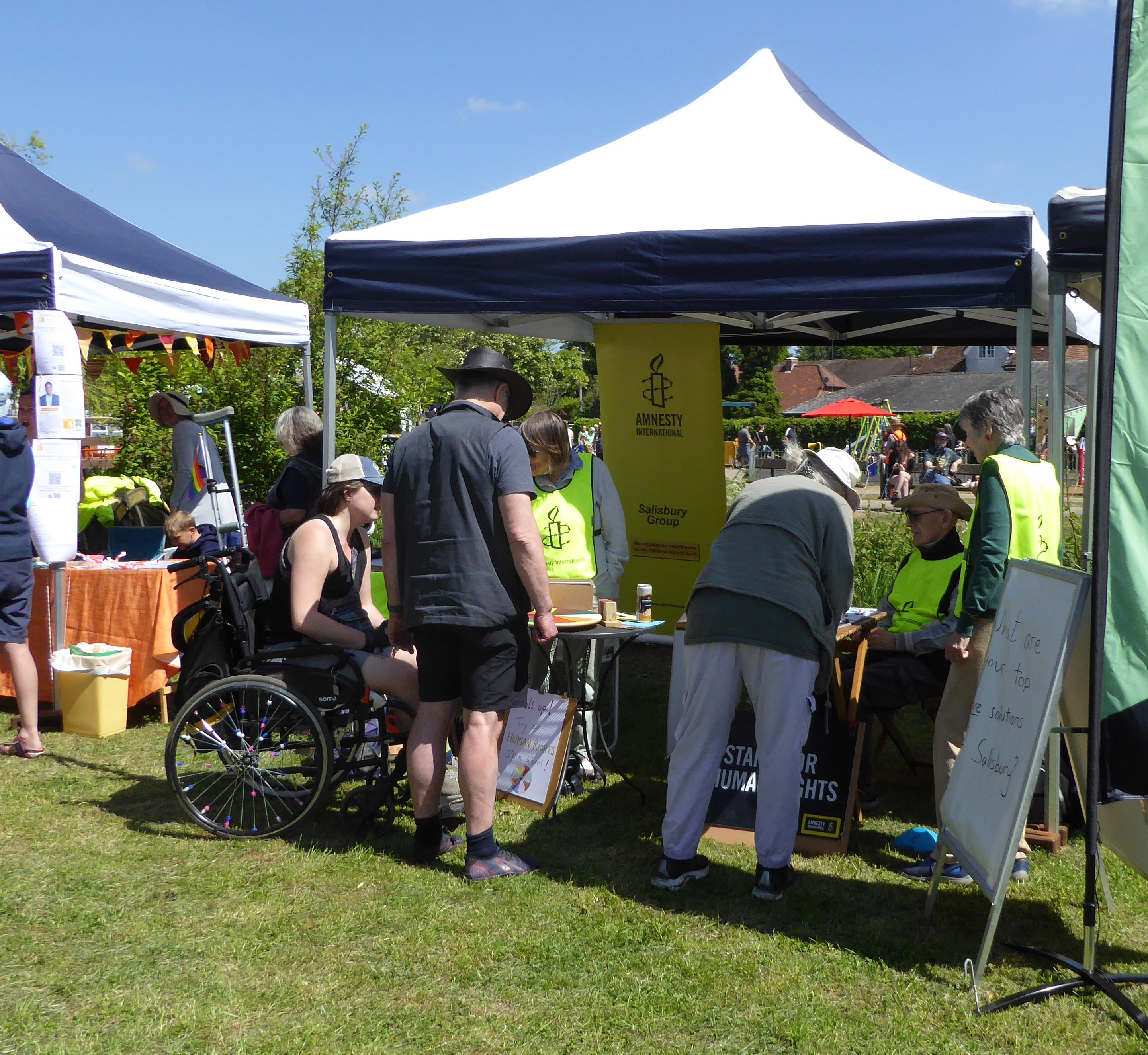
Group holding a coffee morning

June 2025

PAST EVENT

We held our coffee morning in St Thomas’s Church in Salisbury this Saturday 5th July

This is a fund raising do but it is an opportunity to meet the group if you are thinking of joining us. The issue of human rights is ever present with mass violations around the world some of which we have featured in previous posts. But it is also a rising issue in the UK with the legislation passed by the previous Conservative government curtailing various freedoms and increasing police powers to limit demonstrations, which are still on the statute book. The Labour government shows not sign of repealing them. The threat by the Home Secretary to prohibit Palestine Action is also of concern.

We look forward to seeing you.

1751706000

  days

  hours  minutes  seconds

until

Coffee morning

Why Labour Leaders Are Pushing for ECHR Revisions: A Political Analysis


Alarming stories that Labour leaders are wanting to reform the European Convention

June 2025

Alarming reports have emerged over the past few days that the current government is considering some kind of revision to the European Convention of Human Rights (ECHR). Figures such as the prime minister Sir Keir Starmer, the Justice Secretary Shabana Mahmood and the Attorney General Lord Hermer have made speeches suggesting disquiet concerning aspects of the Convention. In particular it is article 3: No one shall be subjected to torture or to inhuman or degrading treatment or punishment and article 8: Everyone has the right to respect for his private and family life, his home and his correspondence.

This story has history and the statements by politicians are more than usually disingenuous. To understand the story and the reasons for this recent slew of statements it is necessary to look at causes and why there is a clamour among politicians, some of the public and the media for change.

Stage 1the media

Much of the pressure has come from sections of the media so it is necessary to look at what is going on there. Newspaper readership has declined precipitately. Between 2000 and 2010, the decline was 65% and in the following decade up to 2020 a further 55%. Add in rising costs and declining advertising, and there is something of a crisis in the newsrooms. In this climate, it is cheaper to break into the emails, phones, bank accounts and even houses of the rich and famous, politicians and footballers to achieve a juicy front page, than to carry on the normal business of journalism.

Then came the hacking exposures and the Leveson enquiry which exposed the depth and extent of the hacking and criminal activity. It included senior police officers in the Metropolitan police in particular who sold information to the newspapers. This changed the dynamic of the industry and the notion of privacy was an anathema to their business models.

Over the last two decades there have been hundreds of stories alleging that criminals were not getting their just deserts because of their human rights either because of the ECHR or the domestic Human Rights Act. It was a ‘criminal’s charter’ they alleged. Photos of wanted criminals could not be circulated because of their human rights (they can), police could not evict an armed man until they provided him with a McDonalds hamburger because of his human rights (they could but it was normal practice to accede to requests to cool the situation). Abu Qatada was seriously misreported in the tussle over his deportation to Jordan.

Sadly, positive stories about the acts were almost entirely missing. The Daily Mail used the act to defend its journalist’s rights to protects their sources but strangely forgot to mention this to its readers.

Stage 2the politicians

Then the politicians began to join in perhaps sensing from the newspaper coverage that they were onto a popular winner. After all, if the voters were reading a never ending litany of stories about the evils of the human rights laws and Europe meddling in our affairs, it was a gift. It soon became part of the Conservative manifestos to abolish the act or later reform it. It became tangled up with the Brexit crusade and it is possible that many thought that coming out of Europe would mean that the ECHR would also be history. There was the famous cat story by Theresa May which was almost complete nonsense.

There was meant to be a Leveson part II to look at the unlawful conduct between the media and police but there were allegations that in return for a softer ride from the press, Keir Starmer agreed not to set it up. These allegations are denied. There are no plans for a part II.

Stage 3 – the boat people

As the means to arrive into the UK as a refugee or an asylum seeker diminished so the numbers who took to the boats to cross the Channel rose. This became a matter of massive political importance and the Reform party made huge progress with its promises to stop it. Media stories of asylum seekers being installed in hotels are constant. Despite boat crossings being only a small part of those coming to the UK, they loom large in the public imagination and politicians on the right have taken note of this.

The problem is that the government has obligations under the ECHR and other agreements, to treat asylum seekers in a proper way. Demands to simply ‘send them back’ are difficult to do particularly as ‘back’ can mean a county riven by war or where they can face dire consequences. But in simplistic terms human rights are standing in the way, as Mahmood says: ‘voters say international law stop them achieving the changes they want to see.

Stage 4 – the Reform party

Along came Reform and quickly began to made inroads into the political landscape. The overturning of a massive Labour majority of 14,700 in Runcorn and Helsby by Reform has shaken them badly. Reform has simple answers to matters like immigration which appeal to many and which has defeated both the Conservatives and now Labour. They would pick up boats in the Channel and return them to France. Asylum seekers would be processed off shore. These and other policies quick fix policies appeal to many and saying that they are difficult or impossible to do because of our international obligations carry little weight with many voters. They are even inflammatory particularly with those who have a deep distaste for anything European.

Stage 5 – today

So the Labour government is feeling under pressure. It has not ‘solved’ the Channel crossings problem. It has lost popularity for a variety of reasons quite apart from the discussion here. Reform is making great strides and even ahead in some polls with suggestions that Nigel Farage becoming a future prime minister was not the joke it might once have been. The Home Office remains dysfunctional and would take years to reform even under competent leadership. The party is becoming desperate to be able to counter the tide of dissatisfaction present in large parts of the kingdom particularly in the red wall seats.

So this brings into where we started and speeches about trying to reform elements of ECHR. The sadness is that they cannot. It would take years to carry through any reform in Strasbourg with little likelihood of success. If the government were to resile from either or both articles 3 and 8 would it solve its problems? Again sadly, no. The opposition to human rights laws and agreements have little to do with the people at the bottom of society so to speak. Almost no part of their speeches are about the victims of injustice which human rights are about.

As we have argued, it is sections of the media who have over decades created myths and disinformation about the workings of the laws. It is their business models which are under threat not the fate of asylum seekers. Why else would the Murdoch press spend over £1 billion in keeping the facts of its intrusion and criminality out of the courts? It is an irony – almost a supreme irony – that the much prized sovereignty that people apparently so desperately want is not in fact available to them. The Judiciary are all too happy to allow these hugely expensive legal actions to go ahead and thus subvert justice and free speech. There is no justice in any meaningful sense of the word. The rich and powerful can ‘buy’ silence by paying large sums into court that no one can afford to match.

These speeches appear to be preparing the ground at present in an attempt to match the rhetoric of Reform politicians. Instead of a proper concern for justice, establishing a Leveson II enquiry into the criminality of some of the media and their friends in the police, or tackling the rampant injustice of the defamation laws which serve to protect the rich from proper enquiry, our politicians seek to curry favour and favourable headlines in those very media outlets which have distorted the public’s attitudes to the laws which in truth protect them. The sadness is that the three politicians saying this stuff are experienced human rights lawyers who know it to be a distortion of the truth. A truly bizarre state of affairs.

Group minutes, June


June 2025

We have pleasure in enclosing the minutes of our last meeting held on 12th June with thanks to group member Fiona for preparing them.

Trade Talks with China: Ethical Dilemmas Ahead


Government has to decide: rights or trade?

June 2025

It is reported today that the government is engaged in a range of talks with Chinese officials to improve trade and political relations. The Chinese Embassy is quoted as saying that relations have ‘positive momentum’. Elsewhere, relations are described as ‘warming’. Of course both countries are suffering from the Trump tariff war and so a degree of mutual comfort is to be expected.

The fact remains that human rights in China are dire across a very wide spectrum, almost too long to describe in fact. They include no freedom of expression; atrocious and genocidal behaviour towards the Uyghurs and other Turkic peoples; Human Rights defenders who face long prison terms and torture; continuing repression in Tibet; the crackdown in Hong Kong and the execution of large numbers of its citizens – possibly equal to all the rest of the world put together. It is also aggressively pursuing overseas Chinese who criticise the country and persecutes any of their family members in China. Restrictions are getting steadily worse over time.

Azeem Ibrahim, speaking at the Humanist Convention this month, described the multi-pronged approach

adopted by the Chinese. It was a talk about the rising threat of autocracies which included Russia and Turkey. He pointed out that the country leads the world in surveillance and it has a massive programme using facial recognition technology. It is also working hard to gain access and control to international agencies in the UN for example. The Warsaw Institute describes how they use their commercial power and investments to shut down any Security Council criticisms of their human rights infringements. His basic message was that China in particular has an organised and well-funded programme to attack western values by any and all means available. He added that the West has been complacent in thinking that western values are a settled state of affairs.

So where does that leave the Labour government? It is reported to be softening its position now it is in government. Nine individuals have travel restrictions placed on them including 5 Conservatives: Ian Duncan Smith being one and Tom Tugendhat another. All because they criticised the treatment of Uyghurs. These restrictions might be lifted. The concern is that the government is desperate to achieve growth and seems willing to abandon all principles to achieve it although a trade deal is not on the cards. This site is concerned with human rights but the wider issue is western governments – like the UK – who seem very slow to wake up to the organised threat posed by autocracies like China who are determined to pursue their view of the world by all means possible.

Sources include: Human Rights Watch, Amnesty, Guardian, US Department of State, New China Human Rights.

Press Freedom Threats in Northern Ireland: Urgent Response Needed


Second of our reports points to failings in the UK

June 2025

A Threat to press freedom in Northern Ireland

Since 2019, Amnesty has documented over 70 death threats, bomb threats, and violent attacks against journalists. Most threats came from armed paramilitary gangs.  Not one has been prosecuted to date. Some reporters now live behind bullet-proof windows, reinforced doors and CCTV. Many people assume Northern Ireland’s conflict is over.  Yet some journalists are receiving more threats of serious violence from paramilitaries than ever before.

Amnesty calls for two urgent steps: a Media Safety Group – to coordinate an effective response to threats against journalists and A Home Protection Scheme – so journalists at risk can secure their homes without paying the price for doing their jobs.

Right to protest 

The EHRC was set up to “encourage good practice in relation to human rights” and “promote… protection of human rights” but it appears to be seeking to ban protests outside its offices.

“Article 11 protects your right to protest by holding meetings and demonstrations with other people”, says its website but the landlord of the Vauxhall office of the Equality and Human Rights Commission is seeking an injunction against protests outside its offices for the entire period for which the EHRC has a licence to occupy, that is until 31 January 2026.  

It would prohibit anyone (without the consent of the EHRC’s landlords) “entering, occupying or remaining upon all or any part of the commercial premises known as Tintagel House”, including on the forecourt outside its offices.  Protest may be possible on the public pavement or road outside its office – although with a risk of criminal conviction – but anyone entering the forecourt would risk imprisonment.  The application was sparked by an entirely peaceful encampment by Trans Kids Deserve Better outside Tintagel House on 30 May 2025.  Good Law Project considers this unlawful and is intervening to resist the injunction application.

Vagrancy Act Scrapped

The “cruel and outdated” Vagrancy Act is finally set to be scrapped in 2026 after making rough sleeping a

criminal offence for more than 200 years, the Labour government has announced. The 1824 law has criminalised rough sleeping and begging in England and Wales since the days of the Napoleonic Wars.  

Frontline homelessness charities have campaigned for years for the Vagrancy Act to be axed, warning that punishments, including fines, drive rough sleepers away from support.  Labour has promised it will finally be removed from law next spring and replaced with increased financial support for people experiencing homelessness and new legislation targeting “real crimes” such as organised begging by gangs.

British support for foreign security and intelligence services  

NGOs and senior MPs  have expressed concern in a joint letter to David Lammy that the Labour government’s ‘light touch’ review of policies regulating British support for foreign security and intelligence services will not remove ministers’ ability to approve UK cooperation in situations where there is a real risk of torture or the death penalty.  The policies were blamed for facilitating injustices in cases such as those of Jagtar Singh Johal and Ali Kololo.  Johal, a British human rights activist, was allegedly tortured in India, where he remains in jail, after a tip-off from UK intelligence services.  Kololo was wrongly convicted and sentenced to death over an attack on British tourists after the Met police provided assistance to Kenyan authorities.

The Mental Health Bill

This has now had its second reading in the Commons and aims to modernise the treatment of mental health. Among other things it will allow greater choice of treatment to patients, will reduce the use of detention especially in the case of autistic patients or those with learning difficulties and will address the disproportionate outcomes for black patients and those from minority groups.

UK’s legal obligations in Israel/Gaza conflict

The UK must impose sanctions on the Israeli government and its ministers and also consider suspending it from the UN to meet its “fundamental international legal obligations”, more than 800 lawyers, academics and retired senior judges, including former Supreme Court justices, have said.

In a letter to the prime minister, they welcome Keir Starmer’s joint statement last week with the leaders of France and Canada warning that they were prepared to take ‘concrete actions’ against Israel.  But they urge him to act without delay as “urgent and decisive action is required to avert the destruction of the Palestinian people of Gaza”.  The signatories, including the former Supreme Court justices Lords Sumption and Wilson, court of appeal judges and more than 70 KCs, say that war crimes, crimes against humanity and serious violations of international humanitarian law are being committed in Palestine.

More than 300 Foreign Office staff have been told to consider resigning if they cannot support the government’s policy on Israel, after they repeatedly expressed concern that the UK could be viewed as complicit in war crimes.

The UK government has now sanctioned Israeli government ministers Itamar Ben-Gvir and Benzalel Smotrich in response to their repeated incitements to violence against Palestinian communities and, in partner with Australia, Canada, New Zealand and Norway, calls for immediate action against extremist settlers.   

British man held in Egyptian prison


Abd El-Fattah remains in prison despite being unlawfully detained

June 2025

The case of the British citizen Abd El-Fattah is gaining more publicity and his mother, who has been on hunger strike for 245 days, has just been admitted to a London hospital as her medical condition is now critical. The Egyptian government has behaved atrociously throughout and has denied consular access to him in breach of the Vienna Convention. Appeals by the current and previous prime ministers and the Foreign Secretary have been ignored.

Mr Fattah’s ‘crime’ was to mention that someone was tortured in an Egyptian prison and his campaigning

for human rights in the country more generally. He established the Adalah Center for Rights and Freedoms. He is held in very poor conditions in Tora Maximum Security 2 Prison in Cairo (pictured). He is in an airless cell, denied a bed or mattress, not allowed to exercise and is not allowed books or other reading material.

Egypt continues to crush dissent and stifle civil society, arbitrarily arrests thousands including journalists, opposition politicians and peaceful protestors.

His case was debated in parliament in December last year initiated by John McDonnell MP. The Parliamentary Under Secretary John Falconer said:

I re-emphasise, both to Alaa’s family and to the House, that his release remains a priority for the UK Government. I recognise the profound impact that his imprisonment has had on him and his family. The Government, and I as the Minister responsible, are doing all we can to find a resolution. Our priority remains to reunite him with his family, and until that happens, we are working to ensure that he is allowed consular access and support. As I said earlier, supporting British nationals overseas is at the heart of our work at the Foreign Office. That includes dual nationals and more recent British nationals such as Alaa.

Amnesty and two dozen human rights groups have campaigned on his behalf but to no avail. There seems no likelihood of his release since sentences in Egypt are simply rotated. He has been incarcerated for 10 years now. Alaa is part of the Middle East problem more generally and Egypt is seen as important in the issues surrounding Gaza (on its border) and with Iran. The government has been urged to consider sanctions or tougher action but is clearly reluctant to do so. The current Labour government, with its emphasis on growth, is unlikely to take actions which would limit that. The result is that he remains in prison for the foreseeable future. We hope his 69 year old mother, Laila Soueif, survives her ordeal.

Recent posts:

Court Decisions Impacting Protests and Gender Rights in the UK


Significant number of things happened this month

May 2025

There were a number of interesting events on the human rights front in the UK this month including the Court of Appeal judgement discussed below. There has been a steady ‘nibbling away’ of rights by successive governments which is why we have started this series of reports of which this is the second and why the judgement is good news.

Right to Protest 

This month the Court of Appeal has upheld an earlier ruling of the High Court from May 2024 that then Home Secretary Suella Braverman did not have the power to create a new law that lowered the threshold of when the police can impose conditions on protests from anything that caused ‘serious disruption’ to anything that was deemed as causing ‘more than minor’ disruption. They said that “the term “serious” inherently connotes a high threshold … (and) cannot reasonably encompass anything that is merely ‘more than minor’”.

This was the first time a government had sought to make changes through so-called ‘Henry VIII powers’ of secondary legislation to a law which had been democratically rejected by Parliament when introduced in primary legislation.

Hundreds of protesters have been arrested under these measures since they were created, including the

climate activist Greta Thunberg (pictured: MusikExpress) who was acquitted of all charges in a hearing in February 2024.

Liberty has called for the regulations to be quashed immediately (as per the initial ruling from the High Court, whose decision to scrap them was put on hold until the conclusion of the appeal) and has called for all arrests and prosecutions under the legislation to now be urgently reviewed, alongside a comprehensive review into all protest laws that have been passed in recent years.

The Court will decide in the coming weeks if the legislation is to be quashed.

Gender Recognition Ruling

Five judges from the UK Supreme Court ruled unanimously that the legal definition of a woman in the Equality Act 2010 dealt with biological sex at birth and did not include transgender women who hold gender recognition certificates.

In a significant defeat for the Scottish government, their decision will mean that transgender women can no longer sit on public boards in places set aside for women and it will have far reaching implications for access to protected spaces and services such as the armed service, hospitals, women-only charities and changing rooms and access to sport.

Lord Hodge told the court the Equality Act (EA) was very clear that its provisions dealt with biological sex at birth, and not with a person’s acquired gender, regardless of whether they held a gender recognition certificate.  In a verbal summary of the decision, he said: “Interpreting sex as certificated sex would cut across the definitions of man and woman in the EA and thus the protected characteristic of sex in an incoherent way.”  He stressed that the ruling does not change the protection trans people are afforded under the protected characteristic of ‘gender reassignment’ under the Equality Act.  Amnesty has called the decision ‘disappointing’.

Humanist Rights

Two couples are taking the government to court over its failure to legalise humanist marriage in Wales and England, five years after a ruling that the lack of recognition was discriminatory. Humanist marriages are legal in Scotland and Northern Ireland, and elsewhere in the world including New Zealand, Canada and Australia.  In Scotland in 2022 there were 9,140 humanist wedding ceremonies compared with 8,072 based on faiths or other beliefs.

Activists Detained

Non-violent activists Roger Hallam and Dr Patrick Hart are being refused their right to a Home Detention Curfew.  Days before their scheduled release from prison in March Dr Hart was told that there was ‘no suitable accommodation’ and Hallam that the media’s interest in his case meant that he was deemed unsuitable for HDC (which actually states that non-violent prisoners can only be denied release ‘in exceptional circumstances’). New release dates are respectively June and possibly August. There will be an appeal.

The Counter Terrorism and Border Security Act of 2019

This was invoked by police at St Pancras rail station for detaining a Palestinian-British Christian academic and his 8-year-old son on their return from Paris on Good Friday. Professor Makram Khoury-Machool (pictured: BBC Arabic Service) is a Palestinian-British Christian academic who has lived in the UK since 1999 and taught in Cambridge since 2004.  He is the founder of the Cambridge Centre for Palestine Studies whose board members and patrons include Dr Rowan Williams, Baroness Helena Kennedy, Baroness Sally Morgan, Lord Chris Smith, HE Clare Short, Baroness Warsi and Lord David Steel.  

He and his son were held over 4 hours until after midnight, were given no food while the police took his fingerprints, DNA samples, searched his personal belongings and confiscated his laptop and mobile phone using the threat of force.  Seven days later, the devices were returned but without his SIM card.  He was subjected to an intimate body search, and his son was left traumatised by the experience.  This is perhaps the first time a child as young as eight has been detained in the UK under the 2019 Act; his treatment may breach the UN Convention on the Rights of the Child to which the UK is a signatory.

Economic, Social Cultural Rights

Amnesty reports that in the UK there is no legislatively defined universal social protection floor such as the one recommended by the UN’s International Labour Organisation: this is left to the discretion of the state and is inconsistent across Great Britain and Northern Ireland.  The changes proposed by the Pathways to Work Green Paper 2025 will require new legislation allowing the secretary of state to implement proposed cuts to social security rates for disability and incapacity schemes, and removing some of the legislative protections which are in place to protect against political whims.

If implemented, Amnesty considers the extensive reforms proposed would be a deliberately discriminatory, disproportionate and retrogressive violation of human rights;  The UK’s social security system does not legally guarantee essential social security payments that ensure access to basic needs such as healthcare, housing, food and education and that social security freezes, caps, and deductions, removal of the spare room subsidy (bedroom tax) and two-child limit have deepened poverty and disproportionately harmed children, the disabled and low-income families. Despite increased social security spending, poverty rates remain unacceptably high.

Recent posts:

Arms trade news


Grim reading in Campaign Against the Arms Trade’s latest newsletter

May 2025

The CAAT Newsletter (Spring 2025, Issue 272) has details of what’s happening in the world of arms sales a world in which the UK is a big player. Our previous post discussed the continuing sale of arms to Israel which is subject to an Appeal Court hearing starting on 13th. Also we mentioned the role of the RAF in carrying out hundreds of flights over Gaza and quite what is being done with the information gleaned is not revealed.

Arms sales are important for several reasons. Weapons have an enormous capacity to do great harm in the wrong hands. Governments need to exert great control over licensing to ensure that arms do not fall into such hands. British governments are frequently to be heard claiming it exercises ‘robust’ controls. It is doubtful that this is the case and CAAT have often noted the considerable use of open licences which means little effective control exists.

The current Labour government has a policy of growth which seems to dominate thinking. As the court case will reveal, and papers have already revealed, this seems to trump considerations of human rights. CAAT News has the following examples:

  • The Defence Secretary has held meetings with counterparts in Saudi Arabia and Turkey to discuss opportunities for expanding military cooperation which is likely to involve arms sales. Both countries have woeful human rights records. Saudi has a full array of violations including public executions, use of torture, restrictions on women’s rights and repression of any opposition or free speech. Turkey has carried out baseless prosecutions against journalists, human rights defenders and opposition leaders, thousands of whom are in gaol.
  • Eurofighter sales – which the UK co-produces – are planned for Qatar and Turkey. The latter is involved in bombing Kurdish groups in its own country and Iraq. Qatar is another repressive Gulf state and is highly corrupt.
  • We have noted before the question of the Revolving Door where politicians, ministers, senior civil servants and military personnel leave their posts and head off for lucrative appointments/directorships/consultancies with arms firms. It is an open invitation for corruption and the ACOBA system seems powerless to stop it. The Aerospace, Defence and Security Group, (ADS) the trade body for the defence industry representing all of the major arms makers, holds an annual dinner at the Grosvenor House Hotel in which, in the words of CAAT ‘The dinner’s purpose is to introduce them to one another and allow them to schmooze and entertain their powerful friends from Parliament and the Civil Service‘ … These kinds of dinners are where relationships are formed and built and where the next round of arms deals are made, over fine food and wines.’
  • And it doesn’t end there. The Defence and Security Equipment International (DSEI) resumes in September at the ExCel Centre in London. This may be the largest such exhibition in the world. It is popular because the UK government invites representatives from a wide range of countries including those with appalling human rights records, some even on its own watch list. The thousands of attendees will be met by ‘a cast of compliant senior civil servants and politicians on hand to make sure things run smoothly’ (CAAT).
  • … or even there because the Farnborough International Exhibition and Conference Centre is to host Security and Policing run by the Home Office. Again, a range of countries with dreadful human rights are cordially invited to view the latest in surveillance, tear gas and ammunition. Journalists are banned. Britain seems happy to be host to regimes who use this equipment to repress and intimidate oppositions, journalists or human rights people.
Growth or rights?

The government seems keen to actively support these activities and to do all it can to promote arms and surveillance equipment to repressive regimes. It does this while piously claiming that:

This Government is fully committed to the protection of human rights both at home and abroad. We are committed to the international human rights framework and the important role that multilateral organisations like the Council of Europe play in upholding it. (Ministry of Justice, November 2024, ref: CP 1192)

It is hard to square the multi-level activities to promote arms sales and in the process currying favour with some of the world’s worst regimes, with their stated desire to be upholders of human rights and the wellbeing of those at the end of it all. While politicians, civil servants, military brass and ministers ‘schmooze’ with the arms manufacturers in expensive London hotels, it may be hard for them to empathise with those who have been bombed, starved, driven from their homes or incarcerated, tortured or executed for no reason. All facilitated by the weapons and equipment they so admire whilst quaffing the Bollinger. Is it growth above all else?

Sources include: CAAT, The Canary, Amnesty

Human Rights report


New report the group is launching

April 2025

Amnesty began by focusing on human rights in other countries. This was probably based on the belief that rights in the UK were secure, we had after all, the Magna Carta, a justice system and things like torture ended several centuries ago. The UK was a key player in introducing the Universal Declaration in 1948. With the arrival of the European Court, it soon became clear that not everything in the UK human rights garden was rosy. The Birmingham Six case was a classic example of a failure to treat the six defendants fairly. The police fabricated evidence, the six were badly beaten in custody, the courts and judges manifestly failed, the forensic evidence was a nonsense. Eventually they were released – not because the justice system worked to correct its mistakes – but because of the dogged work of Chris Mullins, an MP and journalist.

In the recent decade and a half, there has been a long-lasting campaign, largely led by some newspaper groups, to denigrate the Human Rights Act and to claim that it is a ‘terrorist’s charter’ and allows serious criminals to escape justice because of allegedly spurious arguments provided by their human rights. This has been echoed by the Conservative party who have variously claimed to want to abolish or reform the act. We can remember the nonsense claim by Theresa May that a Chilean man could not be deported because of his cat.

Human rights therefore are by no means secure in the UK. Legislation introduced by the last Conservative government limiting the right to protest and increasing police powers, together with the remorseless increase in the use of surveillance technology, shows no sign of being annulled by the current Labour government.

Hence we feel the need to focus on our rights here in the UK and the slow but steady attempts to limit or curtail them.


Funding for victims of trafficking

The High Court has declared that denial of Exceptional Case Funding to four victims of trafficking to access legal advice to prepare an application for criminal injuries compensation breached their rights under Article 6 ECHR.

Military Misogyny 

A coroner has concluded that the UK government may have breached a young soldier’s right to life by failing to protect Jaysley Beck from a sexual assault by a more senior colleague and from sustained unwelcome sexual attention from her line manager.

Deaths in custody

More than 100 relatives of people who have died after contact with the police in the UK since 1971 have joined plans for a class action lawsuit in pursuit of compensation and justice.  At the People’s Tribunal on Police Killings, bereaved families presented evidence to a panel of international experts on how their relatives died and the long-term impact this has had on them.  The findings and conclusions of the event will form the basis of a first-of-its-kind legal action directed at police officers, police chiefs and government departments involved in the deaths.         

Economic, Social, Cultural Rights

Claims by Amnesty and Human Rights Watch state that the UK faces a cost-of-living crisis which has yet to be addressed by policies that safeguard the economic, social and cultural rights of people from low-income households, particularly their rights to food, housing and social security.

Freedom of Expression 

Following last year’s criticism of the UK by the UN special rapporteur on environmental defenders, the High Court concluded that anti-protest measures introduced in 2023 – allowing authorities to clamp down on any protests deemed ‘more than minor’ disruptions – unlawfully restricted protest.  The Labour Government has yet to repeal these repressive laws and is choosing to continue the legal challenge against the High Court ruling brought by the previous government.

Environmental Protest Sentencing 

Gaie Delap (pictured), retired teacher, Quaker and climate protester has finally finished her sentence. 

Her detention was notoriously extended when prison authorities could not equip her with a curfew tag bracelet.  She said: “I think around 80% of the women I met should not have been in prison.  Help with problems such as mental health, addiction and housing would have been more useful.” 

This week the Court announced its ruling to uphold most of the harsh sentences of the ‘Walney 16’, jailing the group for a combined total of 35 years (originally 41) for peaceful protest.  Global Witness say that the UK is at risk of becoming one of the world’s most repressive governments when it comes to policing climate protest, arresting campaigners at three times the global average. Lawyers for the protesters, backed by campaign groups Greenpeace and Friends of the Earth, argued that the sentences were disproportionate and violate the UK’s obligations under human rights law, including articles 10 and 11 of the European Convention on Human Rights and article 3(8) of the Aarhus Convention.

On 25 March prescriptive policing led to the arrest of six Youth Demand members as they met in a London Quaker House.  The civil disobedience group has protested new oil expansion and UK arms to Israel.  Quakers (not allied with the group) have protested at the police raid on their premises. 

Open Justice 

Apple is taking the unprecedented step of removing its highest level data security tool from customers in the UK, after the government demanded access to user data, citing powers given to it under the Investigatory Powers Act.  After reluctantly pulling ADP from the UK, Apple has now launched legal proceedings against the government who argued it would damage national security if the nature of the legal action and the parties to it were made public.  However a judge has sided with a coalition of civil liberties groups and news organisations – including the BBC – and ruled a legal row between the UK government and Apple over data privacy cannot be held in secret. 

Sources: BBC News; The Guardian; Global Witness News; Doughty Street Chambers; Human Rights Watch; Amnesty.

Blog at WordPress.com.

Up ↑