#MagnaCarta


UPDATE:  Where to obtain tickets for 12 March now at the end of that item.

Our group is planning a number of events to mark the 800th anniversary of the signing of Magna Carta.  We have been working with the Cathedral in Salisbury which has one of the surviving copies of the document.  Our focus will be on its relevance to the present day and in particular, the Human Rights Act #HRA and its place in modern politics.

We have several projects planned and we will update these pages as time goes on.  But for the moment, this is a brief introduction to what we have planned:

  • A standing display in the cloisters of the Cathedral outside the Chapter House where the Magna Carta is kept.  This will
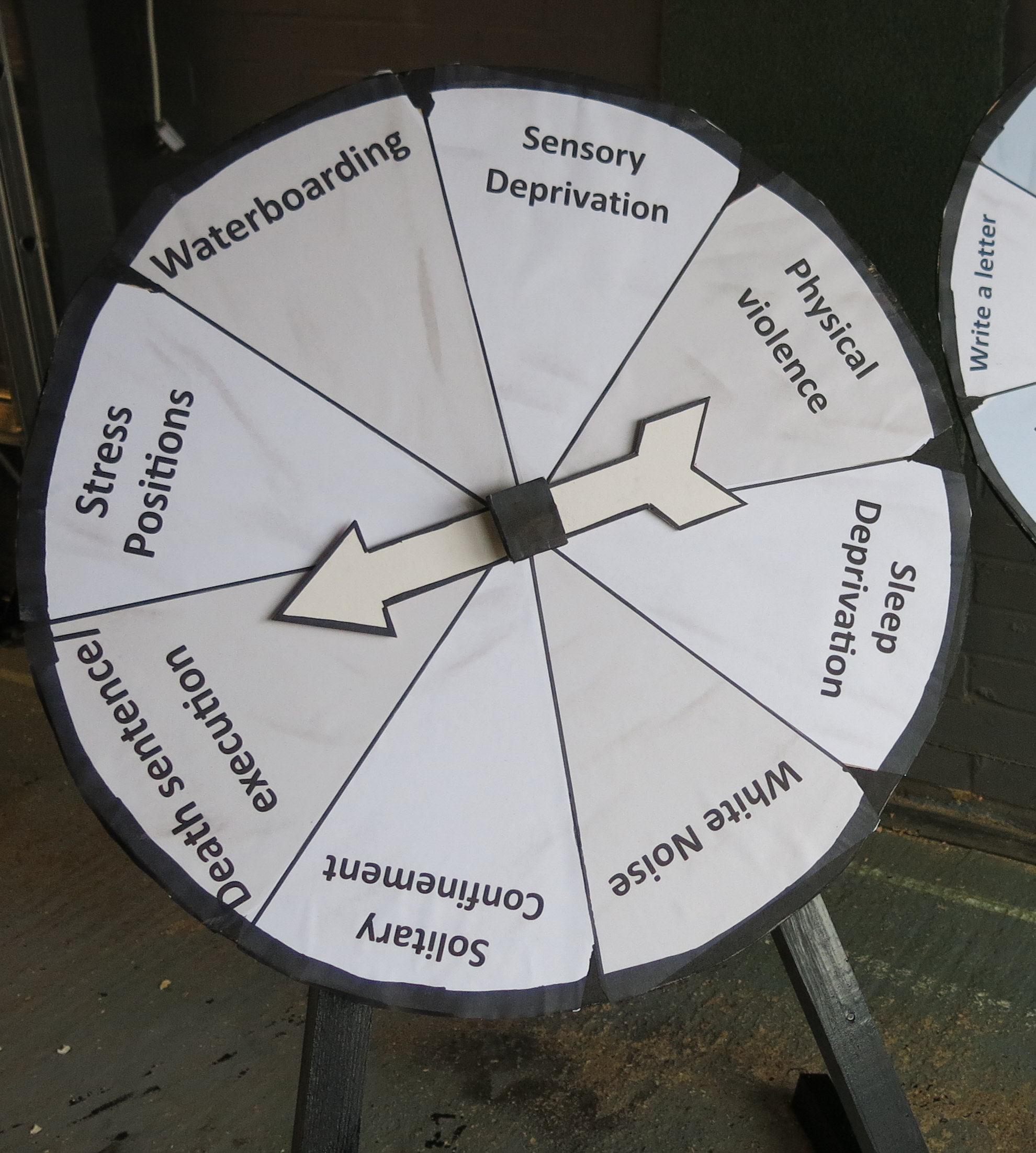
    Torture wheel
    Torture wheel

    feature images to illustrate the #StopTorture campaign and will have the torture wheel, based on the one used by the Philippine police.  In case you have not come across this, it is a wheel on which the various methods to torture their victims are displayed.  They then spin the wheel to decide on which one to use.  This display will be set up in March and will run for at least a month.  To read more about the torture wheel follow this link.

  • On 12th March at 7pm we will be delighted to welcome Dominic Grieve QC MP who will speak on the relevance of the Human Rights Act today.  In June 1999 he was appointed Conservative spokesman for Scotland and in September 2001 the Conservative spokesman for criminal justice and community cohesion as part of the Shadow Home Affairs team.  From 2003 to 2009 he was Shadow Attorney General.
    Dominic Grieve QC MP
    Dominic Grieve QC MP

    Under the coalition Government Dominic Grieve became a Privy Counsellor and appointed the Attorney General for England and Wales and the Advocate General for Northern Ireland and he held that post until July 2014.

    He has spoken often on human rights matters arguing that despite the Conservative leadership’s recent announcement of fundamental change to both the HRA and the national relationship with the ECHR, there is much that remains undebated and misunderstood about both. 

    He will try therefore tonight try to lay out reasons why – while not free of imperfections – the ECHR and its direct application in our law through the HRA is of enormous benefit to our country and our collective wellbeing.  He is determined that this argument can and must be made with some passion because he believes that it goes to the heart of our identity as a nation and of our national interest.

    It will be an interesting talk and will follow the annual Choral Evensong in aid of Amnesty in the Cathedral.  Tickets: apply to magnacartaevents@salcath.co.uk.


    In the summer on 15 June, we are planning, with the Playhouse, an event where an actor will read selected passages from the Charter and then a panel of guests to discuss their significance.  The guests are likely to be Kate Allen, the Director of Amnesty UK, Prof Guy Standing author of The Precariat and writer and researcher, Ben Rawlence.  This will be in the afternoon so it’s a date for the diary at present.  Details will be both here and at http://www.salisburyplayhouse.com.

    On the morning of the 15th, there will be a 6th form conference involving local schools and Kate Allen has been invited to that.

Film, Omar


Last night the Salisbury Arts centre hosted the film #Omar in the fourth of our collaborations with the Centre.  The film is a gripping story of love and betrayal in the occupied territories of Palestine and shows the grim realities of life for Palestinians living there.  Many people signed our cards at the end of the showing which concerned five individuals at risk of, or who have been, tortured (but not in Palestine).  A total of 103 were signed.

Several people expressed interest in the group and may come here to find out about us.  Details are to be found in the ‘About Us’ tab and we look forward to seeing you again.  ‘Every little helps’ is true and if you are able to help now and again at our events that is always appreciated.  From time to time we post urgent actions and if you can find time to write that is also a help.

We are possibly entering a difficult time as far as human rights are concerned with a concerted attack on the Human Rights Act by sections of the media.  It is fuelled often by misreporting of cases and the almost complete absence of reporting of the benefits the act has brought for ordinary people.  Hence the myth has become established that it helps terrorists, mass murderers and the like and it is all to do with the European Union imposing their beliefs on us.  The Conservative government have said they would like to abolish the act and replace it with a new version.

Human Rights Act


There will be much more on the plan by the Conservatives to abolish the #HRA if they get re-elected.  But for now, just a single thought.  The whole exercise is predicated on sovereignty.  Allegedly, Strasbourg is preventing our parliament and its MPs from doing what they are elected to do, thus denying it sovereignty.  But the proposal is to abolish the act.  So they can either abolish the act, that is they have sovereignty, or they cannot because the don’t.  It seems they are going to abolish it so they do.  So why do they need to abolish it?  Answers on a postcard please.

David Cameron’s speech


October 2014

In his speech to the Tory party conference today, the prime minister David Cameron pledged to get rid of the Human Rights Act #HRA and replace it with a British Bill of Rights.  Problem?  Where is it?  A bit like Lewis Carroll’s snark, it is often spoken of but never actually seen.  It has been talked about off and on for around 7 years now but it still hasn’t seen the light of day.

David Cameron Photo, BBC
David Cameron
Photo, BBC

Second problem: how will it be any different to the HRA it will replace?  It will presumably contain many of the clauses about fair trials, no torture, knowing what one is accused of, no slavery, arbitrary arrest etc. etc. that are contained in the HRA.

It is likely that the ire is directed at some individual cases which get the tabloid press in a stew such as Abu Qatada.  The issue here of course was that he could not be deported because it was likely that either, he would be tortured or, evidence gained by torture would be used against him.

The problem is the same as it always has been with the act.  It is European and in the fevered atmosphere of anti-Europeanism stoked up by Ukip, anything from Europe is a bad thing.  The second problem is the media – or sections of it – who dislike the act and print all manner of misinformation and disinformation about its rulings.  They don’t like it because the question of privacy has a higher standing under the act than they would like.  As we have seen with News International – and are beginning to see with the Mirror Group newspapers – newspapers are sold by penetrating the private lives of the famous by a variety of dubious and illegal means.

The benefits of the act, such as that reported today of people in Essex who were able to use it to take action against the police, are seldom reported.

Unless we pull out of the Council of Europe, we will still be subject to the rulings of the European Court.  It is strange to report that with all the venom and anger directed against Strasbourg nearly 99% of cases applications against the UK are struck out.  That is because we have good legal systems here.  The HRA was brought in to stop the trail of people having to go to Europe to get justice.

European Convention on Human Rights


Dominic Grieve was sacked by David Cameron in the last reshuffle and it was widely interpreted as a clearing of the decks by the prime minister of supporters of the Human Rights Act #HRA.  Grieve has now spoken on the issue and below is a link to the interview in the Guardian newspaper.

In an earlier piece, Dominic Grieve expressed his dismay that David Cameron had narrowed the range of views held by his senior team. The attorney general sacked by David Cameron over his dogged support for the European convention on human rights (#ECHR) says he fears the prime minister will use this week’s party conference to dilute the UK’s commitment to the international treaty.

The Conservatives have misgivings about the act partly because of their distaste for things European.  There has been a concerted tabloid campaign against the act and the ECHR because allegedly it gives rights to criminals and terrorists.  The benefits of the act to ordinary people is rarely given a mention however. They also publish a great deal of misinformation which is seldom corrected.

Readers may like to look at an earlier post following a meeting the group had with the Salisbury MP, John Glen.  He has said he wants to see the HRA abolished but after some of the benefits of the act for ordinary people – including some of his constituents – were explained, he did agree to be more balanced in future.

Guardian article


Meeting: update


UPDATE: The full minutes are now available here

September minutes

We held our monthly meeting on 11 September and a number of items were discussed some of which will be separately posted [P].

  • the treasurer reported we had around £334 in the bank.  The funds promised from one of the school groups have not arrived

    Amnesty logo
    Amnesty logo

    however and he will chase this up

  • North Korea.  We have a speaker – Bona Shin – for the November meeting so we will hold it in Sarum College [P].
  • Lesley presented the death penalty report which will be separately posted.  Executions continue apace in Saudi Arabia, Florida and Texas [P].
  • Peter gave an update on progress with the Magna Carta celebrations next year and said that we have held our third meeting with Seif at the Cathedral and arrangements were proceeding well.  Caroline was hoping to prepare tapestry with all the regional groups contributing a panel each to illustrate an aspect of the Human Rights Act.  Fiona is working with S Wilts on the idea of a film.
  • Cathedral service.  Jonathan will liaise with the Praecentor about dates and a speaker.
  • there is to be a coffee morning on Saturday 20 September in St Thomas’s starting at 09:30.
  • the second Citizenship day is to be held next month on 23 October run on similar lines to last year.  There is to be a repeat of the competition with 3 prizes totalling £100 from a supporter.  Peter is to contact the sixth form colleges and schools in the area [P].
  • the forthcoming campaign against torture stall was discussed and will take place on 15 October in the Cheese Market [P].
  • the film will take place again on 4 December at the Arts Centre and will be on the subject of Palestine.  The speaker is Samiha Abdeljebar [P].

Full minutes will be posted soon.

Prisoner voting


After a decade of argument, the European court of human rights #ECHR has decided that the 10 prisoners denied the vote should not be paid compensation for the infringement of their article 3 rights to vote.  It did decide that the government is in breach of the convention.

This is a debate which has generated a lot of heat and a great deal of passion.  The prime minister David Cameron said that prisoners ‘damn well shouldn’t [get the vote]’ and previously was quoted as saying the idea made him feel ‘physically sick.’  It was a topic which came up with the local group’s meeting with John Glen the MP for Salisbury.

It seems that politicians have difficulty in understanding what prison is for.  Someone commits a crime and the court decides that a custodial sentence is appropriate.  There are two purposes to this: to deprive the person of their liberty as a mark of disapproval by society for the crime they have committed.  Then we want to rehabilitate them into society.  Unless we want everyone to go to prison for ever, then with a very few exceptions, they will be back into society.

It therefore makes sense as part of this second purpose that prisoners be allowed the vote.  In a small way it would help facilitate their entry into society.

See the South Region site of Amnesty International


July meeting minutes


The minutes of the July meeting are available, with thanks to Karen.  Remember all recent minutes are posted on the About us tab.

Meeting with John Glen MP: update


The Salisbury group invited John Glen MP to speak to the group following his comments in the Salisbury Journal that – in common with other MPs, the Prime Minister and the Home Secretary Teresa May – he would like to scrap the Human Rights Act [HRA] #HRA.  The Conservatives in their election manifesto had said they wanted to enact a Bill of Rights [BoR] and appointed a Commission to review the matter.  It failed to reach an agreement and there the matter has rested with no current work being done to draft a BoR.  Nevertheless, there is still political agitation to abolish the #HRA.  A key theme of the evening was trying to determine what would the difference be between a new Bill of Rights and the existing HRA.  In other words what would be included and what left out.

Andrew – chair of the local group – welcomed Mr Glen who began by saying he was a keen supporter of human rights.  He was a member of The Westminster Foundation for Democracy and had recently visited Iran, Egypt and the Maldives.  In the first two countries he discussed the plight of Christians with the authorities.  He had recently asked a question* in the House of Commons concerning the Israel/Palestine conflict.

As far as the HRA was concerned the main issue was the question of the interaction with the European Court: Strasbourg [rulings] should be taken into account, not be binding.  A proposal for a British BoR will possibly be in the party manifesto.  He was concerned about some of the claims made using the act and he mentioned the issue of equipment in Afghanistan.  Various points were put to Mr Glen by members:

  • The HRA was passed into UK law to enable claims to be made in this country and to reduce the need to go to Strasbourg. JG said this may have been the intention but was not always the case in practice
  • If a Bill of Rights is to be introduced, how would it in fact be different from the HRA as it is?
  • The HRA was of enormous benefit to ordinary people – some of whom are [your] constituents. For example, art. 8 protects the elderly and vulnerable. The problem is made worse for many by the reductions in legal aid.  JG said he saw people every day with these problems and he was not happy with the Justice reforms.  But he was concerned at perverse outcomes and it needs the will of Parliament.  It was pointed out that the HRA was by will of Parliament.
  • He was asked if the point of a BoR was to fetter the judiciary and again, how will it be different from the HRA?


  • It was reported that Strasbourg was concerned at the risk of the UK abandoning the HRA.  As we (the UK with France) were the countries behind the original convention, it would concern them if we turned our back on it. The convention had had enormous beneficial effects in Russia and Belarus who might be less keen to change if we were not there. It was also pointed out that the FCO web site was a keen supporter.  JG said that without knowing what would replace the act this was a hypothetical question.
  • The point was made several times that the positive effects of the act and the cases which fail in the courts, rarely receive publicity. JG agreed with this point. For the most part, there was an anti-attitude fostered by the tabloid press. JG said he was not following a tabloid agenda. He had to read them to know what would be in his post from constituents. He felt had demonstrated his commitment to human rights through his overseas work.
  • Prisoner voting rights were a topic that caused a lot of anxiety. Would it not be appropriate to allow prisoners the vote towards the end of their sentences to help prepare them for re-entry into society?  JG talked about the importance of education in prisons.  He was reminded that funding had been cut for this.

In conclusion, he said he would reflect on the problem of a lack of balance in the public dialogue.  He will also consider how refinements to the HRA might obviate the need for a Bill of Rights.

Group members were no clearer on what would be the difference between a Bill of Rights and the HRA but welcomed Mr Glen’s statement that his comments on the latter would be more balanced in future.

UPDATE

Reported on 17 July that the Conservatives are planning to introduce a British Bill of Rights in their manifesto.

View the South region site of Amnesty International

*John Glen’s question in the House:

Hansard question 1 July


Ken Clarke’s warning


Ken Clarke MP resigned as a minister in the Government at his own request yesterday and issued a parting warning to the Conservatives on the European human rights convention #ECHR.

In a strong warning to his party, he said: “I personally think it is unthinkable to leave the European convention on human rights. It was drafted by British lawyers after the second world war to protect the values we fought the war for. Now it is a long way from the war, but members of the European council covered by the convention include Russia and Belarus and so on.  It is the way we uphold the values we strive for which are the rule of law, individual liberty, justice for all, regardless of gender. The convention is the bedrock of that.”

He added: “A slightly absurd debate takes place in this country.  We are occasionally taken to the European court in Strasbourg but we win 98% of the cases because of our human rights record.  We only lose 2% of cases and all these mad mullahs that the press love to vilify and blame for our terrorist problems – which is a somewhat uncomplicated way of analysing the situation – are thought to win in Strasbourg.  Well, we have won all the cases in Strasbourg.

Source: Guardian

http://www.theguardian.com/politics/2014/jul/15/ken-clarke-exits-human-rights-warning-tories

View the South region site

Blog at WordPress.com.

Up ↑