UK government signals change re: Israel


New Foreign Secretary indicates tougher approach to new settlements

September 2026

Ed Miliband, the Foreign Secretary has stated in the Commons that the government is prepared to adopt a tougher approach to the proposed new E1 settlement on the West Bank. This highly contentious development is particularly important because it splits the area into two parts thus making any prospect of a viable Palestinian state near impossible.

Israel has just issued tenders for the development of part of the project consisting of around 1,200 homes covering some 4.5 sq miles. Miliband joins a number of other states criticising Israel including Germany which has up to now, been a firm supporter. The UK has joined around 20 other countries and the European Union claiming the development to be unacceptable.

Government ministers have been under increasing pressure to take a firmer stance in relation to Israel. Andy Burnham has apologised for the previous stance of the Labour government. The ever increasing settler violence as well as the destruction of great swathes of Gaza is becoming harder to ignore politically. The encroachment is increasing all the time with over 60% of the land under Israeli control. There are now 2 million Palestinians living in an area of 150 sq km. This is approximately the same area as Havant in Hampshire which has a population of 127,000.

The Israeli embassy has referred to previous comments by the Ambassador saying ‘If Britain acts against the state of Israel, the state of Israel will act against Britain. We have the tools.” The Jewish Chronicle repeated this warning.

Erasure

Amira Hass, writing in the Ha’aretz newspaper (September 1st) quoting the opposition leader Gadi Eisenkot says:

Erasure is the nightmare solution being written into reality every day. Knesset laws, politicians’ declarations, military orders, school textbooks and the holy real estate battalions operating in Gaza, the West Bank and the Negev all work, together and separately, to advance this “solution” diligently and without fear of international condemnation.”

Some argue that genocide, and the elimination of all Palestinians from Israel, has always been the policy of the government. As the Jewish writer Omar Bartov writes:

” […] for the past two years Israel has engaged in a genocidal operation in Gaza and all the indications are this was part of an intentional policy consistent with political and military rhetoric meant to “encourage” Palestinians to leave the Strip altogether (p 190)” [1]

The theme of the elimination of all Palestinians is amply described in the Jewish academic Ilan Pappe’s book The Ethnic Cleansing of Palestine [2]. He notes that right from the start, Ben-Gurion led the Zionist movement to achieve ‘absolute Jewish domination’ of Palestine (p23 ff).

The grim toll of death continues in Gaza with the death toll now put at over 73,000, including 12,500 women, over 20,000 children and 174,500 injured.

The change in stance by the UK government is welcome. As the Ha’aretz article notes, the overwhelming military power possessed by Israel courtesy of the USA, has led it to pursue violent and military solutions. We are rapidly approaching the horrific October 7th massacre with no end of hostilities in sight.

Vigil

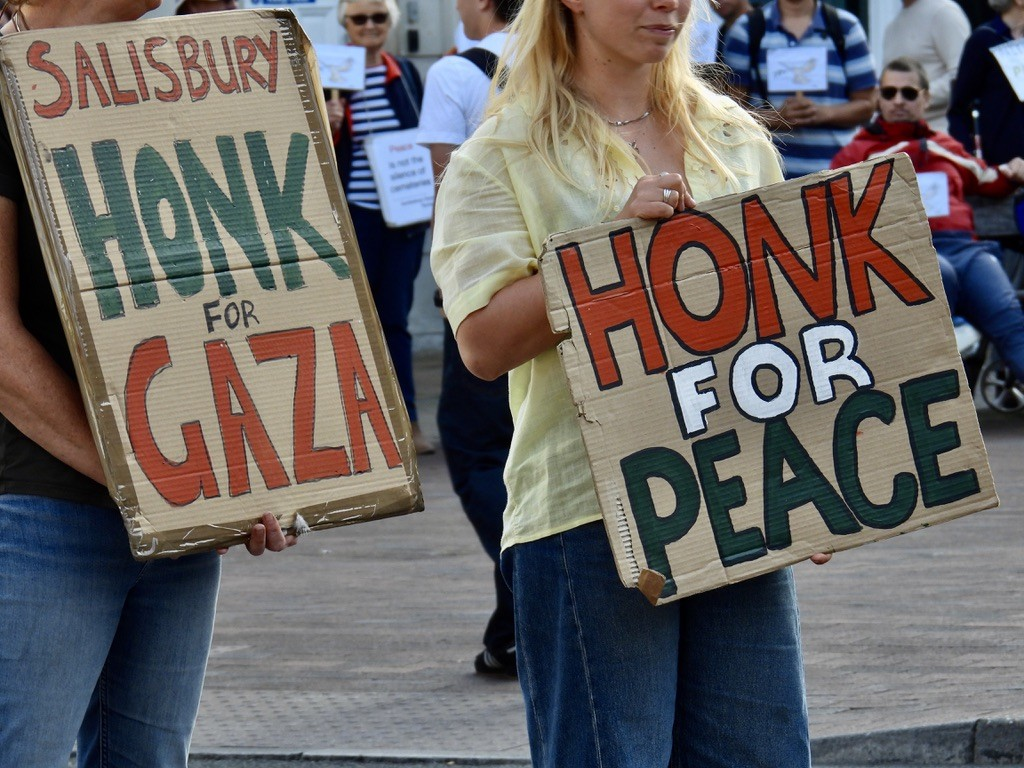
Vigils will continue in Salisbury and the next is this Saturday 5th September at 5pm for half an hour. The local MP Mr John Glen has never attended or acknowledged the vigils and is a proud member of the Conservative Friends of Israel group.

[1] Israel: What Went Wrong, Omar Bartov, 2026, Fern Press

[2] The Ethnic Cleansing of Palestine, Ilan Pappe, 2006 (first published), One World

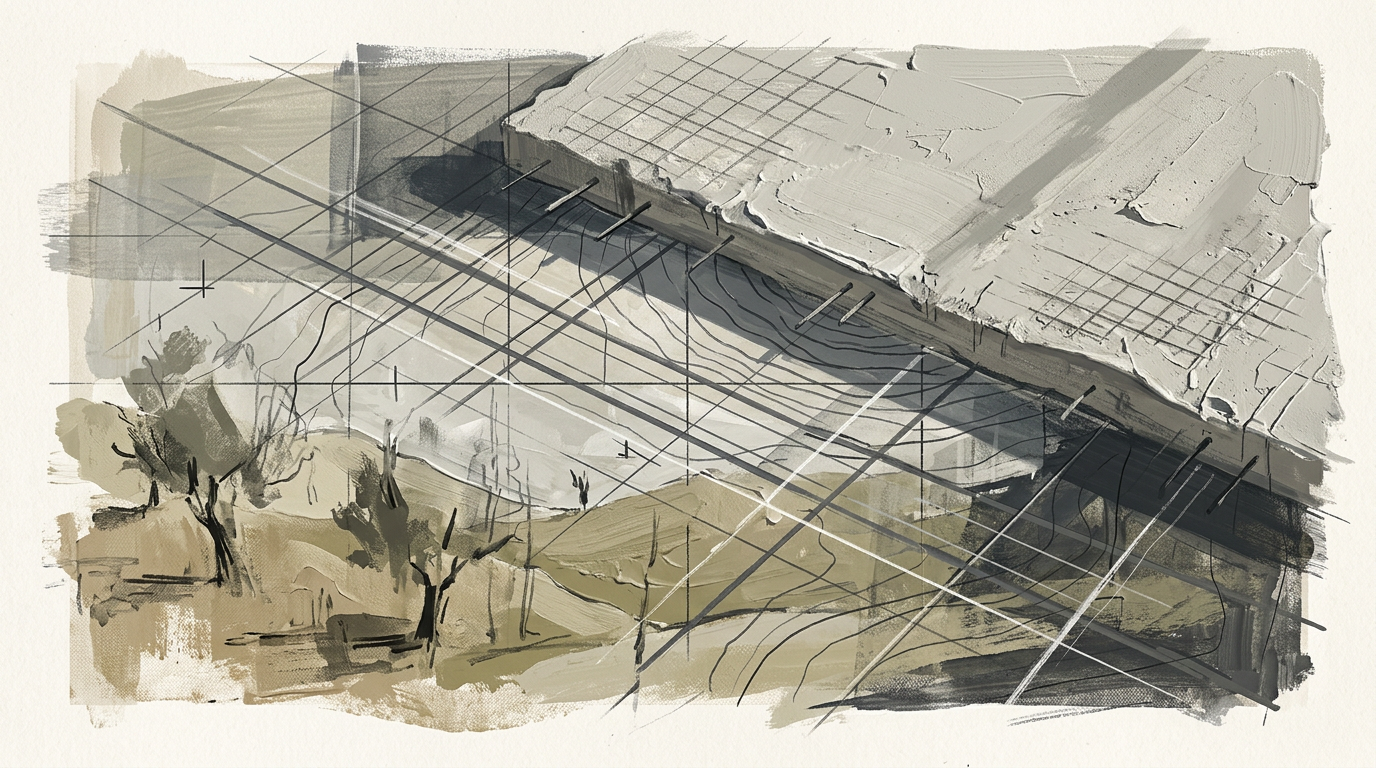
Sources: Guardian, Middle East Eye, Ha’aretz, Jewish Chronicle. Image created by AI.


Good response to our 143rd vigil


We still turn out each week as the need is still there
Proposal to make a film
August 2026

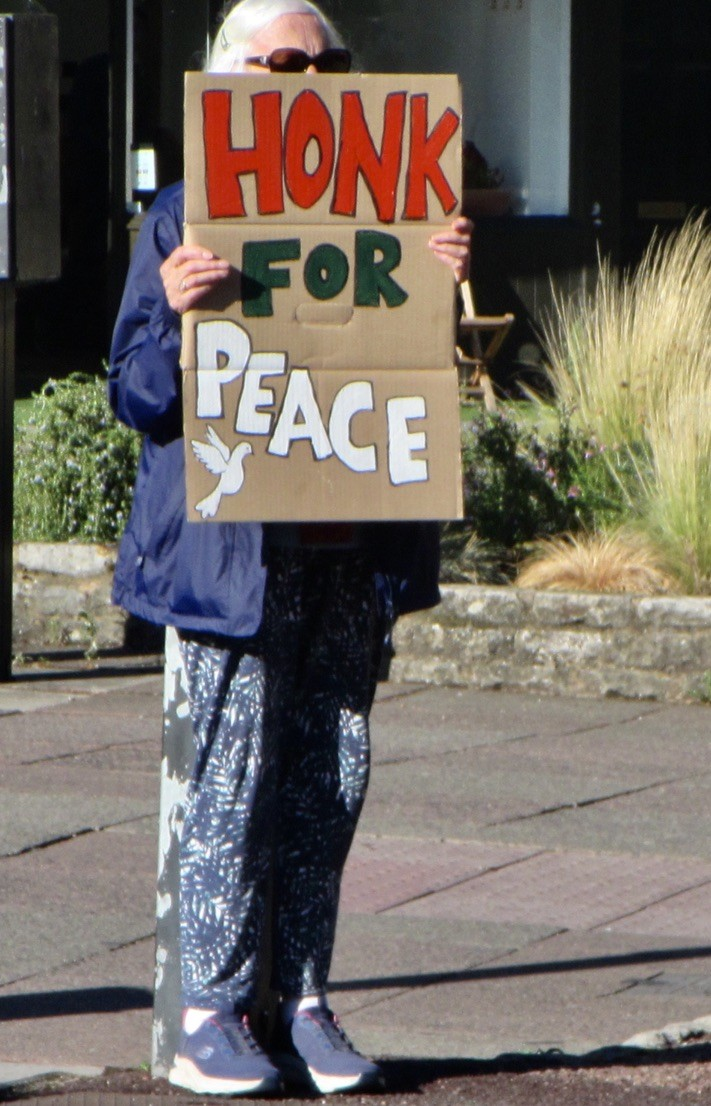
One hundred and forty three vigils for peace in the Middle East supported by around 30 people yesterday (29 August). The photo shows one of our number standing on the traffic island and there were around 35 ‘honks’.

There has been some coverage of the situation in Gaza last week with reports on the yellow line which is slowly creeping across the territory forcing the Palestinians into a smaller and smaller area. According to the LA Times it is now 64% of Gaza. Nearly all the cultivable land has now been seized. According to recent estimates, the death toll is now over 73,000 and continuing despite the ceasefire. 174,000 have been injured. Around 1,300 have been killed since the ‘ceasefire’ and 4,361 injured. Settler violence has intensified in the West Bank.

We still await government action concerning our relations with Israel following the election of Andy Burnham as prime minister who apologised for the government’s stance in July. Although this apology was welcomed, few in the media noted that Burnham is a member of Labour Friends of Israel. On the web site Track Israel Lobbying Mr Burnham heads the page Hall of Shame as having received over ยฃ200,000.

The total received by MPs from Israeli organisations is a massive ยฃ1,574,262 (updated this month). It is reasonable to ask how independent are our members of parliament and to what extent are they representing the interests of those people whom they purport to represent when they are in receipt of such largesse?

Film

We are considering making a short film to be called ‘Because …’ which will have brief interviews with some of those who attend these vigils. We will be carrying out the interviews over the next few Saturdays. Anyone reading this who attends is willing to volunteer. The aim is for people to say they come to the vigils because … and to give their reasons.

We note once again that there has been no sign of the local MP Mr John Glen who is a member of the Conservative Friends of Israel group (see above) and has never mentioned them in his weekly column in the Salisbury Journal.

Photo: courtesy of Peter Gloyns.


Recent posts:

Risks of University Partnerships with Arms Firms and Israel


Report by Southampton University into tensions and risks in dealing with Israel and Palestine

August 2026

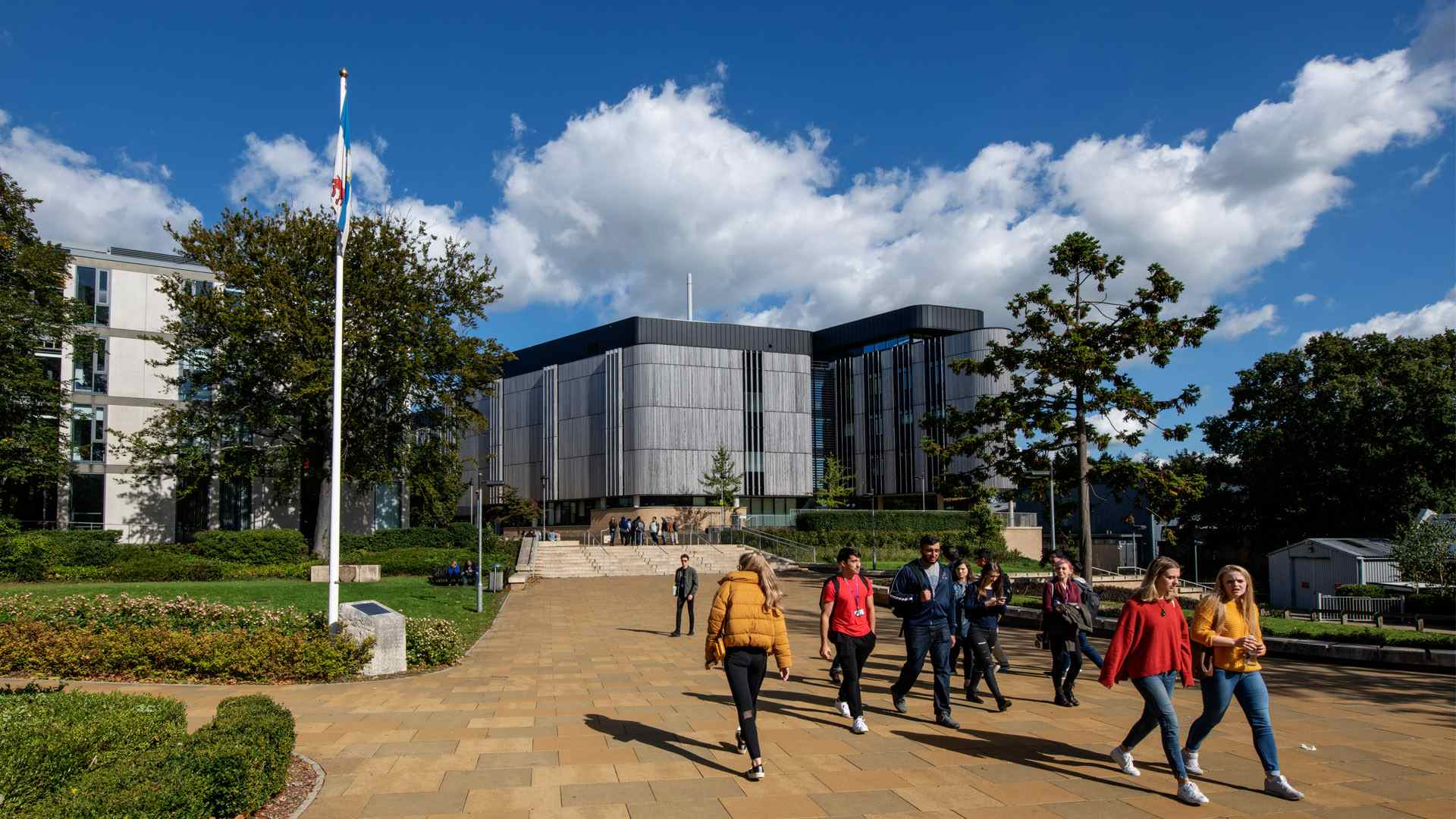
The latest edition of the Campaign Against the Arms Trade’s News (Issue 277, Summer 2026) contains an article discussing links with universities and arms companies in the context of relations with Israel and Palestine. The report Aligning Policy with Practice: Tensions and Risks in the Context of Israel and Palestine, February 2026 analyses these tensions in relation to Southampton but it is clear the issues apply to many universities in the UK. The full report can be accessed here. It is the product of work carried out by the Palestinian Solidarity Network in the University (pictured) and the lead author is Irene Ruiz Espejo.

Essentially, the report analyses the various principles which the University has concerning transparency, sustainability, ethics and EDI and matches that against what happens, the links they have with arms firms and their support for research, and also the links with Israeli universities. They suggest that sometimes matters of governance, partnerships and approaches to free speech can exert a chilling effect as has been seen at other academic institutions.

Risks

They identify several risks: legal, financial, reputational and wellbeing in the report. Official communications do not reference the historical and legal realities of military occupation in Gaza, settler colonialism on the West Bank, apartheid, or the longstanding siege of Gaza. They also do not engage with international legal developments and findings, including United Nations and international and Israeli civil society organisations, which have raised serious concerns that Israelโ€™s conduct in Gaza may amount to grave breaches of international law, including acts that violate the Genocide Convention.

In addition, University statements do not situate events in Gaza within the wider regional context of Israeli military aggression, including the bombing of Lebanon, Syria, Yemen, Qatar, and Iran, which have resulted in additional civilian deaths and escalating regional and global instability. Instead, communications tend to frame events primarily as a bilateral conflict and to address Palestinian deaths, displacement, and civilian harm largely through the language of humanitarian crisis.

This framing obscures a central and well-documented reality: the โ€œconflictโ€ is characterised by profound asymmetries in power, control, and vulnerability, including Israelโ€™s effective control over borders, airspace, and key conditions of civilian survival in Gaza, including access to humanitarian aid. In this context, large-scale civilian harm is not only the outcome war, but it is shaped by Israelโ€™s political and military decisions that have driven mass displacement, civilian targeting, severe restrictions on essential supplies, the use of starvation as a method of war , bombardment, and the destruction of critical civilian infrastructure in Gaza, including all twelve universities.

Power of money

They maintain this bias is not accidental but managed, where money and and power repeatedly take precedence over stated values. Students and staff who raise concerns about arms partnerships, or who engage in Palestinian solidarity, face ‘scrutiny, marginalisation or silencing’ – a direct threat to freedom of speech.

Money has become an existential issue for universities and many are struggling. The drop in foreign students has been a severe blow. The suggestion, implicit in the report, that the desire to secure research funding from arms firms has led to threat to their core values. Links to Israeli universities are not inherently wrong but the nature of the research might be.

The CAAT piece ends “our report is an attempt to interrupt that silence resisting erasure – of lives, of knowledge and our ability to name what is happening requires more than critique. It requires cultivating the capacity to see clearly even when language obscures: to think critically even when institutions reward compliance and to remain connected to our sheared humanity, to people, to place and to the consequences of what is doe with our knowledge our research and our labour”.

Some content from the report.


The vigils continue


Vigil number 137 held on July 18th

We continue to hold vigils in Salisbury’s market place on Saturday evening. Last Saturday was the 137th such event. Thinly attended this time but we were briefly joined by 26 Brazilian students which was a delight.

We continue because the situation in the Middle East gets no better. We await how the new prime minister handles the situation in Gaza but he has already apologised for the party’s response and approach to the conflict which was very damaging. Sir Keir Starmer was so desperate to lay the ghost of ‘anti-Semitism’ that his response to Israel’s violence and destruction of the territory was distorted. Now David Lammy has made statements about the mistaken approach but it has to be noted that there was little sign of this up till now. He did not feel the need to resign.

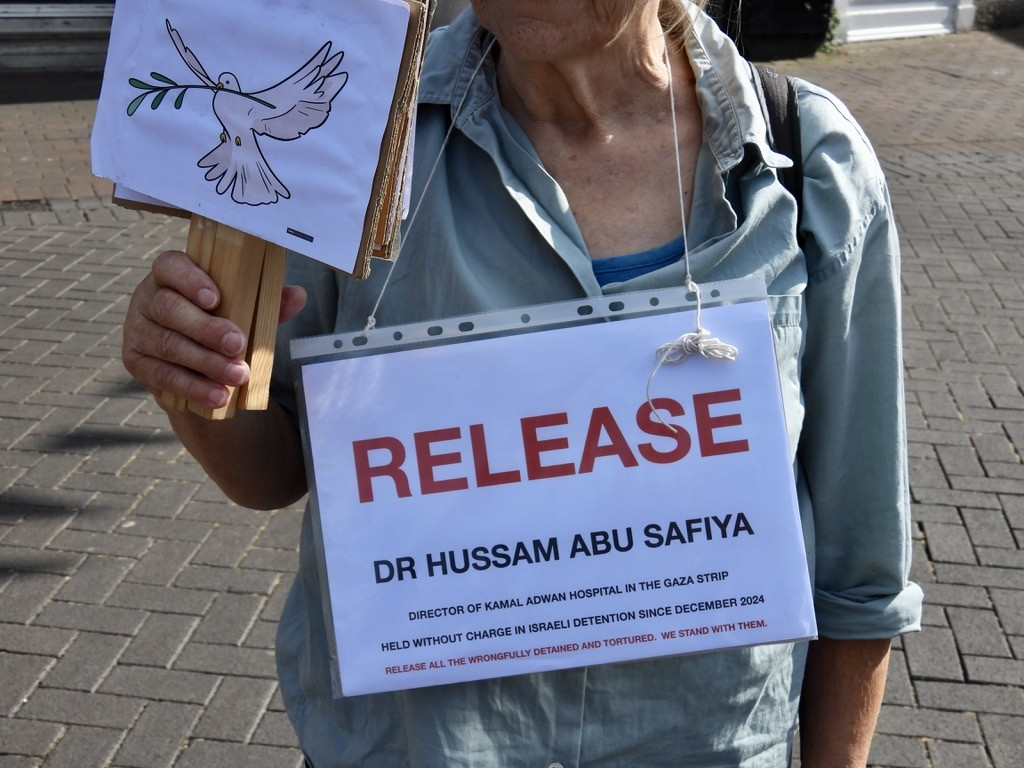
Dr Hussan Abu Safiya

The UN said in a report last month:

“The UN Independent International Commission of Inquiry on the Occupied Palestinian Territory, including East Jerusalem, and Israel expresses its grave concern at credible reports that Dr. Hussam Abu Safiya, a Palestinian doctor and Director of Kamal Adwan Hospital in the Gaza Strip, has been subjected to continued and severe abuse since his detention by the Israeli authorities in December 2024.

“The Commission calls for the immediate, unconditional and safe release of Dr. Abu Safiya and of all medical personnel held in arbitrary detention by Israel. It also urges the Israeli authorities to provide immediate independent medical care for Dr. Abu Safiya.

“The continued arbitrary detention of Palestinian medical personnel and the severe mistreatment they are subjected to are deplorable and flagrant violations of international law. The actions of the Israeli Prison Service guards towards Palestinian detainees raise grave concerns of violations of international law that likely amount to international crimes. Dr. Abu Safiyaโ€™s medical condition is the direct result of these actions. The Commission underscores that persons deprived of liberty are protected against murder, torture and cruel, inhuman or degrading treatment and sexual violence”.

He is held in an underground prison.

Israeli forces now occupy 65% of the Gaza strip in contravention of Trump’s peace plan. The number of Palestinians killed is 73,770 of whom 20,000 or more are children. The total is likely to be much higher with thousands buried and unaccounted for under rubble. 1,144 have been killed since the ceasefire in October.

Sources: Guardian, BBC, Al Jazeera, Copilot Search, UN,

Image courtesy Peter Gloyns


Serious issues raised by Palestine Action decision


Decision by Court of Appeal raises serious issues about our rights

June 2026

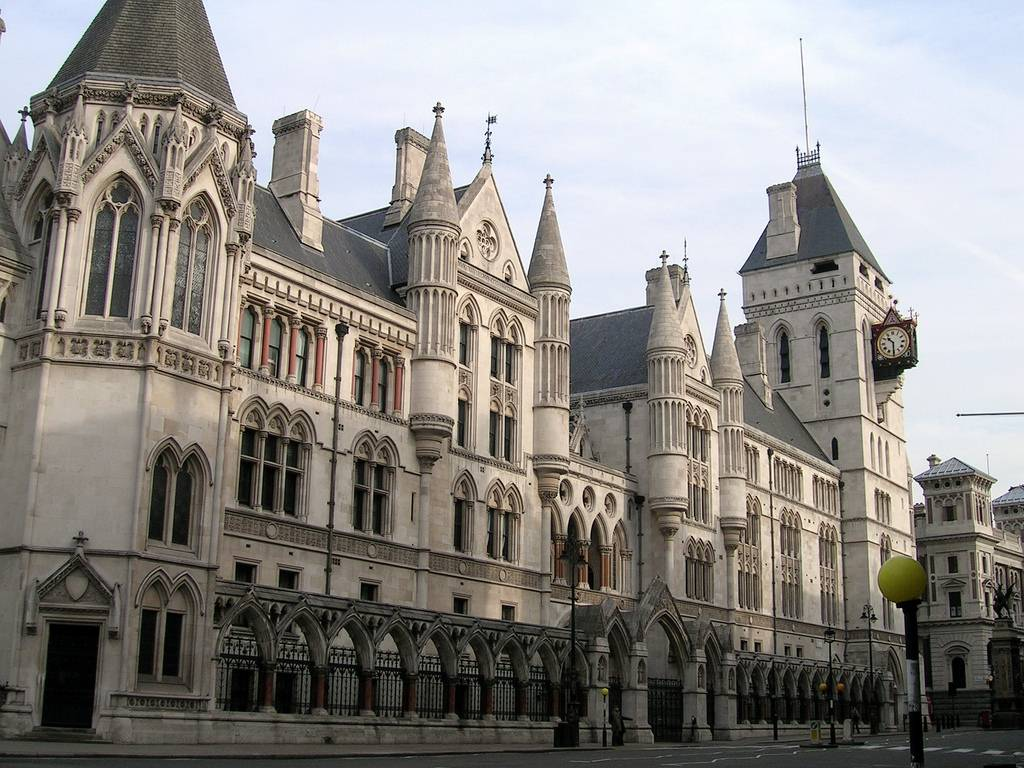
The dreadful decision by the Appeal Court last week raises issues way beyond the matter of Palestine Action and whether or not they are terrorists. On 15 June they upheld the decision to proscribe Palestine Action as a terrorist organisation. As Liberty has argued “This judgement risks paving the way for current and future governments to use counterterror powers against non-terrorist groups as we have seen in other countries, to silence activists, minorities and opponents.”

Amnesty say that prosecutors want to make an example of them and set a precedent for how direct action protestors could be treated in future. The decision will have a chilling effect on protest and will undoubtedly leave many people nervous of making their views known or attending vigils or marches.

Perhaps the most disturbing aspect of the judgement was the statement made by the judges:

It is not, as it claims, a direct action civil disobedience protest group like the suffragettes operating transparently in the open. It is a covert organisation that operates using secret cells to avoid the detection and prosecution of those using violence to destroy the property of third parties. Palestine Actionโ€™s activities have caused injury as well as property damage.

It is hard to countenance that a group of supposedly learned judges should make a statement which is factually incorrect, historically naรฏve and verging on the bizarre. The suffragettes committed a large number of violent acts including damage to property, bombings and arson. They carried out these activities – about 300 all told – over many years. The number and extent of their actions far exceed those of Palestine Action. That judges of a senior court should be so misinformed is a worry.

Belfast and Southampton

Last week saw violence in Belfast and Southampton. Part of this was a series of organised attacks on houses containing refugees or immigrants. They were burnt out of their homes in acts of deliberate violence. The police came under sustained and violent attack. Despite the scale and nastiness of the attacks, there has been no question of using the terrorism word. The actions clearly fell into the definition of terrorism. Those who incited the violence are interviewed on media programmes.

In a previous post we commented on the attitude of successive governments towards the Gulf states and the double think involved. On the one hand talking in grand terms about a new world order, democracy and human rights, and on the other supplying arms and succour to a collection of brutal states which do the precise opposite. Where there is no democracy, women are second class citizens and certainly there are no human rights. Where our Royal family and others happily mingle with tyrants.

It is a looking glass world. Thousands have been arrested, many elderly, for protesting about the violence, destruction and genocide in Gaza and now in Lebanon. At least 73,000 have died in Gaza and thousands more wounded. Israel will not allow in heavy lifting equipment to help clear the rubble and retrieve bodies buried in it.


Recent posts:

An Israeli and a Palestinian debate


Debate between the two at the Festival of Humanism over the weekend

June 2026

So popular was this debate that many couldn’t get in so it was repeated the following day in a bigger hall. The two speakers were Yaniv Aknin who is a British-Israeli software engineer currently working in London. He was born and raised in Israel but left in 2013. Jasr Kawkby is a British-Palestinian paediatrician currently working in East London. He was raised as a Muslim in Palestine.

It would be usual in a write-up of this kind to discuss what A said then to discuss B, making clear thereby who said what. We will not do this in this instance and just discuss what was said by both. These are some of the points made:

  • It was pure chance where you were born and whether you were Moslem, Christian or Jew.
  • Language was important. To call what happened a ‘war of independence’ was quite wrong. It was a colonial war. To live in a land where the ‘natives’ were expelled and prevented from returning was morally wrong.
  • Armed resistance has made life more difficult for those it seeks to support. It has alienated foreign support.
  • Suffering has been inflicted on those with no responsibility for the plight of Jews [in history].
  • Israel must stop its barbaric actions [for example] denying food aid in Gaza and must respect the rights of Palestinian prisoners in Jewish gaols.
  • [In answer to a question] the conflict was about land: religion was very much a secondary factor. It was however a complicating factor.
  • Zionism was a wrong ideology.
  • Most destruction of human life was by Israeli forces [meaning the IDF from other comments he made].
  • Pressure should be applied to Israel until it complies with human rights. We must recognise the oppression of Palestinians.
  • The lack of unconditional support from the West seen as a betrayal or anti-Semitism.
  • Religion was a catalyst for violence: how can we spread non-religious ideas? [This was a Humanist conference].
  • We should not be selling arms to Israel.

You might believe some of the answers are obviously from one ‘side’ or the other. You may well be wrong. There were in fact some surprises. This is to illustrate that there are those from the region – whether Jew or Moslem – who see both sides and recognise some of the wrongs that are committed. Because so much air time is given to extremists, we can be led to believe that they are representative of the population as a whole. It demonstrates that perhaps there is some chance in the future for some kind of reconciliation. The interference by outside forces – discussed in our last post in relation to the Gulf – is a factor in the perpetuation of violence.

Images: Yaniv (top); Jasr (lower)


Recent posts:

Israel passes death penalty bill for Palestinians


The Knesset passes a highly discriminatory law

March 2026

The Israeli Knesset has just passed by a majority of 62 a bill which will allow the executions of Palestinians convicted of fatal attacks in the West Bank. The executions will take place by hanging and do so it is planned, 90 days after conviction or in some cases 180 days. The law is nakedly discriminatory and is a piece with the apartheid policy which exists in the country. No appeals will be allowed and legal contact with the convicted person is via video link only. The Knesset erupted into loud cheers and Ben Gvir was seen waving a champagne bottle in celebration. An illustration of the lapel badge he wears is below.

It has brought a wide range of condemnation from around the world. It will do nothing for Israel’s somewhat battered reputation internationally. A statement by Amnesty International said:

‘Today, Israelโ€™s parliament, the Knesset, adopted the first in what threatens to be a series of laws facilitating the use of the death penalty, in a public display of cruelty, discrimination and utter contempt for human rights. The amendment added to Israelโ€™s Penal Law, known as the โ€˜Death Penalty for Terroristsโ€™, expands the scope and facilitates the use of capital punishment, at a time when there is a global trend towards abolishing it. It also dismantles fundamental safeguards to prevent the arbitrary deprivation of life and protect the right to a fair trial, and further empowers Israelโ€™s system of apartheid, which is maintained by scores of discriminatory laws against Palestinians.’ Erika Guevara-Rosas, Amnesty Internationalโ€™s Senior Director of Research, Advocacy, Policy and Campaigns.

The Palestinian Prisoner’s Society called it a ‘historic escalation – a new phase of openly sanctioned [and] politically motivated executions of Palestinian prisoners’.

Torture and mistreatment

A particular problem is that Palestinians are imprisoned and subject to considerable mistreatment. This can include starvation, physical assaults of various kinds and lack of medical attention. The Times of Israel among others have reported on the inhuman conditions. Testimony and confessions therefore, produced under this system of abuse and torture, will have little credence. Some of the descriptions are horrific and there is a WARNING about the following link.

The problem here is that violence begets violence. An almost ceaseless tide of violence in Gaza, southern Lebanon, parts of Syria, the West Bank and now Iran, has bred into the society that yet more violence is the answer to the security of the state.

Large numbers of British MPs from all parties are members of the Friends of Israel groups, funded by the Israeli government, including the Trade Minister, Peter Kyle. The Salisbury MP, Mr John Glen is a member of this lobby group.

Amnesty is opposed to the death penalty in all circumstances. Mistakes cannot afterwards be corrected. It is not a deterrent and it imposes huge stresses on those who carry out the punishment. The local group publishes a report each month on its use around the world.

Sources: Times of Israel, BBC, Guardian, Palestine Prisoner’s Society, Al Jazeera


Is a two state solution possible?


Talk at the Exeter conference

March 2026

This was the title of one of the talks at the Exeter conference organised by the local Amnesty group. Answer: no. The talk was given by Abdullah al Anjari (pictured) who is a doctoral researcher in Palestine studies at the Institute of Arab and Islamic Studies, University of Exeter, and a member of the European Centre for Palestine Studies. His talk focused on three key elements of the problem: Jerusalem, the refusal to allow Palestinians to return and the actions of the West Bank. Together they meant the prospects for a Palestinian state near impossible. He might have added a general lack of support by other countries for this cause and the unqualified support by the US of Israel.

The removal of large numbers of Palestinians from Jerusalem began in 1948 and has continued sporadically since. It was important to realise that it was Christians who were expelled not just Arabs and Palestinians. Only two weeks previously the Church of the Holy Sepulchre was closed. This is a rarity in the 1,700 year history of the building.

Palestinians do not have the right to return to the lands they previously lived in. It is often forgotten that a significant number of those living in Gaza are themselves refugees.

Thirdly he said, there is the West Bank where around 700,000 Jewish people are now living. A further nineteen new settlements are currently being established. Far-right Finance Minister Bezalel Smotrich, a settler who proposed the move alongside Defence Minister Israel Katz, said the decision was about blocking the establishment of a Palestinian state. Alongside the settlement push has been a steady increase in violence against Palestinians and Arabs living there with no protection offered by the army or police. Abdullah called this ‘settler colonialism’.

Apartheid state

There have been many UN resolutions on this matter which have been ignored. What can we do? He focused on the Apartheid state operated by Israel. There have been a number of detailed reports setting out the mechanics of the state and how Palestinians are second class citizens in their own land. The Israeli human rights organisation B’Tselem, Human Rights Watch, and Amnesty International have all produced extensive reports on the system. These have been variously dismissed by Israel and anti-Semitic and anti-Israel. The world took comprehensive action against Apartheid in South Africa and eventually the system was unsustainable. So far there is no move to apply those principles to Israel.

South Africa became a pariah state and its sports teams were boycotted and foreign companies were eventually persuaded to disinvest or stop trading. Writing to MPs was suggested. However a significant number of MPs are members of the Friends or Israel groups so are unlikely to support any action to boycott Israeli goods for example. Pressure could be applied to local government pension schemes not to invest in arms companies dealing with the country. The powerful Zionist influence in both the US and UK was noted.

Keeping up the momentum of vigils and campaigning was important in raising awareness and not allowing the injustice to continue. The prospects for a Palestinian state are almost nil was the gloomy conclusion. The seeming endless violence against its neighbours, the uncritical support of the US and other countries and a supine media landscape were all facts acting against some kind of peaceful solution for the region.


Amnesty conference in Exeter


Well attended conference with a wide range of human rights issues discussed

March 2026

The Exeter group of Amnesty puts together a conference every year and those attending this year were able to listen to a range of speakers on some of the current problems with human rights around the world. Each topic will need its own space so we shall be putting up a range of posts over the coming week or so to give them justice. For now, this is just a brief summary as a kind of ‘taster’. All credit to the Exeter group for organising this event. Six members from the Salisbury group attended and all found it worthwhile.

Tapestry

The tapestry was on display after many years absence. It was displayed in Salisbury Cathedral several years ago.

Malawi

We do not hear enough from Africa although the war in Sudan occasionally makes the news. Malawi is one of a number of countries in Africa which have anti-gay legislation. Eric Sambisa spoke of his campaign and actions to get the law on LGBTQ+ legislation changed in his country. Those laws derive from colonial times and change is proving slow.

Authoritarianism

We had two speakers on authoritarianism, first in America and second in the UK. Trump and his supporters are carrying out a range of such measures and worryingly, UK governments are quietly following suit with more laws and increased police powers designed to reduce protests. The firm Palentir was raised more than once and they represent a serious risk to our personal security.

Purchasing

A forthcoming Amnesty campaign will focus on what we buy and the human rights stories behind our purchases. Much of what we buy comes from overseas and is produced in sweat shops in the far east where – mostly women – work in terrible conditions with few if any rights. There are no trade unions. The surprising, nay shocking thing, is that big name British retailers are involved, the likes of M&S, Tesco, Next and others. Firms who’s policies have the familiar words about human rights being our ‘first priority’. The supply chains are long and as you go down them the opportunities for abuse increases.

There was discussion of Early Day Motion 1266 concerning banning goods coming from the illegal Israeli settlements. Unfortunately, there was insufficient time to discuss the large number of MPs, from all parties, who are members of the powerful Friends of Israel lobby groups. Their power means the motion is unlikely to succeed.

Palestine

The situation in Palestine was a topic as you might expect and we had a presentation from an academic at Exeter University. Part of the discussion focused on the prospects for a two state solution. There are none was the stark conclusion. Israel has systematically removed people and built settlements which make the creation of a viable Palestinian state impossible. Recent announcements of the creation of 19 new settlements cements this fact, referred to as ‘settler colonialism’. The speaker did focus on the Apartheid regime in place in Israel and the West Bank. Attacking that, much as happened in South Africa which saw that regime come to an end, was the way forward he said.

Amnesty International

There were some speakers who discussed issues surrounding Amnesty itself. In common with all charities at present and the drop in funding to the sector of ยฃ1.4bn in a year, Amnesty is having to reduce its expenditure. It has a new Chief Executive. It is facing ‘significant financial challenges’.

Photo

The photo is the traditional picture where delegates assemble in front of the cathedral.

Once again, thanks to the Exeter group for organising this excellent event. Thought of becoming a subscriber?


Recent posts:

Palestine Action centre of the news


115th vigil took place following a momentous week in the courts

February 2026

We discussed in a previous post the High Court’s decision that the government’s decision to ban Palestine Action was disproportionate. The ban on them has not been lifted as the government seemed determined to appeal and some experts say the Appeal Court may overturn it. The government seem passionate about supressing dissent on this matter – obsessive even – and the possible reasons for this will be discussed in a future post.

Around 30 attended the 115th vigil yesterday and the ‘recognition factor’ by passers-by was higher than usual probably because it was light, Over 50 took note and a few took pictures. A video can be viewed here, with thanks to Peter Gloyns.

Once again we note that the local MP, Mr John Glen has failed to put in an appearance and despite 115 vigils attended by hundreds of his constituents, has never once mentioned them in his weekly Salisbury Journal column. He is a member of the Conservative Friends of Israel, thought to be the largest and best funded of all the lobby organisations in parliament. Although the Conservatives are the largest of such groups, other parties have members as well. It goes some way to explaining why there is silence on the question of genocide in Gaza and little noise about settler violence in the West Bank.

An interesting event took place on the BBC’s Any Questions? programme on Saturday 14th February. Perhaps the programme should be relabelled ‘Some Questions‘ because one audience member stood up and asked “What does the panel think about the BBC not expressing the truth about the genocide in Palestine?” This was not the question she had submitted on the card so it was hastily ignored and the original question about the High Court’s decision discussed instead. It seemed to reveal a BBC deeply nervous of the whole issue of Gaza. A question about the BBC’s poor record would almost certainly never have been allowed. There were a number of disturbances from the audience during the programme talked over by the presenter Alex Forsyth.

“Valentine’s gift to every thug and anti-Semite”

A large part of the ensuing Any Answers? focused on the Palestine Action decision. Most were in favour of the judgement and a handful not. Overall, it seems that the public finds the decision to call them a terrorist organisation over the top. This view is not supported by the Daily Mail among others who concludes that the decision is a ‘Valentine’s gift to every thug and anti-Semite who cheerleads for Palestine Action‘. It found the decision ‘baffling’ and quotes a government source saying it was ‘bonkers’ [accessed 15th February]. It correctly notes that the decision could go the the Supreme Court and take months to decide.


Image courtesy of Peter Gloyns

Previous posts:

Blog at WordPress.com.

Up ↑