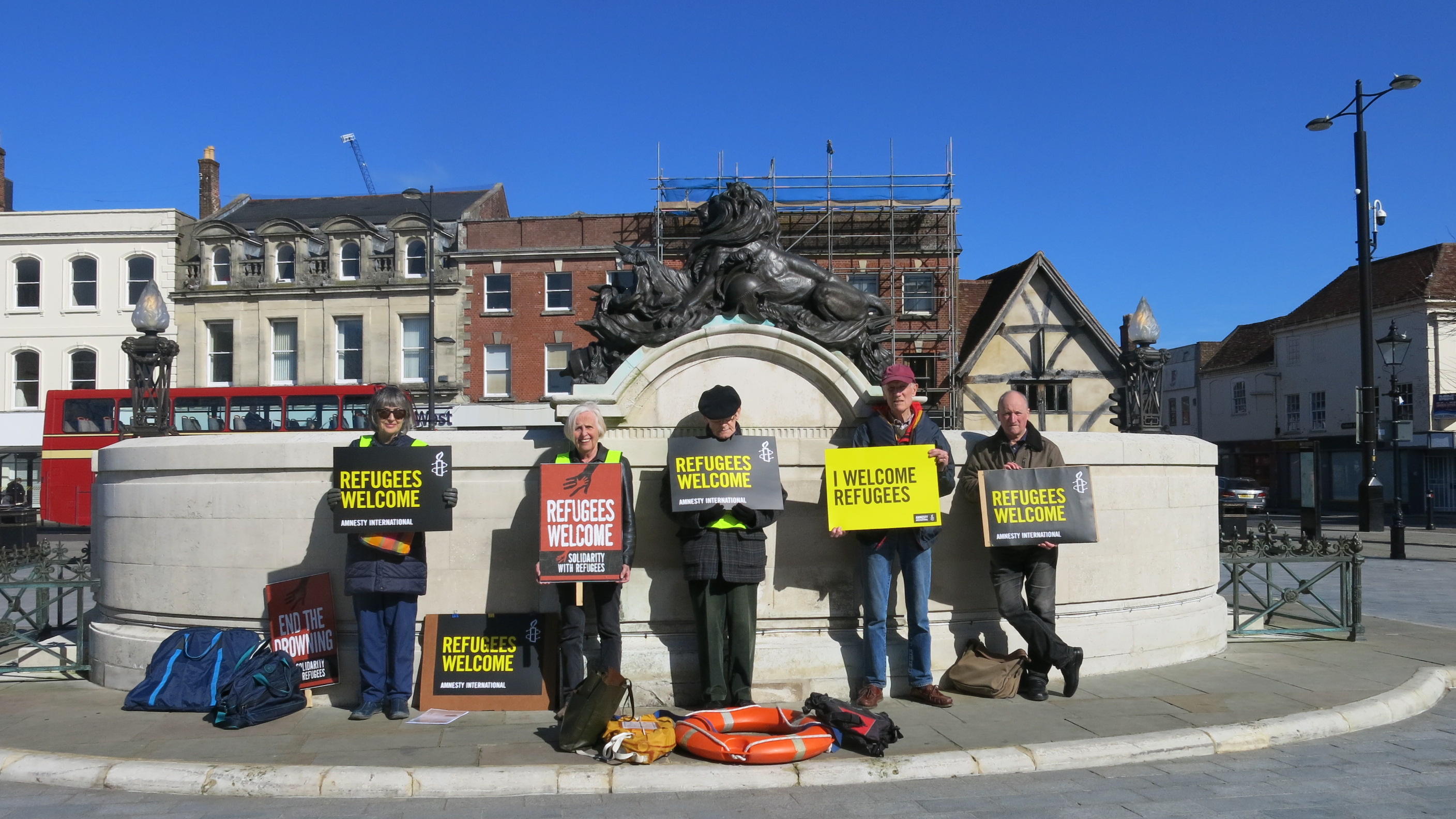
We are grateful to group member Andrew for his work in preparing this piece on the important topic of refugees and asylum seekers. There has been a lot of activity on the legislative front this month concerning refugees and related matters .
There has been much activity on the Nationality and Borders bill, which has reached the report stage, following the detailed discussion in committee, prior to going to the Lords.
Among the changes brought about in the last month, Clause 9 has been the most controversial, allowing the government to remove a person’s citizenship without notifying them, if they consider it in the public interest. The clause, proposed in July and updated in November, exempts the government from giving notice of a decision to deprive a person of citizenship if authorities do not have the subject’s contact details or if it is not “reasonably practical” to do so. The clause states that notice would also not be given if such a move is “in the public interest”. However, the Home Office has said those deprived of citizenship will still have the right to appeal.
A precedent was set in 2019, after Shamima Begum, who was born in London, was stripped of her UK citizenship due to her connections with the ISIL (ISIS). Sajid Javid, home secretary at the time, argued that although Begum did not have a foreign passport, she would not be stateless because of her Bangladeshi ancestry. However, Bangladesh, which she had never visited, said she had no claim to the South Asian nation.
Since 2006, the UK has had the power to strip dual nationals of their British citizenship. The measures were introduced after the 2005 London bombings – four suicide bombings on July 7 that killed 52 people. At that moment, British anti-terrorism laws changed, and collective security was trumped over protecting civil liberties and freedoms.
Under Tony Blair, who was then prime minister, 12 counterterrorism measures were outlined, also including the expansion of the controversial Prevent programme, which was quietly created in 2003. This required public officials working in schools, universities, hospitals and local councils to report people they found to be showing “radical” tendencies to the authorities.
The ability to deny people citizenship was increased in 2010 by then-Home Secretary Theresa May, who used the powers to strip 20 dual-national Britons who were believed to be fighting in Syria. In 2014, May took this further, extending the measures to foreign-born British citizens without dual nationality, as long as they were eligible for foreign citizenship and would not be left stateless. But the new clause – which means people may not be notified of their stripped citizenship – can also be applied before it becomes law, making an appeals process harder.
A report by the New Statesman found that almost six million people from ethnic minority backgrounds could be affected by the proposed clause.
The bill also aims to rule as inadmissible asylum claims made by undocumented people as well as criminalise them and anyone taking part in refugee rescue missions in the English Channel. Moreover, border force staff will be granted immunity if people die in the Channel during “pushback” operations, a matter of concern among immigration lawyers who say the bill breaches international and domestic law.
According to The Guardian, in response to the new clause, the Home Office has said: “British citizenship is a privilege, not a right. Deprivation of citizenship on conducive grounds is rightly reserved for those who pose a threat to the UK or whose conduct involves very high harm. The nationality and borders bill will amend the law so citizenship can be deprived where it is not practicable to give notice, for example, if there is no way of communicating with the person.”
The bill is currently going through the House of Commons and will progress to the House of Lords by next year.
The situation with the points-based immigration system
The Government is struggling to manage the demands of its post-Brexit, points-based immigration system, new figures suggest. Quarterly statistics published by UK Visas and Immigration (UKVI) show that waiting times for immigration sponsorship approvals have increased dramatically since the start of 2021, when the UK’s new immigration system came into effect.
From 2018 to the start of 2021, on average, 78.5% of ‘tier 2’ sponsorship applications were processed within four weeks. In the first half of 2021, this figure sank to an average of 24.6%. This has similarly been the case for ‘tier 5’ sponsorships, 79.7% of which were processed within four weeks from 2018 to the start of 2021. Since that time, 23.6% have been processed within this time limit.
Tier 2 visas are granted to skilled workers seeking employment in the UK. According to the Home Office, applicants “must be able to speak, read, write and understand English” in order to gain entry. Tier 5 visas, meanwhile, are open to temporary workers – with visas granted for between six and 24 months. Both routes require an application fee of roughly £200, and a healthcare surcharge of some £600-a-year – unless the applicant is a health or social care worker.
The average time taken to process a visa application in the second quarter of 2021 was 48.35 days – compared to just 28 days in the second quarter of last year. There are now 2,202 applications in the UKVI system that have taken longer to process than the average amount of time – compared to just 374 in the final quarter of 2020.
From 1 January 2021, the UK introduced a more stringent immigration policy that allows entry for those who have a job offer in a skilled sector that meets certain salary thresholds – as well as students and temporary workers in applicable industries. In order for temporary and skilled workers to gain a visa, the UK demands that they are officially sponsored by their prospective employer. This differs from the UK’s previous immigration system, during its membership of the EU, when European citizens could move freely to live, work, or study in the UK.
Unsurprisingly, the UK has subsequently seen a surge in sponsorship applications, which were previously only required for non-EU migrants. An average of 1,346 applications were made in each quarter from the beginning of 2018 to the third quarter of 2020 – rising to 2,607 in the final quarter of 2020, 3,566 in the first quarter of the new year and 3,794 in the second.
However, this surge was entirely predictable. Home Secretary Priti Patel announced the points-based immigration system in February 2020, with Brexiters having supported the idea ever since the 2016 EU Referendum campaign.
According to employer solutions law firm Davidson Morris, Home Office staff have also been diverted “away from sponsorship applications to handle EU settlement scheme applications from EEA nationals” – the process through which EU residents have gained the temporary or permanent right to remain in the UK.
“One year on, our new system is making it easier for businesses to hire the skills and talent they need, while incentivising investment in our domestic workforce,” a Home Office spokesperson told Byline Times. “Valid and complete applications for visas are processed within the published timescales despite a sustained rise in demand.”
However, the lagging performance of the UK’s immigration system risks exacerbating worker shortages that have plagued the country in recent months. Amid food and fuel shortages, the UK has made 4,700 temporary visas available to HGV drivers, 5,500 visas for poultry workers, and 800 for pork butchers. The Government also encouraged 300 EU fuel tanker drivers without a visa to enter the country – yet only nine people applied.
These schemes will not solve the fundamental issues with the UK’s new immigration regime – either in the short or the long-term. Indeed, speaking to CNN, British Chambers of Commerce President Ruby McGregor-Smith likened the Government’s temporary visa schemes to “throwing a thimble of water on a bonfire
Immigration as a concern for voters
Following Robert Peston’s claim that immigration was top of voters’ concerns, YouGov asked adults in Great Britain, most recently on 22 November 2021, to pick up to three of the most important issues facing the country. The top three responses were health (49%), the economy (40%) and the environment (35%). Immigration and asylum were fourth with 34%. (These figures are analysed to remove random fluctuations in the data due to sampling variability. If this isn’t done immigration and asylum are even lower with 22%).
Ipsos MORI polled people between 5 and 11 November and found climate change was mentioned most as a concern (40%). Coronavirus and pandemic diseases came second with 27% and Brexit issues and the NHS/healthcare were both third with 22%. Immigration and immigrants were mentioned by 11%.
Safe Return of Asylum Seekers
While the Nationality and Borders bill moves on, for some reason a new bill has been tabled to help the government return asylum seekers to “safe countries” in an effort to reduce the number of people claiming asylum in the UK. Introduced by Conservative MP Peter Bone, the Asylum Seekers (Return to Safe Countries) Bill has passed its second reading.
The Bill would “require asylum seekers who have arrived in the United Kingdom from a safe country to be immediately returned to that country”. This could apply to those arriving directly from countries deemed “safe” by the UK or to asylum seekers arriving in the UK via a safe country such as France or Germany. This is essentially an attempt to reinstate the Dublin 111
Accord of the European Union, which allowed member countries to return unregistered immigrants to that part of the EU where they first landed. Post- Brexit, this obviously no longer applies, though the Home Office is trying to return asylum seekers to the Continent wherever it can.
Health issues for refugees
Médecins Sans Frontières / Doctors Without Borders (MSF), alongside other leading healthcare organisations, has written to the Home Secretary in the wake of last month’s tragic loss of life in the English Channel. The letter outlines their collective opposition to the Nationality and Borders Bill due to its lasting and profound harm to the health and wellbeing of people in need of refugee protection.
Dear Secretary of State,
We write to you in the wake of last week’s tragic loss of life in the English Channel, as organisations representing medical professionals and patients, to raise concerns about the health implications of the Nationality and Borders Bill.
In its attempt to establish a two-tiered asylum system based on the way a refugee enters the UK, the Bill undermines established international protection rules and practices and breaks international law. The United Nations Refugee Agency has described these changes as “a recipe for mental and physical ill-health”.
If passed, the Bill will bring in sweeping changes to the asylum system, including establishing large-scale reception centres in the UK and offshore asylum processing sites, which will cause lasting and profound harm to the health and wellbeing of people in need of refugee protection.
Our concerns are based on a wealth of evidence from individuals held on Manus and Nauru Islands under the Australian Government’s offshore detention policy and our work supporting people in asylum accommodation across the UK.
We strongly oppose the Nationality and Borders Bill as it stands and urgently call on you to establish a kinder, fairer, and more effective approach to supporting refugees, regardless of how they arrive in the UK, including a community-based accommodation system that enables meaningful access to health services.
A group of medical organisations and health bodies wrote to you on 26 November 2020 expressing concern about the use of Ministry of Defence sites to house people seeking asylum.
The letter highlighted the sites’ unsuitability for this purpose due to the lack of access to adequate and appropriate healthcare services, public health risks resulting from a lack of compliance with COVID-19 regulations, and the risk of re-traumatisation triggered by accommodation in former military barracks.
Despite this warning, and Public Health England’s advice against using Napier Barracks because of the coronavirus pandemic, no action was taken. Residents were left managing health needs alone and reports of suicidal ideation were frequent.
An inspection by the Independent Chief Inspector of Borders and Immigration found individuals “suffering from serious underlying physical and mental health conditions, including one case of active TB at Napier”, and there have been two avoidable and significant coronavirus outbreaks in the Napier site.
We are deeply concerned by plans to establish large-scale reception centres to accommodate up to 8,000 people, and that Napier Barracks is viewed by the government as a prototype for these centres.
As medical organisations, our experience of supporting vulnerable individuals in Napier Barracks and Penally Camp, as well as medical evidence from Greece which operates similarly large reception centres, show this type of large-scale accommodation prevents people from accessing medical care and presents a real risk to public health.
This type of accommodation is also inappropriate for people seeking asylum, many of whom will have experienced torture, exploitation and abuse, and are at risk of severe psychological distress and re-traumatisation.
The Bill’s proposal for asylum seekers and refugees to be detained offshore indefinitely whilst their asylum claims are processed is deeply alarming from a health perspective.
Australia has implemented a policy of offshoring refugees and asylum seekers on Manus and Nauru Islands since 2012, resulting in severe and well documented harm to people’s physical and mental health whilst concealing their suffering from public scrutiny.
This must not be replicated by the UK. MSF’s mental health project on Nauru Island responded to shocking levels of mental illness among asylum seeker and refugee patients linked to the offshore processing policy.
Sixty percent of patients had suicidal thoughts and 30 percent actually attempted suicide, while 10 children and two adults were diagnosed with the rare, life-threatening condition Resignation Syndrome, which requires medical care to keep the individual alive.
The policy also perpetuated a system of violence, physical and sexual abuse of those detained and led to more than 1,200 people being medically evacuated from Nauru to Australia to receive medical care not available on the island. Many were evacuated for psychiatric reasons after years of distress on the island.
In light of these serious mental and physical health concerns, we are calling for the government to scrap the plans to establish offshore asylum processing and ensure that all asylum seekers who arrive in the UK remain in the country whilst their asylum claim is processed, by removing clause 28 from the Bill.
We also call on government to withdraw plans to introduce UK-based reception centres and make a full commitment to house people seeking asylum in the UK within our communities.
Yours sincerely,
12 signatures
Beyond Europe
Six months after it moved to formally terminate the programme, the Biden administration is restarting the Migrant Protection Protocols, also known as Remain in Mexico, a border policy that forces vulnerable migrants to wait in northern Mexico as their US asylum cases are assessed. This project was instituted by President Trump, and the current administration say they are having to reinstitute it due to a federal court injunction obtained by the states of Texas and Missouri. The American Civil Liberties Union have commented:
“The reimplementation of this illegal and cruel policy will inflict on thousands of additional people seeking asylum the same harms that were well documented under its previous implentation: horrific abuse, including torture, rape, and death; and the denial of any meaningful opportunity to obtain asylum.
“Secretary Mayorkas himself recently acknowledged that MPP is inherently flawed and cannot be fixed, and that its human costs are substantial and unjustifiable. Although the Biden administration may claim it has no choice but to restart MPP, there is no question that it has a choice to end Title 42, which causes many of the same harms, and yet it has chosen to continue and even double down on that cruel and unlawful policy that turns people away at the border under the guise of public health. It is imperative that that administration do everything within its power to bring both policies to a complete end.”