The steady decline in our rights in the UK continues
July 2026
For many years, Amnesty concerned itself with human rights overseas. There was an own country rule. There was a tinge of arrogance in that based as it was on the assumption that rights in the UK were perfectly all right – after all we had the Magna Carta, a democracy and parliament to look after us – it was people overseas that needed the help. Well they still do but here in the UK, there has been a steady stream of legislation with the intention of inhibiting protests. Governments do not like them and act after act has appeared both from Conservative and Labour governments and Home Secretaries, seeking to obstruct and make protests more and more difficult. Which is why we have initiated these posts.
In this 250th year of America Independence, and as we have many (very welcome) readers from over the pond, it is worth noting that the UK does not have a constitution nor the equivalent of the first amendment rights to free speech enjoyed by US citizens. Which is why the slow drift into authoritarianism by our government is so troubling. We have tended to rely on the courts to protect our rights. As you can see in the first item below, that reliance is extremely uncertain.
Right to peaceful Assembly and Protest
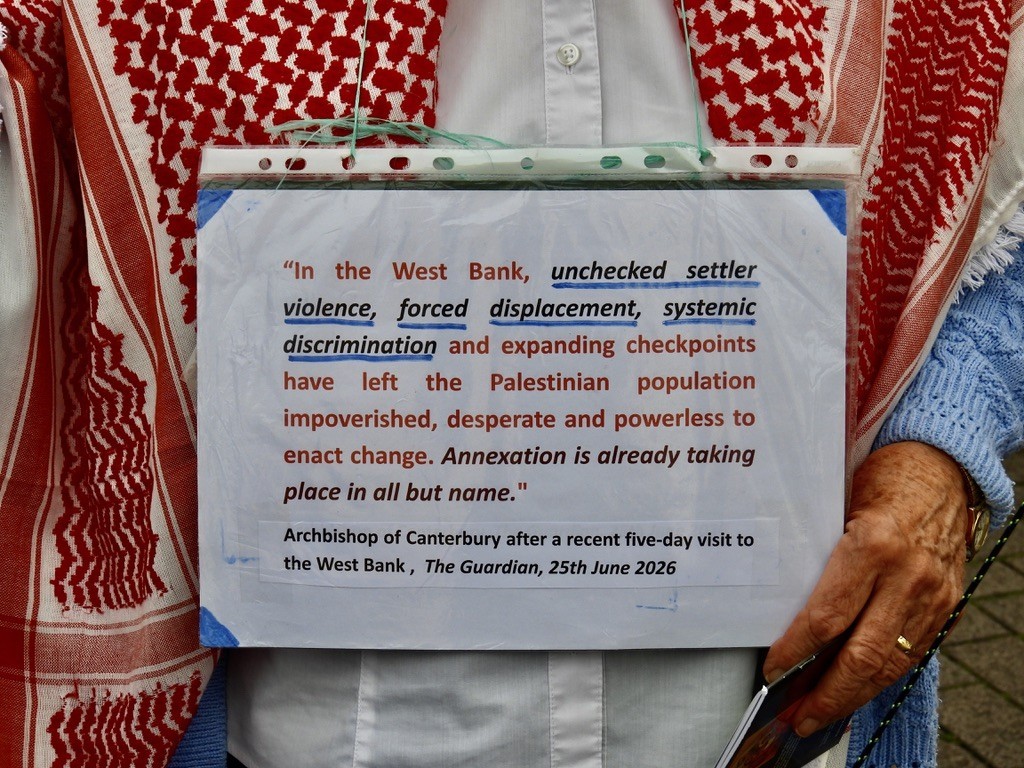
The Supreme Court has controversially overturned the High Court ruling that declared the ban on Palestine Action to be unlawful. This means that the ban on Palestine Action is restored and charges stand against the 700 plus people being charged under the Terrorism Act. Tom Southerden, Amnesty’s legal programme director, said that it was fundamentally disproportionate to treat direct action protest as terrorism and claimed that the images of people from all walks of life, from nurses and pensioners to military veterans, being bundled into police vans for peacefully holding placards would be long remembered as a deeply shameful chapter in our history.
Subsequently, on 12 June the four Palestine Action activists known as ‘the Filton 4’ were told by Judge Mr Justice Johnson they would be sentenced as having a ‘terrorist connection’ following convictions for criminal damage arising out of their direct action at the Elbit Systems arms factory in Filton, Bristol. Criticisms of these verdicts have been widespread in the UK and the UN.
Kerry Moscogiuri, Amnesty International UK’s Chief Executive, concluded:
“The defendants in this case were sentenced as terrorists because prosecutors want to make an example of them and set a precedent for how direct action protesters could be treated in the future. Criminal damage has never been treated as terrorism within the UK justice system before and it is dangerous to treat them as the same thing. We should all be worried about what this means for other individuals taking direct action in protest of a genocide or any other issue. The right to protest is one of the most effective tools we have to hold our leaders to account and today is another step in the ongoing crackdown in this country against it. The use of terrorism laws against direct action protesters must end”
Equality and Human Rights Commission Transgender guidance
A total of 135 MPs, 69 of them from Labour, have signed a Commons motion calling for the code of practice on transgender people, recently drafted by the Equality and Human Rights Commission, to be blocked, primarily because of worries about its impact on transgender people and also the possibility of legal challenges. It’s unlikely that the guidance will be stopped, as the government has declined to allow a vote, but there is pressure on ministers to listen, and possibly to consider new legislation to resolve the problem. The 40-day period for the code to be laid before parliament ends early next month, after which it will become law.
Right to privacy/freedom of information
The High Court has rejected attempts by Nigel Farage’s Reform party to dismiss the challenge from the Good Law Project that they must be more transparent in how they hold data of members of the public. Before the general election, Good Law Project supporters demanded that political parties reveal how personal data is held and used, as the law requires them to do. Notably most requests to Farage’s Reform party received no response.
It is legitimate for political parties to combine the electoral roll with other data they’ve captured to target people with tailored ads and messages. This itself raises questions in a democracy, but is particularly concerning when micro-targeting is done by a far-right party like Reform which currently is experiencing issues over transparency especially over their funding. The Good Law Project will now sue Reform.
Oversight for Police AI
Liberty is calling on the government to establish oversight for the increasing use of AI by police. They demand full transparency in response to public concern; binding rules on what data can be fed into police systems; independent testing and continuous monitoring; accountability to a designated human of decisions resulting from AI; training of officers in its use, limitations and their responsibilities; clear recording and auditing of how decisions are reached; and an independent regulator to enforce these standards.
Workplace rights
The Equality and Human Rights Commission (EHRC) has published new commissioned research on harassment in the workplace. The rapid evidence review shows how organisations can prevent problematic behaviours, fulfilling the legal obligations introduced by the Worker Protection Act.
The research highlights the importance of reporting mechanisms but warns that organisations should not rely on the number of harassment reports to determine if they have a problem. Low harassment reporting rates they say may indicate a workplace in which employees feel unable to report, rather than the absence of harassment.
The study also suggests that when employers are purely motivated by reputation management, policies often involve ineffective ‘box-ticking’ interventions which, in isolation, fail to prevent harassment or protect their employees. It concludes that to be effective, interventions need to be implemented consistently, reviewed regularly and involve multiple approaches to increase awareness of harassment through training and communication.
Transfer of jurisdiction under scrutiny
UK police forces have faced severe criticism for ceding jurisdiction to the US military for off-duty crimes committed by their personnel on British soil, preventing such cases from ever reaching the Crown Prosecution Service
Following the high profile challenge launched by the mother of Harry Dunn, in which only after a long legal battle the CPS succeeded in the prosecution of the American driver responsible for his death, a second instance of a failure of the British Government to protect its citizens has recently come to light. Sarah Steele, who was strangled by an American pilot, failed to have her case heard in a British court when the US military transferred the hearing and judgement to their own court. The defendant was subsequently expelled from the military but found guilty of only one of two charges. Justice Secretary David Lammy undertook to raise the case directly with the US government.
Terrorism bill
We shall be saying more about this bill and its worrying aspects in a future post.