A happy New Year to our readers around the world!
Greetings
A happy New Year to our readers around the world!
Promoting human rights from Salisbury UK
A happy New Year to our readers around the world!

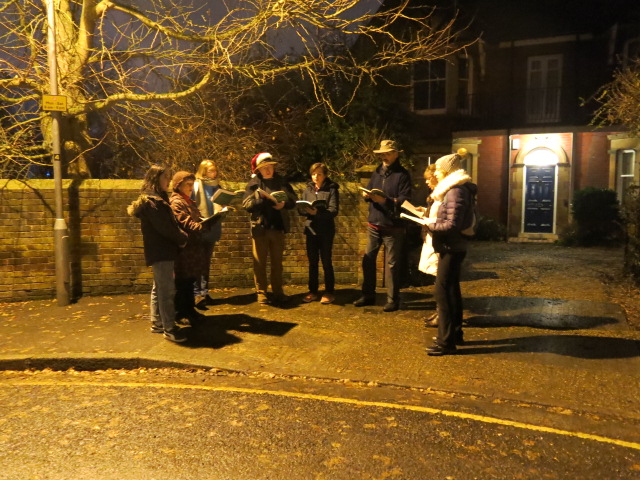
Once again, the Farrant Singers entertained some of the residents in Salisbury with some beautifully sung carols on Monday 19 December. They sang in and around Marlborough Rd; College St; Victoria Road; Albany and Belle Vue Rds. Afterwards we enjoyed soup and cheese generously provided by Michael and Chantal washed down with vin chaud.
A successful evening and many residents came out to enjoy the singing.
Follow us on Twitter and Facebook – salisburyai
If you are reading this in the Salisbury area and are thinking of joining Amnesty there are several ways of doing so. You can join Amnesty International itself for which there is a joining fee and you will receive their magazine. Or you can just join our group which is free. The level of your involvement is of course up to you. Help with our campaigns in the street is always welcome or on the stall we run once a year. You can come to the annual film we do in conjunction with the Arts Centre and stay on to help with the signing afterwards. If you have a particular topic of interest – which might be a country you know about – then making that a focus of your activity is a possibility. The best way is to come to one of our events which you will see here or on Twitter or Facebook (salisburyai), and make yourself known.
Salar Shadizadi has been sentenced to death for a second time and is now in solitary confinement. He was 15 at the time he committed the crime and it is contrary to the Iran penal code to execute minors. Please write if you can.
We are pleased to attach the minutes of the December meeting thanks to group member Lesley for preparing them.
It’s less than a week until the Arts Centre in Salisbury is showing the film Mustang set in Turkey.
This 2015 internationally co-produced film is directed by Turkish-French film director Deniz Ergüven. Set in a remote Turkish village it depicts the lives of five young orphaned sisters and challenges they face growing up as girls in a conservative society. In a Turkish village, the orphaned sisters (Günes Sensoy, Tugba Sunguroglu, Elit Iscan) live under strict rule while members of their family prepare their arranged marriages. The event that triggers the family backlash against the five sisters at the beginning of the film is based on Ergüven’s personal life.
Starts at 7:30 and doors open at 6:45. Tickets £8 with concessions. It has a 15+ rating.
Each year thousands of people in the UK write letters or send cards in solidarity with those suffering humans rights abuses around the world pas part off Amnesty’s Write for Rights campaign.
As a result, people have been freed after having been unfairly imprisoned, human rights defender who have been threatened and harassed by authorities have been able to live freely without intimidation and forced evictions have been halted.
Sending a message of support to those whose rights are being abused and also to the authorities on that person’s behalf is powerful. Imagine drowning in thousands of letters of encouragement and solidarity – in fact, imaging the officials who will see and deliver thousands of cards to the victims and their families. The effect on both is priceless. It shows the authorities that that individual is not alone and that all over the world thousands of people are standing up for them.
People featured this year include:
airport as she was about to board a return flight to London with her 22 month old daughter.
Salisbury Methodist Church is hosting a Write for Rights event from January 4th to 15th and people are invited to see the exhibition and send a message of support. The church will be open from 10 am to noon.
We hope local readers will be able to support this initiative and come along at some time on those 2 days and sign something.
Follow us on Twitter and Facebook @salisburyai

December 2016
The latest death penalty report is now available thanks to group member Lesley for compiling it. Generally gloomy with several countries around the world reverting – or threatening to revert to – the penalty.

The prime minister, Theresa May, is on an official to Bahrain amid controversy about the poor state of human rights in the kingdom. It is really quite difficult to grasp quite what the Prime Minister means when she says the ‘UK must not turn our back on the human rights abuses of foreign countries’ as she prepares to sign various trade deals which does precisely that. There is a growing hint of riddle like statements from her including the meaningless ‘Brexit means Brexit’.
There now seems to be a desperate urge to secure trade deals ahead of our departure from the EU and the Gulf states are fertile ground. She is quoted in the Guardian (5 December 2016)
There will be some people in the UK who say we shouldn’t seek stronger trade and security ties with these countries because of their record on human rights. But we don’t uphold our values and human rights by turning our back on this issue. We achieve far more by stepping up, engaging with these countries and working with them.
So the argument is that Bahrain has a questionable human rights record and that by working with them, and doing business, we can exert some kind of influence to encourage them to stop torturing or otherwise mistreating their people. Since we have been trading there for some time, we would expect that the country would be slowly improving as a result of our influence. The problem is that it isn’t. As Human Rights Watch and Amnesty have said:
Bahrain’s 2016 “reform” agenda has consisted of an assault on core elements of civil society and jailing or deporting government critics. Last month, Amnesty International accused UK Ministers of acting like “overexcited cheerleaders for Bahrain’s woefully inadequate reforms.”
On December 4, Human Rights Watch and others wrote to Prime Minister May to complain about the British government’s ‘abject failure to exert any positive influence’ in Bahrain. We didn’t call on the UK to end trade or security ties, but rather to use the UK’s influence to help put a stop to an orchestrated attack on rights that has badly undermined any prospect of the reform that the UK claims to support.
What exactly “working with” Bahrain to “encourage and support” reform amounts to, remains to be seen. But one thing is clear – human rights will not be at the center of the UK’s relationship with Bahrain.
This is especially worrying in the context of the post Brexit world. The UK will be in a tough position trying to develop trade outside the EU. We will not be in a position to exert any kind of influence on countries like Bahrain if we want to continue to sell them weapons. There will be lip service of course and meaningless phrases from the prime minister and other ministers to assure us that persuasion has been applied to improve human rights. The reality is we will have to accept what’s on offer and be thankful for it. In the context of the Gulf states for example, we export more to them than to China, a situation unlikely to change anytime soon.
Ministers cannot quite bring themselves to say that in reality, there is little they can do and often little they want to do. We must remember also the ‘revolving door’ through which ministers, senior civil servants and top military brass, pass to secure lucrative directorships with the very companies doing the deals in countries like Bahrain. There is little incentive to upset the apple cart.
See also College of Policing.
Follow us on Twitter and Facebook, @salisburyai
The Investigatory Powers Bill became law this week and it is a dark day for democracy, not just in the UK, but the signal it gives to the rest of the world. That one of the oldest democracies in the world should want to garner for itself, a whole set of powers to pry into peoples communications and to find out journalists’ sources is a matter of shame. It will provide increased encouragement to regimes around the world to clamp down further on their citizens.
The wonder of it is that so many people are so relaxed about it. Although over 130,000 people protested, the government took little notice.
The state needs to have a security apparatus. When the nation is under threat either in the time of war or by terror groups, it must have the means to investigate. This is likely to mean eavesdropping in some form or other.
There is also the issue of secrecy and confidentiality. People in government should have the means to discuss ideas and float policy ideas without it being published in the media – to start with at least.
Technology has provided a means now to invade individual’s private space with ease. Technology has surpassed the law in this regard. Nearly all the key technologies are operated out of Silicon Valley in the USA over which we have no control. Is it not interesting that Britain voted to come out of the European Union and one of the key reasons was sovereignty. Yet in this regard, sovereignty is in California.
The Guardian reports:
The new surveillance law requires web and phone companies to store everyone’s web browsing histories for 12 months and give the police, security services and official agencies unprecedented access to the data.
It also provides the security services and police with new powers to hack into computers and phones and to collect communications data in bulk. The law requires judges to sign off police requests to view journalists’ call and web records, but the measure has been described as “a death sentence for investigative journalism” in the UK. (29 November 2016)
The increasing ability to intercept communications has and is having an effect on free speech. It is described as having a ‘chilling effect’. Journalists working on these topics have to go to extraordinary lengths to cover their tracks. Material has to be hidden abroad for protection from the security services. Some other issues are more open to debate.
In case of war and terrorist attacks, the media quickly falls into line and the normal business of tackling government ministers is forgotten. It quickly becomes a matter of supporting ‘our boys’ and even questions of the quality of kit for example do not get asked.
The crucial issue is one of power and control. The very business of being able to pry into anyone’s private affairs gives the state enormous powers. As citizens we should expect that these powers are used when necessary; are subject to control wherever possible (like the controls on searches); are subject to close scrutiny, and are in accord with properly laid down laws. Controls on operational matters should not be in the hands of politicians who cannot on the whole be trusted with secrets of this nature. The level of intrusion should be matched by the degree of scrutiny.
As usual, supporters of snoopery will trot out the old adage that if you have nothing to hide you have nothing to fear. This is, in its most fundamental way, true. But the trouble is that as with all these moves what we are seeing is only the thin end of a very long and dangerous wedge. Most law-abiding people have no reason to worry about other people knowing what websites they have visited. But once you give the authorities the ability to do this history tells us that this ability will, inevitably, end up being abused. (Daily Mail)
In the 3 or so years that the ‘Snooper’s Charter’ has been debated, it is often stated by members of the public that they are not concerned and if the security services want to listen in to their conversations with their auntie they are free to do so – ‘I’ve got nothing to hide’ is the frequent refrain. Yet if police and security services arrived at their front door and searched their house and computer without a warrant or reason to do so, they would be outraged. Is the difference just that one is visible and the other isn’t?
Likewise, if you asked these same members of the public ‘do you trust our politicians?’ they would think you were a little mad. Yet they are happy to allow them or their agents to intrude into their affairs. The current Home Secretary is Amber Rudd and readers of Private Eye and the Daily Mirror will have read several revelations about her less than honest business affairs involving dodgy companies and diamond mines. Questions have also been asked about her tax affairs. To her, the nation entrusts its secrets.
To come of course is the promised withdrawal from the European Court and the threatened repeal of the Human Rights Act.
We have not lived in a state such as existed in East Germany, Romania or the Soviet Union where the degree of control was extreme. Thus people in the UK are not aware of the harmful effects of giving too much power to those in power.
Finally, is it even sensible in its own terms? Someone once said that hunting for terrorists was like ‘hunting for a needle in a haystack’. Is it wise then to increase the size of the haystack?
Chilling.
Follow us on Twitter and Facebook – salisburyai
Further information on UA: 72/16 Index: MDE 13/5217/2016 Iran Date: 25 November 2016
Himan Uraminejad has been warned by prison officials that he is at risk of execution as Iran’s Head of Judiciary has approved the implementation of his death sentence. He has been on death row since 2012 for a crime committed when he was 17 years old.
Amnesty International has learnt on 21 November that Himan Uraminejad, aged 22, was informed by prison officials on 6 October that the Head of Judiciary had approved the implementation of his death sentence and his family should intensify their efforts to seek a pardon from the family of the deceased because his execution could be carried out at any moment. He was sentenced to death in August 2012 after a criminal court in Kurdistan Province convicted him of murder over the fatal stabbing of a boy during a group fight. He was 17 years old at the time of the crime.
In September 2014, the Supreme Court quashed his death sentence and granted him a retrial, based on new juvenile sentencing provisions in Iran’s 2013 Islamic Penal Code. In June 2015, however, he was sentenced to death again. The criminal court presiding over his retrial referred to an official medical opinion that found “no evidence of a disorder at the time of the crime that would remove criminal liability”. The court also referred to Himan Uraminejad’s statements that he had no “mental illness or history of hospitalization” and understood killing someone was “religiously forbidden” (haram). The Supreme Court upheld the death sentence in November 2015 and rejected a subsequent request for retrial.
Grossly unfair trial
Himan Uraminejad (pictured, left) was sentenced after a grossly unfair trial that relied on evidence obtained through torture. He was arrested on 22 April 2012 when he was 17 years old. He was subsequently transferred to an undisclosed detention centre where he was held for 20 days, without access to his family and lawyer. He has said that during this period, he was tortured, including by repeated beatings that left scars and bruises all over his face and body, and suspension from the ceiling by a rope tied to his feet. He has said that police also raped him with an object shaped like an egg, threatened to cut off his testicles and walked over his body with boots. Himan Uraminejad’s trial was held before an adult court, without special juvenile justice protections. The court ordered no investigation into his allegations of torture.
Please write immediately in English, Persian, Arabic, French and Spanish or your own language:
– Urging the Iranian authorities to halt any plans to execute Himan Uraminejad, and commute his death sentence without delay;
– Urging them to ensure that his conviction is quashed and that he is granted a fair retrial in accordance with the principles of juvenile justice, in particular ensuring that no statements obtained through torture and other ill-treatment
are admitted as evidence;
– Urging them to ensure his allegations of torture are investigated and those responsible are brought to justice;
– Immediately establish an official moratorium on executions with a view to abolishing the death penalty.
PLEASE SEND APPEALS BEFORE 6 JANUARY 2017 TO:
Head of the Judiciary
Ayatollah Sadegh Larijani
Prosecutor General of Khoy
Hojatoleslam Alizadeh
And copies to:
President
Hassan Rouhani
PLEASE SEND YOUR APPEALS FOR THE ATTENTION OF THE AUTHORITIES IN IRAN VIA THE UK EMBASSY:
H.E. Hamid Baeidinejad, Embassy of the Islamic Republic of Iran, 16 PRINCES GATE LONDON SW7 1PT, Tel: 02072254208 or 02072254209 Email: iranconsulate.lon@mfa.gov.ir
Please check with your section office if sending appeals after the above date. This is the first update of UA 72/16.
Further information: https://www.amnesty.org/en/documents/mde13/3722/2016/en/
ADDITIONAL INFORMATION
The minimum age of criminal responsibility in Iran is set at nine lunar years for girls and 15 lunar years for boys. From this age, a child who is convicted of murder or crimes that fall in the category of hodud (offences that carry inalterable punishments prescribed by Shari’a law) is generally convicted and sentenced in the same way as an adult. However, since the adoption of the 2013 Islamic Penal Code, judges have been given discretion not to sentence juvenile offenders to death if they determine that juvenile offenders did not understand the nature of the crime or its consequences, or their “mental maturity” is in doubt.
The criteria for assessing “mental growth and maturity” are unclear and arbitrary. As illustrated by the case of Himan Uraminejad, judges often conflate the issue of lesser culpability of juveniles because of their lack of maturity with the diminished responsibility of people with mental illness, concluding that the juvenile offender was not “afflicted with insanity” or was “in a healthy mental state”, and therefore deserved the death penalty. Sometimes, judges focus exclusively on whether the juvenile could tell that it is wrong to kill a human being, and disregard interdisciplinary social science studies on the relationship between adolescence and crime, including neuroscientific findings on brain maturity, which have informed juvenile justice principles considering juveniles less culpable than adults due to their developmental immaturity and cognitive limitations (see Growing up on death row: The death penalty and juvenile offenders in Iran, https://www.amnesty.org/en/documents/mde13/3112/2016/en/).
As a state party to the Convention on the Rights of the Child (CRC), Iran is legally obliged to treat everyone under the age of 18 as a child. This is different from the minimum age of criminal responsibility, which is the age below which children are deemed not to have the capacity to break the law. This age varies between countries, but it must be no lower than 12 years, according to the UN Committee on the Rights of the Child. People who have broken the law who are above the minimum age of criminal responsibility, but under 18, may be considered criminally responsible, prosecuted, tried and punished. However, they should never be subjected to the death penalty or life imprisonment without the possibility of release.
The UN Committee on the Rights of the Child reviewed Iran’s implementation of the CRC in January 2016. The Committee’s Concluding Observations expressed “serious concern” that the exemption of juvenile offenders from the death penalty is “under full discretion of judges who are allowed, but not mandated to seek forensic expert opinion and that several persons have been resentenced to death following such retrials”. Beside Himan Uraminejad, Amnesty International is aware of several other cases, including Salar Shadizadi, Hamid Ahmadi and Sajad Sanjari, who have been retried, found to have sufficient “mental maturity” at the time of the crime and sentenced to death again. Amnesty International is also aware of at least 15 juvenile offenders who have been sentenced to death for the first time since the adoption of the 2013 Islamic Penal Code.
Amnesty International has recorded at least 75 executions of juvenile offenders between 2005 and 2016, including two in 2016. One of them was Hassan Afshar, who was hanged in July. Iran’s lack of transparency on its use of the death penalty means that the total number of executions of juvenile offenders could be much higher. According to a UN report issued in 2014, at least 160 juvenile offenders are now on death row. Amnesty International has been able to identify the names of 78 of these juvenile offenders. Some of them have been on death row for over a decade and are either unaware of their right to seek a retrial based on the new provisions of the 2013 Islamic Penal Code or do not have the means to retain a lawyer to seek it for them.
The Head of the Judiciary must provide a type of approval known as estizan in all cases where the death penalty has been imposed under the Islamic principle of “retribution-in-kind” (qesas) before the sentence can be implemented.
Further information on UA: 72/16 Index: MDE 13/5217/2016 Issue Date: 25 November 2016
WE WANT TO HEAR FROM YOU! Please let us know if you have taken action on this case. You can either include us – iar@amnesty.org.uk – in the email you send to the authorities or send us a separate email if you’ve sent your appeal by post or fax. Tell us any way you like! All we need to know if that you’ve sent an appeal and the UA number – which is at the top of each email. Thank you.
We are now on twitter, follow us for information on Urgent Action cases: @AmnestyUKUrgent
You can view all UAs on our website here.
Follow us on Twitter and Facebook – salisburyai

 Amnesty in Salisbury & South Wiltshire