Conservatives plan to scrap the Human Rights Act


UPDATE: 5 May  … still no sign of a draft of what the British Bill of Rights will contain.  People go to the polls in a couple of days time without knowing what is planned.  Since the election campaign has been based largely on the deficit and who is going to spend the most on the NHS, oh and being run by Scotland: what is, or is not, in the BBoR may seem trivial.  But it touches on all our rights and on our relationship with Europe so it is important. 

The #Conservative party #manifesto was published today 14 April and as promised, there is a plan to scrap the Human rights Act #HRA.  The manifesto says on p73:

We will scrap Labour’s Human Rights Act and introduce a British Bill of Rights which will restore common sense to the application of human rights in the UK.  The Bill will remain faithful to the basic principles of human rights, which we signed up to in the original European Convention on Human Rights.  It will protect basic rights, like the right to a fair trial, and the right to life, which are an essential part of a modern democratic society.  But it will reverse the mission creep that has meant human rights law being used for more and more purposes, and often with little regard for the rights of a wider society.  Among other things the Bill will stop terrorists and other serious criminals who pose a threat to our society from using spurious human rights arguments to prevent deportation.

This will have profound implications in our relations with Europe and we still do not know what the new bill will look like even after many years of discussion about the abolition of the HRA.  Incidentally, although the Act was introduced under the Labour administration, it was voted for by many Conservatives as well.

A draft of the BBoR has been a long time a coming and the latest we heard was that it was to be published before Christmas.  One assumes a draft will now appear before polling so that voters can see in more detail how it differs from the existing HRA.

The Conservatives seem to have got themselves into something of a bind with this Act.  They were happy to go along with the anti-European sentiment expressed by most of our newspapers and were obviously spooked by the Ukip surge over the last few years.  There has been a torrent of misinformation and disinformation about the workings of the HRA which, apart from the honourable exception of Dominic Grieve MP, they have made little or no attempt to counter with facts.

What got them steamed up most of all – and got our tabloids into a fearsome lather – was the case of Abu Qatada or the ‘preacher of hate’ as he was called.  Many attempts were made to deport him but the problem was not just the HRA but the fact that he might be tortured when he was returned to Jordan, or the Jordanians would convict him using evidence obtained from torturing others.  Is this an example of ‘spurious human rights arguments’?  Since, quite apart from the ECHR, we are signatories to treaties banning the use of torture, there was a problem in getting him out of the country in any event.  We might note in passing that the Jordanians had to clean up their judicial act as part of the agreement to send him back.

A puzzle though is that the other area which gets politicians steamed up is the issue of a right to life yet this is quoted as being ‘an essential part of a modern democratic society.’  Something about a cat.

The fact remains that many ordinary people are beneficiaries of the Act.  Lawyers can use it in their day to day work with individuals and their dealings with authorities of one kind or another.  Little of this gets published in the media and most are unaware of it unless by chance they know of someone who has benefited.

As far as the Strasbourg court is concerned, the UK are the ‘good guys’ since we still have a largely uncorrupted police and judiciary and people can appeal decisions in cases of injustice.  Our police operate under PACE and suspects have a right to a lawyer.  Very few of the cases which go to Strasbourg get overturned – we believe there were only eight last year.

As one of the original countries, along with France, who prepared the ECHR after the war at the behest of Winston Churchill – a Conservative – if we leave the Convention it will have significant repercussions in places like Belarus, Turkey and Russia.  Belarus is the last country in Europe with the death penalty and human rights are largely ignored.

It will be interesting to see how our local Conservative candidate John Glen reacts to this.  When he came to see the local group to discuss this topic he did agree to be more balanced in his comments which we welcomed.  This followed an article in the Salisbury Journal saying he wanted it abolished.  But now it is part of the manifesto for his party we shall have to see…

Death penalty report: April


This is the monthly report on the state of death penalty around the world, thanks to Lesley for compiling it.

No to the death penaltyThe news that Ray Hilton has been released after 28 years on death row is both heartening and shocking.  That the state of Alabama should have so badly conducted his trial and then refused to allow the fresh ballistic evidence to be heard, which was the only evidence against him, is particularly shocking.  There can be few better examples of the dangers of this penalty than a case such as this.

Death penalty report APRIL 2015

Death penalty report


texas executionThis month’s #deathpenalty report is attached thanks to Lesley.  It makes depressing reading especially concerning countries in South East Asia and #Pakistan.

Report

Monthly meeting


The monthly meeting took place tonight, Thursday 19 March at 7.30 as usual.  It was held over from last week as we had the Cathedral lecture and service.  A fuller report will appear soon.

Agenda

Amnesty award


It was announced in the Salisbury Journal this week that a group of students at Burgate School in Fordingbridge, Hampshire has won the Amnesty International Youth award for the ‘most committed’ category.  Every congratulations from the Salisbury Group.


New link added to the list: Globalconsilium

Magna Carta and Human Rights Today


Around 160 people attended the Cathedral this evening to hear Dominic Grieve QC MP give a brilliantly lucid lecture in support of the Human Rights Act.  He traced some of the key clauses of the Magna Carta and showed how they had continuing relevance today.  We hope to include a transcript of his lecture soon.  His lecture followed the annual Amnesty evensong which also was very well attended with around 120 people.

#Morocco film


UPDATE 25TH MARCH

The film Bastards (12A) was shown this Wednesday 25 March starting at 7.30 and the audience reaction was very positive indeed.  There were many questions to the producer Deborah Perkin.

This is a fascinating and highly-acclaimed documentary about one Moroccan woman’s struggle to legitimise her daughter and the director, Deborah Perkin will be there to answer questions.  The film follows an illiterate young woman who took on her own family and the Moroccan justice system for the sake of her illegitimate child.   It is a gripping, moving and uplifting documentary from the cutting edge of Islam.
Deborah Perkin is the first person to film in a court in Morocco, a country which leads the world in its legal efforts to give women and children more rights under Sharia law.

In Morocco, as in all Muslim countries, sex outside marriage is illegal and women bear the brunt of society’s disapproval.  But what is the fate of the children of those single mothers?  They cannot attend the better schools, are turned away from infant immunisation clinics and refused government posts.  Jobs, housing and a huge range of social advantages are denied them.  They are despised outcasts, condemned to a life of discrimination.  Bastards is the first film to tell this story from a mother’s point of view.


stop_tortureWe shall have a petition to sign about torture in Morocco.  Morocco is one of the five countries highlighted by Amnesty International in its #StopTorture campaign.  We are pleased to say many people signed our petitions at the end of the showing.  Thanks to the Arts Centre.

Afghanistan


Britain’s role in Afghanistan is coming to an after over a decade of bloodshed and war.  It is doubtful that the country is in a fit state to function effectively since the Taliban and the warlords are still very much in evidence and there are reports of ISIS being present in the country as well.  After all this time it is easy to forget some of the original aims which were defeating terrorism and the Taliban.  We can also forget that it was the CIA who helped establish, arm and train the Taliban in order to assist them in their fight with the Russians.

One of the major victims of the years of war is women.  It has turned thousand of Afghan women into refugees and widows – or both – and made it dangerous for them to seek schooling, go out to work, get healthcare or secure paid employment.  Before the arrival of the Taliban in 1996, women’s rights had steadily improved and indeed, there are many photographs from that era women and girls in schools and university with not a burqa or veil in sight.  Improving the rights of women became one of the additional aims of the invasion and it will be recalled that Cherie Blair – wife of the then Prime Minister, Tony Blair – hosted an event in 10, Downing Street in 2001 with this aim in mind.  Kofi Annan said:

There cannot be true peace and recovery in Afghanistan without a restoration of the rights of women.

Similar sentiments were expressed by the then secretary of state Colin Powell:

The recovery of Afghanistan must entail a restoration of the rights of women, indeed it will not be possible without them.

Abdul Hakim Hashemi  Hademi
Abdul Hakim Hashemi Hademi

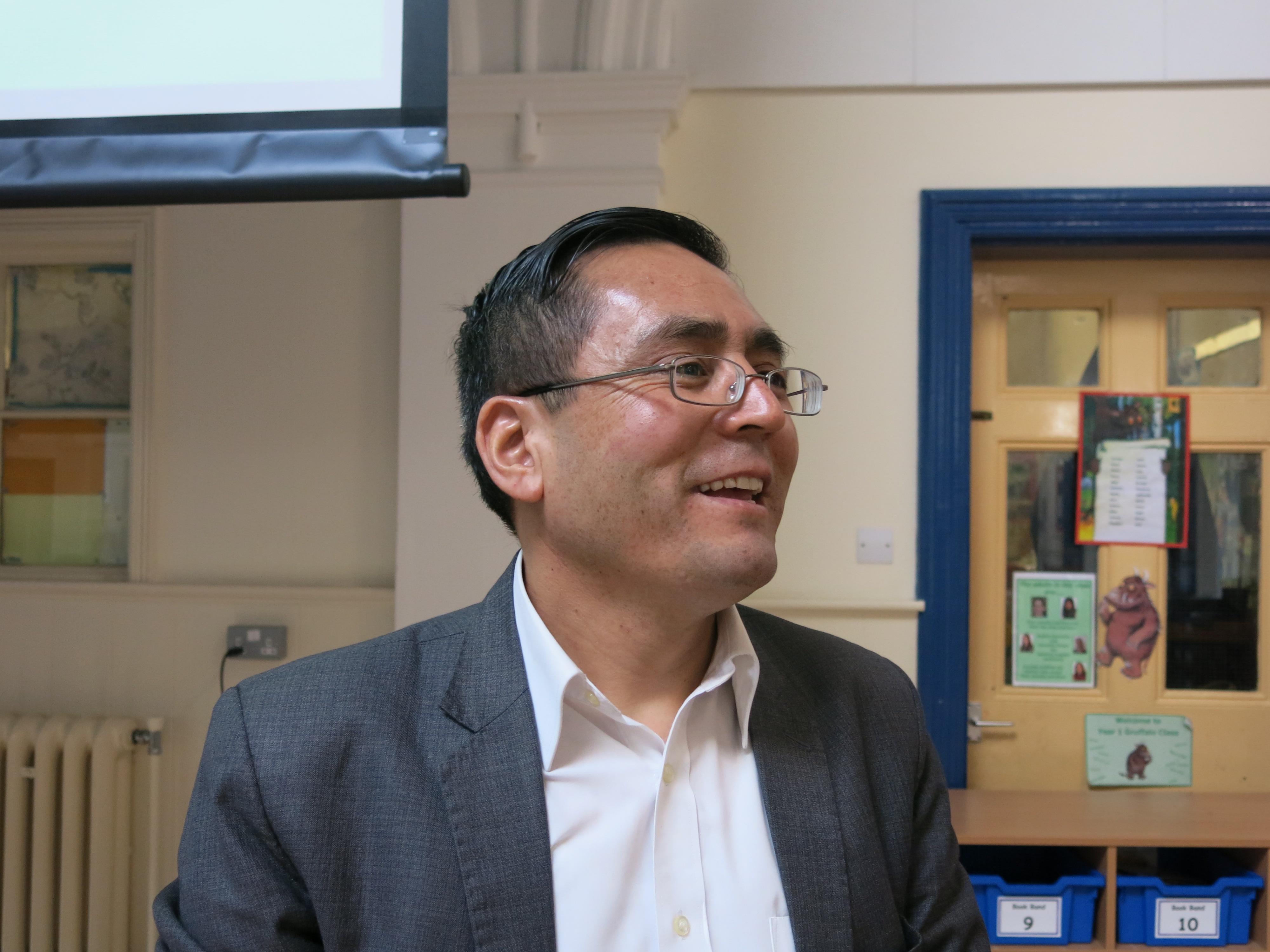
At the South West regional conference of Amnesty International it was heartening to hear from someone who has worked to improve the status of women through theatre and artistic groups in the countryside.  The speaker was Abdul Hakim Hashemi Hamidi who set up the Simorgh Film Association of Culture and Art, SFACA.  Unlike many aid programmes which tend to stay in Kabul or the main cities, SFACA goes out into the countryside and to the villages.

He has organised educational theatre workshops in prisons, juvenile correction centres, drug addiction rehabilitation centres, in schools and with the police.  He has produced films with an emphasis on human rights and the role of women.

Not all the problems faced by women are solely to do with the Taliban. Another factor is honour killings which are at a very high rate in the country.  57% are identified as the responsibility of a family member and 21% by the husband.  The perpetrator of 43% killings is unclear however.  A telling quote from the PowerPoint display was:

A problem with women [is] because men don’t accept women have rights

He went on to discuss the problems of human rights defenders in Afghanistan. These included difficulty in

Delegates at the South West Region conference

travelling to some areas combined with a lack of government control in some parts of the country, traditional beliefs and illiteracy.  Religion was a main cause he said and human rights are seen as a western construct.  He urged that the UK government consider the role of human rights defenders in their discussions with the Afghans.

It was an interesting and uplifting talk by someone who has taken risks to go into the Afghanistan countryside to promote the rights of women.  Abdul is a visiting fellow on the Protective Fellowship Scheme for Human Rights Defenders at York UniversityThere is a permanent link to the York University Centre for Applied Human Rights at the bottom of the main page.

Sources:

Watson Institute

Global Research

Amnesty International

February minutes


The February minutes are below thanks to Karen.  A full agenda as you see with a lot going on.

February minutes

Blog at WordPress.com.

Up ↑