Gaza situation worsens with no real end in sight. Labour party prevaricates over Palestine
July 2025
UPDATED 28 JULY
It seems unbelievable that in the 21st century, we should be witnessing the ever deteriorating situation in Gaza. Currently, famine is adding to the misery of destruction. Around 59,000 have died by some estimates but the ultimate death toll will be much higher as thousands lie undiscovered in the ruins. Images on our screens each evening of starving people, infants with emaciated arms and legs and scenes of mayhem at the food points now being managed by Israeli and American agencies are beginning to strike home. Over 1,000 have been killed at these food stations and images of people clamouring for a ladle of some kind of lentil stew are shocking.
Our own government continues to vacillate over whether to recognise Palestine. One is inclined to say to them, ‘leave it much longer and there won’t be much left to recognise’. Israel continues to blame Hamas for what is happening and it cannot be denied they have a role in it. They also blame the UN for the failure to distribute the aid which is there much of which is rotting. No independent journalists are allowed into the area so verification is hard to achieve. In view of the history of the UN, both here and elsewhere in the world, in distributing aid in difficult situations, it stretches the imagination that they are wilfully withholding supplies. That the IDF is making life as difficult as possible and imposing multiple restrictions seems more likely to be true.
It also fits with the narrative of several of the Israeli cabinet who have made extreme comments about the future of Palestinians. The violent settler activity in the West Bank, where journalists can get access sometimes also suggests, a deliberate policy. We see settlers attacking Palestinian villages and homes with the army looking on.
Foreign Secretary Lammy a member
We discovered this week, courtesy of Declassified UK, that around 130 Conservative MPs, including the MP for Salisbury John Glen, are members of ‘Conservative Friends of Israel‘ along with 40 Labour members. Together they have received over a third of a million pounds of funding and with other front groups the total is over £0.5m. It is the largest lobbying group in the Commons. Included in the list are several members of the Cabinet including David Lammy, the Foreign Secretary who is also alleged to have received over £30,000 from Jewish interests. Sir Keir Starmer has received £50,000 from Trevor Chinn described as a ‘Jewish Grandee’ who promotes Israeli causes in the UK. He was awarded the Israeli Presidential Medal of Honour for services to the state of Israel.
So while arrests take place of people alleged to be supporting Palestine Action, a significant number of MPs enjoy funding from Israeli lobbying organisations. Another £0.3m million is given to MPs by Individuals supportive of Israel. Hmm.
Vigil
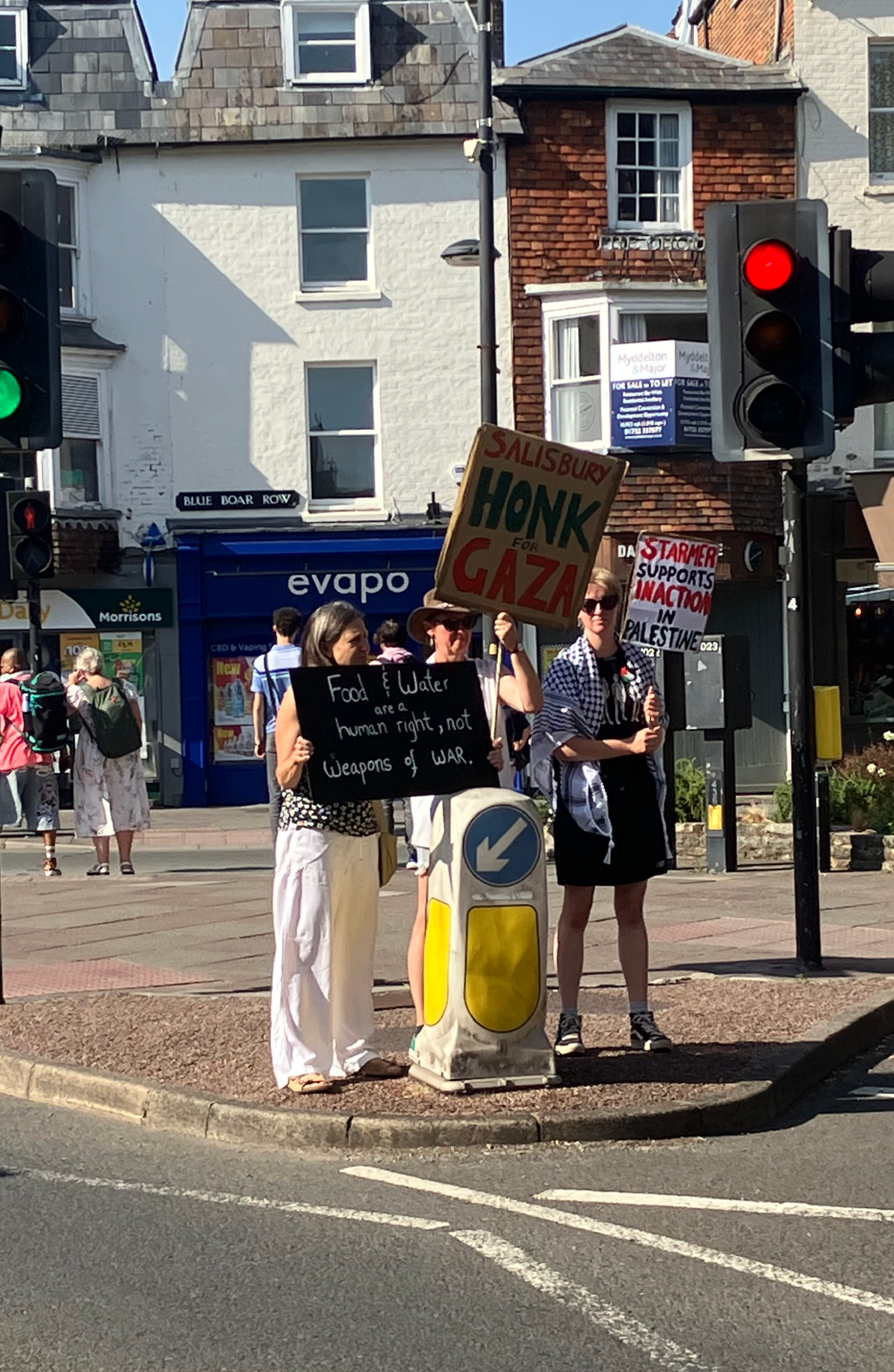
Number 86 took place yesterday (27th) and around 50 attended, the largest for some while. We were delighted to welcome some from Southampton. No sign of the local MP nor any mention of the vigils in his weekly column in the local paper.
Some of our 50 or so supporter on the traffic island.
This YouTube by a Jewish man talking about dehumanising people is a powerful watch.
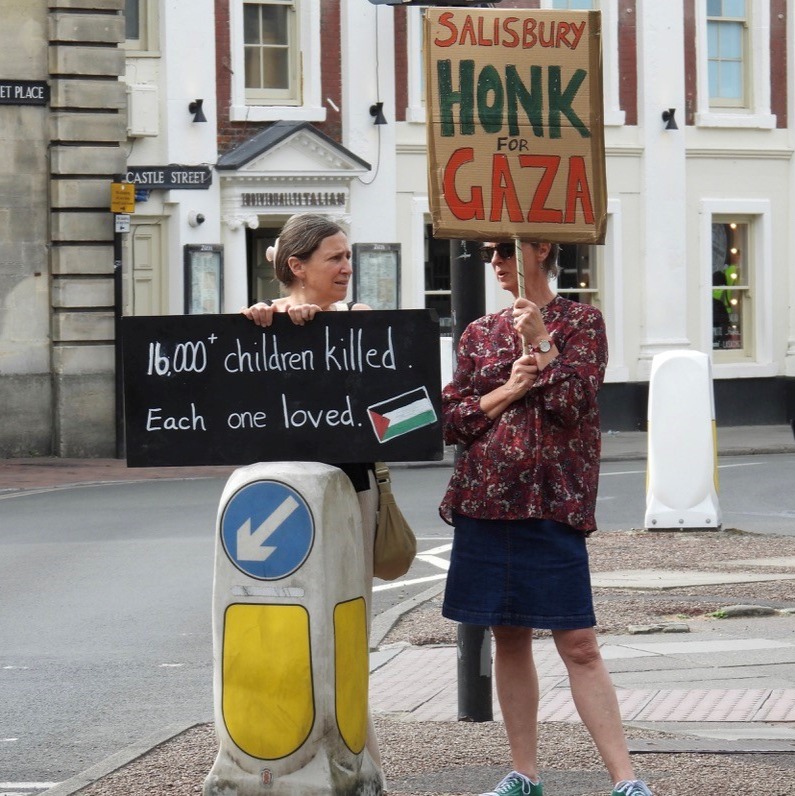
Good turnout again for the weekly vigil with nearly 40 coming. Two of our supporters stood on the nearby traffic island and attracted a significant number of car ‘honks’ – we’ll do that again. The number of ‘recognitions’ that is people who appear to take note of the vigil, was over a 100 approximately.
Following the ban of Palestine Action by the government – a decision widely condemned and not just for the manner in which it was done – someone protesting about Palestine but not PA, was threatened with arrest by armed Kent Police. This seemed to be the very definition of heavy handed and a warning that once legislation introduced to curb and interdict violent terrorists bent on killing people, is used to threaten people engaged in peaceful protests, we should be very concerned. Authoritarianism creeps up on you slowly. A 100 people were arrested on Saturday 19th around the nation.
Shocking revelation about the Charity Commission
A shocking revelation came today that two UK based charities have sent millions of pounds to Israeli settlements with the blessing of the Charity Commission. A charity called UK Toremet has sent £5.7m to the West bank. They are the conduit for another charity the Kasner Charitable Trust founded to assist Zionist causes. The school in question being funded is based near a Palestinian settlement Khirbet Susiya, which was cleared out in 1996 by the IDF. One would have expected the Commission to know that many of the settlements are illegal under internationallaw and that the level of violence against people living there is increasing. See Amnesty report (case study 3).
Baroness Warsi has said that sending money to this illegal settlement in occupied land was ‘appalling’. The Charity Commission says it can do nothing. The charity is legal and operating as it does is not a criminal offence it claims. Anyone who has had dealings with the Charity Commission in the UK knows that they exert considerable and exacting control on what charities do, whom they help, how the money is spent and a host of conditions concerning governance and safeguarding. To give a green light to millions going via a Zionist charity to a settlement violently acquired and existing on illegally acquired land seems to stretching their remit to breaking point.
Al Jazeera reports a further 116 killed today (19 July) seeking food. The death toll is around 58,000.
Horrifying proposals by the Defense Minister widely condemned
July 2025
The proposals by Israel Katz to create a ‘Humanitarian City’ on the ruins of Rafah have shocked many people around the world and many within Israel itself. The idea is to build this city in the tiny area based on the ruins of Rafah in the south of Gaza into which 600,000 Palestinians would enter but not allowed to leave. Eventually the whole of the population would go in. It has been termed a concentration camp and Human Rights Watch has said ‘it inches closer to extermination’. The ultimate idea is to move them all out of the city to a place so far unidentified.
An Israeli human rights campaigner has termed the idea ‘a crime against humanity’. It has also been condemned by a former prime minister Ehud Olmert in an interview on BBC’s World at One radio show today (14 July). It is in keeping with Donald Trump’s statement on Airforce One earlier this year when he talked about ‘cleaning out the whole thing [Gaza]’.
Around 56,000 have now died in the area and every day there are more deaths. Nearly 800 have died since the end of May at the food distribution points. The siege has now lasted 75 days with severe restrictions on aid, food, fuel and medical supplies being allowed in. Those desperate for such limited supplies as are allowed in are being shot at by IDF forces.
What is increasingly clear, and spelled out with the so-called Humanitarian City, is the idea the Israel is responding to the horrific attacks on October 7th 2023 can no longer be produced as a reason for their actions in Gaza. The overwhelming force, the killing of large number of women and children, and the deliberate use of siege as a weapon of war go far beyond a legitimate and proportional response to the attack Israel experienced. The killings are justified on three grounds: that the demolished building contained a Hamas fighter; that underneath the building – be it a hospital, school or a block of flats – is a Hamas control centre, and that Hamas are using those killed as human shields. These reasons are endlessly repeated but almost never challenged. The policy now seems quite clearly to – using President’s Trump’s words – ‘clear out the area’ as though draining a village pond. We have to remind ourselves that we are talking about human beings.
Since foreign journalists are not allowed into the area, independent verification cannot be done. But the IDF which now controls large areas of Gaza have failed to produce any evidence of say, the control centres. Since vast numbers of buildings have been destroyed there must surely be thousands of such centres?
Vigil
We held our 84th vigil on Saturday with over 35 in attendance. Many have contacted the local MP Mr John Glen to tell him about the vigils. He has never attended nor mentioned them in his weekly column in the local paper.
The minutes of our July meeting which is also serves as a newsletter
July 2025
We are pleased to attach our July minutes and newsletter thanks to group member Lesley for producing them. We no longer publish a newsletter due to a lack now of outlets but there is a lot of content in these minutes which would be the basis of such a newsletter. We must also thank group members Andrew and Fiona for their contributions and reports and also Lesley for her work on the death penalty report.
There will not be a meeting in August and the next meeting is on 11 September at 2pm.
Report shows that threats to various rights exist in this country
July 2025
We tend to think of threats to human rights exist elsewhere than in the UK. As this report shows, there are threats to freedom of speech and the right to protest in the UK. There are also issues of poverty which have a dramatic effect on people’s wellbeing. We are grateful for group member Fiona for the work put in to produce this report.
Abortion Law Reform
In an amendment to the government’s crime and policing bill, parliament voted to change the criminal laws that govern abortion in England and Wales so that women procuring a termination outside the legal framework cannot be prosecuted.
The framework of access to an abortion – including the need for two doctors’ signatures, and the time limits at which terminations can be carried out – will remain the same and doctors who act outside the law will still face the threat of prosecution. But women who terminate their pregnancy outside the rules, for example after the time limit or by buying pills online, will no longer face arrest or prison. The offence of inducing a miscarriage carries a maximum sentence of life. The amendment came after growing calls for a change in the law as the number of women investigated, arrested or prosecuted has increased in recent years.
Freedom to Protest
In June the government decided not to continue their appeal against the High Court Judgement brought by campaign charity Liberty, which disallowed the former Home Secretary Suella Braverman’s definition of ‘serious disruption’ as ‘more than minor’ disruption in relation to the policing of protests. This means that Liberty’s original High Court challenge is now legally accepted and the draconian anti-protest laws are now void. Liberty is now demanding a government review of dozens of wrongful arrests and convictions of peaceful protesters that are now invalid.
ECHR Reform
Britain is determined to protect the European Convention on Human Rights claimed the justice secretary but will pursue reform of the ECHR both at home and in Strasbourg. The Home Secretary, Yvette Cooper, said ‘The European convention on human rights is one of the great achievements of post-war politics. It has endured because it has evolved and must do so again.’
She will undertake an examination of how the courts were applying the right to freedom from degrading treatment. Change could come in the form of guidance to courts, or even legislation. The move is seen as a defence against right-wing populism. Concern focuses on Article 3, freedom from torture and other degrading treatment, and Article 8, the right to a family life, recently raised in an ITV documentary about the case of two criminals avoiding deportation because of overcrowded conditions in Brazilian jails.
Assisted Dying
Terminally ill people are to be given the right to an assisted death in a historic societal shift that will transform end-of-life care in England and Wales. After months of argument, MPs narrowly voted in favour of a private member’s bill introduced by Labour’s Kim Leadbeater, which could become law within four years.
The emotional debate in parliament was dominated by pleas from opponents of the bill for stricter safeguards against coercion by abusers, concern from disabled people and warnings about the fundamental change in the power of the state when granted new rights over life and death. The prime minister, Sir Keir Starmer, voted in favour of the bill, and MPs were given a free vote. The House of Lords is not expected to block its progress, though opponents said they would continue to fight the bill there. Royal assent is widely expected by the end of the year. It will give people in England and Wales with less than six months to live the right to an assisted death after approval from two doctors and a panel including a psychiatrist, social worker and senior lawyer.
Note: Amnesty does not have a position on assisted dying. it arose because it concerned the manner of the decision and people’s right to chose.
Campus Protests Guidance
Universities in England will no longer be able to enforce blanket bans on student protests under sweeping new guidance from the Office for Students that urges a “very strong” approach to permitting lawful speech on campus.
The detailed regulations set out for the first time how universities should deal with inflammatory disputes, such as those between the University of Cambridge and students over the war in Gaza, and rows over academics who hold controversial but legal opinions, such as the gender-critical professor Kathleen Stock.
The guidance issued by the OfS will make it harder for universities to penalise students and staff for anything other than unlawful speech or harassment. But experts said the guidance failed to address the complexity of balancing free speech with activities that have “chilling effects” on students or staff. Universities are advised not to apply prolonged bans on protest encampments involving the Israel-Gaza conflict such as were used by Cambridge University earlier this year but are encouraged to block demonstrations that are “frequent, vociferous and intrusive” if they intimidate Jewish students. The guidance also says: academics should not be pressed to support particular views; protests should not be restricted for supporting legal viewpoints; students or staff should not be “encouraged to report others” for lawful speech; universities must “secure freedom of speech” for visiting speakers.
Activism group proscribed
The Home Secretary has determined to proscribe the activist group Palestine Action after their spray painting of two RAF spotter planes in Brize Norton used for surveillance in Gaza. Ministers claim they are used solely to search for hostages but critics claim that any information sharing with Israeli security could lead to the torture of Palestinians. The protest group has now been designated a terrorist organisation.
While sharing information from Netpol.org or Amnesty International about, for example, the legal analysis of the proscription, is not an offence, actively expressing support for Palestine Action, such as through chanting, wearing clothing or displaying articles associated with the group, is an offence according to the Metropolitan Police.
Post Office Horizon Scandal
The first findings from the public inquiry into what has been labelled the worst miscarriage of justice in UK history reveals that more than 13 people may have killed themselves while at least 59 were driven to contemplate suicide. Sir Wyn Williams, the retired judge who chaired the hearings, looks at the “disastrous human impact” on the more than 1,000 post office operators wrongly accused of taking money from their branches because faulty software showed a shortfall.
It also covers the issue of compensation to those seeking financial redress, who now number at least 10,000.
Speaking after the report was published, Williams said evidence had revealed a “profoundly disturbing” picture. About 1,000 post office operators were prosecuted and convicted by the Post Office between 1999 and 2015, the report said, because of faulty Horizon accounting software that suggested they had committed fraud. A further 50 to 60 people, possibly more, were prosecuted but not convicted. At least 3000 cases are still to resolve.
State Broadcaster Impartiality Challenged
Critics have claimed that the BBC’s continuing news coverage of the Gaza situation has shown bias in, for example. failing to mention the role played by the RAF in surveillance of the area. The BBC also decided to pull the film Gaza: Doctors Under Attack which, when subsequently broadcast by Channel 4, exposed a pattern of deliberate destruction of medical facilities and arrest, detention and torture of medics in Gaza. Since Israel and the IDF was given every opportunity to rebut the claims made in the film, critics say it is difficult to see any reason why the BBC could not have shown it.
Trial by Jury
Thousands of defendants in England and Wales could lose the right to a jury trial under plans designed to save the criminal justice system from collapse, with 77,000 cases pending in crown courts.
Former judge Sir Brian Leveson, asked by the government to come up with proposals to tackle a record courts backlog, said he had been forced to make recommendations he did not “rejoice in”. Historically, only defendants facing minor offences in a magistrates court have been denied the right to a jury trial, which has long been synonymous in England and Wales with the right to a fair trial. But if Leveson’s recommendations are implemented the right could be removed for offences such as sexual assault, racially or religiously aggravated strangulation, harassment and child abduction.
Recommendations in the report include: the creation of a new division of the crown court in which a judge and two magistrates hear “either way” offences (those in which the defendant can currently choose to be heard by either a magistrate or a jury in the crown court); removing the right to be tried in the crown court for offences that carry a maximum sentence of no more than two years; reclassifying some either way offences so they can be tried only in a magistrates court; trial by judge alone for serious and complex fraud cases; the right for all crown court defendants to elect to be tried by a judge alone.
Welfare Bill
The second reading of the government’s welfare bill has passed its first Commons test only after a central element – changes to personal independence payments – was removed on Tuesday. The bill passed with an unprecedented 49 Labour MP’s rebelling. The restriction of access to PIP was felt to unduly penalise vulnerable people, the disabled and ethnic minorities.
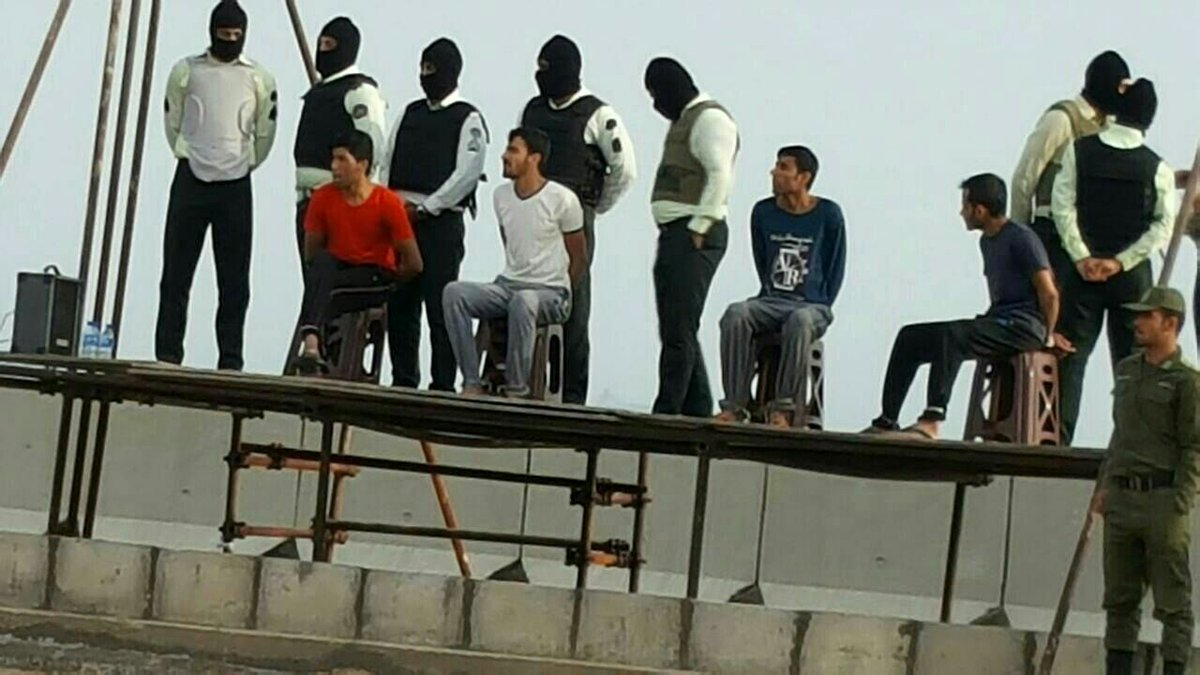
We are pleased to attach the latest report on the use of the death penalty around the world for the period
mid-June to mid-July thanks to group member Lesley for its production. Note that China does not appear because although it is believed to execute more of its citizens than the rest of the world put together, details are a state secret.
Picture of prisoners lining up to be executed in Iran.
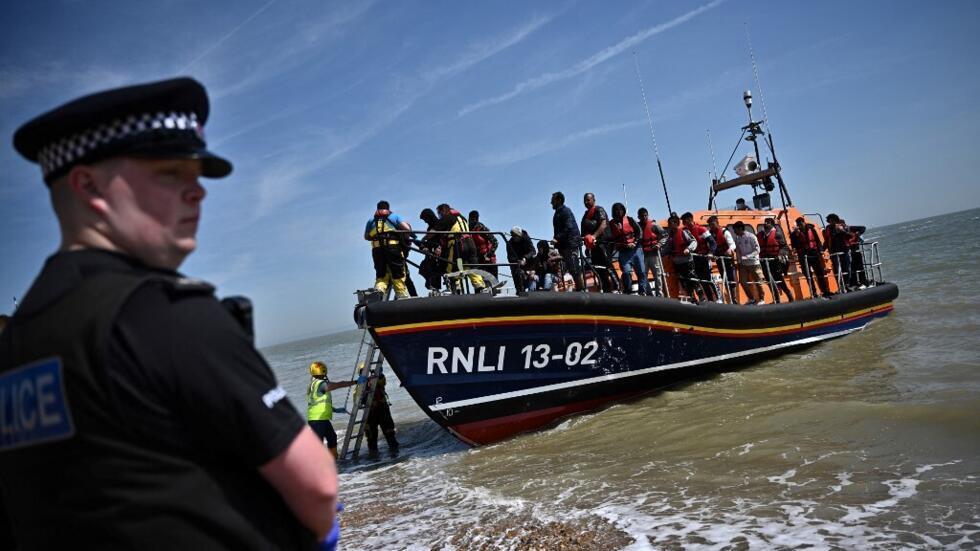
Refugees and boat crossings still making political waves
July 2025
With the state visit of President Macron this week, the small boats are back in the headlines. As Macron and Starmer try to thrash out a deal to reduce the numbers arriving in the UK, the UK has been pressuring the French police to use new tactics against the irregular immigrants, allowing them to stop boats from up to 300 meters from the shoreline rather than only dealing with them on land. Presently they can only intervene if there is danger to life. The police are, in any event accused of puncturing inflatable boats as well as more heinously using tear gas and pepper spray on children.
An agreement between the UK and France on a “one in one out” basis, so that any arrival can be sent
back to France if replaced by a candidate deemed more worthy by dint of family connection, has been mooted, but the press conference will be on Thursday afternoon, so we will not know just yet. At all events, other EU nations are complaining about a possible deal which will make it more likely that arrivals in Europe will end up on their shores.
‘we have to make migration boring again’
Meanwhile, Amy Pope, the CEO of the (UN’s) International Organisation for Migration, has suggested any proposed changes will be unlikely to work, bearing in mind the level of commitment the migrants have already put in before reaching the English Channel. She is also in favour of de-politicising the debate. Her comment “We have to make migration boring again” is clearly the most valuable contribution from anyone so far.
Arrivals
As noted last month, the number of arrivals in the UK on small boats continues to break records (20,000 by the end of June). This has been put down to good weather, smugglers’ new techniques and increasing conflicts around the world (the largest number of hopeful asylum seekers in Calais are from Sudan).
The Government is hoping to save up to £1 billion by speeding up backlog processing. However, the backlog is now 90,000 rather than 50,000 in 2024. In 2024, there were84,000 asylum claims – In the EU as a whole there were nearly a million – 997,000.
With much discussion on what legal routes immigrants can take, here is a summary of the current situation in the UK: there are presently 7 options.
UNHCR can select people it thinks appropriate to send (the places cannot be applied for, and amount to only 1% of all refugees).
UK Resettlement Scheme. The status of this is unclear; it includes community sponsorship and accounts for about 700 arrivals last year.
Mandate Scheme. This is for people with relatives in the UK. 23 cases were reported in 2024.
Family Reunions. Applies after refugee status has been agreed by the UK.
Mostly Syrians , Iranians and Eritreans. 5000 in quarter 1 2025.
Hong Kong. Numbers low now as most cases already settled.
Afghanistan. ACRS and ARAOP have now been closed, with virtually no explanation. “Further measures…[will be] announced later this year.” More Afghans have been arriving by boats than under these arrangements anyway.
Ukraine. Numbers also down now to about 4000 a month. Only 1698 asylum claims since 2022.
The Refugee Council have a new report New Roots, New Futures, arguing for a national integration strategy for refugees in the UK. They are particularly exercised by the need for new arrivals to have access to help in obtaining work and housing once they have been given right to remain.
The Green Party have put forward a plan for the Home Office to be split, with various options for the immigration departments.
By way of context, it should be noted that 73% of the world’s refugees are in Low/Middle Income countries, 67% of them are in countries neighbouring the one they are fleeing. Per head of population the countries with the highest number of refugees are Lebanon (1 in 8 of the population), Aruba and Chad.
The European Convention on Human Rights has become an issue again with questionable claims being made about possible unfair exploitation of loopholes. It should be stated that the Convention does not affect individual countries’ immigration policy, and that it is rare for claimants to a right of “family life” and such to win their case. The ECHR has ruled against the UK twice in the last two years, in neither case about immigration/deportation issues. They have generally prevented removals from the UK about once every 4.5 years since 1980. Leaving the Convention over this issue would seem rather unnecessary.
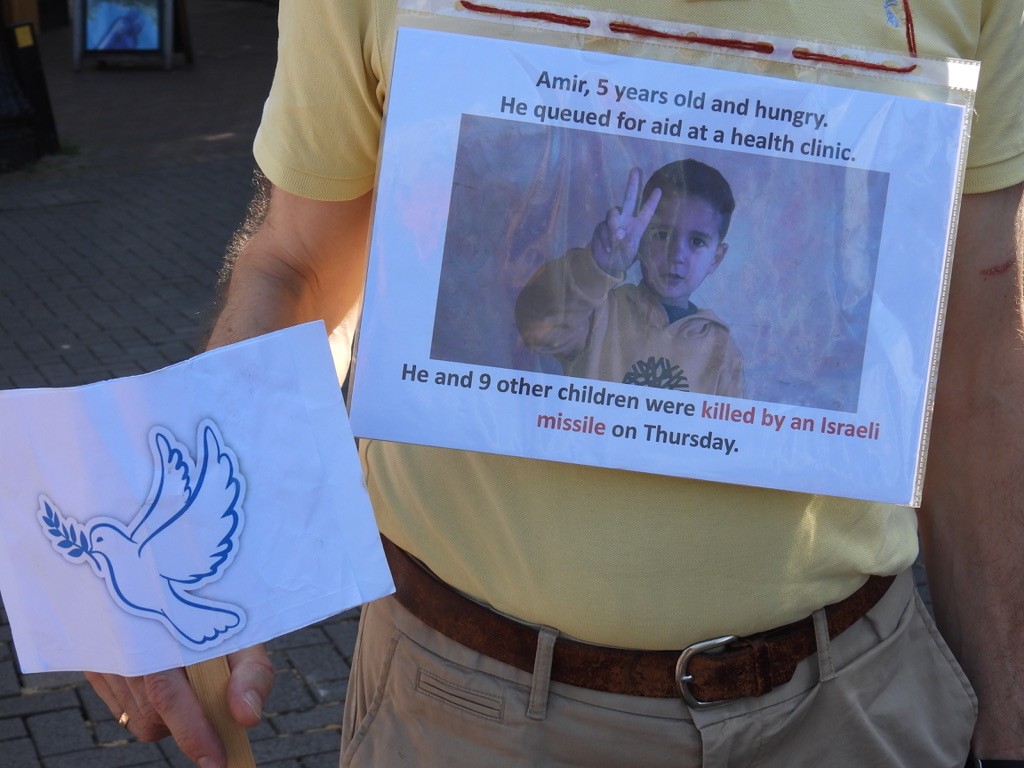
And so they continue, 83 now and counting. We had no notion when we started these vigils that we would still be holding them well over a year later. It is evidence of the strength of feeling that over 30 people (40 yesterday, 5th July) turn out each Saturday for half an hour of silent protest. A YouTube video prepared by Peter Gloyns can be accessed here.
The arguments are now well worn and well rehearsed. Every day, men women and children die in Gaza or have serious and life changing wounds as a result of a relentless bombardment by Israeli jets or drones. A few days ago it was a 500 lb bomb dropped on the al-Baqa café killing many and leaving a pile of mutilated body parts strewn around. Over 56,500 have now died but the actual death toll is far higher as many thousands lie under the rubble undiscovered.
The culpability of the West – including the UK – in this carnage will leave a stain on the nation for years to come. We continue to supply weapons to the Israelis; we allow Elbit Systems to continue to manufacture the drones which hover over the territory and are used to kill; we covertly use RAF planes to overfly Gaza allegedly to help locate hostages but whose real purpose is something of a mystery and we clamp down on protests: only yesterday, the government banned Palestine Action.
The nation’s broadcaster, the BBC, has come in for serious criticism – some of which is justified – for failing properly to inform its viewers and listeners of the true state of affairs. It has failed to mention the role of the RAF for example. It’s decision to pull the film Gaza: Doctors under Attack has come in for particular criticism. Fortunately, it was aired by Channel 4 and exposed in considerable detail the pattern of deliberate destruction of medical facilities in Gaza: first the bombing; then the physical destruction and finally the arrest, detention and torture of the medics. Israel and the IDF was given every opportunity to rebut claims made in the film. There seemed to be no rational reason why the BBC could not have shown it.
A feature of the BBC row is the role of one of its directors, Robbie Gibb, who is closely involved with the Jewish Chronicle and is said to be directly involved in editorial decisions including pulling the earlier Gaza film. Insiders claim the feebleness of the BBC news is largely due to his influence. Under the guise of impartiality, the result in fact is highly partial reporting.
Group loses its case in the High Court and is now proscribed
July 2025
As of today (July 5th) Palestine Action is now a proscribed terrorist organisation. This decision has been widely condemned and is seen as an abuse of legislation introduced to stop far more deadly organisations. The Home Secretary, Yvette Cooper, lumped into the order, two other organisations: Maniacs Murder Cult and Russian Imperial Movement, to give MPs little choice but to approve it which they did 385 votes to 26. PA now joins al-Qaeda and ISIS on the list. Local MP, Danny Kruger (E Wilts) voted for the ban.
There is no doubt that PA caused damage to the various establishments they raided. Although Cooper and others spoke of violence, no evidence of violence has been produced. This action is of a piece with legislation introduced by the previous government to limit and make protests and demonstrations a lot more difficult. Well, not quite, because it may be noticed that the farmers have been taking their tractors into London and elsewhere and blocked streets and stopped traffic. There is no record of any police action against them nor any arrests having been made.
Many have made the point that the activities of PA are covered by existing legislation and indeed, some have been arrested and sentenced after earlier actions using laws already on the statute book. When the terrorism law was introduced about a quarter of a century ago the claim was made then that it would only be used for ‘extreme’ crimes. That seems to have been forgotten. Unfortunately, the legislation is overly broad enabling it to be used in cases like this. The problem has been that juries have not been convinced by government lawyers and have not found against the defendants, hence the need to ban them. Taking them to court for spraying RAF jets stood little chance of a successful conviction now that more people know what dubious activities the RAF are up to and the covert help they are offering the Israelis. The suggestions are that they have carried out over 600 flights over Gaza and that they are refuelling Israeli jets in some of their sorties.
What has embarrassed the government is that the group is drawing attention to the government support being offered, not just by the RAF but in allowing Elbit Systems to continue to make the drones in factories here in the UK, as they claim on their website.
People have a right to protest and the list of protest movements who have brought change is a long one. We noted in our last post that the very fact Yvette Cooper is an MP and a minister is as a result of a prolonged period of protest – latterly violent – by the suffragists and the suffragettes. Her action, and the willingness of 385 MPs to vote for the motion is a shameful one.
One MP, Nadia Whittome (Lab) said “Hundreds of lawyers have written to the Home Secretary, warning that proscribing Palestine Action would conflate protest and terrorism. Amnesty International and Liberty have both expressed deep concerns. A senior civil servant has briefed that there is disquiet among Home Office staff about the decision, and has called it “absurd” [HC Deb 2 July c367]. Earlier in the debate she reminded the House of the suffragettes.
While the government was busy proscribing Palestine Action, people were still being killed in the food queues and what is believed to be a massive 500 lb bomb was dropped on the al Baqa café in the north. The bomb killed a large numbers of people many of whom were blown to pieces. Around 56,500 have been killed in Gaza.
Sources: BBC; Middle East Eye, Al Jazeera, Amnesty International, They Work for You.
Vigil
Forty people turned out today (5 July) for the weekly vigil in Salisbury.
High Court rules against action by human rights groups
June 2025
The High Court has ruled that sales of components for the F35 aircraft can continue to be sold to Israel. The judgement has come as a big disappointment for campaigning organisations including Human Rights Watch, Oxfam, Al-Haq and Amnesty. The judges said that the decision was properly for the government to decide. They said:
‘[The] issue is whether it is open to the court to rule that the UK must withdraw from a specific multilateral defence collaboration which is reasonably regarded by the responsible ministers as vital to the defence of the UK and to international peace and security, because of the prospect that some UK-manufactured components will or may ultimately be supplied to Israel, and may be used in the commission of a serious violation of international humanitarian law in the conflict in Gaza.’
organisations which are parties to the case, argued that under the Arms Trade Treaty and the Genocide Convention, the UK, as a state party to both, is obligated to stop sending the parts and that, by failing to follow its obligations, is threatening the rule of law globally.
Amnesty statement
In response to the verdict, Sacha Deshmukh, Chief Executive of Amnesty International UK, said:
“We are disappointed by today’s ruling, but the court has been clear that while it does not have the authority to make a judgment on UK exports of F-35 arms parts, this does not absolve the executive and Parliament from their responsibilities to act.
The UK has a legal obligation to help prevent and punish genocide and yet it continues to authorise the export of weapons to Israel despite the clear risks that these weapons will be used to commit genocide.
This judgment does not change the facts on the ground, nor does it absolve the UK government of its responsibilities under international law. The risk that UK arms may be used to facilitate serious international crimes remains alarmingly high. If the courts will not intervene, then the moral and legal burden on the Government and Parliament to act – before more lives are lost and further irreparable harm is done – is even greater.
“The horrifying reality in Gaza is unfolding in full view of the world: entire families obliterated, civilians killed in so-called safe zones, hospitals reduced to rubble, and a population driven into starvation by a cruel blockade and forced displacement. These are not isolated tragedies; they are part of a systematic assault on a besieged population.
The UK must end all arms transfers to Israel if we are serious as a country about our commitments to international law and human rights.
Many of those who attend the weekly vigil in Salisbury will find this decision deeply disappointing.
Gaza documentary
The documentary Gaza: Doctors Under Attack is to be shown on Channel 4 on 2nd July at 10pm. The BBC declined to show it saying it did not meet its high editorial standards. Members of staff met Tim Davie the Director General of the BBC at a virtual meeting and many expressed their disquiet at the decision to pull the documentary. The BBC denies claims it is frightened to air such programmes.
Sources: Middle East Eye; Yahoo News; Reuters; Guardian.









 Amnesty in Salisbury & South Wiltshire