Three years on …


Three years since the October 7th massacre. What have we learned?

The first casualty of war is truth is a well worn saying and in the case of the war in Gaza it can be modified to say truth has been a continuing casualty. In this post we want to discuss the things we have learned about this conflict which has inflicted such terrible harm.

The recent history stems from the dreadful massacre which occurred on October 7th three years ago. 1,200 were murdered by Hamas attackers and 251 were taken hostage. It sent shock waves around Israel and around the world. It kicked off a series of violent events including the deaths of over 74,000 Palestinians in Gaza.

A desolate urban landscape featuring crumbling buildings and rubble, with five silhouetted figures standing in the background. In the foreground, a teddy bear sits alongside scattered papers and a book.

But what has been learned or achieved from this violence?

1 The first truth is that it has not brought Israel the peace and tranquillity it has for so long sought. The Zionist quest for a homeland has left them surrounded by neighbours who are at least wary of the state or are solid in their hostility. It has chosen the path of becoming a military superpower as far as the region is concerned. Its answer to so many questions and issues is violence. Violence in the West Bank is increasing and is largely unchecked.

That they are able to pursue this path of violence has largely been down to the support, military and diplomatic, which has been given to it by Western powers in particular the US. The UK has supported them but at a lower level. Despite the wholly disproportionate violence meted out on the population of Gaza, this support has continued. It seems impervious to public protest and disquiet.

2 Which leads directly to the second point which is the distorted way news of the conflict has been treated by the British media. The BBC has come in for serious criticism from the Centre for Media Monitoring and also the journalist Peter Oborne who came to Salisbury to speak about his book Complicit. In their defence it can pointed out that independent journalists have been banned from Gaza and large numbers of journalists who are there have been murdered by IDF snipers. Despite that, the corporation has given unequal weight to its reporting. At the head of this piece we quote the number of hostages taken by Hamas. There were frequent bulletins by broadcasters about their plight, moves to secure their release, interviews with those who were released and with Israeli politicians expressing horror at their captivity.

There was almost no mention of Palestinian hostages by contrast. The BBC and other media referred to them as ‘prisoners’. There were no interviews, bulletins or commentary for them. The horrific treatment they endured in an underground prison where torture was routine, was hardly mentioned. It was almost as though there were two worlds: one where Israeli’s suffering as hostages and whose plight was regularly detailed and another where Palestinian hostages almost became invisible. Any mention of ‘genocide’ will result in an immediate rebuttal by presenters. What the purpose of RAF overflights was likewise almost never mentioned.

This, and other omissions means we cannot rely on balanced reporting from our domestic media particularly with a conflict so politically weighted as this.

3 The shortcomings of our media are exceeded by the shortcomings of the political system. Many have noted the extensive membership of the various Friends of Israel groups in Parliament with around 150 MPs signed up. It really does raise a serious question about impartiality. Harking back to the previous point, it almost always the case that political interviewees are never asked about their membership. It has proved remarkedly easy for the Israeli government to suborn our politicians.

More serious is the continuing sales of arms to Israel only belatedly and partially curtailed by David Lammy MP. (there are doubts even about that. Israel import records showed no change). Along with sales to other despotic or authoritarian regimes, it seems as though arms sales take precedence over any consideration of the death and destruction they cause. Government claims that export controls are ‘robust’ are close to insulting the intelligence of the public.

Lesson: the political class is compromised and is not acting in the best interest of the country.

4 Knowledge of the origins of the conflict are not widely known or understood. There are many who believe October 7th was the start. Many believe the firing of rockets by Hamas is a cause. Few are aware of the 1948/49 Nakba (catastrophe) in which around 700,000 or more Arabs and Palestinians died. Few are aware of the Apartheid system in Israel (denied by them). Few are aware of the Balfour agreement and how that came about. Not understanding the history and the role of the West, and in particular Britain, in creating the situation leading to the current state means we are doomed to carry perpetuating it.

The lesson here, often the fact in all wars and conflicts, is that history is important. Failing to understand the background and why we are where we are, means many are ill-informed. When they are politicians or political commentators, the results can be significant.

Overall conclusions

What are the overall conclusions? A powerful combination of a lack of historical perspective, combined with a desire to sell arms to almost all-comers, a parliament too easily suborned by a powerful and well-funded lobbying operation, and a media too frightened by the relentless claims of anti-Semitism or being anti-Israel, have led to a misinformed public and an epic disaster for the people of Gaza. 74,000 dead. More thousands lie buried in the rubble. Tens of thousands traumatise physically or mentally by the violence. This combination of cowardice and misinformation has played a key part in this disaster. It will come to haunt Israel in years to come.

There are signs of change. Ed Miliband’s statement a few weeks ago is welcome. The threatened closure of the Jerusalem consulate now to be a ‘mission’ demonstrates that criticism of violence in the West Bank is striking home. The mass walkout of the UN when Netanyahu rose to speak is a sign of Israel’s increasing pariah status. However, this change may well have come more quickly had the failings described here not taken place.

If politicians had resigned their membership of Friends of Israel, if the media including the BBC had treated both sides equally, had reported on things like apartheid, if both had not allowed themselves to bullied by claims of ‘anti-Semitism’ etc., and if there was greater recognition of an historical perspective, public attitudes might have been different.

It has been a tragedy made worse by our behaviour.

Another and depressing conclusion is the lack – in that favourite phrase deployed after a disaster or scandal – of ‘lessons learned’. There do not seem to have been any nor any move for an enquiry. We should be thankful at least for an absence of humbug.

Perhaps the biggest lesson is that any idea of a ‘new world order’ is dead. Or rather an order based on rights and the rule of law. It has been replaced by an order where might is right and notions of rights are a fond memory.

World Day Against the Death Penalty


10 October is the 24th WDADP

October 2026

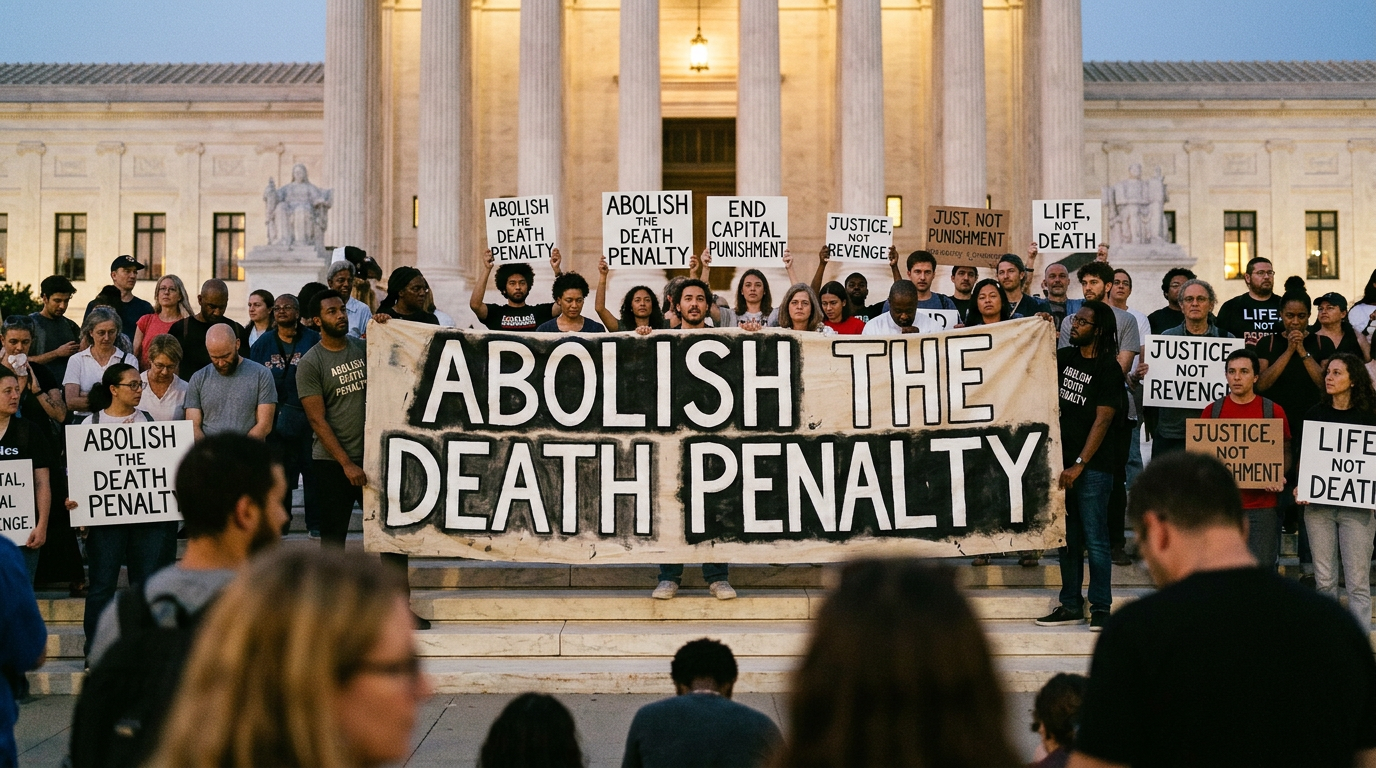
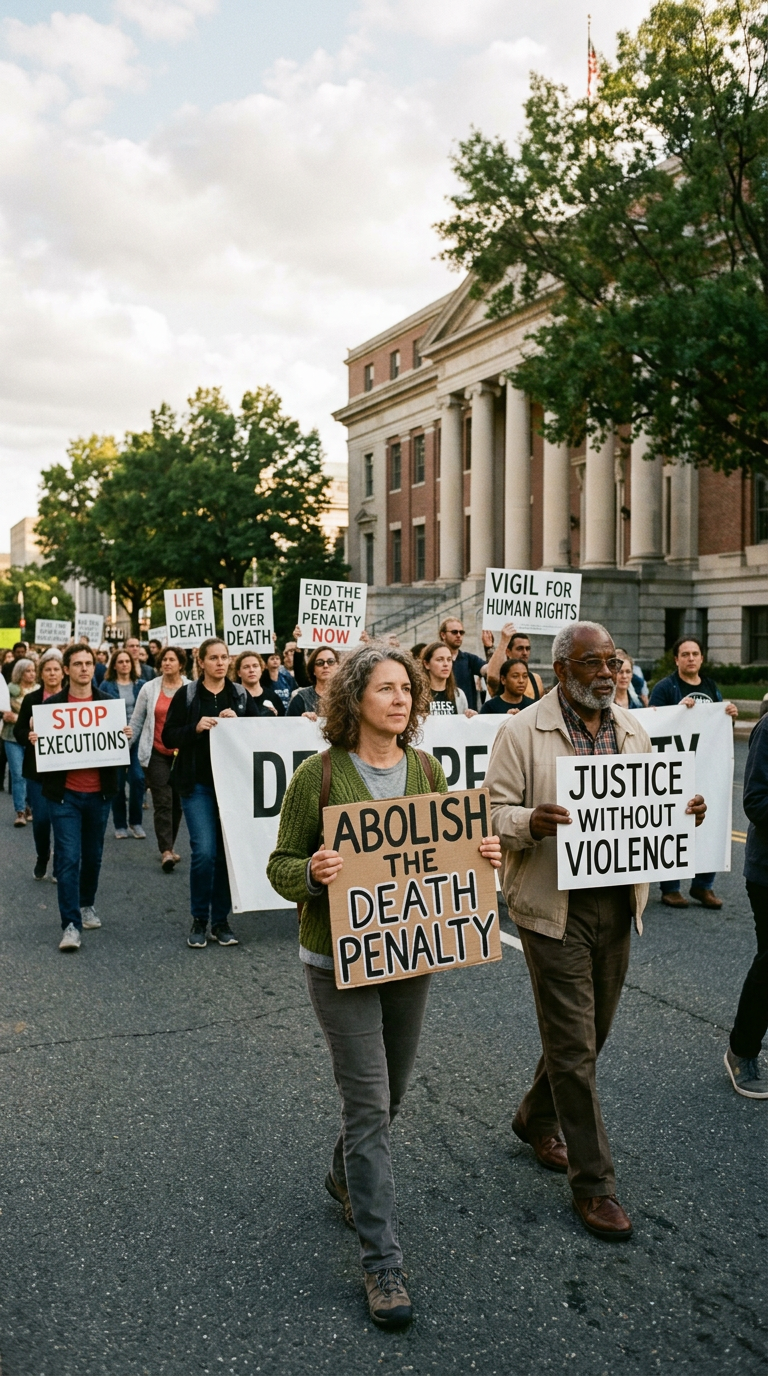
This is written in the UK where the death penalty is no longer practised. It might therefore be wondered why we should continue to campaign for its abolition elsewhere in the world. It is partly because we believe the penalty to be a barbaric one and that applies across the world. We campaign for justice and human rights everywhere not just in our own backyard. We believe the penalty should be abolished in all circumstances and for all crimes.

A group of eight people gathered around a table illuminated by candles, studying a large map. The scene takes place outdoors during dusk, with a city skyline visible in the background.

There are currently 25,508 people on death rows somewhere in the world according to the World Coalition Against the Death Penalty. 2,707 are known to be executed the highest number since 1981. Large numbers are executed in China but the numbers are a state secret. Thousands are executed in a ‘conveyor belt’ of killing there with mobile vans travelling the country to speed up the process. There is a bewildering number of crimes – over 40 – which attract the death sentence.

The top countries carrying out the executions are China, Iran, Saudi Arabia, Yemen and the US. That a notionally civilized country should be in such company is telling.

Christa Pike

The death penalty has made it onto the news in the past few days with the failed execution of Christa Pike in Tennessee. She was twice injected with lethal drugs but survived and has now partially recovered. There has been shock expressed around the world. Members of the Salisbury Group have written to the Governor to ask that her sentence be commuted.

Part of the problem is the difficulty in obtaining reliable drugs since firms and countries are unwilling to supply them. To overcome that problem, the firing squad is being introduced. Which leads to the truly bizarre, shameful and shocking proposal by Pete Hegseth to allow the live streaming of an execution. This is of Nidal Hasan who killed 13 in Texas. It is in a belief it will act as a deterrent.

Deterrence

The continued belief in the penalty is based on its supposed deterrent effect. However, a report released in April by the National Research Council of the National Academies based on a review of more than three decades of research, concluded that studies claiming a deterrent effect on murder rates by a use of the death penalty are fundamentally flawed. The report concluded: โ€œThe committee concludes that research to date on the effect of capital punishment on homicide is not informative about whether capital punishment decreases, increases, or has no effect on homicide rates”.

Many of the countries are using it not just to put series criminals to death, but as a form of coercion and intimidation.

Some reasons why it should be abolished
  • It is degrading and inhumane. What is often forgotten is the effects it has on others including prison staff who have to carry out the task
  • it is not a deterrent as we have argued
  • the justice system is imperfect and often flawed. The poor quality of legal representation for the poorest in society often means there is injustice. Mistakes cannot afterwards be put right
  • it is being used in some countries as a means of coercion and to intimidate those the state disapproves of
  • It disproportionately affects the poorest and marginalised in society.
Action you can take

Following the shockingly botched attempts to execute Christa Pike on 1st October, please write a letter dated 10th October to Bill Lee, Governor of Tennessee, calling for the commutation of Ms Pikeโ€™s death sentence as a first step, followed by the commutation of the sentences of all those on death row and the establishment of an indefinite moratorium on executions. ย 

Contact details: ย Bill Lee

                           Governor of Tennessee

                           State Capitol

                           600 Dr Martin Luther King Jr Blvd

ย  ย  Nashville

                           TN 37243

                           USA.

Governor Leeโ€™s email address is bill.lee@tn.gov but a letter would be preferable as he is more likely to see it.  

You might want, as well as expressing your deep concern about what has happened,  to recognise as positives the review he has ordered into the protocol and procedures, and the fact that he has paused executions at least until the end of the year – that of Gary Sutton will not now go ahead on 3rd December.

IT SHOULD BE ABOLISHED


Roll up! Roll up! Watch a live execution!


A scarcely believable wish by Pete Hegseth to live stream an execution by firing squad

UPDATE: the execution will no longer be live streamed President Trump announced on 15th. This has followed a sustained and worldwide condemnation of Pete Hegseth’s proposal. 16 October.

The Defense Secretary, Pete Hegseth, wants to live stream the execution by firing squad of Nidal Hasan who murdered 13 at a medical processing facility in Texas in November 2009. President Trump is reported to have agreed to it. America is already alone among civilised nations in continuing to use the penalty and providing a livestream of the event adds a level of barbarism to it. There is no other nation in the world which live streams such an event.

Public executions take place in Saudi Arabia and the state is seen to be medieval. That the Defense Secretary wishes America to join it seems scarcely believable.

The last public execution took place in the UK in 1868 in Newgate prison. The last in America was much later in 1936 in Kentucky that is only 90 years ago. France surprisingly, was later still and took place in 1939 but caused such outrage it was abolished.

Hegseth claims it is to explain to people there are serious consequences for crimes such as this. Many Americans will be revolted by this spectacle. For a supposedly civilised nation to countenance this is almost unbelievable.

The penalty itself is not a deterrent. There is no significant difference in murder rates between States who still use it and those who don’t. Mistakes cannot be rectified and there have been many acquittals of those convicted of serious crimes which turn out to be mistaken. Offering a livestream adds a layer of barbarity to the process.

Doubts were expressed today (9th) whether it will in fact go ahead.

CORRECTION: We believe Saudi Arabia no longer carries out executions in public. 11 October.


AI, Protest and Surveillance: Are UK Human Rights Under Threat?


Regulation of Artificial Intelligence

October 2026

The Joint Committee on Human Rights has called for a new AI Bill to address the scale and seriousness of threats posed to human rights by artificial intelligence systems.  Local MP, Sir Desmond Swayne is on the Committee. It points out that existing UK laws that could apply to AI do so primarily at the point of deployment, leaving the responsibility on its users rather than its designers. Regulators lack the power to test and evaluate AI systems before they are released, or to prevent their release if they are considered to pose unacceptable risks. Model developers engage with the AI Security Institute on a voluntary basis and it has no statutory power.

An illustration of a balance scale with books and documents on one side and a glowing, networked brain on the other, symbolizing the balance between knowledge and intellect.

In a fast moving world with technology moving at breakneck speed, the current legal framework that applies to AI is fragmented and difficult to navigate. It relies on harm-specific and sector-specific legislation leaving gaps in protection which fails to address preventable human rights risks. 

The right of an individual to seek effective remedy against decisions made against them is endangered by the use of AI. Insufficient transparency concerning how AI systems are used in decision making and a lack of effective mechanisms to challenge those decisions threatens the rights of people in the UK, particularly those of already minoritised communities, including Black and Minority Ethnic people. The right to privacy is also under serious threat.

To address the global nature of AI harms it argues governments need to collaborate to identify risks and promote consistent standards and that the UK should continue to play a leading role in international AI summits and seek to be party to international declarations and agreements on AI safety. (Source – Joint Committee [accessed 7 October])

Government approach to protest

Much concern has been expressed about successive government’s introducing legislation to try and limit protests. Climate campaigns and activities by Palestinian support organisations have come in for increasing controls and abundant arrests. Egged on by the right media with its talk of ‘zealots’ and ‘fanatics’, successive home secretaries have awarded the police more and more powers to clamp down on them. We have fundamental rights of assembly and of free speech which underpin protests.

Recent home secretaries have all been women who would not have been able to be MPs, let alone a home secretary, had it not been for the concerted and violent actions of the suffragettes. Many of the improvements to life we somewhat take for granted are the result of campaigns or protest movements.

The Parliamentary Joint Committee on Human Rights under Lord David Alton is launching an enquiry to look at the Governmentโ€™s approach to protest:  โ€œWe want to understand if the expansion of police powers relating to protest has been proportionate or if they will have a chilling effect on the right to protest. We will also examine if the new laws are effective in protecting wider society from the potential negative consequences of disruptive protest.โ€ 

Online privacy

The Investigatory Powers Tribunal is today considering how to take forward two legal challenges concerning the Governmentโ€™s reported attempt to weaken end-to-end encryption for Apple users. One challenge has been brought by Apple. The other has been brought by Liberty, Privacy International and two individuals. End-to-end encryption is an essential security tool. It protects our bank details, health information, private conversations and photos, ensuring that only the sender and recipient can access the data being shared.
 

Surveillance

Between February and July this year, the British Transport Police ran a six-month live facial recognition trial across some of Londonโ€™s busiest transport hubs โ€“ without making a single arrest.

The aim of the scheme was to catch offenders and people breaching court orders. More than half a million faces were scanned. The trial cost more than ยฃ320,000 and took up almost 100 hours of police time. This resulted in one alert which turned out to be incorrect. Despite this, the British Transport Police announced last month that it will be extending the trial for another four months and expanding it into London Underground stations.

Facial recognition is an essential tool used by repressive regimes such as China to control their citizens.

These two technologies, combined with a series of home secretaries keen to limit freedoms and giving police more and more powers, are a serious threat to our rights. We need to be aware of this.


Thought of subscribing?

Politics, Borders and the Human Cost of Refugee Underfunding


Political concerns still a factor in attitudes to immigration and refugees

October 2026

Worldwide, while the number of refugees continues to grow by contrast, the amount of support continues to fall. The UNHCR have a new report Protection Eroded: the Human Cost of Underfunding, which notes how governments are cutting back on their provisions for refugee aid. Between 2024 and 2025, the total amount of aid fell from $5.2 billion to $3.9 billion, and by July of this year only 32% of the allocated funds had been received. Some British political parties are, of course, eager to cut the aid budget even more.

The US government has attacked the UNHCR for its emphasis on protection, inclusion, durable solutions and legal pathways, on the grounds that it facilitates mass migration. In reality 65% of refugees are in states near to their origins, 70% in Lower and Middle Income countries. An article in the Swiss-based New Humanitarian notes that European and North American countries want refugees to stay nearer their bases, but cutbacks have made the problem worse โ€“ by making it someone elseโ€™s problem, they encourage more movement. They summarise โ€œRefugee protection is not the opposite of border controlโ€ฆ calling [legal routes] โ€˜open bordersโ€™ is like accusing a court of acquitting everyone simply because it gives each defendant a hearing.โ€

Shabana Mahmood

Closer to home, speaking to The Rest is Politics podcast, Home Secretary Shabana Mahmood said “sexual abusers would exploit most asylum seekers as long as traffickers continued to decide who came to the UK”. She said: โ€œWeโ€™re not in control of this border. The sifting of the people that end up in the north of France and are about to get on a dinghy is done by criminal gangs who are also, by the way, people traffickersโ€ฆ You can almost guarantee that every woman thatโ€™s in the north of France has probably been raped along the journey. Some of the men too, theyโ€™ve certainly been abused and threatened. That is not the model that should decide whether somebody gets to come to the UK, make this their place of sanctuary and ultimately become one of us.โ€

In passing, the recent claim by a whistleblower that only 1 in a 100 claims for asylum are genuine appears to have had little purchase, and has not become a serious contention.

The โ€œone-in-one-outโ€ scheme for boat people between the UK and France has not been renewed; the government considered the numbers involved to be unable to be increased for practical reasons. It has been very costly.

The Home Secretary has established a legal resettlement route for women and girls from Afghanistan and Pakistan with medical needs, but this will only apply to hundreds rather than thousands of refugees. From this month, charities and local community groups can apply to be sponsors or hosts to arrivals, as from next Autumn, according to Mahmoodโ€™s speech to the Labour Party conference. The Refugee Council considers the numbers allowed in to be far too small.

For those already here, the new legislation will impose new limits. With the extended time frame for right to remain, it is calculated that in 20 years, the cost has increased from ยฃ155 to ยฃ3,226. For those receiving temporary support before a decision is made a ยฃ10,000 โ€œrefugee taxโ€ will effectively be imposed once they are accepted. The UK has the most expensive immigration fees in Europe. It has been suggested that the extended qualifying period may be reduced, as discussions are ongoing.

A group calling itself the Coalition for Asylum Rights and Justice has opposed the planned Independent Immigration Appeals Authority as not independent, less qualified, unfair in not expediting appeals and not improving decision-making. This is still under discussion in the Bill in committee.

At a time of much disturbance centred around asylum seekers accommodation, the Chief Constable of Essex stated that the level of crime in the towns around the Wethersfield holding centre is less than 3 years ago when the site opened.

AH


Recent posts:

Thought of subscribing?

Death penalty webinar


Amnesty holds a webinar to discuss aspects of the death penalty

October 2026

Amnesty International does not agree with the use of the death penalty in any circumstances. Even if the individual or individuals have committed horrific crimes, the use of the penalty merely perpetuates violence by the state. There is no evidence that it acts as a deterrent. A major problem is that mistakes cannot be rectified if the individual has been executed. It is costly and in states like the US it costs millions if not billions of dollars keeping people on death row while the appeals process grinds on.

Intimidation

The webinar looked at another aspect which has probably been overlooked, namely its use as a means of intimidation. In countries like China, Saudi and Iran in particular, the penalty – or the threat of its use – is a form of intimidating people into silence. It often goes in parallel with the use of torture, it was said, to obtain the confession needed for executions to take place.

Iran in particular has seen considerable unrest much predating the February war launched on them by the US and Israel. 36 have been executed and a further 78 remain under sentence of death. It is a ‘tool for intensifying fears’. Some of the accusations against those arrested include the ‘waging war against God’ and the absurd ‘corruption on earth’.

In Saudi the numbers are massive with nearly 100 executed by June this year. It was noted there was not a proper court system which are sometimes run by intelligence officers. Torture is normalised. Intimidation is made worse by executions held in public.

Uganda was mentioned with the possibility of executions for homosexuals.

Amnesty is planning a campaign as the 10th is World Day Against the Death Penalty.


Latest death penalty report


October 2026

We are pleased to attach the latest death penalty report for mid September to mid October thanks to group member Lesley for the work in compiling it. This month the failed execution of Christa Pike in Tennessee has led to international outrage. After two failed attempts to execute her she was found still to be alive and was rushed to hospital where it is reported she is still alive.

The governor of Florida continues with his drive to execute people making it the record state in the US.

We are pleased to report the release of Jagtar Singh-Johal on bail after being held in prison for 9 years.

As ever we must note that we have no reports from China which is believed to execute more of its citizens than the rest of the world combined but where details are a state secret.


Film about protest rights launched


October 2026

Amnesty has just produced this video about the right to protest and the threats to that right by successive governments and home Secretaries.

Video


Latest vigil


Latest vigil – No 148 – well attended. Green party passes a vote on Zionism

October 2026

Over 30 attended the 148th vigil on what turned out to be a damp evening.

The major news this week was the decision by the Green party at their annual conference to declare Zionism an ‘ethnonationalist project’ which has drawn predictable criticism from Israel. The Israeli foreign ministry said in a post on X on Sunday that the motion “constitutes a clear antisemitic text according to the IHRA (International Holocaust Remembrance Alliance) definition, as it denies the Jewish people’s right to self-determination”.

The chief rabbi, Ephraim Mirvis, described the motion as โ€œpoisonous antisemitismโ€ and a โ€œthreat to British Jews and to Britainโ€. However, as we have pointed out previously, not all Jewish people in the UK agree with the rabbi.

It was also reported last week that there has been a rise in Jewish people in the UK feeling ’emotionally attached to Israel’. This follows a longitudinal survey carried out by the Institute for Jewish Policy Research of 2,500 individuals. It has risen 13 points since the start of the Gaza war. There is also a rise in those identifying themselves as Zionist.

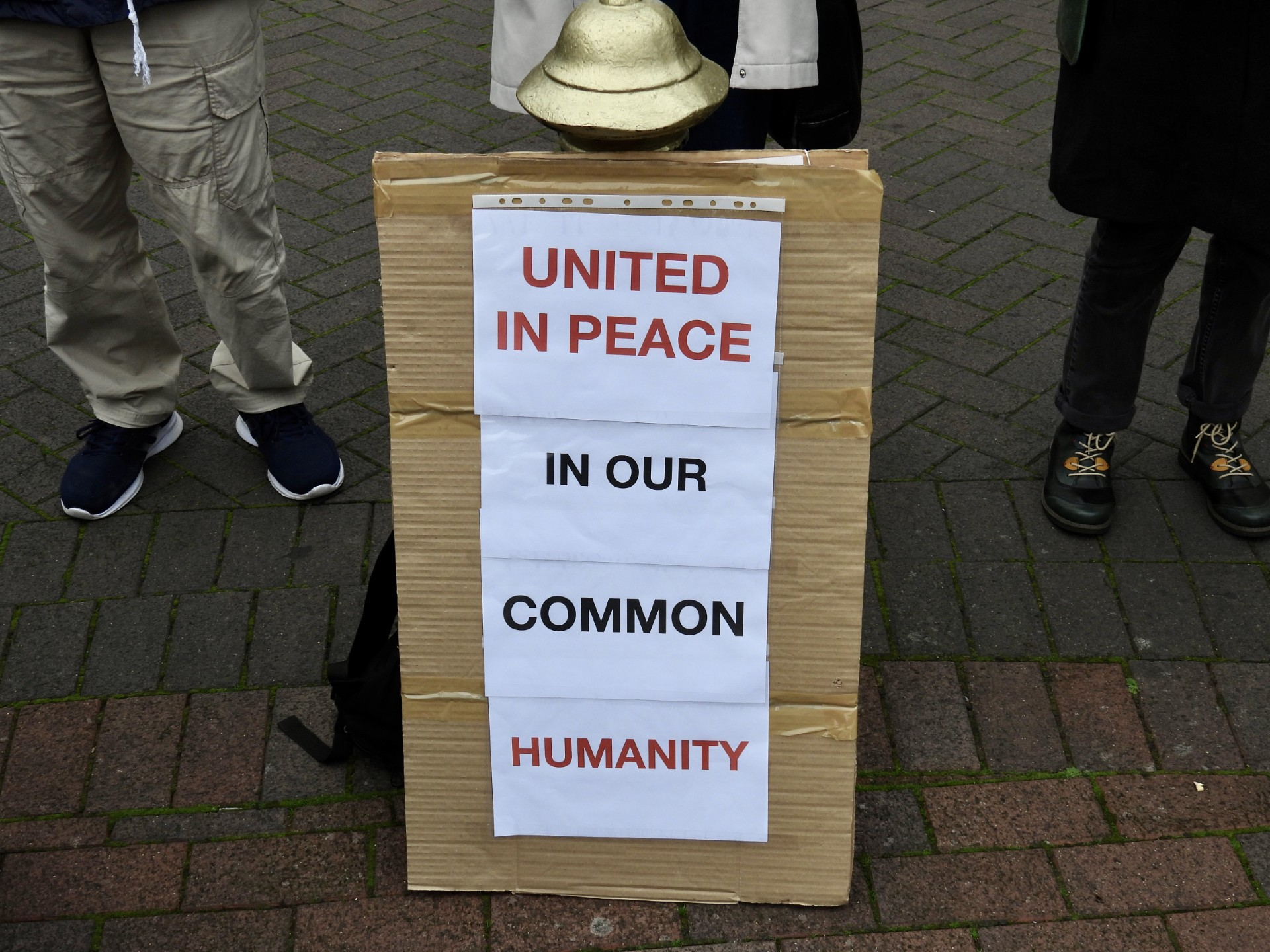
A cardboard sign with the text 'UNITED IN PEACE IN OUR COMMON HUMANITY' displayed on a street during a gathering.

Our attention has been drawn to the following two items concerning how children are treated in Israeli prisons. One by Save the Children and the other a video by Al Jazeera. There is a WARNING that the latter contains distressing material.


Photo: courtesy of Peter Gloyns.

Uyghur campaign


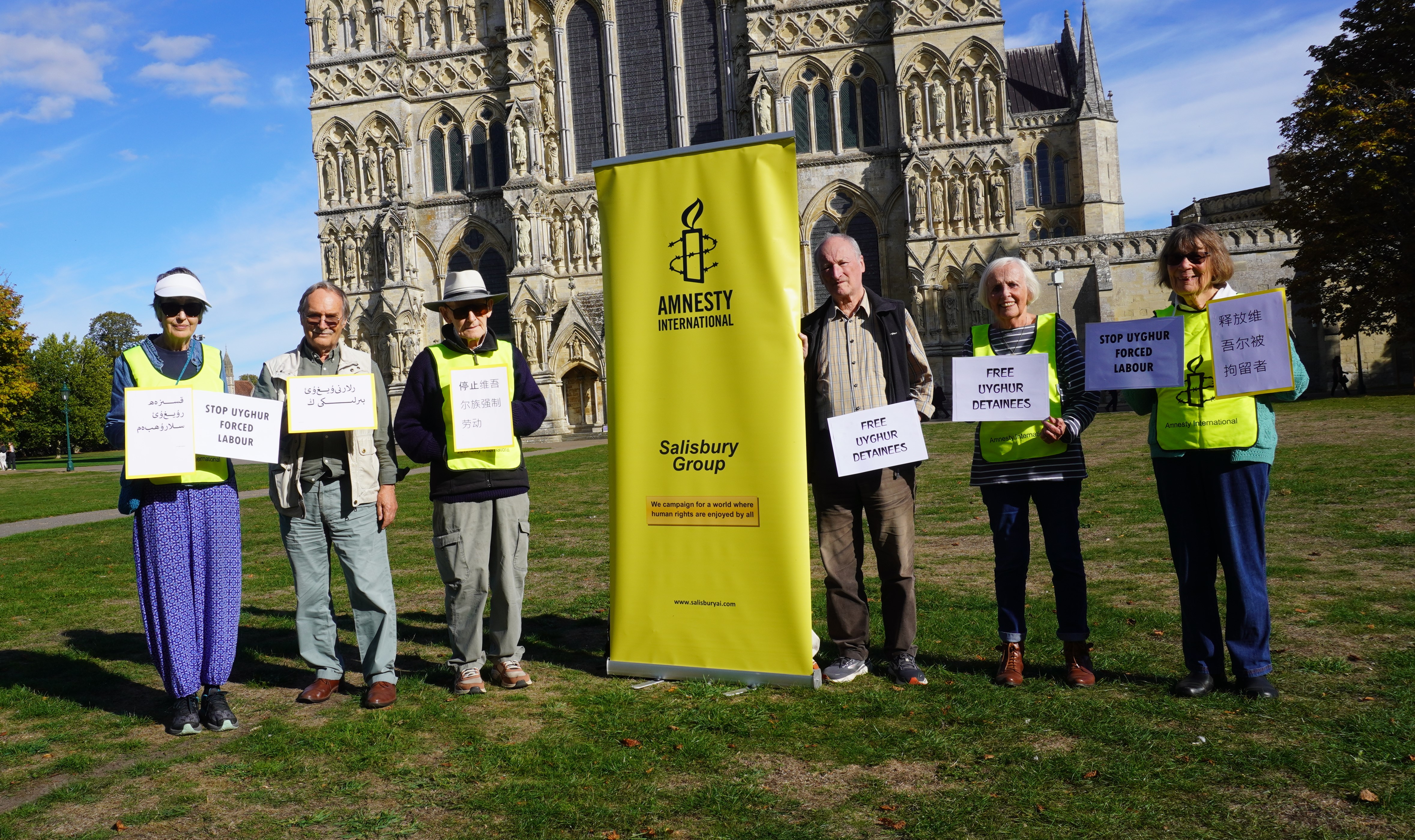
Some members of the group meet for a photo op

October 2026

Throughout August the Salisbury group took part in the national campaign to highlight the plight of the Uyghur population in Xinjiang province in China. We reported on the extreme measures used by the Chinese to repress the culture, language and religion of this population and the imprisonment of around a million as part of a process of ‘re-education’. We also noted the vast programme of forced labour particularly of cotton much of it finding its way its way into high street clothing with seemingly little concern by our retailers.

The group held a brief photo opportunity today to highlight the Uyghurs and to keep them in the public eye.

A recent report by Global Rights Compliance suggests we may have been a bit ‘narrow’ in focusing on cotton as the latest 5 year plan for the region in which it is explained:

“The Plan’s overriding priority is to position China at the “forefront of global science and technology”, by eliminating critical technological dependencies and ensuring that its development trajectory cannot be disrupted by external pressure or supply chain coercion.

“This self-reliance shift ultimately relies on material foundations. The success of these goals depends on securing reliable access to raw materials at scale. The Xinjiang Uyghur Autonomous Region (Xinjiang) is central: the region holds the majority of Chinaโ€™s beryllium reserves, a material with no substitute in semiconductor manufacturing, and provides the cheap coal-based energy that makes energy-intensive mineral processing”.

This suggests the process of repression will continue because this dominance relies not just on the material itself but its processing. This will also need forced labour to achieve.

There are signs that politicians are beginning to worry about the ‘China threat’ which is on several levels. Our concern is with the rights of a people who are not Han Chinese, who are routinely persecuted and the fruits of their persecution finds its way into products we buy in the West.


Recent posts:

Blog at WordPress.com.

Up ↑