Monthly meeting took place last night Thursday 9th March at Victoria Road. It was a full agenda including North Korean talk at Five Rivers; NWR meeting; Films at the Arts Centre; Social media and Death Penalty reports and the market stall. Minutes will be posted soon.
Amnesty publishes a report today on the programme of mass executions in Syria
A terrifying and sickening report on the execution of possibly 13, 000 Syrians is published in a major report by Amnesty. The report makes chilling reading as testimony from survivors and guards describe the horrific process of killing and disposal of bodies by the regime. A summary of the report is published in the Guardian today. There is also a piece by Kate Allen, director of Amnesty describing the prison as a slaughterhouse.
We attach a link to the Guardian‘s obituary of Sir Nigel Rodley who was a key member of Amnesty and did so much to get the legal tools enacted in the anti-torture campaign and also worked hard to end the death penalty.
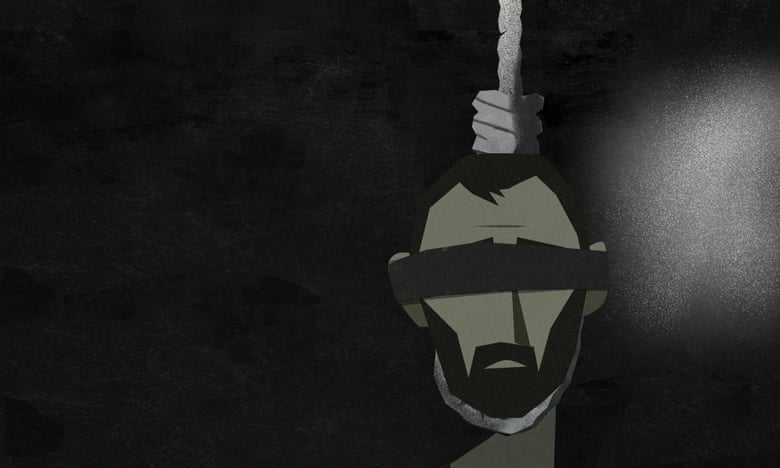
Donald Trump’s favourable comments on the use of torture have put this topic back on the agenda
As early as the third century A.D, the great Roman Jurist Ulpian noted that information obtained through torture was not to be trusted because some people are “so susceptible to pain that they will tell any lie rather than suffer it”.
President Trump said last week that ‘torture absolutely works’ and threatened its use at Guantanamo. I want to do everything within the bounds of what you’re allowed to do legally but do I feel it works? Absolutely I feel it works.” It now seems he is resiling from this after an outcry.
Amnesty disagrees that torture works. And here’s five reasons why…
1: Torture is illegal under international law. It reflects the widespread belief that torture is cruel, inhumane and morally wrong. The physical and psychological damage it causes is often permanent. Even if it was effective, it would still be wrong.
2: No ends justify torture as a means. You might be able get useful information out of torture in the short term, but in the long term it’s counter-productive. It does more damage to the reputation of the country that commits torture than any criminal or terrorist. Statistics prove that American use of torture is Al Qaeda’s number one recruiting tool.
3: Torture produces false intelligence. Some victims will say anything to make the torture stop. At best this wastes only time and resources. At worst people may be implicated and even convicted for crimes they did not commit, on the basis of false evidence.
4: While it remains illegal, information extracted through torture cannot be used as evidence in court of law. It actually makes it harder to bring people to justice for any crime they have committed.
5: You can’t condone torture even in ‘special cases’, otherwise it becomes normalised and a “torture culture” emerges across the chain of command. In the USA the CIA used waterboarding on Khalid Sheikh Mohammed 183 times, and low-ranking soldiers tortured for sport in grotesque ways in Abu Ghraib prison, in Iraq.
Of the more than 700 men held at Guantanamo Bay since 2002, many are now acknowledged as ‘merely guilty of being in the wrong place at the wrong time.’ Originally described as “the worst of the worst,” by Vice President Cheney, many were subjected to torture particularly waterboarding. More than 400 of these men have now been released or cleared for release (Center for Constitutional Rights, 2009).
A common justification for the use of torture is the implausible ticking-time-bomb scenario. This is beloved by Hollywood and was the opening scene in the TV series 24 staring Kiefer Sutherland. It rests on several questionable assumptions: that a specific piece of “actionable” information could be used to avert the disaster; that somehow interrogators know for certain that the suspect possesses specific information about the location of the bomb; that the threat is imminent; that only torture would lead to disclosure of the information; and that torture is the fastest means of extracting this valid, actionable information.
Of course, part of the appeal of this scenario is that it also portrays the torturer as a principled, heroic figure who reluctantly uses torture to save innocent lives. This carefully rigged, forced-choice scenario pits the temporary pain of one evil person against the deaths of thousands (or even millions) of innocent people. And, once we have acknowledged that there might possibly be a situation where torture could yield precious, life-saving information, it is then a small step to conclude that we are sometimes morally obliged to use torture. While this scenario might provide a useful stimulus for discussion in college ethics courses, or an interesting plot device for a television drama, there seems no evidence that it has ever occurred. As one scholar put it, “Even though torture is not, on balance, effective or rational, it persists through its deep psychological appeal, to the powerful and the powerless alike, in times of crisis. The reality of torture is unpleasant as one FBI agent put it:
On a couple of occasions, I entered interview rooms to find a detainee chained hand and foot in a fetal position to the floor, with no chair, food or water. Most times they had urinated or defecated on themselves, and had been left there for 18 to 24 hours or more. FBI agent on visiting Guantanamo
CIA report
Picture: Washington Post
The Inspector General of the CIA conducted a review in 2004 and although great chunks of the report were redacted, they found that interrogators assumed detainees were withholding valuable information but this was not always supported by objective evaluation of available information. Guilt was assumed despite the dubious nature of their capture. Very little actionable information was obtained and there was little evidence to show that it could not have been got by ordinary means.
Morality
Setting aside its effectiveness – or rather lack of it – the main objection is morality. Around the world governments and the various agencies working for them, use torture sometimes routinely to brutalise, suborn, humiliate and coerce their citizens. Amnesty has credible evidence that it is used by 141 countries. As the leader of the free world, America should be setting an example not joining with the sordid list of countries still carrying out this barbaric practice.
We hope President Trump’s change of mind is permanent.
Sources: Amnesty International; CIA, Inspector General Report, 2004; New York Times
The Effects and Effectiveness of Using Torture and an Interrogation Device: Using Research to Inform the Policy Debate Costanzo, Mark, Gerrity Ellen, in Social Issues and Policy Review, Vol 3, No: 9 2009
Over a thousand refugees and migrants are being exposed to disease and inhuman living conditions by the Serbian authorities who are failing to provide accommodation, food and healthcare to them. They are being forced to endure the extreme cold winter temperatures by lighting fires and squatting in derelict warehouses in the capital.
If you can find time to write that would be appreciated.
Lecture by Prof Phillippe Sands at Southampton University
Phillippe Sands
It was a pleasure to attend the annual lecture organised by the Romsey and Southampton Amnesty group given by Phillippe Sands (the link is to several of his articles). It was based on his book East West Street concerning in part the city of Lviv which was known at Lemberg in the nineteenth century and was also known as Lwów. Under the Soviets it was called Lvov. Its importance in his story was that two people came from the town who were very influential in the post-war developments of human rights.
Hersch Lauterpacht. Picture: the Guardian
First was Hersch Lauterpacht who was born just north of Lemberg and moved there in 1911, and the second was Rafael Lemkin who was born in Ozerisko and moved to Lemberg in 1900. They both worked behind the scenes during the Nuremberg trials. But their claims to fame are that Lauterpacht was instrumental in getting the world to agree the need for action on crimes against humanity and Lemkin on the concept of genocide. It is surprising that these two concepts are fairly recent and both date from 1945: one assumes they have been around for a lot longer. But that they both emanate from two men from the same town in east Poland is even more remarkable. Despite this and despite the fact they worked in the same field, they never met as far as is known.
Lauterpacht it was who wrote the International Bill of the Rights of Man which invoked Churchill’s commitment to the ‘enthronement of the rights of man.’ His book was key in the development of the UN declaration.
Sands discussed the arguments concerning whether ‘genocide’ should be included and in
the early years it was sometimes in and sometimes dropped. It met resistance because of legal doubts. Lemkin was keen to introduce this as a crime largely because of the German’s crimes in the war an in particular the activities of Hans Frank who oversaw the slaughter in his former town and Poland generally. Frank was hanged after the Nuremberg trials.
He finished his lecture by discussing briefly, the current state of affairs with regard to human rights. He expressed an ‘acute sense of anxiety at what stirs in our midst’ referring part to the far right groups in eastern Europe especially as they suffered so much under the Nazis.
He said he had a ‘sense of going backwards’ with our own politicians wanting to come out of the European convention which he thought was ‘unbelievable’. The platitudes of many of the current politicians seems to reflect a lack of knowledge of post-war events.
East West Street: On the Origins of Genocide and Crimes Against Humanity is published by Weidenfeld & Nicolson (£20).
The latest death penalty report is now available thanks to group member Lesley for compiling it. Generally gloomy with several countries around the world reverting – or threatening to revert to – the penalty.
If you are interested in joining us then a good moment would be to come along to the Arts Centre on December 15th at 7 o’clock or so when we will be hosting a film (you don’t have to stay for the film); card signing in Salisbury on 10 December in the morning or Evensong at the Cathedral on 21 November (if you are not religious you do not have to stay for the service). Details will be on the web site and on Twitter @salisburyai. We will be wearing Amnesty tabards at all events (except the Cathedral).



 Amnesty in Salisbury & South Wiltshire