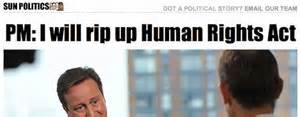
The government is proposing to issue a public consultation on scrapping the Human Rights Act sometime in the autumn.
Amnesty in Salisbury & South Wiltshire
Promoting human rights from Salisbury UK

The government is proposing to issue a public consultation on scrapping the Human Rights Act sometime in the autumn.

 Rights Info has only been going four months but has already begun to establish itself in the human rights world. It is dedicated to providing accurate information on the subject of human rights. This is extremely important now because the present government would like to repeal the Human Rights Act (HRA) and replace it with their own Human Rights and Responsibilities act (or whatever it may be called). This has been promised for several years and we await details in due course.
The government is egged on by a media which regularly produces inaccurate or exaggerated stories of the workings of the act, often tying it into the European Convention on Human Rights, presenting it as an unwarranted intrusion into our legal processes. The fact that it was British and French lawyers who prepared the ECHR – at Churchill’s behest – based on basic principles of justice established over many years, seems to have been forgotten. As we have noted before, the act is of great benefit to ordinary citizens in the UK who use it to secure justice from authorities.
Rights Info has been providing a source of information to counter the tide of misinformation from newspapers and some politicians. They have just launched a similar exercise to provide information about the European Court which also gets a bad press. It is called The European Court of Human Rights Uncovered. One of the examples it gives concerns the total number of applications and judgements. There have been 22,781 applications against the UK. Number of judgements is just 513 of which the court found at least one violation to be 301. 301 over 22,781 is 1.32%. The Sun newspaper reports this as ‘UK loses 60% of cases’.
Terrorism cases get a lot of publicity with the impression given that they are winning cases all over the place. In 40 years (1975 – 2015) out of 297 cases, just 14 were terrorists. 203 were ‘other people’ that is ordinary citizens in their fights against authorities of one kind or another.
Over the coming months we are likely to see an increase in bad news stories about the HRA and the European Court as the government seeks to soften up the public ahead of its plans to abolish it. It is useful to know that there is a source of accurate information to go to.
The Human Rights Act HRA remains under threat from the Conservative Government who promised in their manifesto to abolish it. There is speculation that it was put in the manifesto to appeal to Ukip supporters and those for whom anything with ‘Europe’ attached to it is bad news. They were expecting to be in a coalition again – so the theory goes – and the LibDems would not have allowed it to go ahead. In other words it was a promise unlikely to be put into effect but sounded good in the manifesto.
Now that they are in power on their own they are faced with a problem. Abolition will prove extremely difficult for all sorts of reasons. Reform is difficult if you have nailed your colours to the abolition mast. The Scots will not countenance it and the recent proposal to allow hunting with dogs to be re-introduced was effectively ended by the Scot Nats who demonstrated their influence in Parliament. It also underpins the Good Friday agreement in Northern Ireland. It may also mean us withdrawing from the European Council. It will send a very negative message to those countries, such as Russia, who are being pressed to improve their human rights records, a point made by Dominic Grieve QC MP when he came, at our invitation, to speak in the Cathedral.
Just over a year ago our local MP John Glen (Con) wrote to the Salisbury Journal to say he was keen on abolition. Our group wrote to Mr Glen and after an exchange of letters, a meeting was arranged in June 2014. At that meeting, the many unreported benefits of the act were explained and that these benefits were likely to apply to a number of his constituents. The battle that individuals have with authorities of all kinds to get a fair deal is made that bit easier by the Human Rights Act.
Unfortunately, the act gets a near universal bad press certainly from the tabloid end of the market. An incessant series of articles claiming that all kinds of evil people escape justice because they can claim the right to a ‘family life’ or it’s their ‘human right’, inevitably infuriates people reading it. Frequently, it isn’t the HRA at all but some other piece of legislation involved. No matter. Some of the stories are hugely exaggerated or just plain wrong. But the benefits to ordinary people seldom gets a mention.
In the latest edition of Valley News (a free sheet in the Salisbury area, July 2015) Mr Glen writes:
[…] This month also marked the 800th anniversary of Magna Carta. In addition to some spectacular celebrations, this has re-opened the debate about human rights here in the UK.
Too often I hear from constituents who are fed up with some of the decisions made in our courts and in the EU, about human rights laws.
While these cases represent only a small minority, I do not believe we should simply turn a blind eye to them. A recent opinion poll suggested three quarters of the UK felt that human rights laws were being applied too widely.
It is far from healthy in our democracy to accept this status quo: human rights should be celebrated, and I hope we seize the opportunity of the Magna Carta anniversary to restore some confidence in them at home.
We do not know how many constituents have written to Mr Glen or the topics they are concerned about. He makes no mention of benefits to ordinary people and to some of his constituents. But if his correspondents have read tendentious stories in our media, it is hardly surprising they write to their local MP. For example a Daily Mail journalist spoke of the HRA ‘[which] blights every aspect of our life.’
Maybe one of the reasons these papers do not like the act is because there is the right to privacy within it. There is no mention of benefits to ordinary people. Since many newspapers have depended on intrusion – using both legal and often illegal means – to get their stories, this represents quite a threat to their business model.
Human rights should indeed be celebrated as Mr Glen says and we hope he can do some celebrating. But it does need politicians of courage to stand up and defend the act and the many beneficial effects it has on the lives of ordinary – or should we say ‘ordinary hard-working’ – people’s lives. At our meeting with Mr Glen he was asked if he was just repeating stories from the Daily Mail. He said he did not but that he did have to read it to understand what his constituents were writing to him about. We can only hope that ‘to restore some confidence in [human rights]’ means explaining the benefits, countering the myths and criticising the many misleading stories. In short, putting the case for the act.
A new web site established with the sole purpose of countering the misinformation and disinformation about human rights is www.rightsinfo.org which is well worth putting in your favourites.


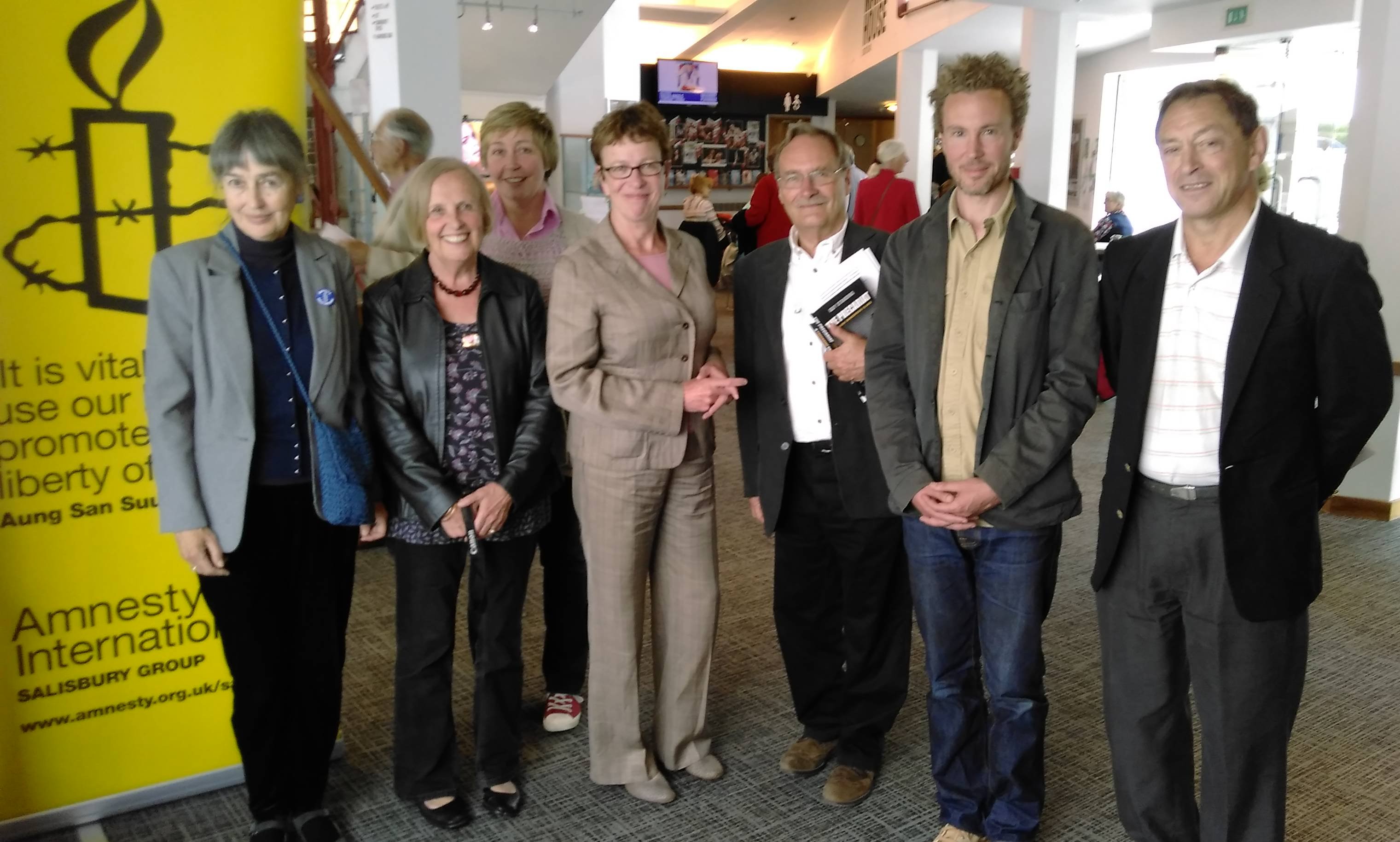
Kate Allen, Director of Amnesty International with David Davis MP, Peter Oborne the journalist, and Ed Probert of the Cathedral posing for a photo during the sixth form conference which took place at the Cathedral on 15 June.
Attendance was good with several hundred 6th formers from the local schools who listened to the speakers and then asked questions.
Kate also took part in another event in the Playhouse in which she was joined by Prof Guy Standing, author of The Precariat and A Precariat Charter and Ben Rawlence writer and researcher and author of Radio Congo. Ben used to be a country representative with Human Rights Watch.
The event was called Magna Carta Now and was looking at the relevance of the Magna Carta in today’s world especially as it was the 800th anniversary of its sealing. Edward Fox the actor read out sections of the charter and the panel debated their significance and relevance today. Local member, Peter Curbishley was in the chair. Around 140 people attended.


UPDATE: 28 APRIL
Human rights myths Thanks to http://www.RightsInfo.org – see link at the bottom of this site.
As we pointed out in our previous blog, the Conservatives, if they form an administration after the election, want to abolish the Human Rights Act #HRA. Amnesty has launched a campaign with a link to KeeptheAct spelling out the benefits of the act for everyone in the UK. For example:
These are some of the day to day stories of the HRA and how it helps ordinary people in their daily lives. But it is a story a lot of our newspapers do not tell, preferring to peddle disinformation and myths. The act protects ordinary people and means that public bodies like the police and local authorities must respect our basic human rights. It does seem strange that we are celebrating 800 years since the signing of Magna Carta with politicians waxing lyrical over that document whereas its modern version is derided and is under threat, often for quite spurious reasons. Go to KeeptheAct and add your voice.
UPDATE: 5 May … still no sign of a draft of what the British Bill of Rights will contain. People go to the polls in a couple of days time without knowing what is planned. Since the election campaign has been based largely on the deficit and who is going to spend the most on the NHS, oh and being run by Scotland: what is, or is not, in the BBoR may seem trivial. But it touches on all our rights and on our relationship with Europe so it is important.
The #Conservative party #manifesto was published today 14 April and as promised, there is a plan to scrap the Human rights Act #HRA. The manifesto says on p73:
We will scrap Labour’s Human Rights Act and introduce a British Bill of Rights which will restore common sense to the application of human rights in the UK. The Bill will remain faithful to the basic principles of human rights, which we signed up to in the original European Convention on Human Rights. It will protect basic rights, like the right to a fair trial, and the right to life, which are an essential part of a modern democratic society. But it will reverse the mission creep that has meant human rights law being used for more and more purposes, and often with little regard for the rights of a wider society. Among other things the Bill will stop terrorists and other serious criminals who pose a threat to our society from using spurious human rights arguments to prevent deportation.
This will have profound implications in our relations with Europe and we still do not know what the new bill will look like even after many years of discussion about the abolition of the HRA. Incidentally, although the Act was introduced under the Labour administration, it was voted for by many Conservatives as well.
A draft of the BBoR has been a long time a coming and the latest we heard was that it was to be published before Christmas. One assumes a draft will now appear before polling so that voters can see in more detail how it differs from the existing HRA.
The Conservatives seem to have got themselves into something of a bind with this Act. They were happy to go along with the anti-European sentiment expressed by most of our newspapers and were obviously spooked by the Ukip surge over the last few years. There has been a torrent of misinformation and disinformation about the workings of the HRA which, apart from the honourable exception of Dominic Grieve MP, they have made little or no attempt to counter with facts.
What got them steamed up most of all – and got our tabloids into a fearsome lather – was the case of Abu Qatada or the ‘preacher of hate’ as he was called. Many attempts were made to deport him but the problem was not just the HRA but the fact that he might be tortured when he was returned to Jordan, or the Jordanians would convict him using evidence obtained from torturing others. Is this an example of ‘spurious human rights arguments’? Since, quite apart from the ECHR, we are signatories to treaties banning the use of torture, there was a problem in getting him out of the country in any event. We might note in passing that the Jordanians had to clean up their judicial act as part of the agreement to send him back.
A puzzle though is that the other area which gets politicians steamed up is the issue of a right to life yet this is quoted as being ‘an essential part of a modern democratic society.’ Something about a cat.
The fact remains that many ordinary people are beneficiaries of the Act. Lawyers can use it in their day to day work with individuals and their dealings with authorities of one kind or another. Little of this gets published in the media and most are unaware of it unless by chance they know of someone who has benefited.
As far as the Strasbourg court is concerned, the UK are the ‘good guys’ since we still have a largely uncorrupted police and judiciary and people can appeal decisions in cases of injustice. Our police operate under PACE and suspects have a right to a lawyer. Very few of the cases which go to Strasbourg get overturned – we believe there were only eight last year.
As one of the original countries, along with France, who prepared the ECHR after the war at the behest of Winston Churchill – a Conservative – if we leave the Convention it will have significant repercussions in places like Belarus, Turkey and Russia. Belarus is the last country in Europe with the death penalty and human rights are largely ignored.
It will be interesting to see how our local Conservative candidate John Glen reacts to this. When he came to see the local group to discuss this topic he did agree to be more balanced in his comments which we welcomed. This followed an article in the Salisbury Journal saying he wanted it abolished. But now it is part of the manifesto for his party we shall have to see…

October 2014
In his speech to the Tory party conference today, the prime minister David Cameron pledged to get rid of the Human Rights Act #HRA and replace it with a British Bill of Rights. Problem? Where is it? A bit like Lewis Carroll’s snark, it is often spoken of but never actually seen. It has been talked about off and on for around 7 years now but it still hasn’t seen the light of day.

Second problem: how will it be any different to the HRA it will replace? It will presumably contain many of the clauses about fair trials, no torture, knowing what one is accused of, no slavery, arbitrary arrest etc. etc. that are contained in the HRA.
It is likely that the ire is directed at some individual cases which get the tabloid press in a stew such as Abu Qatada. The issue here of course was that he could not be deported because it was likely that either, he would be tortured or, evidence gained by torture would be used against him.
The problem is the same as it always has been with the act. It is European and in the fevered atmosphere of anti-Europeanism stoked up by Ukip, anything from Europe is a bad thing. The second problem is the media – or sections of it – who dislike the act and print all manner of misinformation and disinformation about its rulings. They don’t like it because the question of privacy has a higher standing under the act than they would like. As we have seen with News International – and are beginning to see with the Mirror Group newspapers – newspapers are sold by penetrating the private lives of the famous by a variety of dubious and illegal means.
The benefits of the act, such as that reported today of people in Essex who were able to use it to take action against the police, are seldom reported.
Unless we pull out of the Council of Europe, we will still be subject to the rulings of the European Court. It is strange to report that with all the venom and anger directed against Strasbourg nearly 99% of cases applications against the UK are struck out. That is because we have good legal systems here. The HRA was brought in to stop the trail of people having to go to Europe to get justice.
Dominic Grieve was sacked by David Cameron in the last reshuffle and it was widely interpreted as a clearing of the decks by the prime minister of supporters of the Human Rights Act #HRA. Grieve has now spoken on the issue and below is a link to the interview in the Guardian newspaper.
In an earlier piece, Dominic Grieve expressed his dismay that David Cameron had narrowed the range of views held by his senior team. The attorney general sacked by David Cameron over his dogged support for the European convention on human rights (#ECHR) says he fears the prime minister will use this week’s party conference to dilute the UK’s commitment to the international treaty.
The Conservatives have misgivings about the act partly because of their distaste for things European. There has been a concerted tabloid campaign against the act and the ECHR because allegedly it gives rights to criminals and terrorists. The benefits of the act to ordinary people is rarely given a mention however. They also publish a great deal of misinformation which is seldom corrected.
Readers may like to look at an earlier post following a meeting the group had with the Salisbury MP, John Glen. He has said he wants to see the HRA abolished but after some of the benefits of the act for ordinary people – including some of his constituents – were explained, he did agree to be more balanced in future.
Ken Clarke MP resigned as a minister in the Government at his own request yesterday and issued a parting warning to the Conservatives on the European human rights convention #ECHR.
In a strong warning to his party, he said: “I personally think it is unthinkable to leave the European convention on human rights. It was drafted by British lawyers after the second world war to protect the values we fought the war for. Now it is a long way from the war, but members of the European council covered by the convention include Russia and Belarus and so on. It is the way we uphold the values we strive for which are the rule of law, individual liberty, justice for all, regardless of gender. The convention is the bedrock of that.”
He added: “A slightly absurd debate takes place in this country. We are occasionally taken to the European court in Strasbourg but we win 98% of the cases because of our human rights record. We only lose 2% of cases and all these mad mullahs that the press love to vilify and blame for our terrorist problems – which is a somewhat uncomplicated way of analysing the situation – are thought to win in Strasbourg. Well, we have won all the cases in Strasbourg.
Source: Guardian
http://www.theguardian.com/politics/2014/jul/15/ken-clarke-exits-human-rights-warning-tories
View the South region site
It may seem odd, not to say a little reckless, to be defending an act so widely criticized by large parts of the British media and so many politicians, particularly those in the Conservative party. Indeed, such is the level of criticism in the press that it would be a brave politician who puts his head above the parapet to attempt to say something positive about it, Kenneth Clarke being one of the few.
There are many politicians who want to see it abolished including the Conservative member for Salisbury, John Glen. They would like to see a British bill of rights to replace the Human Rights Act (HRA) although quite what has happened to this is unclear but it has probably foundered because of Lib Dem opposition. Both Theresa May, the Home Secretary and Chris Grayling the Justice Secretary, are committed to repealing the act if re-elected in 2015.
The criticisms come in varying forms but they include statements that it is a ‘charter for criminals’, that we are subject to ‘European diktats’, that it makes it harder to ‘keep our country safe’ (David Cameron), and that we cannot deport foreign criminals and terrorists. There are also stories – many of them made up or are a wilful distortion of the truth, such as a mass murderer wanting pornography in his cell because it was his ‘human right’ (it isn’t and he didn’t) or a violent man demanding a burger before coming out of a house (likewise). In that case the police bought him a burger as part of the negotiating strategy and it was nothing to do with HRA.
In all this tirade of criticism the facts almost get lost. It is also hard to recall that it was a conservative politician, Sir Winston Churchill who, after the war was keen to see a convention established and that it was an Englishman Sir David Maxwell-Fyfe, with a French colleague, who put together the original act which was completed in 1950 by the then newly formed Council of Europe, and came into force in 1953. It was their desire to see an end to the horrors seen in the war by establishing the rule of law in Europe. Key influences in drafting the convention were the Magna Carta (whose 800th anniversary we are to celebrate in 2015), the 1689 Bill of Rights and habeas corpus.
When reading the HRA, what surprises most readers is how benign and self-evidently beneficial it is. It says for example, that torture or other cruel and unusual punishments should not be used; that people should know of what they are charged; that people have the right to a lawyer; a right to a fair trial; that there should be no slavery or servitude, and there should be freedom of thought, conscience and religion. Indeed politicians are asked which of these they object to and in what way the proposed bill of rights would be different, they are strangely silent. This question was posed to Mr Glen in the Salisbury Journal and there was no answer from him.
The critics hold sway because no serious attempt has been made to explain it to the general public. There has been no attempt at all, by any political party, to set out the benefits of the act either in this country or in other countries in the EU. Instead, a general dislike of any and all things European sets the tone for the debate, if debate is in fact what we get. Because there is no positive argument, the nay sayers and critics are free to expound their beliefs largely unopposed. The recent head to head debates between Nigel Farage and Nick Clegg revealed what a hard job the latter had in convincing his audience of the benefits of being in the European Union. The polls suggested he lost heavily. Although they weren’t discussing the HRA, it is bound up with all things Europe and hence a bad thing.
Advantages
So what are the advantages? The most important one of all is that the HRA protects everyone’s human rights whatever their age or whether they are rich or poor. A key feature of the act is this emphasis on individual rights against state power. There is very little in our laws or constitution which protects free speech, the right of protest, privacy or non-discrimination. In some countries these provisions are of considerable importance where the police or the state wield immense power against the individual and the court system is either corrupt or ineffective. These rights are enshrined in the HRA. Up until it became law in this country, individuals had to go the Strasbourg to get justice. Now that it is part of our law that is no longer necessary.
The European court has had most beneficial effect in Europe and in former Soviet republics. In Greece and Italy for example the court is trying to improve the enormous lengths of time the legal processes take there. In Russia there has been a sea change in the legal processes and references to the European court are testimony to improvements taking place.
It is Russia and currently the Ukraine which is particularly interesting. Both are in the news at present with the Crimea and, from time to time, the issue of human rights has been mentioned. In an earlier conflict in Chechnya, Russia was accused of using excessive force and there were accusations of disappearances, the use of torture and extrajudicial detention. Initially, Russia refused to accept any findings against them, but at the end of last year, there has been a slow change and it has accepted the European court’s ruling in some cases. The improvements are small but are beginning to happen and observers say that although more needs to be done, without the court it could be much, much worse.
In amongst the frequent criticism of the HRA and threats to abolish it by Teresa May, Chris Grayling and echoed by our own MP, it is odd to read a different interpretation by the Home Office and the Foreign Secretary, William Hague. This is a policy statement from the FCO:
The Human Rights and Democracy Programme (HRDP) is the Foreign and Commonwealth Office’s dedicated fund supporting human rights and democracy work overseas. The Programme aims to make a difference to people’s lives, helping to build the capacity of governments and civil society to promote and protect human rights. In 2012/13, we supported over 70 projects worldwide.
Human rights, democracy and the rule of law are at the heart of the Government’s foreign policy. The HRDP targets areas that are both important to us and where we consider we can make the greatest impact in delivering the FCO’s overarching purpose to “pursue an active and activist foreign policy, working with other countries and strengthening the rules-based international system in support of our values. FCO’s web site
The last sentence here is most relevant and it is hard to reconcile this policy statement with other ministers’ statements. We are not talking of differences within the coalition here as all the relevant individuals are conservative MPs. If we repeal the act it is hard to see how its principles can be used by the FCO in its foreign policy.
The FCO clearly sees that in an international context promoting the values enshrined in the European Convention are central to establishing a stable world order. The rights we take for granted are not always taken for granted in foreign or even some European countries.
Indeed, many of our partners are alarmed at both the political and media campaign against the act. The United Kingdom’s desire to pull out is particularly alarming since we are regarded as one of the ‘good guys’ as far as legal process is concerned and as the key architect of the act in the first place, it would send a truly negative message to the rest of world and Europe. The right of a suspect to have a lawyer present while being interviewed by the police, is well established here but is still a rarity in other countries.
Why the hostility?
The question has to be asked why is it that so many politicians and significant parts of the media are so opposed the HRA? It is not an easy question to answer. In part it is a fear and distaste for immigrants and immigration generally. When the restrictions on Romanians and Bulgarians coming into the country were lifted at the end of last year, there was a concerted campaign in the tabloid press with scare stories of ‘floods’ of Romanians reportedly about to enter the country. They were allegedly coming here for the benefits or to get access to better health provision. Thousands if not tens of thousands were expected. The story rather fizzled out when journalists and some politicians turned up at Stansted airport to greet the expected multitude to find, well, just two. That’s 2 as in 1, 2, 3, not two thousand, two hundred thousand or 2 million.
Reliable studies have shown that immigrants have a net beneficial benefit to our society and economy. If a strike of immigrants were a possibility then large parts of our society and industry would quickly be in trouble. Hospitals would cease to function, care homes would shut, the food industry would struggle and food shelves in supermarkets would quickly empty. This is not an essay on immigration but the constant negative stereotyping of immigrants plays into the political and human rights story. They are here to work and being young they have little need of the health service. The beneficial effects seldom get a voice unfortunately.
The second argument is that of sovereignty. This is based on the idea that because the people elect a parliament via the ballot box then they are allegedly in control of our affairs. The ‘unelected bureaucrats in Brussels,’ (or Strasbourg) to quote a well-worn phrase, are interfering with our affairs and we want less of it and them. We need to get this power back so that ‘we’ the people of the United Kingdom are back in control.
The argument over sovereignty has some problems however. The first is that the people have very little actual say over how the country is run. Corporate interests – either directly or through a large army of lobbyists – have much greater influence. Plain packaging of tobacco products (now likely to happen) and excessive sugar in our diet are both recent examples where commercial lobbying might have been the deciding factor not the health of the nation or what ordinary people want. Media moguls – again either directly, or through their media interests – wield enormous power and influence. The idea that once we come out of Europe we the people will in sole charge of our affairs is on very thin ground.
It is also paradoxical that with all this concern for sovereignty, very little has been said by the same politicians about the penetration of our electronic mail and mobile phone messages by GCHQ and NSA in America. The HRA gives us a right to privacy and this is, and has been, comprehensively breached by electronic surveillance. Initially it was claimed that there was adequate oversight. This argument quickly melted away. The ‘you have nothing to fear if you have done nothing wrong’ argument was also trotted out. Sir Malcolm Rifkind quickly looked silly claiming that his committee was fully in charge of the situation when so clearly they had been sidelined. But whereas politicians speak readily about any Brussels inspired infringement of liberty they are deafeningly silent about the comprehensive intrusion into all our electronic communications by the security services.
It is politics where the real answer may lie. And a key factor here was the election in Eastleigh where the Conservatives came third to Ukip. This shook the party and the rhetoric against the act – and against the EU generally – gained traction. The debates between Nigel Farage and Nick Clegg are further evidence that the anti–EU message is simple and strong and goes down well with large sections of the electorate. The failure of politicians from all parts of the spectrum to address this is coming home to roost.
Perhaps another reason lies behind this and concerns the fundamental nature of the HRA which is about giving power to the individual. For the first time, individuals have the power to hold the state in its various forms to account and this is arguably why it is so disliked by some politicians. It is this shift in power to enable an ordinary citizen to take on a corporation or the state and to use fundamental rights to do so, shakes the status quo.
The HRA has been a force for good in this country despite its imperfections and it should be defended.
Sources:
Why is the European court of human rights so hated by the UK right? John Henley Guardian 22 December 2013
Big changes to Human Rights or not? HRLA.co.uk April 2012
Human Rights Act myths Liberty, [accessed 17/01/2014]
Right to a fair trial (removal to Jordan) – Othman (aka Abu Qatada) Hansard HC Deb 17 April 2012 c173)
Six questions for Chris Grayling on human rights New Statesman 1 October 2013 [accessed 21 January 2014]
Judges would regret Human Rights Act repeal Joshua Rozenberg Guardian 14 March 2013
Human rights are good for Britons – and the Tories know that Natalie Samarasinghe Guardian 10 March 2013
Counter-Interpretation, Constitutional Design, and the Right to Family Life: How the Conservatives Learned to Stop worrying and Love the HRA (Briefly) Joshua Braver UK Constitutional Law Association 6 January 2014
Theresa May’s assault on the right to family life ignores a complex reality Julian Norman Guardian 30 September 2013
Also Amnesty UK.

 Amnesty in Salisbury & South Wiltshire