Human Rights Act


Expect an announcement soon
Tapestry illustrating the UN Convention

Things have gone quiet with the plans to abolish the HRA and the promise of something before Christmas has not come to anything.  There is a glimmer of hope in that Michael Gove has taken over as Justice Secretary and seems willing to modify or drop completely some of the worst excesses of his predecessor.  However, the negotiations currently coming to some kind of conclusion concerning our role in Europe are likely to see a fresh assault on the act emerging soon.  The watch word is ‘sovereignty’.  Parliament wants to be sovereign and this is being presented as a good thing and it is implied we will be the better for it.  The right wing press will delight at this and there will be many articles about ‘bringing power back to Westminster’ with the implication that this will result in better laws for us all.  Salisbury MP John Glen is a keen advocate for abolition.

A parallel story over the past couple of weeks has been the tax situation of Google and other American behemoths who so manage their affairs that they pay little or only derisory levels of tax.  Here, our sovereign parliament (since Brussels has little to do with tax collection) has failed.  Indeed, successive chancellors have made numerous announcements about ‘cracking down’ but almost nothing seems to happen.  Hardly surprising since accountants from the big four firms are actually in the Treasury ‘advising’ the chancellor on tax policy.  So the idea that sovereignty is key and is some kind of magic bullet is clearly illusory and does not lead to better outcomes.

A useful guide explaining the HRA and what it does has just been published by the British Institute of Human Rights and is worth a look.  There is a short video as well.  No doubt we will be returning to this topic when the announcements are made.

Follow us on Twitter and Facebook


November group minutes


The November minutes of the Salisbury group are now available thanks to Lesley.

November minutes (pdf)

Correction: the Death Penalty vigil took place on 17 October and not November as stated in the minutes

Rightsinfo video on the Human Rights Act


The Human Rights Act is under threat and we await the current government’s plans for its replacement which must be due very soon.  Rights Info has produced a short video which is worth a look which you can access from their web site or from this link.

Rights info video

Tapestry erected in Salisbury Playhouse


The tapestry – which has been put together by members of the southern region of Amnesty International – was erected today in the Playhouse.

Each panel illustrates one of the clauses of the UN Declaration of Human Rights.  It will be on display in the theatre for the next two weeks or so and while a series of plays are being performed on the subject of Magna Carta.

We hope to move it to the Cathedral, subject to their agreement, at the end of the theatre run.  The tapestry can be viewed on the first floor of the theatre.

Tapestry in the Playhouse

Scrapping the Human Rights Act HRA


The government is proposing to issue a public consultation on scrapping the Human Rights Act sometime in the autumn.

abolish hra

Human Rights Act under threat


Leading or following?

The Human Rights Act HRA remains under threat from the Conservative Government who promised in their manifesto to abolish it.  There is speculation that it was put in the manifesto to appeal to Ukip supporters and those for whom anything with ‘Europe’ attached to it is bad news.  They were expecting to be in a coalition again – so the theory goes – and the LibDems would not have allowed it to go ahead.  In other words it was a promise unlikely to be put into effect but sounded good in the manifesto.

Now that they are in power on their own they are faced with a problem.  Abolition will prove extremely difficult for all sorts of reasons.  Reform is difficult if you have nailed your colours to the abolition mast.  The Scots will not countenance it and the recent proposal to allow hunting with dogs to be re-introduced was effectively ended by the Scot Nats who demonstrated their influence in Parliament.  It also underpins the Good Friday agreement in Northern Ireland.  It may also mean us withdrawing from the European Council.  It will send a very negative message to those countries, such as Russia, who are being pressed to improve their human rights records, a point made by Dominic Grieve QC MP when he came, at our invitation, to speak in the Cathedral.

Just over a year ago our local MP John Glen (Con) wrote to the Salisbury Journal to say he was keen on abolition.  Our group wrote to Mr Glen and after an exchange of letters, a meeting was arranged in June 2014.  At that meeting, the many unreported benefits of the act were explained and that these benefits were likely to apply to a number of his constituents.  The battle that individuals have with authorities of all kinds to get a fair deal is made that bit easier by the Human Rights Act.

Unfortunately, the act gets a near universal bad press certainly from the tabloid end of the market.  An incessant series of articles claiming that all kinds of evil people escape justice because they can claim the right to a ‘family life’ or it’s their ‘human right’, inevitably infuriates people reading it.  Frequently, it isn’t the HRA at all but some other piece of legislation involved.  No matter.  Some of the stories are hugely exaggerated or just plain wrong.  But the benefits to ordinary people seldom gets a mention.

In the latest edition of Valley News (a free sheet in the Salisbury area, July 2015) Mr Glen writes:

[…] This month also marked the 800th anniversary of Magna Carta.  In addition to some spectacular celebrations, this has re-opened the debate about human rights here in the UK.

Too often I hear from constituents who are fed up with some of the decisions made in our courts and in the EU, about human rights laws.

While these cases represent only a small minority, I do not believe we should simply turn a blind eye to them.  A recent opinion poll suggested three quarters of the UK felt that human rights laws were being applied too widely.

It is far from healthy in our democracy to accept this status quo: human rights should be celebrated, and I hope we seize the opportunity of the Magna Carta anniversary to restore some confidence in them at home.

We do not know how many constituents have written to Mr Glen or the topics they are concerned about.  He makes no mention of benefits to ordinary people and to some of his constituents.  But if his correspondents have read tendentious stories in our media, it is hardly surprising they write to their local MP. For example a Daily Mail journalist spoke of the HRA ‘[which] blights every aspect of our life.’

Maybe one of the reasons these papers do not like the act is because there is the right to privacy within it.  There is no mention of benefits to ordinary people.  Since many newspapers have depended on intrusion – using both legal and often illegal means – to get their stories, this represents quite a threat to their business model.

Human rights should indeed be celebrated as Mr Glen says and we hope he can do some celebrating.  But it does need politicians of courage to stand up and defend the act and the many beneficial effects it has on the lives of ordinary – or should we say ‘ordinary hard-working’ – people’s lives. At our meeting with Mr Glen he was asked if he was just repeating stories from the Daily Mail.  He said he did not but that he did have to read it to understand what his constituents were writing to him about.  We can only hope that ‘to restore some confidence in [human rights]’ means explaining the benefits, countering the myths and criticising the many misleading stories.  In short, putting the case for the act.


A new web site established with the sole purpose of countering the misinformation and disinformation about human rights is www.rightsinfo.org which is well worth putting in your favourites.


Magna Carta event at the #playhouse with #EdwardFox reading


Playhouse event

UPDATE: Piece in the Salisbury Journal

On Monday, June 15, celebrated actor Edward Fox will read extracts from Magna Carta at Salisbury Playhouse as part of a panel discussion investigating the relevance of the historic document today.

We are pleased to announce an event at Salisbury Playhouse called Magna Carta Now on 15 June at

Edward Fox
Edward Fox

2pm.  It will involve Edward Fox OBE who will read parts of the Magna Carta and there will be a panel discussion on the relevance of these readings in the politics today.

The event is particularly relevant in view of the announcement by the new government of their plans to scrap the Human Rights Act (or the ‘hated’ Human Rights Act as some would say), details of which are expected in the forthcoming Queen’s Speech on 27th.  We have waited several years now for the promised British Bill of Rights which we understand from press comment has gone through at least 8 drafts but has still not been published.

The panel is a distinguished one:

  • Kate Allen, Director of Amnesty UK
  • Prof Guy Standing, author of among other writings The Precariat and A Precariat Charter
  • Ben Rawlence, from Salisbury, who has been a country representative for Human Rights Watch and is author of Radio Congo

Tickets are available from Salisbury Playhouse www.salisburyplayhouse.com (24 hours) or phone 01722 320333 or at the Playhouse itself.

We hope local Amnesty supporters and others will come along to what promises to be an interesting event.  We should add that there will be an opportunity for audience participation at the end of the event.

Some human rights success stories


Reading this blog can sometimes seem depressing as we highlight individuals imprisoned for their beliefs; the widespread use of torture around the world; the use of the death penalty and recently, a desire by some of our (UK) politicians to abolish the Human Rights Act.

Successes

There are successes however, some of which have been a long time in the making. After six years of legal proceedings and campaigning by Amnesty members around the world, Shell Oil have at last been made to pay for the devastation caused by oil spills in the Niger Delta.

wire tap imageOthers successes have been unprecedented. For the first time ever, the Investigatory Powers Tribunal ruled that UK secret services acted illegally in their surveillance activities.

And that’s not all. Because of you Guadalupe found justice in El Salvador. With a window of just 48 hours, we asked you to tweet El Salvador’s members of parliament calling for a pardon for Guadalupe – a young woman imprisoned after suffering a miscarriage. Every tweet counted: her pardon was granted by a majority of just one vote. Thank you. We’re continuing our work to ensure Salvadoran women are not criminalised by the total abortion ban in the country

Burma has dropped off the radar in the last couple of years and things have improved there.   But not totally and there are still prisoners of conscience. For example, long-standing prisoner of conscience Dr Tun Aung has recently secured release.

February saw two historic victories in the age-old battle for the right to privacy and free expression. The USA and UK’s past intelligence-sharing on Communications surveillance was ruled illegal and the Security Services conceded their current regime for intercepting legally privileged communications is also unlawful. These landmark rulings, in which Amnesty were co-claimants, should mean there are more significant positive changes ahead.


A great step towards justice was made in January when three journalists imprisoned in Egypt had their sentences overturned on the basis of a flawed trial. Peter Greste was allowed to return home to Australia but Mohamed Fahmy and Baher Mohammed are awaiting a retrial in Egypt, currently set for 22 April. Egypt must now drop all charges against them and free, not retry these prisoners of conscience.

Forced to sign a confession after being kidnapped and tortured by marines, Claudia Medina Tamariz has had the last of the charges against her dropped, and she is now a free woman.  Claudia thanked the 300,000 Amnesty members around the world who demanded justice.  We continue to call for an investigation into the torture she suffered, and for the perpetrators to be brought to justice.

A month after Claudia’s release, the Mexican president came to the UK and we delivered your Stop Torture petition signatures to him – in a giant piñata. Ahead of the visit you called on the UK representatives meeting him to raise the issue of torture. Guess what? They did. Thanks to Amnesty supporters campaigning, the Prime Minister, Deputy Prime Minister and Secretary of State for Scotland all helped send a strong message: it’s time for Mexico to respect human rights.

So campaigning does sometimes work.

David Cameron’s speech


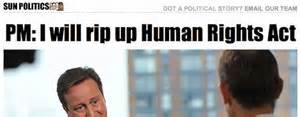
In his speech to the Tory party conference today, the prime minister David Cameron pledged to get rid of the Human Rights Act #HRA and replace it with a British Bill of Rights.  Problem?  Where is it?  A bit like Lewis Carroll’s snark, it is often spoken of but never actually seen.  It has been talked about off and on for around 7 years now but it still hasn’t seen the light of day.

David Cameron Photo, BBC
David Cameron
Photo, BBC

Second problem: how will it be any different to the HRA it will replace?  It will presumably contain many of the clauses about fair trials, no torture, knowing what one is accused of, no slavery, arbitrary arrest etc. etc. that are contained in the HRA.

It is likely that the ire is directed at some individual cases which get the tabloid press in a stew such as Abu Qatada.  The issue here of course was that he could not be deported because it was likely that either, he would be tortured or, evidence gained by torture would be used against him.

The problem is the same as it always has been with the act.  It is European and in the fevered atmosphere of anti-Europeanism stoked up by Ukip, anything from Europe is a bad thing.  The second problem is the media – or sections of it – who dislike the act and print all manner of misinformation and disinformation about its rulings.  They don’t like it because the question of privacy has a higher standing under the act than they would like.  As we have seen with News International – and are beginning to see with the Mirror Group newspapers – newspapers are sold by penetrating the private lives of the famous by a variety of dubious and illegal means.

The benefits of the act, such as that reported today of people in Essex who were able to use it to take action against the police, are seldom reported.

Unless we pull out of the Council of Europe, we will still be subject to the rulings of the European Court.  It is strange to report that with all the venom and anger directed against Strasbourg nearly 99% of cases applications against the UK are struck out.  That is because we have good legal systems here.  The HRA was brought in to stop the trail of people having to go to Europe to get justice.

Meeting with John Glen MP: update


The Salisbury group invited John Glen MP to speak to the group following his comments in the Salisbury Journal that – in common with other MPs, the Prime Minister and the Home Secretary Teresa May – he would like to scrap the Human Rights Act [HRA] .  The Conservatives in their election manifesto had said they wanted to enact a Bill of Rights [BoR] and appointed a Commission to review the matter.  It failed to reach an agreement and there the matter has rested with no current work being done to draft a BoR.  Nevertheless, there is still political agitation to abolish the .  A key theme of the evening was trying to determine what would the difference be between a new Bill of Rights and the existing HRA.  In other words what would be included and what left out.

Andrew – chair of the local group – welcomed Mr Glen who began by saying he was a keen supporter of human rights.  He was a member of The Westminster Foundation for Democracy and had recently visited Iran, Egypt and the Maldives.  In the first two countries he discussed the plight of Christians with the authorities.  He had recently asked a question* in the House of Commons concerning the Israel/Palestine conflict.

As far as the HRA was concerned the main issue was the question of the interaction with the European Court: Strasbourg [rulings] should be taken into account, not be binding.  A proposal for a British BoR will possibly be in the party manifesto.  He was concerned about some of the claims made using the act and he mentioned the issue of equipment in Afghanistan.  Various points were put to Mr Glen by members:

  • The HRA was passed into UK law to enable claims to be made in this country and to reduce the need to go to Strasbourg. JG said this may have been the intention but was not always the case in practice
  • If a Bill of Rights is to be introduced, how would it in fact be different from the HRA as it is?
  • The HRA was of enormous benefit to ordinary people – some of whom are [your] constituents. For example, art. 8 protects the elderly and vulnerable. The problem is made worse for many by the reductions in legal aid.  JG said he saw people every day with these problems and he was not happy with the Justice reforms.  But he was concerned at perverse outcomes and it needs the will of Parliament.  It was pointed out that the HRA was by will of Parliament.
  • He was asked if the point of a BoR was to fetter the judiciary and again, how will it be different from the HRA?


  • It was reported that Strasbourg was concerned at the risk of the UK abandoning the HRA.  As we (the UK with France) were the countries behind the original convention, it would concern them if we turned our back on it. The convention had had enormous beneficial effects in Russia and Belarus who might be less keen to change if we were not there. It was also pointed out that the FCO web site was a keen supporter.  JG said that without knowing what would replace the act this was a hypothetical question.
  • The point was made several times that the positive effects of the act and the cases which fail in the courts, rarely receive publicity. JG agreed with this point. For the most part, there was an anti-attitude fostered by the tabloid press. JG said he was not following a tabloid agenda. He had to read them to know what would be in his post from constituents. He felt had demonstrated his commitment to human rights through his overseas work.
  • Prisoner voting rights were a topic that caused a lot of anxiety. Would it not be appropriate to allow prisoners the vote towards the end of their sentences to help prepare them for re-entry into society?  JG talked about the importance of education in prisons.  He was reminded that funding had been cut for this.

In conclusion, he said he would reflect on the problem of a lack of balance in the public dialogue.  He will also consider how refinements to the HRA might obviate the need for a Bill of Rights.

Group members were no clearer on what would be the difference between a Bill of Rights and the HRA but welcomed Mr Glen’s statement that his comments on the latter would be more balanced in future.

UPDATE

Reported on 17 July that the Conservatives are planning to introduce a British Bill of Rights in their manifesto.

View the South region site of Amnesty International

*John Glen’s question in the House:

Hansard question 1 July


Blog at WordPress.com.

Up ↑