What is the Foreign Office’s policy on human rights?


Contradiction at the heart of government’s human rights policy

October 2015

There seems to be a fundamental contradiction at the heart of the government’s policy as it relates to matters such as human rights and the death penalty.  Readers of this blog will be aware that we wrote to our local MP, John Glen, on 8 June to point out that France was speaking out publicly concerning the rise in the number of executions taking place in Saudi Arabia and that Sweden had reportedly stopped selling arms there.  We noted that in the first 5 months of this year, the number of executions has equalled that for the whole of 2014.

We received a response from a FCO minister Tobias Ellwood who assured us that Saudi Arabia ‘remains a country of concern on human rights, because of its use of the death penalty as well as restricted access to justice, women’s rights, and restrictions on freedom of expression, freedom of assembly and freedom of religion or belief.’

Within days of receiving this letter from Mr Ellwood with a covering letter from John Glen, it was reported that the Foreign Office had both dropped any explicit reference to death penalty and had also dropped the very phrase used by Mr Ellwood namely: ‘a country of concern’ and replaced it with the more anodyne ‘human rights priority countries’.

We wrote pointing this out to Mr Glen on 5 August and, not receiving a reply, wrote again a month later on 14 September.

Then, on 20 September came the astonishing news that a Saudi representative was to become a member of the UN’s human rights council (The Independent).  Human rights organisations were aghast that a country such as Saudi with its record of torture, floggings, executions and so on and so on, should be elected to such a body.  No sooner had we digested this piece of news when The Australian newspaper revealed on 30 September that this election had not happened by chance but that diplomatic cables released by WikiLeaks showed that the UK government had allegedly initiated the secret negotiations to enable the Saudis to get elected.  The cable apparently read:

The delegation is honoured to send to the ministry the enclosed memorandum, which the delegation has received from the permanent mission of the United Kingdom asking it for the support and backing of the candidacy or their country to the membership of the human rights council (HRC) for the period 2014 – 2016, in the elections that will take place in 2013 in the city of New York.

The ministry might find it an opportunity to exchange support with the United Kingdom, where the Kingdom of Saudi Arabia would support the candidacy of the United Kingdom to the membership of the council for the period 2014 – 2015 in exchange for the support of the United Kingdom to the Kingdom of Saudi Arabia.

In simple terms: we will support you if you support us.  Why the UK should need the support of such a country is a puzzle in its own right but for the UK to be supporting the Saudi government for a human rights council is beyond belief.

UN Watch commented:

[we] find it troubling that the UK refused to deny the London – Riyadh vote trade as contemplated in the Saudi cable, nor even to reassure the public that their voting complies with the core reform of the UNHRC’s founding resolution, which provides that candidates be chosen based on their human rights record, and that members be those who uphold the highest standards of human rights.

On 18 September, Mr Glen replies to our second letter.  He claims the change in wording came about on the basis of feedback from diplomats who ‘reportedly had difficulty relating our long list of human rights priorities with the issues they faced in real life – from the chaos of failing states to the corridors of Geneva.’  Adopting more thematic categories makes it easier to apply pressure it is argued depending on the circumstances of the country concerned.

Rather than being ‘vague and obfuscating’ (as has been claimed) the ‘categories are sufficiently broad that diplomats can tailor them appropriately to local circumstances.’  He argues that the change of wording is ‘essentially about semantics’.   FCO ministers have been very clear, even since the change of wording, that their stance on the abolition of the death penalty remains the same, he says.   He quotes Rt Hon David Lidington, Minister for Europe:

The Government calls on all states to adopt an immediate moratorium on [the] use of the death penalty in accordance with the relevant UN General Assembly resolution, and views this as part of the process towards complete abolition.  The Foreign and Commonwealth Office will continue to use its diplomatic and programmatic tools to work towards the goal of global abortion.

Finally, he says ‘I can assure you that the change of wording is not an indication of a change in policy: the UK government will continue to work towards a complete abolition of the death penalty, using all the tools at its disposal.’

So where is the truth?

On the one hand, solemn assurances are given that government ministers are committed to the cause of global human rights, whatever the wording of their policies, which are purely a matter or semantics it is claimed.  On the other hand, a ‘trade’ was undertaken between London and Riyadh to get the latter elected onto a UN human rights body.  Assurances that ‘all the tools at its disposal’ are being used in pursuit of global abolition must be set against George Osborne’s visit to China this month where the nationalist State-run Chinese newspaper The Global Times, lauded the 44-year-old Chancellor for his ‘pragmatism’ in concentrating on business matters and not drawing attention to human rights like some other visiting western leaders.  China leads the world in executions the numbers being a state secret.  It is a serial offender on the human rights front.

On the basis of this evidence it would appear that the claimed commitment to human rights is for domestic consumption only and that the reality, when it comes to actual dealings with foreign governments, is that they seldom feature.

Sources:

Human Rights Watch; The Australian; The Global Times (China); The Observer; The Guardian; The Daily Telegraph; International Business News

London Arms Fair


Will torture equipment be on display this week in London?

September 2015

The London Arms fair, DSEI, opens on 15th September at the ExCel centre at which – in addition to the range of arms large and small – torture equipment has been displayed in past years.  No doubt drones will be on display which enable executions to be carried out from thousands of miles away.  The exhibition runs under conditions of great security and in the past, the comedian Mark Thomas was able to set up a fake stall and interest various passing visitors with his torture equipment.

Arms-Fair---share-assets-email-Sep-2015

The four day exhibition is supported by the government and is an exclusive expo of deadly weapons and arms with a history of companies advertising illegal torture equipment.  Britain has sold arms to 19 of the 23 countries listed by the UN for grave violations against children.

There is a kind of irony that two weeks ago the country was shaken by the death of Aylan Kurdi which prompted a volte face by our government and has seen Mr Cameron in the Lebanon visiting the camps.  The Chancellor, George Osborne spoke of the need to tackle the refugee crisis at source yet we host an event which supplies deadly equipment to countries like Saudi Arabia; Turkmenistan; Pakistan; Libya and Colombia where respect for human rights is almost non-existent.

We want to see the government to stop illegal torture equipment being advertised in the UK.

Poster by Amnesty International

Eritrea


Why Eritrea?

In all the discussion about the relative merits of refugees from the various war-torn parts of the world, the Syrians are presently claiming most attention.  We all understand how dreadful their plight is, and so too those fleeing wars in Iraq, Afghanistan, Libya and the Sudan.  But Eritrea?  Eritrea is not actually at war with anyone (well, it’s in a face-off with Ethiopia, but wouldn’t dare to take on its bigger neighbor in a full-scale war), and the regime is in total control of the country.  So why the desperation of people to escape to Europe?  Indeed the British government has changed its view of the country in recent months to say that it is safe for asylum seekers to be returned home. The Home Office said:

its guidance on Eritrea is based on a careful and objective assessment of the situation in Eritrea using evidence taken from a range of sources including media outlets; local, national and international organisations, including human rights organisations; and information from the Foreign and Commonwealth Office.

However they have relied largely on a Danish report, the authors of which have disowned for its misinterpretation, and Eritrean government sources, rather than the reports of human rights groups.

The UK’s position is totally confused, as they are supposedly taking account also of a recent UN report, which would also give a somewhat different picture.  The report, by the UN Commission of Inquiry on Human Rights in Eritrea, cites a raft of human rights violations – some, it says, which may constitute crimes against humanity – of a ‘scope and scale seldom witnessed elsewhere’. The report strongly urges continued international protection for Eritrean refugees fleeing human rights violations, and warns against sending them back to danger in a country that punishes anyone who tries to leave without permission

President Aferworki
President Afeworki

Following its independence in 1991, the country has lapsed into a total disregard for the rule of law.  Elections have been regularly postponed – President Isaias Afeworki has never faced the electorate – arbitrary detention is rife; torture is so common that the Commission concluded that it was government policy, and mass surveillance and neighbourhood spying is the norm.  Justice is arbitrary, detention conditions are appalling, and complete disappearance not unusual.  So far, so typical dictatorship but in Eritrea it is egregiously appalling.

The speciality of the state is that, under the pretext of defending the integrity of the State and ensuring national self-sufficiency, much of the population is subjected to open-ended national service, either in the army or through the civil service.  When they turn 18 or even before, all Eritreans are conscripted.  While national service is supposed to last 18 months, in reality conscripts end up serving for an indefinite period, up to 20 years in extreme cases.  Thousands of conscripts are subjected to forced labour that effectively abuses, exploits and enslaves them for years.  Women conscripts are at extreme risk of sexual violence during national service.

Many others – detainees, students, members of the militia – are also subjected to forced labour.  The report says

The use of forced labour is so prevalent in Eritrea that all sectors of the economy rely on it and all Eritreans are likely to be subject to it at one point in their lives.  The commission concludes that forced labour in this context is a practice similar to slavery in its effects and, as such, is prohibited under international human rights law.

The Eritrean Foreign Ministry inevitably claimed the Commission’s report contained ‘wild allegations’ which were ‘totally unfounded and devoid of all merit’ and charged the UNHRC of ‘vile slanders and false accusations’, without addressing any of the issues.  The British government have since modified their stance based on Eritrean assertions that military service will be limited to 18 months to 4 years, which would render it legal, but there is no evidence of this happening.

These widespread abuses have prompted thousands of Eritreans to flee their home country in search of asylum in Europe.  According to the latest estimates produced by Italian authorities, 32,000 Eritreans were rescued in 2014 as they attempted to traverse the Mediterranean – the majority of all migrants rescued by Italy’s comprehensive Mare Nostrum operation.  Meanwhile, the UN refugee agency has placed the number of Eritreans under its concern outside the country at more than 357,400.

This is the country we are intending to return refugees to as being “safe”.  The Government needs to think again.

September minutes


The minutes of the September meeting are now available thanks to Lesley.  We discussed North Korea, the death penalty (see separate post on this), the forthcoming vigil on 17 October and agreeing to write to John Glen concerning his failure to reply to our letter of 5 August.

September minutes

Scrapping the Human Rights Act HRA


The government is proposing to issue a public consultation on scrapping the Human Rights Act sometime in the autumn.

abolish hra

Human Rights Act under threat


Leading or following?

The Human Rights Act HRA remains under threat from the Conservative Government who promised in their manifesto to abolish it.  There is speculation that it was put in the manifesto to appeal to Ukip supporters and those for whom anything with ‘Europe’ attached to it is bad news.  They were expecting to be in a coalition again – so the theory goes – and the LibDems would not have allowed it to go ahead.  In other words it was a promise unlikely to be put into effect but sounded good in the manifesto.

Now that they are in power on their own they are faced with a problem.  Abolition will prove extremely difficult for all sorts of reasons.  Reform is difficult if you have nailed your colours to the abolition mast.  The Scots will not countenance it and the recent proposal to allow hunting with dogs to be re-introduced was effectively ended by the Scot Nats who demonstrated their influence in Parliament.  It also underpins the Good Friday agreement in Northern Ireland.  It may also mean us withdrawing from the European Council.  It will send a very negative message to those countries, such as Russia, who are being pressed to improve their human rights records, a point made by Dominic Grieve QC MP when he came, at our invitation, to speak in the Cathedral.

Just over a year ago our local MP John Glen (Con) wrote to the Salisbury Journal to say he was keen on abolition.  Our group wrote to Mr Glen and after an exchange of letters, a meeting was arranged in June 2014.  At that meeting, the many unreported benefits of the act were explained and that these benefits were likely to apply to a number of his constituents.  The battle that individuals have with authorities of all kinds to get a fair deal is made that bit easier by the Human Rights Act.

Unfortunately, the act gets a near universal bad press certainly from the tabloid end of the market.  An incessant series of articles claiming that all kinds of evil people escape justice because they can claim the right to a ‘family life’ or it’s their ‘human right’, inevitably infuriates people reading it.  Frequently, it isn’t the HRA at all but some other piece of legislation involved.  No matter.  Some of the stories are hugely exaggerated or just plain wrong.  But the benefits to ordinary people seldom gets a mention.

In the latest edition of Valley News (a free sheet in the Salisbury area, July 2015) Mr Glen writes:

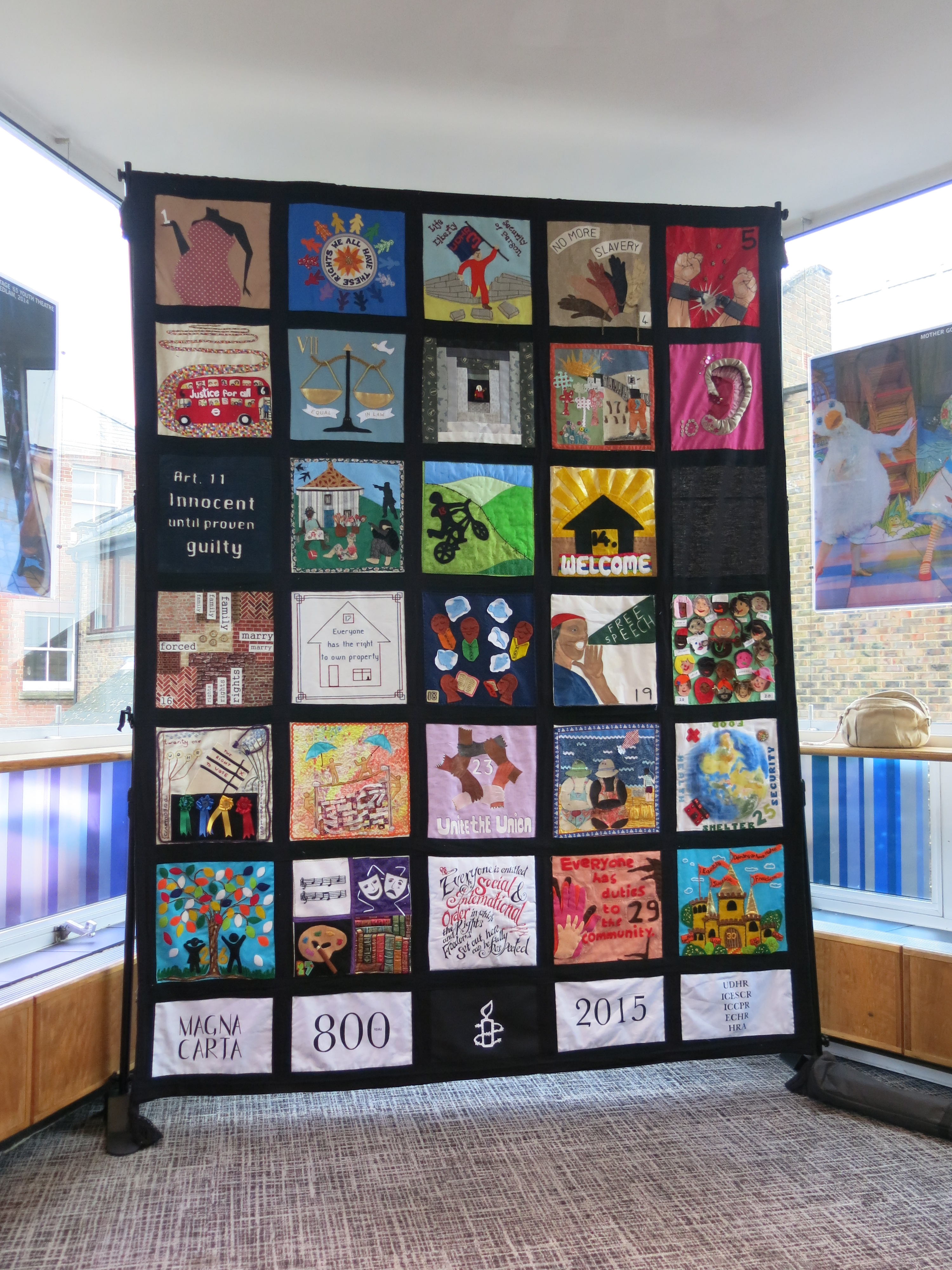
[…] This month also marked the 800th anniversary of Magna Carta.  In addition to some spectacular celebrations, this has re-opened the debate about human rights here in the UK.

Too often I hear from constituents who are fed up with some of the decisions made in our courts and in the EU, about human rights laws.

While these cases represent only a small minority, I do not believe we should simply turn a blind eye to them.  A recent opinion poll suggested three quarters of the UK felt that human rights laws were being applied too widely.

It is far from healthy in our democracy to accept this status quo: human rights should be celebrated, and I hope we seize the opportunity of the Magna Carta anniversary to restore some confidence in them at home.

We do not know how many constituents have written to Mr Glen or the topics they are concerned about.  He makes no mention of benefits to ordinary people and to some of his constituents.  But if his correspondents have read tendentious stories in our media, it is hardly surprising they write to their local MP. For example a Daily Mail journalist spoke of the HRA ‘[which] blights every aspect of our life.’

Maybe one of the reasons these papers do not like the act is because there is the right to privacy within it.  There is no mention of benefits to ordinary people.  Since many newspapers have depended on intrusion – using both legal and often illegal means – to get their stories, this represents quite a threat to their business model.

Human rights should indeed be celebrated as Mr Glen says and we hope he can do some celebrating.  But it does need politicians of courage to stand up and defend the act and the many beneficial effects it has on the lives of ordinary – or should we say ‘ordinary hard-working’ – people’s lives. At our meeting with Mr Glen he was asked if he was just repeating stories from the Daily Mail.  He said he did not but that he did have to read it to understand what his constituents were writing to him about.  We can only hope that ‘to restore some confidence in [human rights]’ means explaining the benefits, countering the myths and criticising the many misleading stories.  In short, putting the case for the act.


A new web site established with the sole purpose of countering the misinformation and disinformation about human rights is www.rightsinfo.org which is well worth putting in your favourites.

#deathpenalty report for June now available


No to the death penaltyThe monthly report on the state of the death penalty around the world is attached – thanks to Lesley.

July death penalty report (pdf)

News about Moses Akatugba from Nigeria


stop_tortureWe have featured Moses before on this site since news of his release has been received.  Briefly, he was arrested for allegedly stealing some mobile phones.  He was then brutally tortured and the confession extracted from him was used to sentence him to death.  He has been in prison for 10 years but a world wide campaign has resulted in his release.  The Salisbury group was active on his behalf and over 400 signatures were collected and a petition sent to the Nigerian Embassy in London.

Moses has written a description of his release and how he was reunited with his family and this can be read here:

Article by Moses

An item on Moses and the involvement of the Salisbury Group appeared in the Salisbury Journal on 2 July which unfortunately does not appear to be available on line.

Moses’ piece ends thus:

If I have my way, and can stop torture, I will be the happiest man on earth. I don’t want any future generation to go through what I went through in that torture chamber.

On 28 May 2015, Moses was pardoned after nearly 10 years in jailOver 800,000 of you around the world took action demanding justice. 

Nigeria fact sheet prepared at the time of the campaign.

Kate Allen of #Amnesty International at the Sixth Form Conference in #Salisbury


June 15 007

Kate Allen, Director of Amnesty International with David Davis MP, Peter Oborne the journalist, and Ed Probert of the Cathedral posing for a photo during the sixth form conference which took place at the Cathedral on 15 June.

Attendance was good with several hundred 6th formers from the local schools who listened to the speakers and then asked questions.

Kate also took part in another event in the Playhouse in which she was joined by Prof Guy Standing, author of The Precariat and A Precariat Charter and Ben Rawlence writer and researcher and author of Radio Congo.  Ben used to be a country representative with Human Rights Watch.

The event was called Magna Carta Now and was looking at the relevance of the Magna Carta in today’s world especially as it was the 800th anniversary of its sealing.  Edward Fox the actor read out sections of the charter and the panel debated their significance and relevance today.  Local member, Peter Curbishley was in the chair.  Around 140 people attended.

Playhouse event. L to R: Group members Fiona, Karen, Lesley, Kate Allen, Peter Curbishley, Ben Rawlence and Prof Guy Standing. Photo: Paul Donovan
Playhouse event.

Raif Badawi is still in peril in SaudiArabia as sentence is renewed. #backlash


UPDATE: 11 June  Sentence upheld and flogging could start tomorrow (Friday 12th)

The blogger Raif Badawi’s life is still in peril after the court in Saudi Arabia upheld the sentence of 1000 saudi flogginglashes.  This case has received enormous publicity worldwide with calls for Raif to be pardoned and released.  There is now a suggestion that he may face a retrial with the possible sentence of being executed.

This case brings into focus the role of the British government and arms sales to the Saudis.  The Coalition government authorised £3.8bn in arms sales (Source: Campaign Against the Arms Trade) and previous governments have done the same.  These arms are now being used in the Yemen where the latest death toll estimate has passed 2 000.  CAAT say the human rights situation is ‘dire’ and Amnesty International has described in many reports the high rate of executions, routine torture and ill-treatment of prisoners and discrimination which is rife.

When the Badawi case came into the limelight earlier this year the British government was stirred into some kind of action.  The Deputy crown prince Muhammad bin Nayef had dinner with the Foreign Secretary, Philip Hammond and met the Defence Secretary, Michael Fallon on his visit here in February.  Prince Charles was said to have raised the case with the Saudi Royal family on his visit to the country.  The British Ambassador was quoted as saying that ‘Royal to Royal links have a particular value…  These kinds of visits are capable of having a significant value.’

The government has long taken the approach that discrete and ‘behind the scenes’ contacts are better than what they might term mega-phone diplomacy.

The problem is that absolutely nothing has changed

It is interesting to contrast our government’s quietly, quietly approach – which is clearly ineffective – with Sweden which has cancelled its arms treaties with Saudi.  They were worth £900m which compared to its size is worth more than Britain’s.  France has a high level of sales to Saudi yet Francois Hollande felt able to speak out in public about their human rights record.

It is clear that the Saudi government is deaf to all approaches either from our ministers or from the Royal family.  It is very hard to pursue an ethical foreign policy when what underpins everything is the sale of arms.

The local group has written to our local MP John Glen to ask him to lobby for a more vigorous response to the Saudis and we await his reply.

Blog at WordPress.com.

Up ↑