June minutes


June 2024

We are pleased to attach the minutes of our June meeting thanks to group member Lesley for producing them. We have noted before that they are rather longer than normal minutes but as we do not produce a newsletter they act as a kind of replacement for that.

As we are the only group in Wiltshire now, any ex-members of the Marlborough or Devizes groups who might just pick up on this are welcome to get in touch. Also north Dorset. You would be welcome to come to our summer party.

Refugee News


March 2024

As usual, we lead with Rwanda. The Lords have been inflicting a number of defeats on the government over the provisions of the Bill, and the “ping pong” between the two Houses will reach a climax next week, when we will know which, if any, amendments the government will accept. Further issues have arisen over the role of the civil service in the planned scheme, with the FDA union threatening legal action against the government in the event of a clash with the European Court.

The National Audit Office has calculated the cost of the first (total?) 300 deportees to Rwanda to be £541 million, at £1.8 million per person. Indeed, the cost to date is £20 million with no flights. Ian Dunt has calculated that the cost per asylum seeker generally in 2015/6 was £7062, whereas in 2022/3 it was £20921.

The latest wheeze, as revealed in The Times today (Wednesday) is simply to pay failed claimants £3000 for a  “voluntary return” – to Rwanda.

Figures released this month show that, as of 23 December 2023 the number of asylum seekers waiting for an initial decision was 128,000. The Government, of course, has claimed to have removed most of the legacy backlog, so most of these are new.

The sacking of the Independent Chief Inspector of Borders and Immigration has resulted in the sudden release of the plethora of reports he wrote, which had not previously been published. They mostly concern the implementation of the Nationality and Borders Act 2022 and are generally critical of the Home Office’s performance. It is unlikely that a replacement for Mr Neal will be found before the end of this parliament.

Refusal rates for asylum seekers went up in the last quarter of 2023, with a  third of applications refused. This is unusual, as most applications end up being accepted.

The rules on Ukrainian refugees’ visas changed last week (with 4 hours notice of implementation) – The Family Scheme was closed though the Homes for Ukraine scheme is extended, but will not be processed until 2025.

This week the Council of Europe Commissioner for Human Rights, Dunja Mijatovic, criticised the Rwanda scheme along with certain French actions as acting above the law. She was concerned that two large European nations were giving a bad lead to the rest.

A small boat arrival, Ibrahima Bah, was sentenced this month to 9 ½ years in jail for “facilitating illegal entry, gross negligence and manslaughter “ following the deaths of fellow passengers. He is the first shipwreck survivor in the UK to face such charges and was not a people smuggler, but a refugee left in charge of the boat. The court concluded his age was 20, but he claimed to be 17.

Andrew Hemming


The Salisbury Group was established 50 years ago this year

Group minutes and reports


The group’s minutes and reports for October 2023

October 2023

We are pleased to attach the minutes of the group’s meeting on 12 October 2023 thanks to group member for compiling them.

July minutes


Minutes of the July Group meeting

July 2023

We are pleased to attach minutes of the meeting held in July 2023 thanks to group member Lesley for producing them. As well as giving details of our activities past and future, it has items of more general interest for example, progress with government bills which will have an impact on human rights, a report on the refugee situation and a report on the death penalty around the world.

Rwanda: the morality question


How moral is the plan to deport asylum seekers to Rwanda?

July 2023

The wish by the government to deport asylum seekers and refugees to Rwanda has consumed considerable political capital and is a topic rarely out of the news. It is the flip side of the problem of people arriving by small boats across the Channel which causes so much fury in sections of the media. The extreme difficulty in applying for asylum from outside the UK is only occasionally mentioned. Legal routes have all but been closed off forcing those seeking asylum to engage in perilous journeys. According to ex prime minister Boris Johnson however, writing for the Daily Mail in his new job, said there are ‘numerous safe and legal routes for people to come to Britain’. His argument is that once word gets round the ‘camp fires’ of northern France that there is a chance of being sent to Rwanda, the business model of the smugglers will be broken (We must take radical action to get Rwanda done!) 30 June*.

This raises a moral question which is that the idea of deportation and treating them badly is to use people as a matter of policy. It is using deportation as a kind of punishment for a class of people no matter what the legitimacy of their claim might be. It is also logically unsound since it will be the refugees who will suffer and end up in Rwanda, not the people smugglers. The likelihood of the policy deterring the smugglers has been challenged recently in an impact assessment report which notes that the Home Office had little evidence to show that it might work. Academics say that it is issue of culture, kinship and language which are important factors and changing the rules has little effect.

Stopping the boats – assuming that to be possible – does not stop the problem. War, persecution, climate and poverty are among the factors which force people to leave their homes and embark on long, perilous journeys to seek asylum.

It has been pointed out that Rwanda is not the best of countries as far as human rights are concerned. There is little freedom of expression. Journalists are harassed and intimidated and opposition leaders find it hard to make headway. Bloggers and lawyers are intimidated and sometimes unlawfully detained. What has not been commented on however is that the deportation policy crucially depends on Rwanda being a safe place for us to send refugees and it will be extremely difficult for the UK government to stop the deportations if evidence of mistreatment by police or security forces in Rwanda subsequently emerges. It will also be difficult and embarrassing for the government to criticise President Kagame for any infringements of evidence of bad treatment. Having invested so much political capital in the policy, to admit the country is not in fact safe will be extremely awkward.

Refugees will find it hard to settle in the country as did those who went their as part of the – now abandoned – Israeli scheme. Perhaps the enthusiasm for the schemes owes something to several Australians who act in advisory roles in Downing Street. The Australians sent their asylum seekers to islands in the Pacific in a much criticised scheme.

Public attitudes toward refugees seems slowly to be changing and a recent IPSOS poll showed the UK to have one of the most positive attitudes towards immigrants at 56%. The numbers wanting our borders closed totally has declined. 54% wanted immigrants to stay. This despite the relentless rhetoric in the tabloid press.

Government attitudes seem to have hardened by contrast and ‘stopping the boats’ is one of the prime minister’s five pledges. In the i newspaper on Saturday (2 July) there was speculation that the government is considering leaving the European Court of Human Rights to enable it to overcome the courts’ objections to the deportations.

In all the commentary, the political jousting in the Commons and the seemingly relentless articles in the media, the moral argument seems seldom to emerge. The boat people are treated as though they are almost criminal and there is even an attempt to besmirch the RNLI for rescuing them in the Channel: RNLI a Migrant taxi service claims the Daily Mail (1 July*). Deportation is to be used as an instrument of deterrence.

Some indeed might be economic migrants and not ‘real’ asylum seekers. But a large proportion are desperate people fleeing desperate circumstances and need our help. We have a moral and legal obligation to hear their appeals. It is a great shame that the voices of intolerance have such salience in our media and in some members of the government.

*Articles accessed 3 July

Refugee march


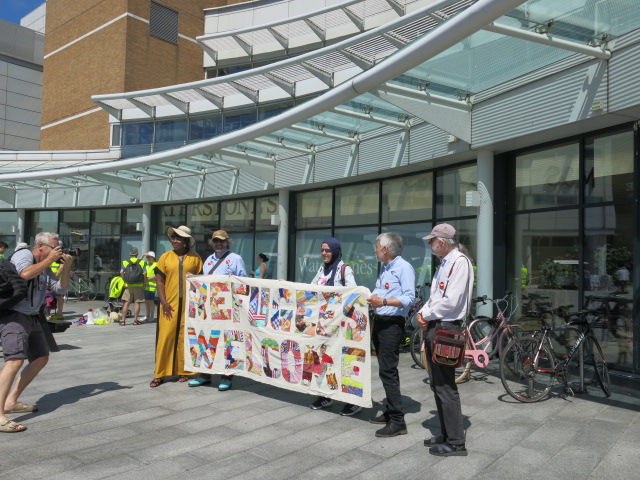
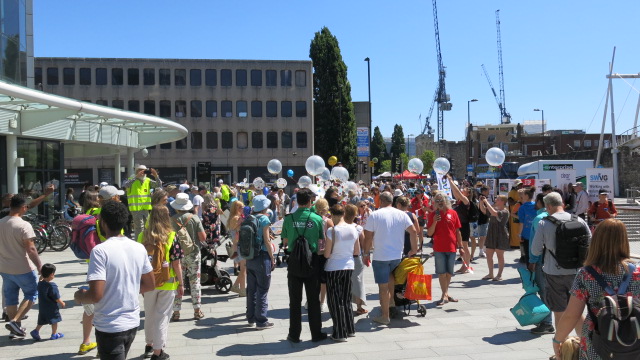
Members of the Salisbury group joined the refugee march in Southampton

June 2023

Some members of the Salisbury Amnesty group went over to join the march in Southampton held in support of refugees. It goes without saying that refugees are getting a terrible press at present with tabloid fury at the boat crossings showing no signs of abating. Politicians are in full cry and new legislation is promised to make asylum even harder. Plans to send them to Rwanda are still in place and there is a section of the Conservative Party which would be happy for the UK to withdraw from the European Court to achieve this. In a previous post we drew attention to some of the inconsistencies in the attitudes towards refugees and asylum seekers. We were sad not to meet colleagues from the Soton group.

Pics: Salisbury Amnesty

Refugee report – June


Refugees continue to generate considerable political tension in the UK

June 2023

We are pleased present our monthly refugee report thanks to group member Andrew for preparing it. Refugees, immigration and the boat people continue to generate a considerable degree of political and media heat in the country.

The latest immigration figures for 2022 give a total of 606,000 arrivals, but most of these are legal, and mainly students. There were 7,000 applications for asylum (by 91,000 people). In the first quarter this year 3,793 applications were received, compared to 4,548 last year. It is worth noting that the numbers are higher in France, Germany and Spain. Arrivals in the UK amount to just 7% of the European total.

Arrivals to the UK are just 7% of the European total

20,000 claimants were in detention in March, 20% fewer than last year, but the average period of detention was longer.

Few forced returns based on asylum claims have taken place, the majority of them being to Albania, where the new agreement has resulted in 90% of arrivals from Albania being returned there.

The Illegal Migration Bill is this week in committee stage in the House of Lords, and a vast number of amendments are being debated. The largest bone of contention currently is the lack of an economic impact assessment of the measures, which the government has said it will produce “in due course”. The BBC has claimed that the cost of the new rules will be up to £6 billion over the next two years. The Refugee Council have more precisely reckoned it at £8.7 to 9.5 billion over 3 years. The Home Office have admitted that numbers would have to be below 10,000 for the Act to be operational. On the plus side for the Government, former senior judge Lord Sumption has argued that justification for overruling their Rwanda plan by the ECHR would be “slender.” On this point, the Sun is reporting that the Home Office think they can make their first flight to Rwanda in September if the Court of Appeal rules in their favour.

The Prime Minister, on his visit to Dover this week, claimed that his policies were working, as the number of asylum seekers arriving in small boats was down 20% this year. Others have suggested this has had more to do with the weather in the English Channel, and the fact that most crossings take place between July and September.

It is reported that the two new vessels commissioned to house asylum seekers are cruise liners. Apart from the plan for a barge to be moored at Portland, other locations are presently unknown.

The Refugee Council has been protesting this week about the size of the accommodation made available to claimants. Operation Maximise is a deliberate initiative to cram as many claimants as possible into the available accommodation. The leader of Westminster Council has said it “defies common sense and basic decency.”

The UNHCR has produced an audit of the UK asylum system and declared it to be “flawed and inefficient.”  The report particularly points to a lack of training at the Home Office, inadequate information on claimants, lack of skill in interviewing, and an inability to assess children’s ages accurately.

An article in Coda Media has drawn attention to the EU’s International Centre for Migration Policy Development, a shady body based in Vienna that has been supplying Maghreb governments with material to aid disempowering boats aiming to cross the Mediterranean.

AH

Salisbury Journal and refugees


Journal publishes forthright piece on the subject of refugees

March 2023

The Salisbury Journal is a local paper in the United Kingdom and is fond of publishing self-promoting puff pieces by our local MPs, so a forthright article by Martin Field in the March 16 2023 edition is worth highlighting. It concerned the controversy surrounding the suspension, and subsequent reinstatement, of Gary Lineker who presents the Saturday night BBC programme on football called Match of the Day. It arose following the publication of Illegal Migration Bill the previous week and Gary’s tweet comparing aspects of the bill to the actions of the National Socialists in ’30s Germany. The tweet caused a huge outrage against both Lineker and the BBC by a number of Conservative politicians together with sections of the right wing media.

Several commentators have wondered, like Field, whether the intensity of the furore was intended to be a distraction from the underlying issue. Field reminds us that the bill proposes that people who are fleeing persecution, who may have a legitimate claim for asylum and have family and relatives here, will never be able to have their claim heard and will be deported.

He says that they [refugees] are not being treated as individuals, as fellow human beings but classified generically, as members of a group, defined not by human characteristics, but by their manner of arrival in the UK.

“Make no mistake. This is a slippery slope. Removing people’s humanity through language is the first step; through law which criminalises them and takes away their rights the second; extremists emboldened the third; [then] inhumane and degrading treatment will follow. The lesson from history is unequivocal”.

In the same paper was a piece by Tom Bromley also referring to the Lineker affair and wider issues around allegations of impartiality by the BBC.

Refugees, and the boat people in particular, have raised great passions in the UK so it is interesting – and encouraging – to read of two commentators in the Journal expressing doubts about the bill and the subsequent events at the BBC.

The Archbishop of York, Stephen Cottrell, declared the bill ‘[it] amounts to cruelty without purpose’ and to be ‘immoral and inept’.

To note that Salisbury MP John Glen and Devizes MP Danny Kruger both voted for the second reading of the bill on 13 March.

Group meeting, February


February 2023

We are pleased to attach the minutes of the group meeting held in February 2023 with thanks to group member Lesley for producing them. The next event is the coffee morning at St Thomas’s Church in Salisbury on Saturday 18 February, 10 until noon and this would be a good time to make yourself known if you were thinking of joining us. This is an important time in the UK for human rights with the government keen to reduce rights and rid itself of the Human Rights Act (see an item in the minutes for more detail).

Refugee report: February


February 2023

The report for February/January 2023 thanks to group member Andrew for the work on this post.

As we await yet another immigration bill (this time designed to send anyone arriving here “illegally” on their way immediately) let us consider what legal means of arrival still exist.

The Johnson government committed the government to providing safe and legal routes of entry as part of a broader programme of asylum reforms outlined in its New Plan for Immigration policy statement (March 2021).  It wanted fewer people to come to the UK as asylum seekers and more to come through safe and legal routes.

December 2022 statement by the Prime Minister went further.  Rishi Sunak announced that the Government now intends to make further legislative changes so that “the only way to come to the UK for asylum will be though safe and legal routes”.  He said that the Government would create additional legal routes “as we get a grip on illegal migration” and would introduce an annual quota for refugee resettlement.

Refugee rights campaigners have previously called for an annual target for refugee resettlement.  But they have also cautioned that safe and legal routes are not available to everyone who needs protection.  Consequently, they want them to be provided alongside an accessible in-country asylum system.

The other continuing issue about immigration is the endeavour by the government to prevent legal stays to the proposed deportation policy.  Much of the debate has centred on possible appeals to the European Court of Human Rights, which is referred to as a “foreign court”, but is actually an international body on which the UK is represented.  The Home Secretary is keen to leave the ECHR in the event of dispute, putting the UK in a class with Russia and Belarus.  There is opposition to the possibility of this happening, not only in the legal profession but also in the Conservative Party.  Also, the High Court has now allowed appeals against their finding in favour of the government over the legality of the Rwanda plan to go ahead.

Elsewhere, the head of the Windrush inquiry has expressed disappointment after the home secretary confirmed the government was dropping three key commitments made in the wake of the scandal.  The Home Secretary Suella Braverman, told MPs she would not proceed with the changes, including establishing a migrants’ commissioner. They were put forward in the report into the wrongful deportation of UK citizens of Caribbean descent. Wendy Williams said “crucial” recommendations had been scrapped.

Ms Williams’s formal inquiry examined how the Windrush scandal unfolded at the Home Office – when British residents, many of whom had arrived in their youth from Caribbean countries in the 1950s and 60s, – were erroneously classified as immigrants living in the UK illegally.  In a written statement in the House of Commons, Ms Braverman insisted the Home Office was looking to “shift culture and subject ourselves to scrutiny”.  But she confirmed that plans to beef up the powers of the immigration watchdog; set up a new national migrants advocate; and run reconciliation events with Windrush families would be axed.

The government plans to end providing accommodation for Afghan refugees by the end of the year. Currently, 9000 Afghans are living in hotels.

The stories above have contributed to Human Rights Watch, in its annual report, declaring that the actions of the UK government breach domestic human rights obligations and undermine international human rights standards.

Debate about the right to work for asylum seekers has become more prominent lately. Canada allows claimants to work straight away, Germany after 3 months, compared to the UK’s 1 year if the claimant is still waiting a decision.

Asylum support cost in 2022 was £898 million; £5.6 million a day was spent on hotel accommodation.

Final fact: for those applying for visas for partners to come to the UK the cost of the process has been calculated at £8,110 over 5 years and £13,326 over 10 years, not counting lawyers’ fees.  It has been suggested that this money could have been spent into the economy rather than the government’s coffers.

AH

Blog at WordPress.com.

Up ↑