Human rights under threat


Talk organised by the Romsey group

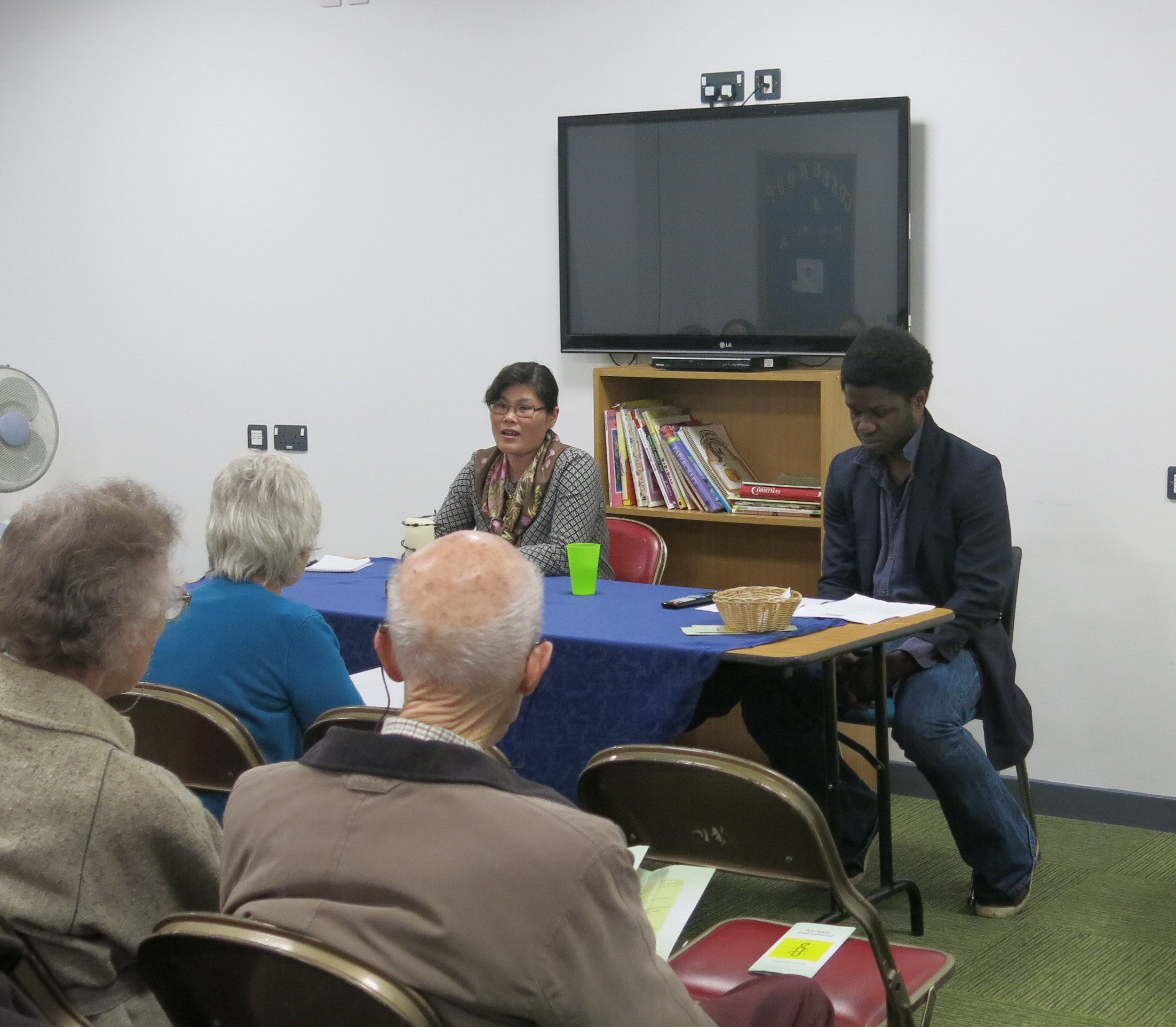
Dr Claire Lugarre. Picture, Salisbury Amnesty

On Monday March 19 the Romsey group of Amnesty hosted a most interesting talk by Dr Claire Lugarre who is a lecturer in Human Rights Law at the Southampton Law School, part of Southampton University.

An element of the desire of those who wish for the UK to come out of Europe is a wish to regain our (i.e. the UK’s) sovereignty.  There is also a desire, expressed most strongly by some members of the Conservative Party, to abolish the Human Rights Act and replace it with a British Bill of Rights.  This has been promised in the party’s manifestos and has been talked about for about a decade but details of what the BBoR will look like and how it will differ from the existing HRA is still largely opaque.  It seems to be a solution in search of a problem.

The Conservatives are not alone in wanting us to come out of the European Convention along with Brexit: most of the media have kept up a barrage of criticism and denigration of the Court and all its doings.  As the example on the right of the Daily Mail shows, there is talk of a ‘triumphant week for British values,’ the ‘crazy decision’ making by European Court judges – usually referred as ‘unelected’ judges and the ‘human rights farce’.

The talk

Claire Lugarre explained some of the background issues surrounding the issue of the European Court and what it might mean for the country if we left.

Her first point is that the notion of human rights is not just a western construct and similar ideas are seen throughout history even if they were actually called that at the time.  She also emphasised that the European Convention on Human Rights (ECHR) had a utilitarian purpose not just a moral one.  There was an urgent desire after the carnage of WWII to construct a legal basis of good behaviour between states.

States have to comply with European Court judgements.  The Human Rights Act – often referred to by critics as ‘Labour’s’ Human Rights Act which it isn’t as it received all party support – incorporates the ECHR into British law thus removing the need for litigants to go to Strasbourg to get justice.

One matter is the vexed question of prisoner voting she said.  The European Court rejected the Government’s case which banned all prisoner voting and said that to ‘prescribe general, indefinite and automatic deprivation of a right to vote’ infringed a prisoner’s article 3 rights.  Thus far the government has ignored the ruling.  The issue was one of proportionality.

She spent some time on the often confusing difference between the Council of Europe and the European Union the latter being what we wish to leave (it was announced yesterday that the Article 50 notice to depart will be served on 29th of this month).  The Council of Europe consists of 47 states and within which the European Court sits.  This deals with human rights issues.  The European Union consists – at present – of 28 states and is a political and economic union.  There seem to be many who think that Article 50 means we will no longer be subject to ‘crazy decisions’ of the European Court.  To do that we have to leave the European ConventionThere have been reports that the prime minister Theresa May wishes to do that as well.

All legislation and legal judgements have to be in accordance with the HRA she said.  Indeed, the number of judgements already made by the courts represent a considerable body of precedent based on the HRA and the European Court.  Even if we come out of the European Convention the effects will be present for a considerable period.  It is also forgotten that the European Court is not the only thing which binds us, we are also signatories to a host of other treaties which will still be in existence.

BBoR

One of the arguments frequently heard is that it is not just about rights but also about responsibilities.  It was this principle which led to the desire to have a British Bill of Rights and Responsibilities.  This is a difficult argument to fathom.  Sometimes, people talk about responsibilities in terms of the government’s responsibilities to its citizens to uphold the Act.  Others argue that the citizen has responsibilities not just rights.  There are other arguments about the need to fight terrorism because the act has undermined this ability, it is claimed, and this requires responsibilities in some ill-defined way.   Claire was unclear what the BBoR would contain.

The relationship between rights and responsibilities needs to be understood.  Most rights are qualified in any event and, in practical terms, depend on the responsibility of everyone in society to respect one another’s freedoms (so that one party’s right to free expression, for example, does not impinge too far on another’s right to a private and family life).  These rights cannot be subjected to any all-encompassing limitation, such as that they are legally contingent on performance of set of duties and responsibilities. Their application regardless of such considerations is precisely the point of their existence.

It is often claimed by critics that the European Court was ‘imposed’ on the UK.  It wasn’t and the UK was a key participant in its formation after the war with many British lawyers involved.  It is also argued that the HRA should only be used for the most serious of cases but what this would mean in practice is not clear.  Who would decide on seriousness?

If, as is threatened, we do come out of the European Convention the effects could be traumatic.  At present countries like Russia and Turkey are part of it.  Russia’s human rights record is already poor and Turkey has arrested tens of thousands of judges, lawyers, academics and police.  If the UK pulls out of the Convention, of which it was a founder member, the effects could be even more serious in those countries.

The HRA has had a steady and beneficial effect on many people’s lives in this country.  In countless day to day decisions by authorities of various kinds, its provisions have to be adhered to and lawyers regularly use it to defend their client’s interests.  Perhaps its chief problem is that it shifts some power down to the individual, a fact which those who were in control find uncomfortable.

This was a most interesting evening about a subject which is bound to be in the news for some time to come.


Follow us on Twitter and Facebook – salisburyai

If you would like to join the Salisbury group you would be very welcome.  We meet once a month for a planning meeting and perhaps the best thing is to come along to an event and make yourself known.


Fascinating talk by North Korean refugee


Jihyun Park gives moving talk to an audience in Salisbury
Jihyun Park. Pic: Salisbury Amnesty

Jihyun’s story is one that is difficult for British people to comprehend.  She has endured privation both in China and in her home country of North Korea.  She escaped from North Korea and spent six years in China effectively as a slave.  She has been trafficked and forced into marriage.  Eventually she was arrested and sent back to North Korea and was confined to a Labour Camp where she endured the severest of treatment.  She escaped a second time via Mongolia and now lives in Manchester where she has been reunited with her son.

Part of her harrowing story was how she managed to regain contact with her young son on the phone while she was still in North Korea.  He had been told she had deserted him and would not speak to her.  It took several calls before meaningful contact could be resumed.

Jihyun and Kenny Latunde-Dada speaking at Five Rivers. Pic: Salisbury Amnesty

On Thursday 16 March, Jihyun came down to Salisbury and spoke to an audience at the Five Rivers Leisure Centre in the city.  Over 50 attended and were immensely moved by her experiences.  The evening started with a short film called The Other Interview (which can be viewed by following this link) followed by questions.  The moderator was Amnesty regional representative Kenny Latunde-Dada who came down from Cambridge for the event.  The audience asked many questions about both her experiences and life in North Korea.

There was some discussion about the role of China in both Jihyun’s story and more generally.  North Korea is a sensitive issue for China and they are concerned about such an unstable country with its equally unstable leader on its doorstep.  There are indications that they are tightening their policy of returning escapees to North Korea.

We were delighted to welcome Jihyun Park and were grateful for her making the trip down from Manchester to speak to us.  We were also grateful to Kenny Latunde-Dada for coming down from Cambridge.  Jihyun said she is writing her memoires and it should be published soon.  Those interested may wish to read In Order to Live by another escapee Yeonmi Park published by Penguin (2015).


Follow us on Twitter and Facebook.

North Korea Video made by the Salisbury group

March minutes


Group minutes for the March meeting are now available thanks to group member Lesley for compiling them.  We covered a lot of ground and there are a number of events including a talk by Jihyun Park this Thursday at the Five Rivers Leisure Centre, Hulse Road, Salisbury at 7:30.

March minutes (pdf)

Meeting


Monthly meeting took place last night Thursday 9th March at Victoria Road.  It was a full agenda including North Korean talk at Five Rivers; NWR meeting; Films at the Arts Centre; Social media and Death Penalty reports and the market stall.  Minutes will be posted soon.

February minutes


Members of the group took part in the London Refugee march last year

Minutes of the February meeting are now available thanks to group member Lesley for compiling them.  It was a full agenda and we have a lot going on and planned at present.  If you live in the Salisbury area and would like to help that would be appreciated.  If you go to the end of the minutes you will see the list of events and activities.  If you are interested in becoming involved, then come along to one of those and make yourself known.  Follow this site or twitter or Facebook if you prefer those.

February minutes (Word)

Cluster weapons


Good news on cluster bombs
Just before the Christmas holidays, the Government finally admitted that Saudi Arabia had indeed dropped UK cluster bombs in its bombing campaign in Yemen and in doing so, confirmed that our research was entirely correct.  When we alerted the UK government to this in May 2016, the Government strongly denied it, as did Saudi Arabia. This is a major victory for our research work and campaigning to keep the government under pressure on this issue. 

Amnesty joined with 100s of other organisations around the world to campaign to ban cluster bombs because of the risks they pose to civilians.  Cluster bombs scatter 100s of lethal bomblets that can continue to kill and cause horrific injuries long after the conflict has ended.  The UK rightly banned these horrific weapons and their use in Yemen provides yet more evidence of indiscriminate nature of the Saudi Arabian led coalition’s bombing campaign.

From Amnesty briefingcluster bombs

January meeting minutes


Attached are the minutes of the January meeting thanks to group member Lesley for preparing them.  We discussed the death penalty, forthcoming events including the film Fire at Sea, talk by a North Korean, the stall and the music festival.

January minutes (Word)

Preparing for the service

Salisbury firm involved in spyware


A Salisbury based firm, Gamma TSE, has been accused of supplying spyware to enable Bahraini activists to be arrested

UPDATE 15 March 17

Extract from a recent University of Toronto report:

[…] Far from using this spyware solely to track what might be considered legitimate targets, these countries and their shadowy agencies have repeatedly used them to get inside the computers of human rights activists, journalists, opposition politicians, and even health advocates supporting a soda tax in Mexico. Some of the victims of these campaigns have found themselves arrested and tortured. Leaked emails from certain companies reveal that, despite public assurances by executives, the vendors seem cavalier about these type of abuses, have few internal checks in place to prevent them, and, indeed, knowingly court the clandestine agencies responsible for such abuses. Despite these alarming incidents, however, the dynamics of and participants in the market at large remain opaque. 

While arguments rage in the USA concerning the alleged interference by Russia of the

Porton Business Centre

presidential elections, a secretive Salisbury based firm, Gamma TSE, has been accused by the Organisation for Economic Cooperation and Development of supplying software called FinFisher or FinSpy to the authorities in Bahrain and elsewhere.  This software enables intelligence agencies to insert Trojan software into computers and mobile phones.  This in turn enables people critical of the regime to be tracked and if necessary arrested by the security services.  The University of Toronto’s Citizen Lab is documenting the widespread use of this spying software.

Privacy International, Bahrain Watch, the Bahrain Centre for Human Rights and Reporters Without Borders lodged a complaint with the European Centre for Constitutional and Human Rights.  They allege that the equipment is used by repressive regimes to harass and target dissidents, politicians and human rights activists.

Our involvement with repressive states – especially those in the Gulf – is well-known and Theresa May recently visited Bahrain to promote business interests in the kingdom.  As we have noted many times before, there seems little interest in the consequences of our arms and security companies activities on the ordinary people who live in those countries, the death and destruction in Yemen being particularly awful.

Part of the units occupied by Gamma in Porton

Gamma is again in the news today (9 January 2017, p13) in a Times article entitled ‘No 10 linked to spyware in human rights row’ which reveals that despite the criticism by the OECD, they have been invited to the Home Office sponsored International Security and Policing exhibition in London.  Amnesty reports show that the human rights situation in Bahrain is very poor with reports of torture and other forms of abuse:

[it] details dozens of cases of detainees being beaten, deprived of sleep and adequate food, burned with cigarettes, sexually assaulted, subjected to electric shocks and burned with an iron.  One was raped by having a plastic pipe inserted into his anus.

It said the report showed torture, arbitrary detentions and excessive use of force against peaceful activists and government critics remained widespread in Bahrain.

The OECD report was not conclusive about Gamma as it was a ‘reluctant participant in the proceedings refusing to productively engage in a September 2013 mediation and employed stalling efforts.’

Privacy International say:

Gamma has proven itself to be and irresponsible corporate actor that is indifferent to the human rights impacts of its activities.

The Amnesty report also says:

The government [of Bahrain] continued to curtail freedoms of expression, association and assembly and cracked down further on online and other dissent. Opposition leaders remained imprisoned; some were prisoners of conscience. Torture and other ill-treatment remained common. Scores were sentenced to long prison terms after unfair trials. Authorities stripped at least 208 people of their Bahraini nationality. Eight people were sentenced to death; there were no executions.

A firm helping regimes with a record of mistreating its citizens and regularly using torture, is based in the village of Porton, near Salisbury, Wiltshire.


Withdrawal from the European Convention threatened


Government plans to withdraw from the European Convention of Human Rights

The Conservative government has long disliked the European Convention and is now proposing to put withdrawal in the next manifesto.  This will be a serious mistake and will affect the human rights of many individuals in the UK.  It will also send a message to many other countries around the world whose record on human rights leaves a lot to be desired.

Theresa May MP. Picture: ibtimes

One of the problems with discussing this issue is that it is clouded by a programme of disinformation by the tabloid press.  Being a European creation it is damned by association.  It is also, in their eyes, a serious threat because it gives people some rights concerning privacy.  Since large parts of the British press are concerned with the private lives of celebrities and profit from such stories (which to be fair have an avid readership), anything which inhibits their ability to publish such material is going to harm profits.  There has thus been a continuous series of stories which rubbish the Human Rights Act and the European Convention (ECHR).  Small wonder therefore that politicians follow this line and brave it is for those few who stand up for the Act.

Theresa May has a particular animus against it and is famous for her fatuous remark about someone not being deported because of a cat.  “I’m not making this up” she famously said: only she was.  The person involved was a Bolivian who wasn’t an illegal immigrant anyway but was a student who had overstayed his visa.  At the tribunal and later at appeal, part of the evidence for his right to stay, was his relationship with a British woman, various other domestic matters, and their ownership of a cat.

A more serious case which caused Mrs May angst whilst at the Home Office was the case of Abu Qatada.  The Home Office spent many years trying to deport him and the HRA was blamed by her and the right wing media for being unable to do so.  In simple terms, he could not be deported because either he – or the witnesses against him – would be tortured by the Jordanian authorities.  He was eventually deported following diplomatic negotiations which led to Jordan agreeing to renounce torture.  It was never really explained during all the months of dispute about the need to deport him, why he was never put on trial here.

In a speech in April last year Theresa May (then Home Secretary) set out her reasons for wishing to depart from the ECHR:

[…] The ECHR can bind the hands of Parliament, adds nothing to our prosperity, makes us less secure by preventing the deportation of dangerous foreign nationals – and does nothing to change the attitudes of governments like Russia’s when it comes to human rights. So regardless of the EU referendum, my view is this. If we want to reform human rights laws in this country, it isn’t the EU we should leave but the ECHR and the jurisdiction of its court. (26 April 2016)

Almost every part of this paragraph is nonsense but one element is ‘[it] does nothing to change the attitude of governments like Russia’s’.  We have just seen the brutal activities of Russian forces in action in Syria and prior to that, in Ukraine and Chechnya.  Human rights in Russia are at a low ebb and the murder of opposition leaders and journalists a fairly frequent occurrence.  But Russia has been subject to the ECtHR for some years and something like half their judgements are against Russia, Turkey, Romania and Ukraine.  It is, in a small way, a civilising influence.  It has had an effect on their activities.

On the other hand there has been a miniscule number of judgements against the UK – 10 in 2012 for example.  Indeed if one looks at the statistics, between 1959 and 2015 there have been 525 judgements concerning the UK of which 305 decided that there was at least one violation.  That is 305 over a period of 56 years.  From all the sturm and drang in the media you would imagine it was at least ten times greater.

The chief worry is that if we – one of the founders of the European Court – pull out it will give the Russians the perfect excuse to do so as well.  One of the lawyers acting for the survivors of the Beslan massacre in Russia said:

It would be and excuse for our government to say we don’t want it either.  Putin would point at the UK straight away.  It would be a catastrophe.  [the UK] has to understand; we all live in the same world and we all have impact on one another.  (quoted in A Magna Carta for all Humanity by Francesca Klug, Routledge, 2015, p193)

At the end of the extract from Theresa May’s speech she goes on to say ‘if we want to reform human rights laws in this country, it isn’t the  EU we should leave but the ECHR and the jurisdiction of its court.’   But what laws do we want to reform?  We still wait after more than five years for sight of the British Bill of Rights although it is still promised.

There are two aspects to the proposed withdrawal: internal and external.  Internally, it will reduce the rights of individuals in their claims against the state.  People like the Hillsborough survivors would never have succeeded in their quest for justice without article 2.  The parents of the Deepcut shooting would never have received justice without the ECHR.  On that subject, Theresa May also wants to remove the armed services from the act, a view echoed by the local MP for Devizes.

Behind all this anti-ECtHR rhetoric, are the assumptions that all EU rulings are wrong and that we have a superior and infallible legal system.  We do indeed enjoy a very good system – witness the low number of rulings against us by the European Court – but it is not perfect and judges have shown themselves to be too keen on supporting the establishment.  There is also the issue of sovereignty and a belief that it is only our parliament who should decide our laws.  The problem here is the weakness of parliament in challenging the executive.

Externally, it will send a harmful message to countries like Russia and Turkey where human rights are fragile.  It is astonishing to recall that it was a conservative, Sir Winston Churchill who was instrumental in forming the Convention.  Yet now it is the same conservatives who want to abolish it because, now and again, we fall foul of it and have to change our procedures or right a wrong.

Coming out of the European Convention would be a serious error and a backward step.  Our influence in the world would be diminished.  As a result of Brexit, we will be desperate to secure trade deals with whoever we can.  Such limited concerns as we do have for human rights will all but disappear in the rush to sign a deal.  Witness our activities in the Yemen where we are more concerned with selling £3bn of arms than we are with the results of the bombing.   In the UK, the ability of ordinary people to uphold their rights in every day situations will be diminished.


The local group hopes to campaign in favour of the Human Rights Act and related issues as when we get some details from government.  If you believe these matters are important, as we do, both for people’s rights in this country and our influence overseas, you would be welcome to join us.  Details will be here and on twitter and Facebook


Display at the Methodist’s church


Write for Rights display now on at the Methodist Church in Salisbury

We are pleased to say that the Methodist Church in Salisbury has agreed to host a display of four cases from our current ‘Write for Rights’ campaign and this display will be in place until 14th of January.  Visitors to the church will be able to read the cases and if they wish, send a card which is available from the coffee shop.  The church is open from 10 in the morning and often for much of the day.  They serve coffee (which is very good value and can be recommended!).

A YouTube video about the programme can be seen here (2 mins).

Blog at WordPress.com.

Up ↑