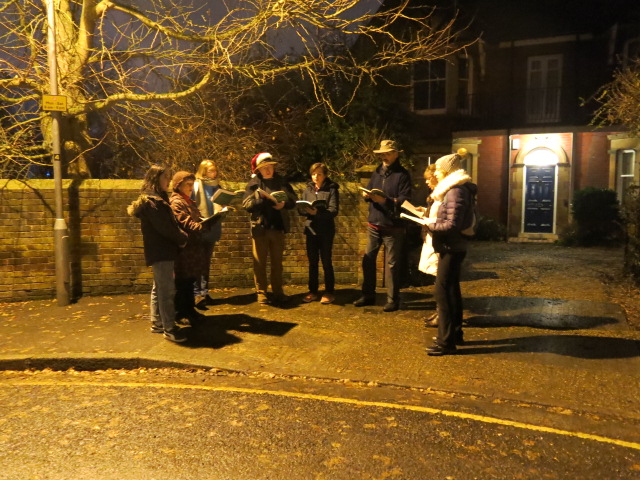
Once again, the Farrant Singers entertained some of the residents in Salisbury with some beautifully sung carols on Monday 19 December. They sang in and around Marlborough Rd; College St; Victoria Road; Albany and Belle Vue Rds. Afterwards we enjoyed soup and cheese generously provided by Michael and Chantal washed down with vin chaud.
A successful evening and many residents came out to enjoy the singing.
Follow us on Twitter and Facebook – salisburyai
If you are reading this in the Salisbury area and are thinking of joining Amnesty there are several ways of doing so.You can join Amnesty International itself for which there is a joining fee and you will receive their magazine.Or you can just join our group which is free.The level of your involvement is of course up to you.Help with our campaigns in the street is always welcome or on the stall we run once a year.You can come to the annual film we do in conjunction with the Arts Centre and stay on to help with the signing afterwards.If you have a particular topic of interest – which might be a country you know about – then making that a focus of your activity is a possibility.The best way is to come to one of our events which you will see here or on Twitter or Facebook (salisburyai), and make yourself known.
The following piece was published in the Salisbury Journal (8 December 2016)
Each year thousands of people in the UK write letters or send cards in solidarity with those suffering humans rights abuses around the world pas part off Amnesty’s Write for Rights campaign.
As a result, people have been freed after having been unfairly imprisoned, human rights defender who have been threatened and harassed by authorities have been able to live freely without intimidation and forced evictions have been halted.
Sending a message of support to those whose rights are being abused and also to the authorities on that person’s behalf is powerful. Imagine drowning in thousands of letters of encouragement and solidarity – in fact, imaging the officials who will see and deliver thousands of cards to the victims and their families. The effect on both is priceless. It shows the authorities that that individual is not alone and that all over the world thousands of people are standing up for them.
People featured this year include:
Fomoseh Ivo Feh a young man in Cameroon who faces 20 years in prison for forwarding a sarcastic text message
a photojournalist from Egypt, named Shawkan who was beaten, arrested and then held without trial following a demonstration in Cairo
a British-Iranian charity worker Nazanin Zaghari-Ratcliffe who was arrested in April at Tehran
Nazanin Zaghari-Ratcliffe. Picture: Iran Human Rights
airport as she was about to board a return flight to London with her 22 month old daughter.
Salisbury Methodist Church is hosting a Write for Rights event from January 4th to 15th and people are invited to see the exhibition and send a message of support. The church will be open from 10 am to noon.
We hope local readers will be able to support this initiative and come along at some time on those 2 days and sign something.
The latest death penalty report is now available thanks to group member Lesley for compiling it. Generally gloomy with several countries around the world reverting – or threatening to revert to – the penalty.
Dark day for democracy and free speech. Government gets ‘the most extreme powers ever’
The Investigatory Powers Bill became law this week and it is a dark day for democracy, not just in the UK, but the signal it gives to the rest of the world. That one of the oldest democracies in the world should want to garner for itself, a whole set of powers to pry into peoples communications and to find out journalists’ sources is a matter of shame. It will provide increased encouragement to regimes around the world to clamp down further on their citizens.
The wonder of it is that so many people are so relaxed about it. Although over 130,000 people protested, the government took little notice.
Picture: 5pillarsuk.com
The state needs to have a security apparatus. When the nation is under threat either in the time of war or by terror groups, it must have the means to investigate. This is likely to mean eavesdropping in some form or other.
There is also the issue of secrecy and confidentiality. People in government should have the means to discuss ideas and float policy ideas without it being published in the media – to start with at least.
Technology has provided a means now to invade individual’s private space with ease. Technology has surpassed the law in this regard. Nearly all the key technologies are operated out of Silicon Valley in the USA over which we have no control. Is it not interesting that Britain voted to come out of the European Union and one of the key reasons was sovereignty. Yet in this regard, sovereignty is in California.
The Guardian reports:
The new surveillance law requires web and phone companies to store everyone’s web browsing histories for 12 months and give the police, security services and official agencies unprecedented access to the data.
It also provides the security services and police with new powers to hack into computers and phones and to collect communications data in bulk. The law requires judges to sign off police requests to view journalists’ call and web records, but the measure has been described as “a death sentence for investigative journalism” in the UK. (29 November 2016)
The increasing ability to intercept communications has and is having an effect on free speech. It is described as having a ‘chilling effect’. Journalists working on these topics have to go to extraordinary lengths to cover their tracks. Material has to be hidden abroad for protection from the security services. Some other issues are more open to debate.
In case of war and terrorist attacks, the media quickly falls into line and the normal business of tackling government ministers is forgotten. It quickly becomes a matter of supporting ‘our boys’ and even questions of the quality of kit for example do not get asked.
The crucial issue is one of power and control. The very business of being able to pry into anyone’s private affairs gives the state enormous powers. As citizens we should expect that these powers are used when necessary; are subject to control wherever possible (like the controls on searches); are subject to close scrutiny, and are in accord with properly laid down laws. Controls on operational matters should not be in the hands of politicians who cannot on the whole be trusted with secrets of this nature. The level of intrusion should be matched by the degree of scrutiny.
As usual, supporters of snoopery will trot out the old adage that if you have nothing to hide you have nothing to fear. This is, in its most fundamental way, true. But the trouble is that as with all these moves what we are seeing is only the thin end of a very long and dangerous wedge. Most law-abiding people have no reason to worry about other people knowing what websites they have visited. But once you give the authorities the ability to do this history tells us that this ability will, inevitably, end up being abused. (Daily Mail)
In the 3 or so years that the ‘Snooper’s Charter’ has been debated, it is often stated by members of the public that they are not concerned and if the security services want to listen in to their conversations with their auntie they are free to do so – ‘I’ve got nothing to hide’ is the frequent refrain. Yet if police and security services arrived at their front door and searched their house and computer without a warrant or reason to do so, they would be outraged. Is the difference just that one is visible and the other isn’t?
Likewise, if you asked these same members of the public ‘do you trust our politicians?’ they would think you were a little mad. Yet they are happy to allow them or their agents to intrude into their affairs. The current Home Secretary is Amber Rudd and readers of Private Eye and the Daily Mirror will have read several revelations about her less than honest business affairs involving dodgy companies and diamond mines. Questions have also been asked about her tax affairs. To her, the nation entrusts its secrets.
To come of course is the promised withdrawal from the European Court and the threatened repeal of the Human Rights Act.
We have not lived in a state such as existed in East Germany, Romania or the Soviet Union where the degree of control was extreme. Thus people in the UK are not aware of the harmful effects of giving too much power to those in power.
Finally, is it even sensible in its own terms? Someone once said that hunting for terrorists was like ‘hunting for a needle in a haystack’. Is it wise then to increase the size of the haystack?
On Monday 22 November we had the annual evensong for Amnesty International. We are delighted to work with Salisbury Cathedral on this event, which has been running for a number of years now, especially as it ends in the Trinity Chapel where the Amnesty candle is situated and under the Prisoner of Conscience window.
All the celebrants are given a candle and carry these through at the end of the service to the chapel. Canon Robert Titley spoke during the service and he said:
This evening we hear one of the uglier Christmas stories. When the wise men visit local ruler Derod, they say the are looking for ‘the King of the Jews’, and he realises that they don’t mean him. Herod judges – rightly – that Jesus, the child they seek, is a threat to his kingdom and to his way of doing power. And so, says Mathew the gospel writer, Herod begins some targeted slaughter to neutralise this potential source of rebellion, and Jesus and his family must escape as refugees.
Herod’s way of doing power is of course still alive and kicking. Mathew would find present day Syria – where innocents are killed as a means of neutralising so-called ‘rebels’ – very familiar. He does not describe the experience of being a refugee, though it is unlikely that things were so different then:
the indifference of some of the native population in the land you come to
their understandable caution
their fear of the threat you might pose, especially if there are a lot of you – a ‘swarm’ perhaps
a tendency to talk about you as part of a lump, a collectivity, an issue, a problem, not a person with a story.
He then went on to talk about Amnesty today;
Throughout its 55 years, Amnesty – to the vexation of the Herods of this world – has tirelessly brought into the light the stories of people whose rights are abused, people like a teacher in Indonesia who we are supporting with our prayers during this month.
Groups like Amnesty International patiently and persistently bring to the minds of rulers and their representatives the stories of people they would rather forget. And now, as our continent faces the severest displacement of people since Second World War, refuges are at the top of Amnesty’s concerns.
Arthur Aron. Pic: Time.com
On Amnesty’s website you will find a short film called A Powerful Experiment. According to the psychologist Arthur Aron, four minutes of eye contact is enough to bring people close together, even to fall in love. And so, in a bare factory space, a group of native Europeans – women, men, and one girl – each sit with a refugee for four minutes.
In that space and time the ‘issue’ acquires a human face: Samira from Syria and Danuta from Poland and Fatima from Somalia: they open their eyes and at first just look at each other. Soon the are smiles – warm or perhaps shy – some tears, then words ‘nice moustache. I’m sixty-five. Are you new in Berlin? Eight months. And are you alone here or with your family? Alone. And finally, touch – a handshake, a hug, a game of It, and that word ‘refugee’ is made flesh.
In just four weeks’ time, we shall proclaim again the good news of the word of God made flesh and the birth of Jesus. The Christmas stories will remind us how glorious is the full ness of God: how infinitely treasured is each human life, made in the image of God.
And tonight we give thanks to God for Amnesty, for the patient, persistent work of its staff and volunteers in reminding the powerful of this treasure and how blasphemous it is to deny it; and reminding us all that the refugee glimpsed on a screen or news page is bone of our bone and flesh of our flesh, that each one, like each of us, has their story to tell.
Around 80 people attended which is fewer than usual but the bad weather would have deterred many. Our thanks to Cathedral staff for their help with this event.
If you are interested in joining us then a good moment would be to come along to the Arts Centre on December 15th at 7 o’clock or so when we will be hosting a film (you don’t have to stay for the film); card signing in Salisbury on 10 December in the morning or Evensong at the Cathedral on 21 November (if you are not religious you do not have to stay for the service). Details will be on the web site and on Twitter @salisburyai. We will be wearing Amnesty tabards at all events (except the Cathedral).
As we wait to see what the government brings forward to replace the Human Rights Act it seeks to repeal, a book was recently published which is recommended to all those who believe in human rights and – despite its faults – that the HRA is a major step forward in granting rights to its citizens. The book is called On Fantasy Island* by Conor Gearty who, amongst other things, is professor of Human Rights Law and Director of the Institute of Public Affairs at LSE. He has written several other books including the Struggle for Civil Liberties (2000)
The HRA has come under sustained attack in the media particularly but not exclusively at the tabloid end of the market with regular stories of criminals and terrorists escaping justice because of it. Positive aspects of the Act including use by the media themselves to protect sources, seldom get a hearing. A recent example from the Daily Mail gives a flavour of the type of reporting which is common at that end of the media market:
Folly of human rights luvvies: As actors fight plans to axe Human Rights Act, how thousands of foreign convicts use it to stay in Britain
Number of foreign offenders on UK’s streets has spiralled to a record high
Includes killers, rapists and paedophiles who have avoided deportation
Left-wing luvvies lining up to oppose plans to scrap the Human Rights Act
Benedict Cumberbatch and Vanessa Redgrave condemn Tory proposals
25 June [accessed 31 October 2016]
Conor Gearty methodically discussed the history of rights in the UK and tackles head on some of the absurdities regularly reported in papers like the Mail and the Sun. Myths abound and include the case of Abu Qatada; the murderer of Philip Lawrence outside the school and Denis Nilsen’s request to access pornography and write a book. In each case, the HRA is in the frame when it was either irrelevant or the event complained of was not going to happen anyway. Perhaps the most famous instance was the absurd statement by Theresa May at the Conservative Party conference in 2011 about a Bolivian student who could not be deported because of a cat. ‘I’m not making this up’ she said: problem was she did make it up and had grossly exaggerated a small part of the case.
The government – now led by Theresa May – is apparently preparing a British Bill of Rights. Gearty discusses this and says:
…attentions shifted to the Human Rights Act. Here we find uppermost the fantasies that drove the much of the first part of this book – you cannot change a law for the better if it has never been what it you have claimed it to be in the first place. (p189f)
He sets the context of hostility to the Act in terms of a deadly combination of the nostalgic and the negative. For a country which until the recent past, ruled a large part of the world and whose power and influence was supreme, we now have to form partnerships and accept that our writ no longer runs as it once did. Strasbourg is just one of the elements of this. Nostalgic because were we not the inventors of common law so who are these overseas people interfering in our law making? The role of the media is discussed and a fuller account of the media’s role in ‘monstering‘ the HRA is provided by Adam Wagner of RightsInfo.
Human rights offer a route to a society where all are equal before the law and where each of us has a chance to engage in political activity on a level playing field if we so wish.
Several years have gone by since the Conservatives announced their desire to abolish the act and we are still waiting to see what happens. The new Home Secretary, Amber Rudd, has reaffirmed that and of course Theresa May is now prime minister. We wait and see … Our Local MP, John Glen, is on record in the Salisbury Journal as someone who agrees with abolition so we wait and see when the time comes.
Damning criticism of government’s blind eye to arms sales to the Saudi Arabians
Recommends suspension of arms sales to the Saudis
Picture: mintpressnews.com
Followers of this blog will be aware of the attention we have been drawing to the war in Yemen and our government’s role in it. It started by accident with a letter to our MP Mr John Glen who forwarded a bland reply from a Foreign Office Minister, Tobias Ellwood. The answers began to unravel quite quickly when it was revealed that, for example, far from reigning in the Saudi’s, we were promoting their membership of the UN’s Human Rights Council.
Now the International Development and the Business, Innovation and Skills Committees have produced a lengthy report which is extremely critical on several different levels. The chair’s summary remarks were:
The UK led the way in establishing international humanitarian law to govern the sale of arms. The conflict in Yemen has raised serious concerns that we are not showing equal determination in ensuring that these are respected.
During this inquiry we have heard evidence from respected sources that weapons made in the UK have been used in contravention of International Humanitarian Law. The Government can no longer wait and see and must now take urgent action, halting the sale of arms to the Saudi-led coalition until we can be sure that there is no risk of violation.
We call on the Government to continue the UK’s long-standing commitment to IHL and lead the international community in establishing a strong, independent inquiry. The circumstances surrounding incidents in Yemen, such as allegations of the use of cluster bombs, must be firmly established and send a clear message to all combatants in Yemen that human rights must be respected.
The current system for overseeing the sale of arms must be improved. At present we do not have sufficient transparency to hold licensing decisions to account or the confidence that the benchmarks ensuring human rights law is respected are high enough. This must be addressed immediately.
Backbench committees do valuable and largely unsung work in the House of Commons and provide an opportunity for members to question government activities more closely than they are able to do in the House itself.
Background
The background situation in the Yemen is dire. The UN categorises it as a level 3 crisis which is the most severe. UNICEF say that 1,211 children have been killed and 1,650 injured, both are likely to be under-estimates in view of the difficulty in reporting. The economy and health care systems are on the verge of collapse. Over a million people are internally displaced.
Britain however continues to profit from the war by supplying huge amounts of weaponry to the Saudis. Between April and December 2015 we supplied £1.7bn worth of aircraft and a further £1bn of air-delivered bombs. More shockingly is that, although we are no longer supplying cluster munitions, previously supplied ones have turned up on the ground. These weapons kick out tens or hundreds of sub-munitions which saturate an area the size of several football fields. Duds can be dangerous to children especially who can lose limbs or be blinded if they pick them up.
Both Amnesty and Human Rights Watch have provided evidence to the FCO about the use of these weapons.
The report
The report makes interesting reading most particularly concerning the UK government attitudes to the conflict. It contrasts the FCO’s attitude to the documented evidence it is presented with on the Yemen by NGOs including Amnesty and HRW, which it ignores, with that from Syria where evidence is accepted. David Mepham, the UK director of HRW said in evidence:
I was at a meeting with [the Foreign Secretary] several months ago when I gave him copies of our report and said, “These are the GPS coordinates; these are the strikes; these are the markets and schools that were hit.” Therefore, he has that evidence. The Foreign Office has had that evidence for months. It is extraordinary that the line comes back that they do not have evidence, when that evidence has been shared with them for a considerable period of time.
Picture: the Independent
The line from the government is that the UK has ‘the most robust arms control export regimes in the world’. The committee heard evidence of how long this robust arms control regime took to make its decisions: a matter of days. The hundreds of licences take around 20 or 25 days to approve. In comparison with other government decision making, this is merely the blink of an eye. It seems fairly obvious that little control is exercised. No licence has been refused.
In the face of the hundreds of incidents of schools, marriage ceremonies, factories and hospitals being hit by bombing, the UK government accepts the answers given it by the Saudi government. The committee was sceptical at FCO reliance on Saudi assurances and said:
We are not convinced that Saudi Arabia is best placed to investigate reports of IHL breaches and their lack of progress with reporting findings only confirms our concerns that they are obstructing progress. Of 185 incidents reported by UN, HRW and AI, only 9 investigations have taken place
UK personnel
Our involvement is not just limited to supplying weapons but military and civilian personnel are also involved in the control centre and elsewhere. The claim is that they are not directing the actual bombing. The committee were not convinced by this argument.
It is impossible, on the basis of the evidence that is before us to claim plausibly that the United Kingdom is not involved. We provide the aircraft and the bombs. This level of involvement without being party to a conflict is unprecedented. This is an area where there is much confusion and greater clarity is needed. (para 75)
Human Rights
The committee considered our political role in this conflict and our supposed commitment to an international rules based order. We were now in a tricky position. UK’s support for the Saudi led coalition primarily through the sale of arms and in the face of violations of International Humanitarian Law is inconsistent with our global leadership role in the world. The very rules the UK championed – represented by the Arms Trade Treaty – are at risk of unravelling.
The committee heard evidence that the arms companies were a huge source of employment and that if we did not supply the weapons, others would. An argument which could easily be applied to slavery.
Summary
For the sake of weapons sales, the government has become ensnared with a war which is fast becoming a humanitarian disaster. Our involvement is much to close for comfort and attempts to dissemble and hide the truth are at risk of unravelling. We also risk losing the moral argument as well. It is difficult for us to criticise the Russians and Syrians for their barbaric activities in Aleppo and elsewhere, when we are only slightly removed from doing the same things in Yemen. So far the government has been lucky: all eyes are on Syria and there are few reports emerging from Yemen. But this report is a welcome spotlight on the unsavoury and ultimately foolish activities by our government in that country. They recommend ending arms sales to the Saudis.
On 26 October the House of Commons debated the question of withdrawing support for Saudi Arabia’s war in Yemen. The intention was to send a message to the government that MP’s do not want to support a war without a UN investigation into breaches of international humanitarian law. Labour MPs did not attend and the vote was lost. Mr Glen voted against the motion. So the carnage continues.
We are pleased to attach the monthly minutes for the October meeting thanks to Lesley for preparing them. We discussed the Refugee, North Korean and Death Penalty campaigns, forthcoming films, Evensong at the Cathedral and Citizenship days at some of our schools.



 Amnesty in Salisbury & South Wiltshire