Minutes and Newsletter


March minutes and Newsletter

March 2026

We are pleased to attach this month’s minutes and Newsletter for the group thanks to group member Lesley for preparing them. We do not publish a Newsletter as such but they contain a lot of material on the death penalty around the world, the state of UK politics as they affect human rights and the current refugee situation. There are also some statistical details and we are pleased to report that number viewing the site have risen significantly.

Thought of becoming a subscriber?

Middle East ‘forever’ wars


Iran, Lebanon join victims in the forever war. Vigils continue

March 2026

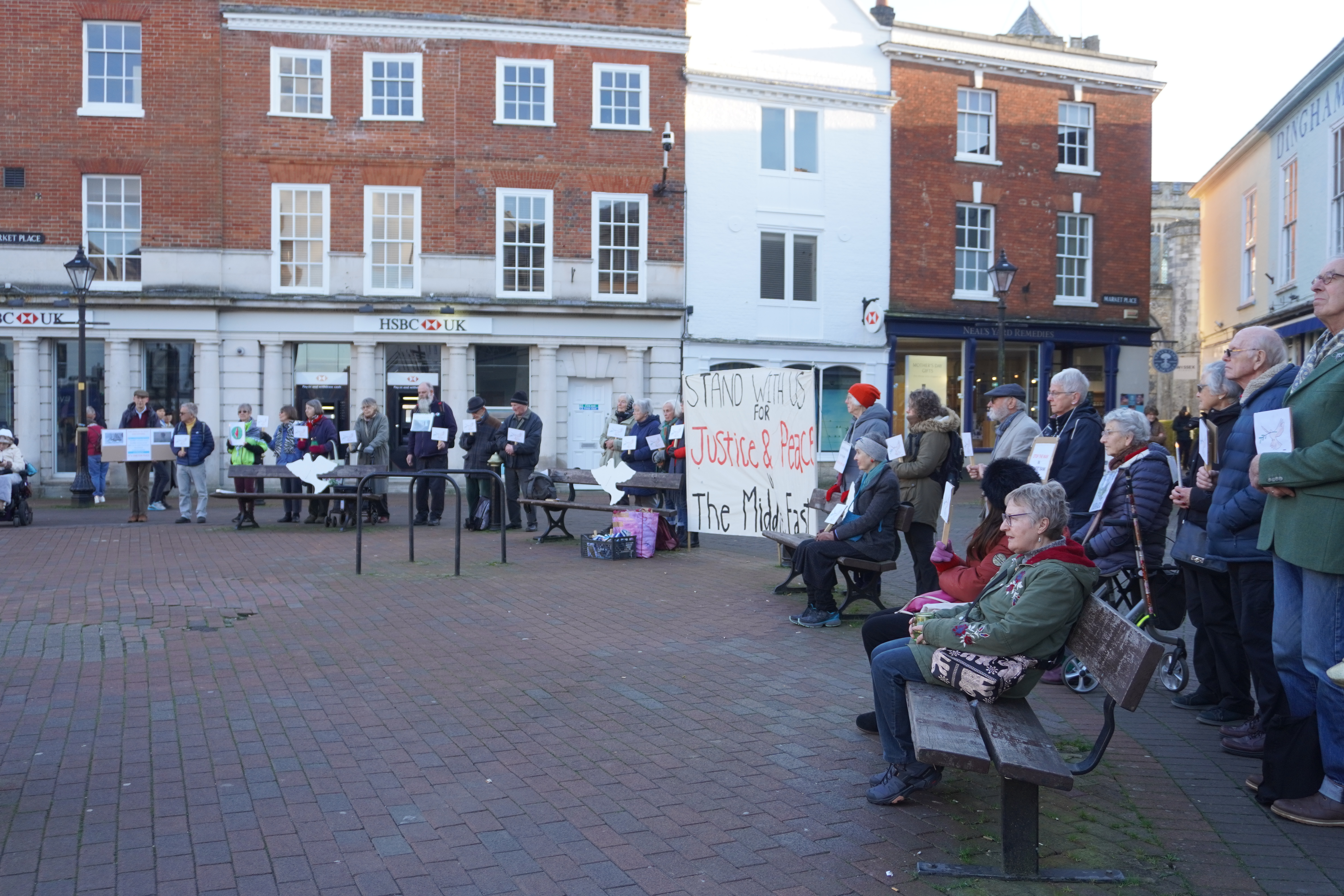
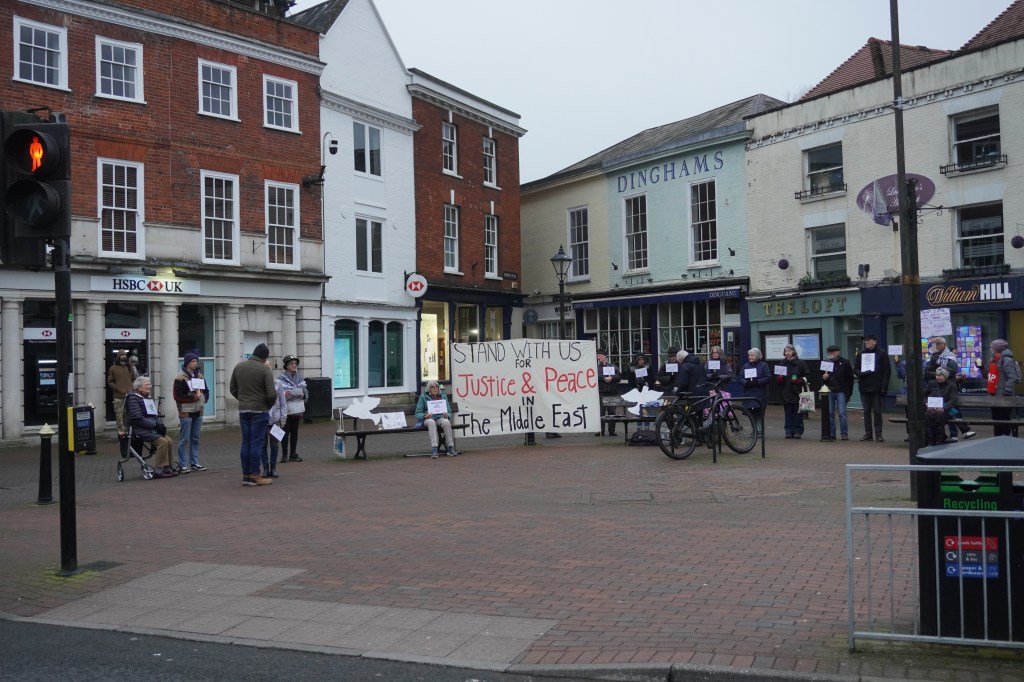
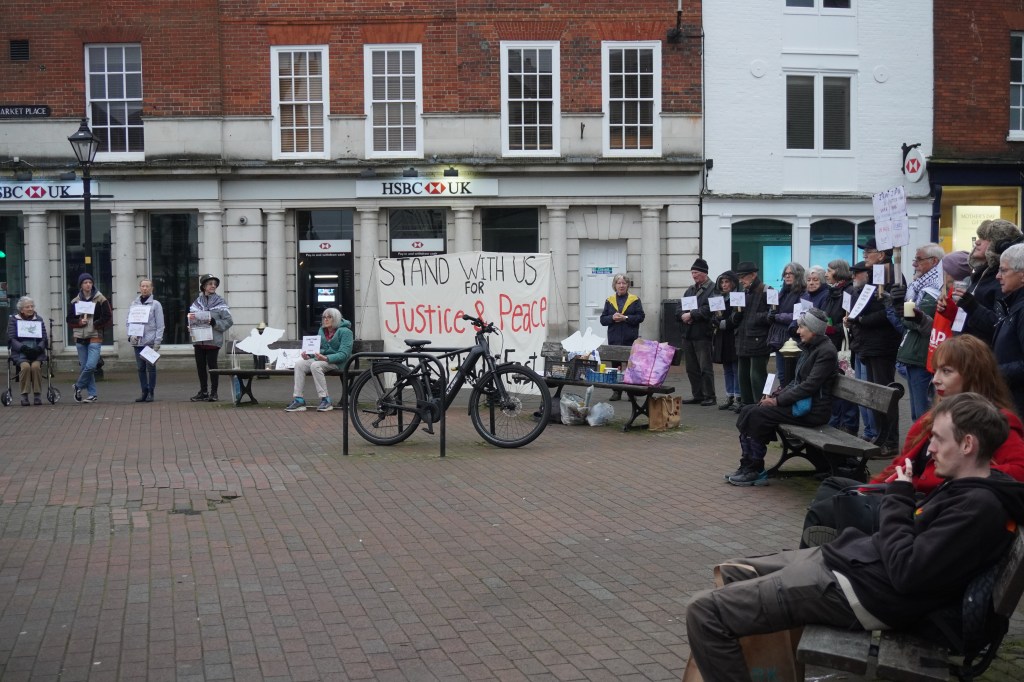
The 119th vigil took place in Salisbury with over 25 in attendance, as the war intensified in the Middle East. We are in the third week of attacks on Iran as Israel and the US are bombing large areas of the country. Israel has resumed attacking Lebanon with over 800 dead. Israel seeks to destroy Hezbollah who are firing rockets into northern Israel. With Iran significantly weakened, the IDF regard now as a key opportunity finally to destroy the organisation’s activities in the Lebanon. Reporting on Gaza has been overlooked recently where the death toll now stands at 72,000 plus.

This new development has resulted in consequences which do not seem to have been anticipated. The response from Iran has massively affected the Gulf states and the movement of oil. The impact on western economies is only just starting. Some UK politicians were all for the Israeli/US action urging Sir Keir Starmer to be more pro-actively involved. There seems to be some rowing back from that as its effects became apparent. The bombing of the Shajareh Teyyabeh girl’s elementary school in, Minab, Iran killing around 170 – mostly children – has had an effect on public opinion.

The war, only three weeks old in its current manifestation, has led to a massive displacement of people around the region running into hundreds of thousands. The glee with which Pete Hegseth has spoken about the destruction of Iran is especially alarming. The objectives and timescale remain unclear.

Sources: Independent, CBS, Al Jazeera, Haaretz, Guardian


Recent posts:

Become a subscriber?

Ex Iranian prisoner to tell his story


Anoosheh Ashoori will speak in Romsey

March 2026

PAST EVENT – see later report of the event itself.

The story of Nazanin Zaghari-Ratcliffe has been widely told and she has become a household name. A BBC film was made of her ordeal and she came to Salisbury to speak. Iran is in the news at present with the bombing campaign being carried out by Israel and the US one aim of which – it is thought – is to rid the nation of the current regime, the regime which thought seizing hostages was a good idea.

Along with Nazanin was the rather less well-known Anoosheh Ashoori (pictured) a dual national businessman who spent 5 years in Evin prison in Tehran at the same time as Nazanin. He is coming to Romsey on 18th March to talk about his experiences. The talk starts at 7pm at the United Reform Church, SO51 8EL. The talk has been organised by the Romsey Amnesty Group.


Recent posts:

Threat to Jury Trials: MPs Debate New Court Bill


Threat to trial by jury

March 2026

MPs voted to allow the Courts and Tribunals Bill to proceed to the next stage after significant debate during its second reading.  This was over proposals to replace juries in England and Wales with a single judge in cases where a convicted defendant would be jailed for up to three years.  Justice Secretary David Lammy says changes to jury trials and other reforms can help turn around the Crown Court backlog, which has reached record levels of 80,000 cases. These delays mean some defendants charged today may not face trial until 2030.

However more than 3,200 lawyers including 300 top barristers and retired judges have called on the government to drop the plan to abolish some jury trials.  The letter to Prime Minister Sir Keir Starmer, a former director of public prosecutions, says there is no evidence the “unpopular” plan will solve unprecedented delays in criminal courts.  The letter organised by the Bar Council, which represents all barristers in England and Wales, says the plan is an attempt “to force through an unpopular, untested and poorly evidenced change to our jury system”.

The bill will still have to clear the House of Lords before it can become law.  The right to jury trial – in which ordinary people decide on the guilt or innocence of defendants brought before Crown Courts – is a cornerstone of the constitution dating back more than 800 years.

Magna Carta did not specifically mention jury trials but does say ‘no free man shall be seized or imprisoned except through the lawful judgment of his peers or by the law of the land’ (women are not mentioned). It did however plant the seed of juries and over time the idea became established in British law. The Statute of Westminster was passed in 1275 that required jury trials in certain cases, showing how these ideas from the Magna Carta were evolving into legal practice.

Recent governments have revealed a dislike of protest and have done a lot to introduce measures and restrictions making such protests more and more difficult. Police powers have been increased and thousands were arrested protesting on behalf of Palestine Action for example. Some juries have gone against judicial directions and have freed defendants. There must be a worry therefore that restricting the right to a jury trial leaves defendants at the mercy of judges alone who, some argue, can be reactionary,


How the New UK Bill Aims to Prevent Foreign Election Interference


New bill to tackle electoral reform

March 2026

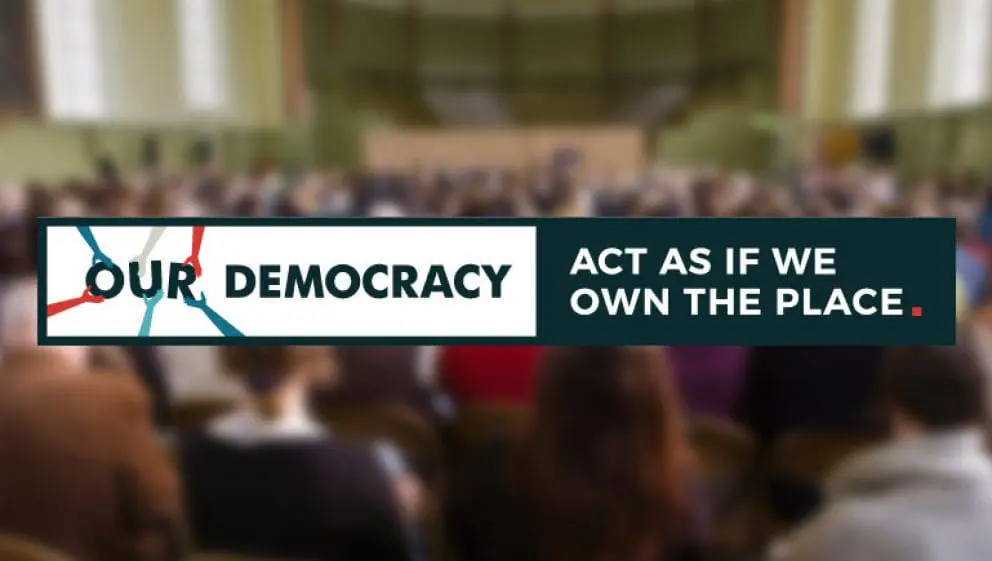
A functioning democratic system is vital for human rights.  It is about power and how it is wielded.  Increasingly, we have witnessed powerful outside interests – whether they be states or wealthy individuals – influencing the political debate.  Electoral reform is carried out infrequently partly because political parties settle into a comfortable relationship with the status quo.  They can also be reluctant to go against the wishes of their influential patrons. 

The newly introduced Representation of the People Bill aims to keep hostile foreign states from interfering in British elections while significantly extending democratic rights to the population. As part of the biggest expansion of democratic participation in a generation it offers first the extension of the franchise to 16 and 17-year olds, which will give voice to millions of young people.

Second, the capping of donations from companies towards electoral expenses will be set at two years of revenue, ensuring that companies that have no genuine business activity or UK footprint will be prevented from making donations.  The Bill means companies will need to have shown sufficient revenue made over the previous 3 years (allowing in most cases two financial years of revenue) to justify their donation.  It means foreign actors will no longer be able to use their money to interfere in the UK’s elections,

MPs will not be allowed to accept gifts of money or in-kind donations over £2,230. Legitimate gifted hospitality valued below this thresh-hold will continue to be acceptable.

The many other proposals to ensure election fairness include automatic voter registration without voters needing to apply, extending legitimate Voter ID to include bank cards digital forms of ID, increasing the time available for postal voting, ensuring candidates offer documentary proof of their identity to avoid misleading voters, and addressing issues of harassment at polling stations

It marks the beginning of a process that may reshape the practical workings of the UK’s democracy. Few governments have attempted to reform our democratic system quite so comprehensively in a single legislative package.  For once, the over-used ‘once in a generation’ tag may actually be justified.

But it does little to protect democracy from misinformation and disinformation in elections, despite the government recognising the risks.  It is this ability to ‘control the narrative’ which is a big factor in our political process.

Image: Electoral Reform Society

Impact of Middle East Conflicts on Refugees in Turkey


War in Middle East and its effects

March 2026

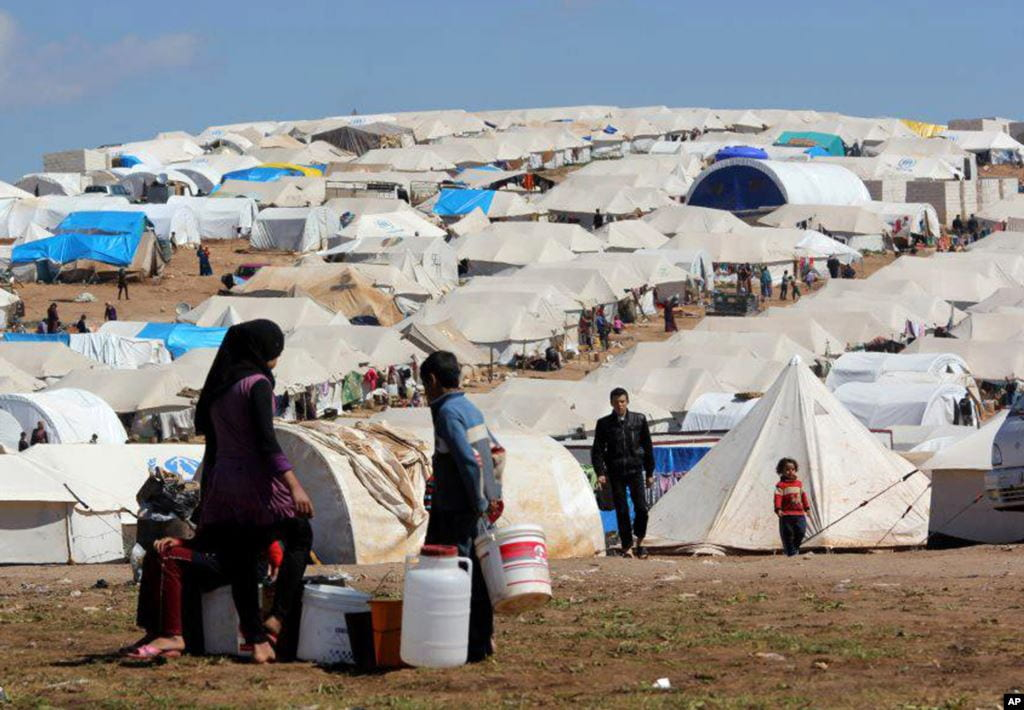
Although war reporting generates a lot of commentary on the deaths of those caught up in the conflicts, the effects on refugees and those displaced receives much less attention. With the new war(s) in the Middle East, refugees are again in the news. So far, most displaced people have been moved within the countries of Iran and Lebanon, but Turkey in particular is being readied for an influx of refugees.  The European Union Agency for Asylum thinks here will possibly be large numbers of displaced persons as a result of the conflict, many of them heading for Turkey. The Institute for Migration estimates that as of now there are 19 million internally displaced in the region; the UNHCR have calculated in the last few days that 667,000 Lebanese have registered as displaced.

Home Secretary’s refugee plans

At home, the big story is the Home Secretary, Shabana Mahmood’s plan to reduce the length of protected stay of refugees from 5 years to half of that, during which time they will only have temporary refugee status.  This will be subject to review every 30 months for up to 20 years. During this period claimants may be deported if, in the opinion of the Home Office, their country of origin has become deemed “safe”.  A large number of Labour backbenchers are opposing the move, and the Law Society has observed that it might not comply with international law. Other objections have been that the plan will be costly (£872 million over a decade, according to the Refugee Council) and impractical. On 5th March, the Home Secretary revoked the legal duty to provide destitute asylum seekers with support and accommodation while their claims are processed, often for months or years.  The Home Office have been influenced by the so-called “Danish model”, which takes a hard line on immigration.

Among the latest statistics to be released, the Home Office received up to 23,000 referrals of alleged human trafficking in 2025 (the main sources were Eritrea and Vietnam).  The backlog of cases has reduced, but there has been an increase in the number of reconsiderations.  In 2025 about 100,000 claims for asylum were made in the UK. Of these, 41% were from small boat arrivals, 11% other irregular means, while 40% already had some form of leave before claiming.  The level of grants continues to drop, at 42% in 2025 (it used to be over 80%).  Syria has suffered particularly with levels of asylum grants down year-on-year from 88% to 9%.  Claims from Eritrea and Somalia are mostly accepted.

The ban on family reunions instigated last autumn is being challenged in the courts by Safe Passage International.  A High Court ruling is expected later this year.

Small boats in the Channel are now starting from further north, in Belgium, according to a BBC report.

The UN Missing Migrants Project, which records the number of deaths among attempted migrants globally, has designated three routes as particularly dangerous: from North Africa to the Central Mediterranean (esp. Libya); from Afghanistan to Iran (this was before the current conflict), and from West Africa to the Canaries (they note that migrants are coming from further south than they used to, with more risks attached).

Those politicians who seem keen on war and wanted the UK to adopt a more interventionist stance with the Israeli and US actions, seem not to be quite so aware of the knock-on effects. Many of those same politicians are to be heard railing against refugees. Wars generate refugees. A proportion end up at Calais.

AH


Recent posts:

Death in Florida


Ron De Santis continues his campaign of executions

March 2026

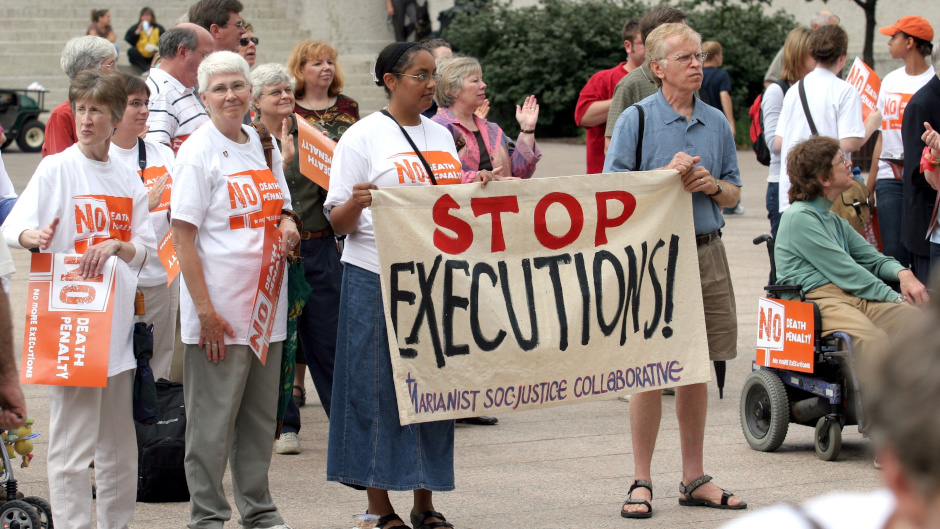
We have recently drawn attention to individual executions being carried out in Florida as part, it is claimed, of governor De Santis’s desire to show he is tough on crime. Florida is known as the ‘sunshine state’ but a pall is cast over it by the list of people put to death or who are scheduled to be executed. The sunshine is dimmed. The US is currently bombing Iran as part of a campaign who’s objectives are not that clear but involve death and destruction of many Iranians. De Santis, along with President Trump, seems to think that violence is some kind of an answer to problems.

Florida executed 19 people in 2025 – the highest number in modern history (Source: Floridians for Alternatives to the Death Penalty.). The state contributed 40% of executions in USA and was around one every 12.26 days – [13th February to 18th December 2025]. In the current rush to carry out executions there is an average 30 day warrant period. People sometimes forget that many spend decades on death row which is typically 33 years from offence to execution.

The list of executions in 2025:

Note UK date format day/month/year

· James Ford 13.2.25

· Edward James 20.3.25

· Michael Tanzi 8.4.25

· Jeffrey Hutchinson 1.5.25

· Glen Rogers 15.5.25

· Anthony Wainwright 10.6.25

· Thomas Gudinas 24.6.25

· Michael Bell 15.7.25

· Edward Zakrzewski 31.7.25

· Kayle Bates 19.8.25

· Curtis Windom 28.8.25

· David Pittman 17.9.25

· Victor Jones 30.9.25

· Samuel Smithers 14.10.25

· Norman Grim 28.10.25

· Bryan Jennings 13.11.25

· Richard Randolph 20.11.15

· Mark Geralds 9.12.25

· Frank Walls 19.12.25

An important issue in considering the system in the state is convictions are often based on non-unanimous juries – 8 out of 12 – allowing significant doubt among jurors. There should be a high degree of unanimity by the jury if someone is to be executed not one that allows a considerable degree of uncertainty.

Unusually among states, the governor has sole authority to schedule executions. Since the governor is committed to the use of the penalty for – it is alleged – to promote his desire to be the next president of the Union, this is a doubtful power to confer on one man. They also want to widen the scope of crimes carrying the penalty. Legislation tightening immigration laws eg mandating death penalty for ‘unauthorised aliens’ convicted of certain capital crimes is planned.

As we discussed in detail in our last post, there are many ethical and constitutional concerns about the process of

execution itself and the use of expired drugs, incorrect dosages, and use of non-listed drugs. Numbers of prisoners on death row have filed claims with the US Supreme Court that the State repeatedly violated its own execution protocol amid an unprecedented execution spree. They have raised the fact that Florida is the only State to include a paralytic medication in its three-drug execution protocol. This means witnesses are unable to see any physical signs of distress. Ronald Heath and Melvyn Trotter have presented evidence showing the use of expired drugs, incorrectly prepared and incomplete dosages, drugs not authorised by the protocol, and documentation not completed at the time. (Source: FADP.)

The current year 2026 to date:

Executions – 2

· Ronald Palmer Heath– 10.2.26

· Melvyn Trotter -24.2.26 – Court in first trial mishandled aggravating factors but re-sentenced to death; claims re: drugs as above.

Scheduled – 3

· Billy Leon Kearse – 3.3.26 – 18 at the time of crime (killing Enforcement Officer) with intellectual disability

· Michael Lee King – 17.3.26 – convicted of murder. At 6, severe frontal lobe injury following accident – neuropsychological testing and brain imaging revealed structural abnormalities affecting his executive functioning. Full details were never adequately presented to sentencing jury.

· James Duckett – 31.3.26 – sentenced to death by 8:4 jury.

There is an irony that the US is engaged in a war in Iran against a regime President Trump regards as vicious and [to be] terrible people. He is angry – often speaking from his Florida home – about how the Ayatollahs treat their people which includes a heavy use of the death penalty. Yet the very same state is busy executing a record number of people often in a rushed and unsatisfactory fashion. Does not Trump have his own Ayatollah on the doorstep?

It is worth repeating that there is no evidence that the penalty is a deterrent. A recent report by the Death Penalty Information Center discusses this. It points out for example that when states have abol­ished the death penal­ty, mur­der rates have not fol­lowed any con­sis­tent pat­tern of change. Rates in states that for­mer­ly retained the death penal­ty fol­low nation­al trends rather than spik­ing or falling after abolition. Earlier research by the National Academies also expresses doubt and does not find conclusive evidence of effectiveness.

The penalty involves the state using violence against an individual. A fundamental problem is that mistakes cannot be put right. Once executed someone cannot be brought back to life if new evidence emerges. The state has an unenviable history of mistakes. Those in line for execution cannot afford expensive or experienced lawyers and as Clive Stafford Smith has described in his books, it may well be the the first murder trial a defence {defense} attorney has carried out. Unlike the UK for example which has passed laws* to ensure the defence has all the evidence, no such law exists in Florida.

The most damning judgement is that if the allegations are true, then the penalty is being used for a political purpose: that is to demonstrate that the governor is ‘tough on crime’ as part of his desire to be president of the US.

*Police and Criminal Evidence Act introduced after several miscarriages of justice.


Recent posts:

Amnesty is opposed to the death penalty in all circumstances. The group publishes a monthly report on the penalty around the world (see the link above for the most recent).

Thought of becoming a subscriber?

This month’s Death Penalty report


Report for mid – February to mid – March

March 2026

We are pleased to attach this month’s report on the use of the death penalty around the world thanks to group member Lesley for the work in compiling it. It features several US states, Iran, Israel and India. We note as ever that China is thought to be the world’s largest executioner of its citizens but details are a state secret.

Recent posts:

Yet more violence in the Middle East


Vigil continues with Israeli and US attacks on Iran

March 2026

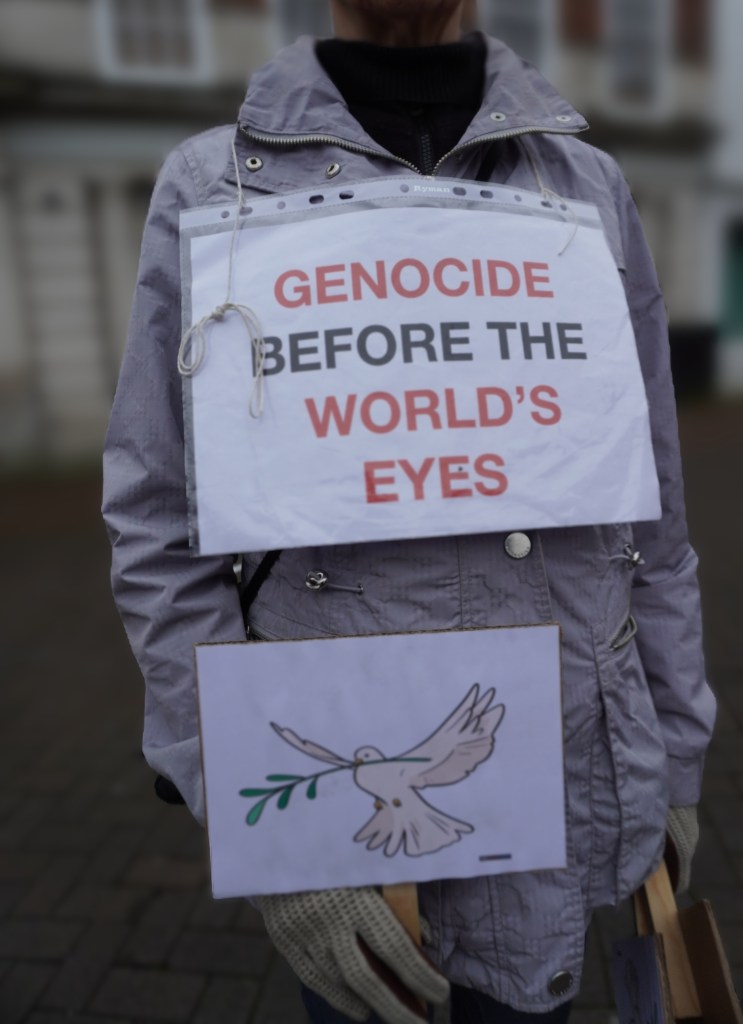
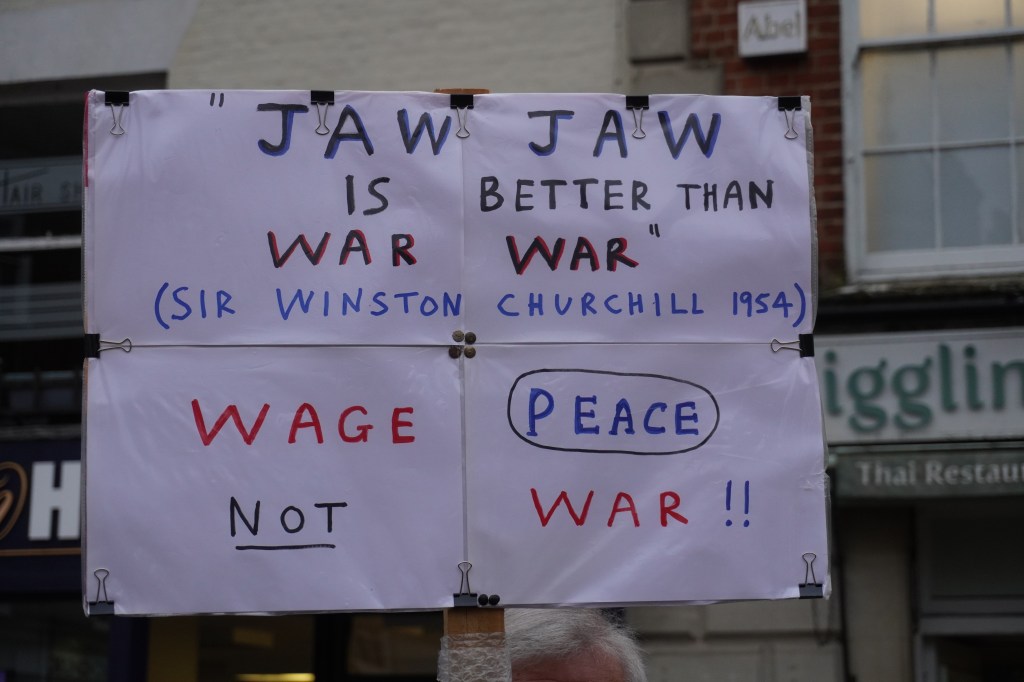
For 118 weeks now, we have held a vigil in Salisbury with the theme peace in the Middle East. Around 30 attended yesterday (7 March) and the hope must be that one day it would end. Any such hopes were dashed last week when Israel led an attack on Tehran and other Iranian cities followed by the Americans. They claim that all Iranian air defences are destroyed together with their air force and navy. The attacks continue and Israel has now restarted its attacks on Lebanon.

The objectives of the latest campaign are unclear. One aspect is to destroy Iran’s nuclear ambitions which President Trump has already claimed were destroyed. The other is to enable regime change and initially that appears to have happened because the late supreme leader, Ayatollah Khamenei and his top aids, were tracked to a location enabling them to be assassinated. There was a hope that the people of Iran would rise up and evict the regime.

Thus the violence has continued and taken on a new life. There have been many implications well aired in the press: retaliation from Iran and its dramatic effects on the Gulf states, the closure of the Straights of Hormuz with its effects on oil and gas prices and the closure of the important air hub at Dubai. International stock markets have fallen and energy prices have risen dramatically.

It has also had ramifications for UK politics basically between those who think we should support Israel and the US and those who do not think yet more bombing and violence is a way to conduct foreign affairs. Arguments have surfaced about Britain’s role in offering support via its bases in Fairford Gloucestershire, Cyprus and the Indian Ocean. Initially denied, within days they were made available to the Americans.

The most damaging feature of this latest violence is the erosion of international law. Attacks on foreign states has rapidly become normal behaviour. As ever, it is not the leaders and politicians who suffer, but those at the receiving end of missile, drone and bombing attacks.

The escalating crisis in the Middle East poses a grave threat to multilateralism and to the integrity of the international legal order. Unlawful acts by parties to the conflict, particularly those committed by influential states, not only endanger civilians across multiple countries, but also accelerate the erosion of the global norms that are essential for the protection of human rights and global peace and security.” Agnès Callamard, Secretary General, Amnesty International. (March 3rd)


Previous posts:

Thought of becoming a subscriber?

Another execution in Florida


Billy Kearse executed on Tuesday in Florida’s killing spree

March 2026

Florida is proceeding apace with its execution programme (program) and Billy Kearse was executed on Tuesday 3rd March 2026. Florida seems to have overtaken Texas as the state keenest to use the penalty. Questions have been raised about the use of the drugs and the secrecy of the process.

Supreme Court Judge Sonia Sotomayor has alleged that the state has failed to follow the protocols which raised the possibility that the executions would violate the Eighth Amendment of the Constitution by causing additional and unnecessary pain and suffering.

This seems to be backed up by evidence produced by The Independent Florida Alligator which has published details of the ages of the drugs used showing that some had expired. The article suggests that the state’s protocol consists only of ‘two sentences’. However, the protocol we have found is longer than that at 14 pp. It is worth reading this as it is ghoulish to read the process of putting someone to death. A remorseless list of actions setting out what is to be done, before, during and after execution.

The Secretary of the Florida Dept. of Corrections, Ricky Dixon, said ‘the foremost objective of the lethal injection process is a humane and dignified death’ (18 February 2025). This must be questioned if out of date drugs are used. Indeed, the protocol says ‘the designated team member will ensure that the lethal chemicals have not reached or surpassed their expiration date’ (rule 6).

Sources: The Independent Florida Alligator, WCADP, Floridians for Alternatives to the Death Penalty, Death Penalty Information Center, Florida Dept. Corrections.

Previous posts:

Blog at WordPress.com.

Up ↑