Vigils, Violence and Votes: How Palestine Shapes Britainโ€™s Debate


Palestine becoming ‘an election issue’ claim

September 2026

Palestine Solidarity Campaign have made the claim that ‘public anger over Israel’s treatment of Palestinians and Britain’s response was increasingly being expressed‘. The claim was made by Aimee Shalan who will become director in November.

She said Palestine becoming an electoral issue both domestically and nationally. She pointed to Ed Miliband’s recent statement and the change in policy towards the West Bank in particular. The West Bank appeared in the news in recent days because of the latest incident of severe violence involving over 100 militant settlers who overwhelmed security forces in an attack on the village of Jalud.

Several senior politicians, including the president Isaac Herzog, have condemned the violence but there is an element of shutting the stable door after the horse has bolted. Settler violence has been overtly and covertly supported by politicians and the security forces have up to now, stood by while Palestinians were attacked and their properties destroyed. It is a bit late to complain now when the scale of violence and ethnic cleansing has become so extreme.

Miliband spoke at the Labour conference but there is still concern about how real British actions are. It is reported that British diplomats have told the Americans the actions are merely ‘symbolic‘. It is noted that he did not accuse the Israelis of genocide.

Vigil
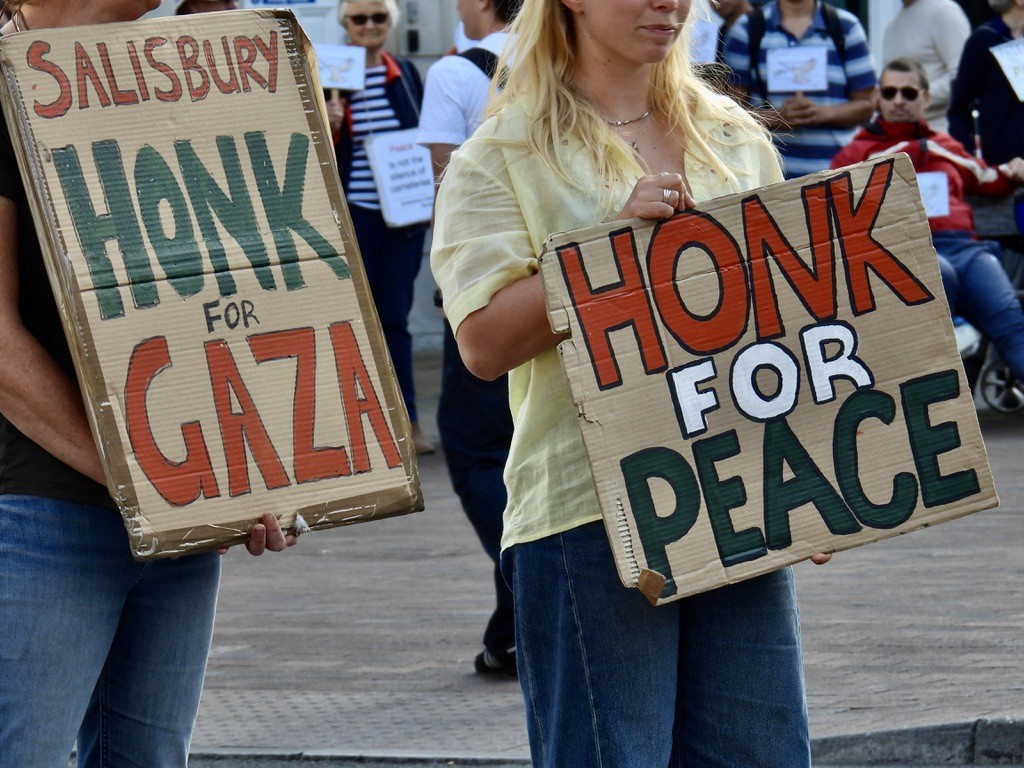
Two individuals holding protest signs. One sign reads 'Honk for Gaza' and the other says 'Honk for Peace.'

The 147th vigil was held on Saturday with nearly 40 in attendance. There was a good response to the invitation to ‘honk for peace’. The Salisbury MP, Mr John Glen. has not appeared and there was no mention of the vigil again in his weekly column courtesy of the Salisbury Journal. He is a member of the Conservative Friends of Israel group.

Film update – Because …

Our film Because ... is progressing well and will be finished ready for the 150th vigil. Most interviews have been completed.

Picture courtesy of Peter Gloyns

Sources: Middle East Eye, Guardian, Haaretz, Palestine Solidarity Campaign


Recent posts:

150 Weeks of Salisbury Peace Vigils Marked by Strong Turnout


This milestone vigil well attended October 2026 It almost doesn’t seem possible that a group of people in Salisbury have turned out each Saturday for 150 weeks to stand, sometimes in the cold and rain, to support the principle of peace and justice in the Middle East. Yesterday (17th) there were 40 of us andโ€ฆ

150th vigil today!


October 2026 Today, 17th October, is the 150th vigil in Salisbury. If you are able to come that would be wonderful. You may wonder why you haven’t heard of this and we are disappointed to report that the Salisbury Journal declined to publish the press notice. We cannot know why. 5 o’clock outside the Libraryโ€ฆ

NAZA – the film


NAZA was shown in cinemas around the country October 2026 The film NAZA was shown in cinemas around the country yesterday and following the showing there was an interview with the makers and others involved. NAZA is the word used by the IDF to assess collateral deaths in pursuit of one Hamas operative. It isโ€ฆ

Floridaโ€™s Execution Spree and the Case of Curtis Beasley


Another execution in Florida

September 2026

We include a text today largely written by Floridians for Alternatives to the Death Penalty, concerning the execution of Curtis Beasley on 29th of September. Florida is on something of an execution spree partly because the Governor, Ron DeSantis, believes in its effectiveness as a deterrent. There is no evidence for this.

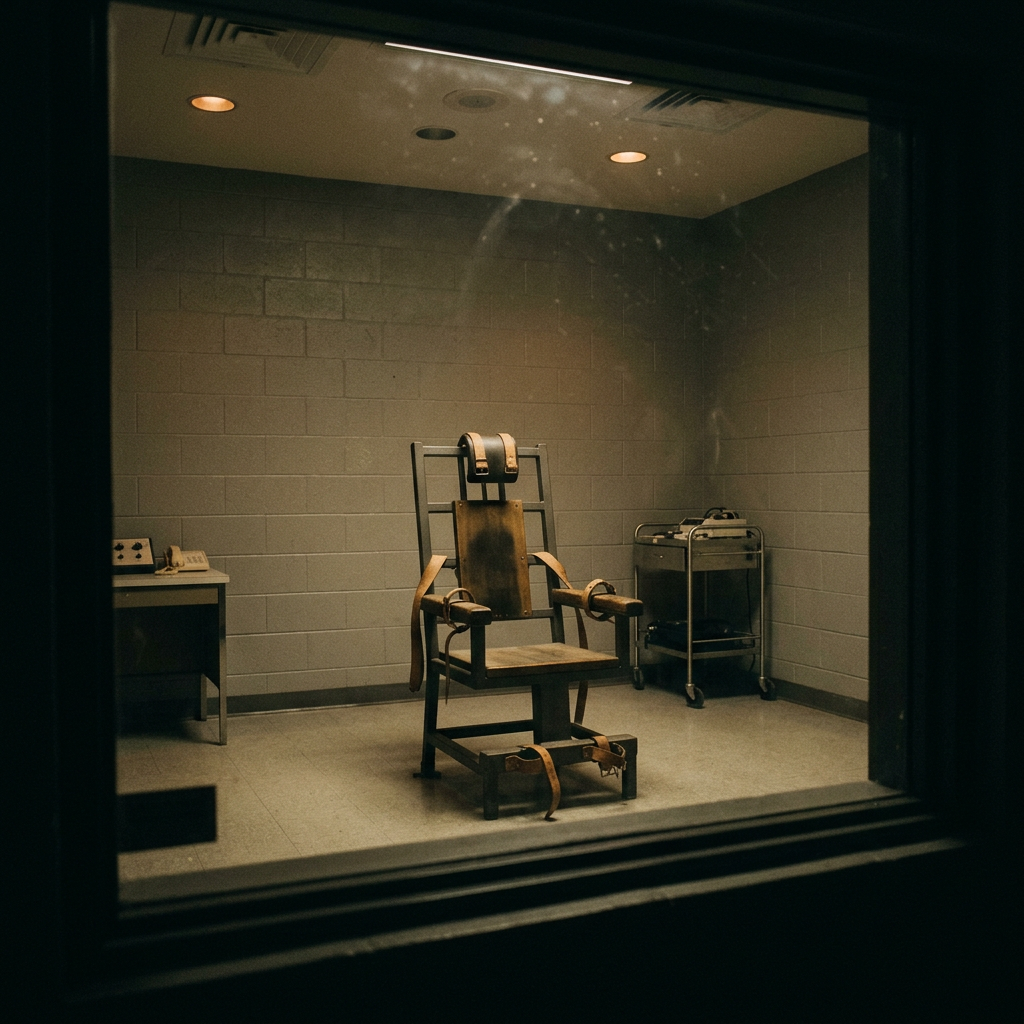
Tonight, the People of the State of Florida executed Curtis Wilkie Beasley, Sr. for the 1995 murder of Carolyn Monfort. In this gubernatorial administration alone, that makes him the 44th execution, the 13th veteran, the 14th senior citizen, and the 27th person condemned to die despite a non-unanimous jury vote for death.

An empty electric chair in a dimly lit room, viewed through a glass window. The chair has leather straps and is positioned in front of a small table with equipment.

Carolyn Monfort was murdered in her own home by someone she knew and had welcomed there. She had a family, a life, and people who expected to see her again. Her life deserves our recognition in its own right, even as we oppose the way Florida chose to bring her story to its conclusion.

Some executions command the attention of our state and even the whole US. Others happen quietly, while most people go about their Tuesday evening. Floridaโ€™s unprecedented and remarkable pace of executions over the past two years makes that possible. Before we have finished saying one personโ€™s name, another death warrant is signed. The names blur and the numbers rise, and those who arenโ€™t closely following along are none the wiser. This is part of the administrationโ€™s plan to overwhelm and desensitize. To let everyday Floridians forget that all of this killing is happening in their names.

The Case

Curtisโ€™ case drew comparatively little of the attention that others have drawn. But the facts deserve to be heard nonetheless. Curtisโ€˜ case is a prime example of the arbitrariness of Floridaโ€™s death penalty. Over the past month, his lawyers have fought to bring this disparity to light. The courts continue to turn a blind eye.

Curtis was sentenced by a non-unanimous jury, a practice found almost exclusively in Florida. Florida requires a jury vote of 8 to 4 to sentence someone to death, while Alabama requires a supermajority of 10 of 12 votes. Every other death penalty state has rejected this practice.

The right to a jury trial is firmly rooted in the nationโ€™s fabric. So is the history of denying some jurors a meaningful voice. Non-unanimous jury rules took hold in the Jim Crow era as a way to let Black people sit on juries while allowing other jurors to disregard their votes. In a 2020 landmark case called Ramos v. Louisiana, the U.S. Supreme Court confronted that history and held that a jury must be unanimous to convict someone of a serious crime.

This term, the Supreme Court will consider another part of that promise: whether the right to a jury trial requires twelve jurors, rather than the six Florida uses in most criminal cases. Florida asks a full jury of twelve to decide a capital case, but permits a death sentence even when one, two, three, or four of them believe life without parole is the appropriate sentence. The questions before the Court are different, yet they reach the same concern: whether the state can call people to serve on a jury and then diminish the force of their voices. That is exactly what happened to the two jurors who believed that Curtis Beasley should live.

Before drugs and alcohol carved a destructive path through his life and led to the violence that landed him on death row, Curtis lived a life that many of us would recognize. He played Little League baseball and went to Bible camp. He won the Perfect Attendance award in 4th grade. He had an after-school job at a T.V. repair shop, started a garage band with his friends, and listened to country music. He was president of his senior class. He volunteered to serve our country in the Army, and did so honorably, during a time of intense anti-military sentiment. He was a father, a son, and a brother. He was more than the 44th, 13th, 14th, or 27th โ€“ more than a statistic in this steady stream of violence.

We will keep telling these stories, including the ones that receive less attention as Florida continues to carry out executions at a pace unrivaled by any time period in the Stateโ€™s recorded history. Tonight we remember Carolyn Monfort and the life taken from her. We remember Curtis Beasley as a whole person, too. Neither should disappear into the count.


Recent posts:

Blog at WordPress.com.

Up ↑