Meeting: update


UPDATE: The full minutes are now available here

September minutes

We held our monthly meeting on 11 September and a number of items were discussed some of which will be separately posted [P].

  • the treasurer reported we had around £334 in the bank.  The funds promised from one of the school groups have not arrived
    Amnesty logo
    Amnesty logo

    however and he will chase this up

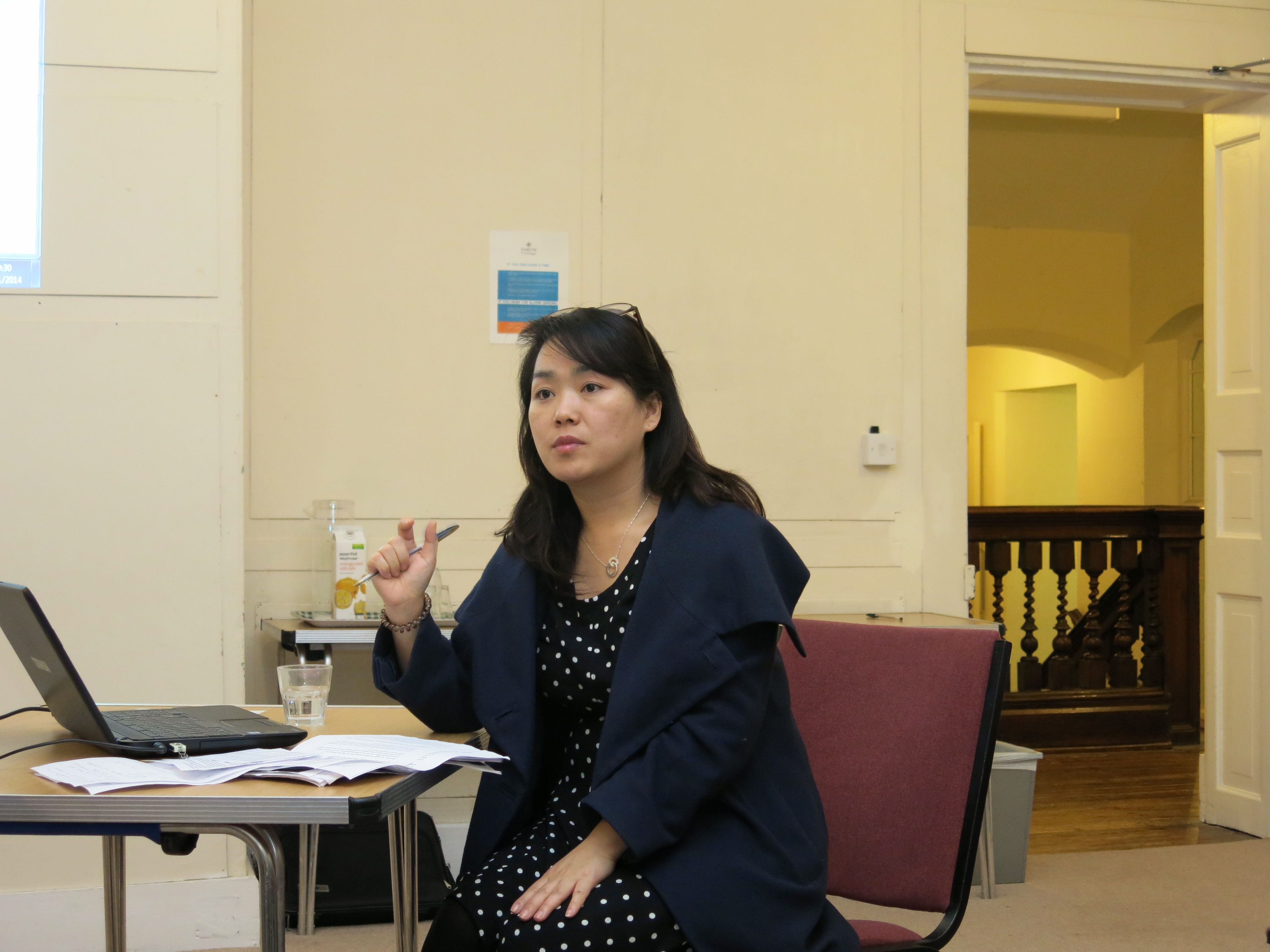
  • North Korea.  We have a speaker – Bona Shin – for the November meeting so we will hold it in Sarum College [P].
  • Lesley presented the death penalty report which will be separately posted.  Executions continue apace in Saudi Arabia, Florida and Texas [P].
  • Peter gave an update on progress with the Magna Carta celebrations next year and said that we have held our third meeting with Seif at the Cathedral and arrangements were proceeding well.  Caroline was hoping to prepare tapestry with all the regional groups contributing a panel each to illustrate an aspect of the Human Rights Act.  Fiona is working with S Wilts on the idea of a film.
  • Cathedral service.  Jonathan will liaise with the Praecentor about dates and a speaker.
  • there is to be a coffee morning on Saturday 20 September in St Thomas’s starting at 09:30.
  • the second Citizenship day is to be held next month on 23 October run on similar lines to last year.  There is to be a repeat of the competition with 3 prizes totalling £100 from a supporter.  Peter is to contact the sixth form colleges and schools in the area [P].
  • the forthcoming campaign against torture stall was discussed and will take place on 15 October in the Cheese Market [P].
  • the film will take place again on 4 December at the Arts Centre and will be on the subject of Palestine.  The speaker is Samiha Abdeljebar [P].

Full minutes will be posted soon.

#Saudi executions


Over the last two weeks there has been considerable outrage over the gruesome execution of the American #JamesFoley by beheading allegedly by a jihadist from the UK, possibly London.  That someone nurtured on these shores should go to another country and commit such a crime horrifies people in this country and of course the USA.  The execution has added to the degree of urgency in the government and there are plans to bring in legislation to confiscate passports and monitor the movement back to this country of jihadists from ISIS areas of Iraq.

ISIS forces
ISIS forces

The barbaric and medieval nature of the crime has shocked many in the west.

In the last three weeks – between 4 and 22 August – 23 people in Saudi Arabia have been executed by beheadings. These executions take place in public and frequently, the bodies are left on public display as some kind of deterrent. Around 2000 have been executed in this fashion since 1985.  Around half are foreign nationals.

The executions follow trials where confessions are read out.  Many or even most of the confessions are extracted following torture.  Defendants often do not have legal representation and may not be able to follow the trials such as they are.  You will have to look long and hard to find much about these executions in western newspapers.

How are the two connected?

Saudi Arabia, along with Qatar, are in receipt of considerable quantities of arms from western countries including the UK.  David Cameron visited the country to promote trade and arms sales.  The Campaign Against the Arms Trade #CATT has found out that we exported £113 million of arms to Saudi in 2013.

With American support, both countries were arming the Syrian rebels of which the Islamic State is one.  So we support and provide arms to countries which are in turn supporting the Islamic State and which carry out barbaric executions in public.  Almost nothing is said about this and it receives very little coverage.

We need to be more balanced in our policies and attitudes to some of these despotic regimes.  If we are going to say nothing about barbaric behaviour because it might upset an arms deal to Saudi or Qatar, it is then inconsistent to start making speeches when no arms deals are in the offing.


Increased #terrorthreat


There were announcements by Theresa May, the Home Secretary, and by the Prime Minister last week saying that the terror threat has been raised to ‘severe,’ one down from the highest.  This came about following news that people have been leaving this country to fight for the #IslamicState formerly known as #ISIS.  Some are said to be returning and having been radicalised, pose an increased threat to this country.

A package of anti-terrorism measures are currently being worked on for presentation to Parliament when it reconvenes.  The decision was taken following advice from the Joint Terrorism Analysis Centre.

Governments – and ours is no different – are frequently looking for more powers especially of an intelligence nature.  They want to demonstrate that they care for our safety and it is a way to be seen to take action.  The fact that inaction has been clear in terms of what is going on in Iraq and our policy towards it doesn’t seem to matter: at home new powers are needed and MPs will no doubt airing their views inside and outside the House of Commons.

Are these extra powers really needed?  The government and its agencies already have a huge armoury of powers at their disposal enabling them to intercept messages, phone calls, internet traffic, emails and so forth.  As has been shown, there is too little control being exercised by parliament over this activity and the key committee had little idea of the scale of it.

These proposals, combined with the parallel plans to make people stateless, show that there is a degree of knee-jerk reaction to events in Iraq.

The worry has to be that the proposals will represent a further erosion of our liberties.  Once the new powers are enshrined into law and the terror threat is reduced, will they be removed?  Unlikely on past form and they will have represented a ratcheting up of intrusion into our lives.

Our liberties and freedoms were hard won and we need to be especially vigilant when governments seek to limit or curtail them.  It will be interesting to follow the debate when it happens.


Helen Bamber


We are sad to record the death of Helen Bamber #helenbamber who set up Medical Foundation for the Care of Victims of Torture following many years as a member of Amnesty International and later the Helen Bamber Foundation.  The foundation helped many people who had suffered torture in various countries from which they had managed to flee.

Helen Bamber
Helen Bamber

The local group was privileged to hear Helen speak at one of its meetings some years ago.  She will be sadly missed.

#Gaza letter


We attach a letter published in the Guardian newspaper on 15th of August from survivors of the Holocaust.  It is an extremely moving letter, particularly bearing in mind the people who signed it.  It is unequivocal in its criticism of the violence by the IDF in GazaIt is worthy of a wider audience.

“As Jewish survivors and descendants of survivors and victims of the Nazi genocide, we unequivocally condemn the massacre of Palestinians in Gaza and the ongoing occupation and colonisation of historic Palestine.  We further condemn the United States for providing Israel with the funding to carry out the attack, and western states more generally for using their diplomatic muscle to protect Israel from condemnation.  Genocide begins with the silence of the world.

We are alarmed by the extreme, racist dehumanisation of Palestinians in Israeli society, which has reached fever-pitch.  Politicians and pundits in the Times of Israel and the Jerusalem Post have called openly for genocide of Palestinians and rightwing Israelis are adopting neo-Nazi insignia.

Furthermore, we are disgusted and outraged by Elie Wiesel’s abuse of our history in these pages (advertisement, 11 August; Report, 11 August) to promote blatant falsehoods used to justify the unjustifiable: Israel’s wholesale effort to destroy Gaza and the murder of nearly 2,000 Palestinians, including many hundreds of children.  Nothing can justify bombing UN shelters, homes, hospitals and universities. Nothing can justify depriving people of electricity and water.

We must raise our collective voices and use our collective power to bring about an end to all forms of racism, including the ongoing genocide of Palestinian people.  We call for an immediate end to the blockade of Gaza.  We call for the full economic, cultural and academic boycott of Israel. “Never again” must mean “Never again for anyone”. ”
Hajo Meyer survivor of Auschwitz; The Netherlands, Henri Wajnblum survivor and son of an Auschwitz victim from Lodz, Poland; Belgium, Norbert Hirschhorn refugee of Nazi genocide and grandson of three people who died in the Shoah; London, Suzanne Weiss survived in hiding in France, whose mother died in Auschwitz; Canada, Felicia and Moshe Langer survivors from Germany, Moshe survived five concentration camps, family members were exterminated; Germany, Michael Rice child survivor, son and grandson of survivor; United States and 30 Jewish survivors of the Nazi genocide and 260 children, grandchildren, great-grandchildren and other relatives of survivors
See full list at ijsn.net/gaza/survivors-and-descendants-letter/


Prisoner voting


After a decade of argument, the European court of human rights #ECHR has decided that the 10 prisoners denied the vote should not be paid compensation for the infringement of their article 3 rights to vote.  It did decide that the government is in breach of the convention.

This is a debate which has generated a lot of heat and a great deal of passion.  The prime minister David Cameron said that prisoners ‘damn well shouldn’t [get the vote]’ and previously was quoted as saying the idea made him feel ‘physically sick.’  It was a topic which came up with the local group’s meeting with John Glen the MP for Salisbury.

It seems that politicians have difficulty in understanding what prison is for.  Someone commits a crime and the court decides that a custodial sentence is appropriate.  There are two purposes to this: to deprive the person of their liberty as a mark of disapproval by society for the crime they have committed.  Then we want to rehabilitate them into society.  Unless we want everyone to go to prison for ever, then with a very few exceptions, they will be back into society.

It therefore makes sense as part of this second purpose that prisoners be allowed the vote.  In a small way it would help facilitate their entry into society.

See the South Region site of Amnesty International


Gaza


The world has been horrified by the films, reports and photographs coming out of #Gaza since the latest violence started.  Amnesty teams – along with other organisations – have been in Gaza to assess the damage and have found evidence of war crimes by both sides in the conflict.  There have been serious violations by both parties but since the Israel Defence Force is the best equipped army and air force in the region by far, the damage and destruction has been predominantly on the Palestinian side.

Hamas continues to fire rockets into Israel but with the protection of Iron Dome, few have resulted in casualties.  The casualties on the Palestinian side have now passed 2000 (12 August, Sky News) with 67 Israeli deaths.  Many of the Palestinian casualties are women and children, killed in strikes on schools, mosques and hospitals.

Israel is able to carry on its attacks secure in the knowledge that it has, and continues to have, the support of the United States.  Indeed, the USA has continued to supply weapons to replace those lost in the latest fighting.  The United Kingdom supplied £6.3m in weapons to Israel last year.

It seems clear to most outside observers that whatever the provocation Israel has suffered, the scale of destruction in Gaza has been disproportionate.  This latest incursion follows hard on operation Cast Lead which also wrought terrible destruction in the territory.

Nor is the suffering imposed limited to the fighting but comes on top of the relentless expansion of settlements and the blockade of Gaza which has now lasted over seven years.  Gaza is in effect a prison surrounded by a stifling regime of checkpoints, barriers and walls.  They are not allowed to catch fish in the sea.  Inhabitants also have to endure power and water cuts for no apparent reason.

Protest in the south of France

Is there any hope in all this?  Surprisingly, there may be.  It will not come from the ceasefires and feeble political statements wishing peace while at the same time continuing to sell arms.  The key difference this time is that Israel is losing the propaganda war.  Such is the volume of evidence emerging from Gaza, the harrowing footage of injured children and pictures of the scale of destruction, that people around the world have been moved to protest (see picture).

British Ministers are forbidden to use the word ‘disproportionate’ in their various statements.  But the public can see that it is.  Nick Clegg described the attacks on schools as ‘outrageous’.  Israel is desperate to avoid its actions going to the International Criminal Court and will no doubt succeed with US help in so doing.

With Cast Lead, the Israelis were able to keep journalists out of Gaza so that very little was seen on our TV screens.  This time, with a range of devices, images are coming through loud and clear.  This is another example of the public seeing things for what they are and politicians being behind the curve.  Support for Israel is still strong in the United States certainly among Senators and Congressmen, but younger people are not so supportive.  This is likely to be the key difference this time.

Visit the South Region site of Amnesty

Amnesty International comments on Gaza

Stop arming Israel

July meeting minutes


The minutes of the July meeting are available, with thanks to Karen.  Remember all recent minutes are posted on the About us tab.

Meeting with John Glen MP: update


The Salisbury group invited John Glen MP to speak to the group following his comments in the Salisbury Journal that – in common with other MPs, the Prime Minister and the Home Secretary Teresa May – he would like to scrap the Human Rights Act [HRA] #HRA.  The Conservatives in their election manifesto had said they wanted to enact a Bill of Rights [BoR] and appointed a Commission to review the matter.  It failed to reach an agreement and there the matter has rested with no current work being done to draft a BoR.  Nevertheless, there is still political agitation to abolish the #HRA.  A key theme of the evening was trying to determine what would the difference be between a new Bill of Rights and the existing HRA.  In other words what would be included and what left out.

Andrew – chair of the local group – welcomed Mr Glen who began by saying he was a keen supporter of human rights.  He was a member of The Westminster Foundation for Democracy and had recently visited Iran, Egypt and the Maldives.  In the first two countries he discussed the plight of Christians with the authorities.  He had recently asked a question* in the House of Commons concerning the Israel/Palestine conflict.

As far as the HRA was concerned the main issue was the question of the interaction with the European Court: Strasbourg [rulings] should be taken into account, not be binding.  A proposal for a British BoR will possibly be in the party manifesto.  He was concerned about some of the claims made using the act and he mentioned the issue of equipment in Afghanistan.  Various points were put to Mr Glen by members:

  • The HRA was passed into UK law to enable claims to be made in this country and to reduce the need to go to Strasbourg. JG said this may have been the intention but was not always the case in practice
  • If a Bill of Rights is to be introduced, how would it in fact be different from the HRA as it is?
  • The HRA was of enormous benefit to ordinary people – some of whom are [your] constituents. For example, art. 8 protects the elderly and vulnerable. The problem is made worse for many by the reductions in legal aid.  JG said he saw people every day with these problems and he was not happy with the Justice reforms.  But he was concerned at perverse outcomes and it needs the will of Parliament.  It was pointed out that the HRA was by will of Parliament.
  • He was asked if the point of a BoR was to fetter the judiciary and again, how will it be different from the HRA?


  • It was reported that Strasbourg was concerned at the risk of the UK abandoning the HRA.  As we (the UK with France) were the countries behind the original convention, it would concern them if we turned our back on it. The convention had had enormous beneficial effects in Russia and Belarus who might be less keen to change if we were not there. It was also pointed out that the FCO web site was a keen supporter.  JG said that without knowing what would replace the act this was a hypothetical question.
  • The point was made several times that the positive effects of the act and the cases which fail in the courts, rarely receive publicity. JG agreed with this point. For the most part, there was an anti-attitude fostered by the tabloid press. JG said he was not following a tabloid agenda. He had to read them to know what would be in his post from constituents. He felt had demonstrated his commitment to human rights through his overseas work.
  • Prisoner voting rights were a topic that caused a lot of anxiety. Would it not be appropriate to allow prisoners the vote towards the end of their sentences to help prepare them for re-entry into society?  JG talked about the importance of education in prisons.  He was reminded that funding had been cut for this.

In conclusion, he said he would reflect on the problem of a lack of balance in the public dialogue.  He will also consider how refinements to the HRA might obviate the need for a Bill of Rights.

Group members were no clearer on what would be the difference between a Bill of Rights and the HRA but welcomed Mr Glen’s statement that his comments on the latter would be more balanced in future.

UPDATE

Reported on 17 July that the Conservatives are planning to introduce a British Bill of Rights in their manifesto.

View the South region site of Amnesty International

*John Glen’s question in the House:

Hansard question 1 July


Ken Clarke’s warning


Ken Clarke MP resigned as a minister in the Government at his own request yesterday and issued a parting warning to the Conservatives on the European human rights convention #ECHR.

In a strong warning to his party, he said: “I personally think it is unthinkable to leave the European convention on human rights. It was drafted by British lawyers after the second world war to protect the values we fought the war for. Now it is a long way from the war, but members of the European council covered by the convention include Russia and Belarus and so on.  It is the way we uphold the values we strive for which are the rule of law, individual liberty, justice for all, regardless of gender. The convention is the bedrock of that.”

He added: “A slightly absurd debate takes place in this country.  We are occasionally taken to the European court in Strasbourg but we win 98% of the cases because of our human rights record.  We only lose 2% of cases and all these mad mullahs that the press love to vilify and blame for our terrorist problems – which is a somewhat uncomplicated way of analysing the situation – are thought to win in Strasbourg.  Well, we have won all the cases in Strasbourg.

Source: Guardian

http://www.theguardian.com/politics/2014/jul/15/ken-clarke-exits-human-rights-warning-tories

View the South region site

Blog at WordPress.com.

Up ↑